
Market Report · July 16, 2026

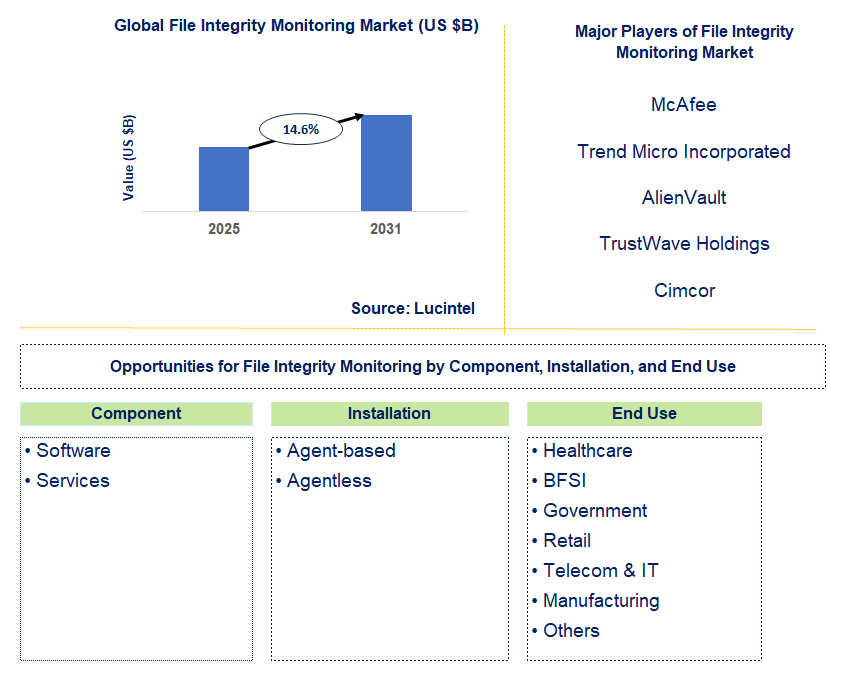
Key data points: The growth forecast = 14.6% annually for the next 7 years. Scroll below to get more insights. This market report covers trends, opportunities and forecasts in file integrity monitoring market to 2031 by component (software and services), installation (agent-based and agentless), end use (healthcare, BFSI, government, retail, telecom & IT, manufacturing, and others), and region (North America, Europe, Asia Pacific, and the Rest of the World)
We'll send your sample report shortly.
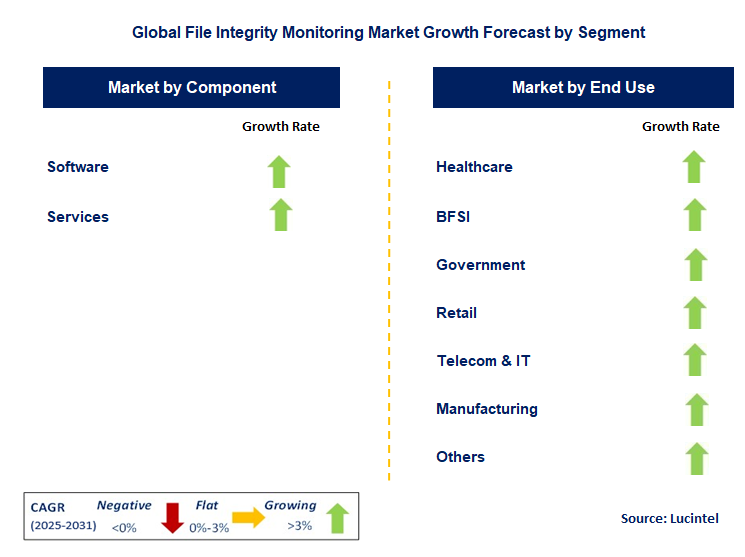
• Lucintel forecasts that, within the component category, software is expected to witness higher growth over the forecast period.
• Within the end use category, BFSI is expected to witness the highest growth.
• In terms of region, North America is expected to witness the highest growth over the forecast period. Gain valuable insights for your business decisions with our comprehensive 150+ page report. Sample figures with some insights are shown below.
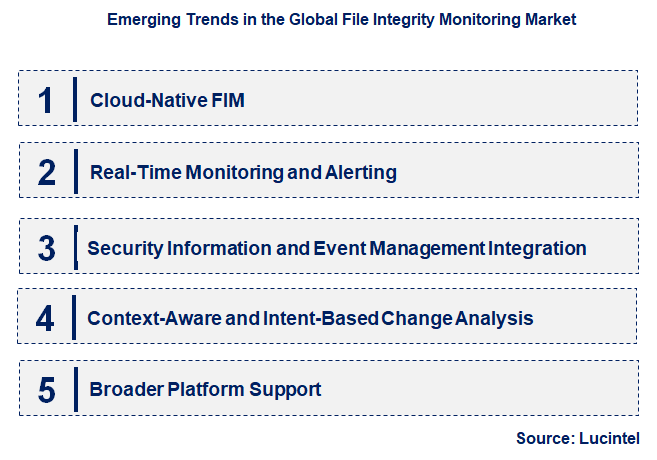
• Cloud-Native FIM: With the general adoption of cloud computing, the trend now is towards FIM solutions that are cloud-native. Cloud-native FIM solutions can track file and configuration integrity in clouds such as AWS, Azure, and GCP, promoting visibility and security in hybrid and multi-cloud environments. This ensures that FIM benefits are available to new-age cloud infrastructures.
• Real-Time Monitoring and Alerting: Legacy FIM tended to be based on periodic scans. The new trend is real-time monitoring, where file modifications are sensed and alerted immediately. Real-time detection enables prompt response to unauthorized changes, shortening the time window available to attackers and limiting potential harm. Real-time capabilities are essential for keeping a high security posture.
• Security Information and Event Management Integration: Enhanced integration between FIM products and SIEM solutions is becoming more widespread. By correlating file integrity events with other security logs, security teams can view potential security breaches in a broader context. When FIM alerts are integrated with network and system events, organizations are able to further develop their threat detection and response measures.
• Context-Aware and Intent-Based Change Analysis: Advanced FIM solutions today go beyond mere change detection to analyzing the intent and context of the changes. Using machine learning and threat intelligence, these smart FIM tools can distinguish between authentic updates and malicious modifications, minimizing false positives and allowing security teams to concentrate on real threats. This makes FIM more efficient and effective.
• Broader Platform Support: FIM is now expanding its reach beyond the conventional operating systems and file systems to encompass databases, configuration files, and even container environments. With the support of a wider set of platforms, organizations are able to keep track of the integrity of their vital assets throughout their entire IT environment, irrespective of the underlying technology. Such end-to-end perspective is obligatory in today's heterogeneous and complex IT landscape. These trends are redefining the file integrity monitoring market by making FIM solutions more flexible, smarter, and converged. The emphasis is on delivering real-time insight into file modifications in a variety of environments, allowing organizations to be able to detect and respond to threats proactively while staying compliant.
• Increased Support for Container Environments: One of the notable improvements is the enhanced capability of FIM solutions to track the integrity of files and configurations in container environments such as Docker and Kubernetes. This caters to the increasing use of containers and the requirement to secure and maintain the integrity of such dynamic and ephemeral systems.
• Integration with Configuration Management Tools: FIM solutions are being integrated more and more with configuration management tools like Ansible, Chef, and Puppet. This enables a more comprehensive approach to maintaining system integrity, where the desired configurations are watched over and deviations can evoke alerts, filling the gap between security monitoring and configuration management.
• Advanced Anomaly Detection: Advanced FIM tools are embracing enhanced anomaly detection methods, such as behavioral analysis, to detect suspicious changes to files that may not have a known threat signature. This assists in the detection of insider threats and highly advanced malware that are trying to make subtle modifications to system files.
• Enhanced Forensic Functionality: New FIM capabilities include advanced forensic functionality, giving more detailed information about file changes, such as who did it, when, and how. This enhanced audit trail proves priceless in terms of incident response and post-breach analysis, enabling organizations to realize the scope and magnitude of security incidents.
• Increased Focus on Usability and Automation: Suppliers are prioritizing the usability of FIM solutions and automating processes like policy administration and reporting. This simplifies the deployment and management of FIM, lowering administrative burden and enabling security teams to concentrate on processing alerts and reacting to incidents. These advancements are affecting the file integrity monitoring market in such a way that FIM products are becoming more adaptable, smart, and manageable. The market is shifting towards a phase where FIM forms part of an overall security plan, offering ongoing certainty of system integrity in increasingly complicated IT environments.
• Protection of Critical Infrastructure: Protecting critical infrastructure, including energy grids, transport networks, and utilities, is a key growth area for FIM. Ensuring the integrity of the software and configurations governing these systems to avoid interruptions and possible catastrophes creates demand for dedicated FIM solutions.
• Compliance in Healthcare: The health sector, given its strict regulatory environment such as HIPAA, represents a large growth market for FIM. Compliance and patient safety demand that monitoring the integrity of electronic health records (EHRs) and other confidential information is of utmost importance, and thus FIM solutions specifically designed for use within healthcare settings experience growing adoption.
• Security for Financial Services: The financial services industry, under stringent regulations and under huge threats of cyber forgery, is a prime growth area for FIM. Maintaining the integrity of financial transaction logs, configuration files, and application code is critical for ensuring trust and compliance with regulations.
• Supply chain security: With heightened awareness of supply chain attacks, there is greater demand for FIM to track data integrity of software and firmware along the supply chain. This means authentication of updates and data integrity assurance that no unauthorized changes were introduced, offering a new growth area for FIM solutions.
• Dev SecOps Integration: Integrating security practices into the DevOps pipeline presents a growth opportunity for FIM. Integrating FIM into the development and deployment processes enables continuous monitoring of code and configuration integrity so that security is designed in upfront and sustained throughout the software life cycle. These opportunities for growth are influencing the file integrity monitoring market by fueling innovation and the creation of FIM solutions specific to the needs and regulatory requirements of various application areas. This emphasis on vertical-specific solutions is broadening the market potential and enhancing the value proposition of FIM.
• McAfee
• Trend Micro Incorporated
• AlienVault
• TrustWave Holdings
• Cimcor
• Ionx Solutions
• Qualys
• Securonix
• AT&T Intellectual Property
• Software Diversified Services
• Software
• Services
• Agent-based
• Agentless
• North America
• Europe
• Asia Pacific
• The Rest of the World
• United States: The United States market for FIM is mature and regulated by strict regulatory needs for many industries, such as finance and healthcare. New developments involve a strong focus on FIM solutions that can easily integrate with cloud platforms and DevOps pipelines. There is also a growing need for FIM tools with advanced analytics and threat intelligence to give better insights into file changes and potential security breaches.
• China: China's FIM market is expanding, driven by the growing emphasis on data protection and cybersecurity. Recent trends have involved the implementation of FIM solutions by large organizations and government agencies to secure the integrity of key systems. There is also a shift toward integrating FIM functionalities into unified security management platforms, reflecting the country's efforts toward integrated cybersecurity platforms.
• Germany: In Germany, the focus on data privacy and compliance, especially with GDPR, is impacting the FIM market. Recent trends indicate an increased implementation of FIM solutions that have the capability to offer complete audit trails of file changes, which support compliance activities. Growing interest is also seen in FIM tools that provide better reporting and alerting features to quickly detect and react to unauthorized changes.
• India: The growth of India's FIM market is being fueled by its growing digital infrastructure and heightened cybersecurity consciousness. Developments in the recent past have seen FIM solutions being adopted across industries such as banking, IT services, and government. The trend is towards FIM tools that are scalable and capable of monitoring large numbers of systems and files effectively, addressing the requirements of large organizations.
• Japan: The FIM market in Japan is dominated by a keen emphasis on stability and reliability of IT systems. Recent trends involve a gradual uptake of FIM solutions for keeping critical infrastructure and sensitive information secure. A preference also exists for FIM tools that integrate effortlessly into current security environments and offer fine-grained control over file monitoring policies.


• McAfee
• Trend Micro Incorporated
• AlienVault
• TrustWave Holdings
• Cimcor
• Ionx Solutions
• Qualys
• Securonix
• AT&T Intellectual Property
• Software Diversified Services Q5. Which file integrity monitoring market segment will be the largest in future? Answer: Lucintel forecasts that, within the component category, software is expected to witness higher growth over the forecast period. Q6. In file integrity monitoring market, which region is expected to be the largest in next 5 years? Answer: In terms of region, North America is expected to witness the highest growth over the forecast period. Q7. Do we receive customization in this report? Answer: Yes, Lucintel provides 10% customization without any additional cost.


Choose a license that fits your team. Instant PDF delivery.
Prices exclude taxes. Instant delivery. Custom licensing available on request.
Market Report · July 16, 2026
Market Report · May 18, 2026
Market Report · May 18, 2026
Trusted partner for strategic intelligence and business growth


Receive a complimentary market analysis tailored to your industry. Our analysts will identify key growth opportunities and competitive dynamics specific to your business.

Market size, growth rate, and key trend analysis for your specific sector.

Top competitor positioning and market share analysis.

Strategic recommendations backed by data-driven insights.
Get curated market intelligence and competitive moves straight to your inbox.
By subscribing, you agree to receive our monthly insights. Unsubscribe anytime.
Receive a complimentary market analysis tailored to your industry. Our analysts will identify key growth opportunities and competitive dynamics specific to your business.
Market size, growth rate, and key trend analysis for your specific sector.
Top competitor positioning and market share analysis.
Strategic recommendations backed by data-driven insights.
Get curated market intelligence, emerging trends, and competitive moves straight to your inbox each month.
By subscribing, you agree to receive our monthly insights. Unsubscribe anytime.
We'll send your sample report shortly.