
Market Report · July 22, 2026

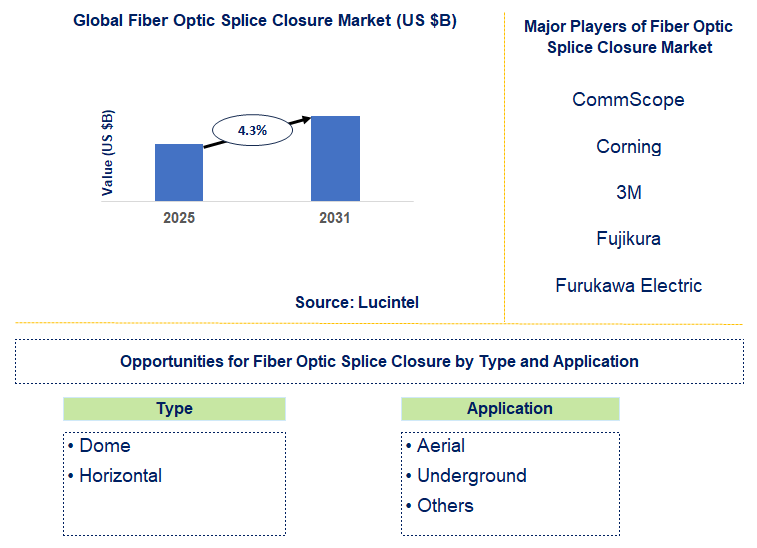
Key data points: The growth forecast = 4.3% annually for the next 7 years. Scroll below to get more insights. This market report covers trends, opportunities and forecasts in fiber optic splice closure market to 2031 by type (dome and horizontal), application (aerial, underground, and others), and region (North America, Europe, Asia Pacific, and the Rest of the World)
We'll send your sample report shortly.
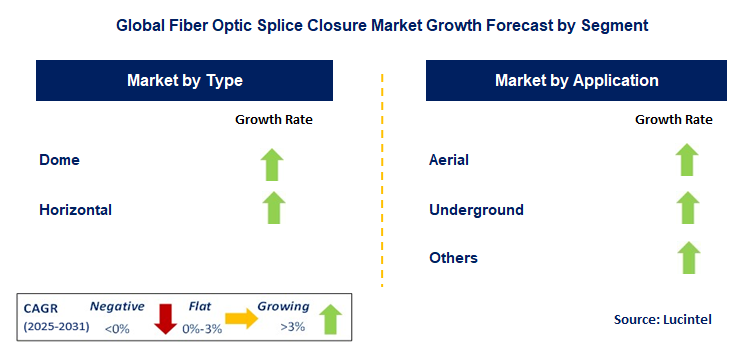
• Lucintel forecasts that, within the type category, horizontal is expected to witness higher growth over the forecast period.
• Within the application category, underground is expected to witness higher growth.
• In terms of region, APAC is expected to witness the highest growth over the forecast period. Gain valuable insights for your business decisions with our comprehensive 150+ page report. Sample figures with some insights are shown below.
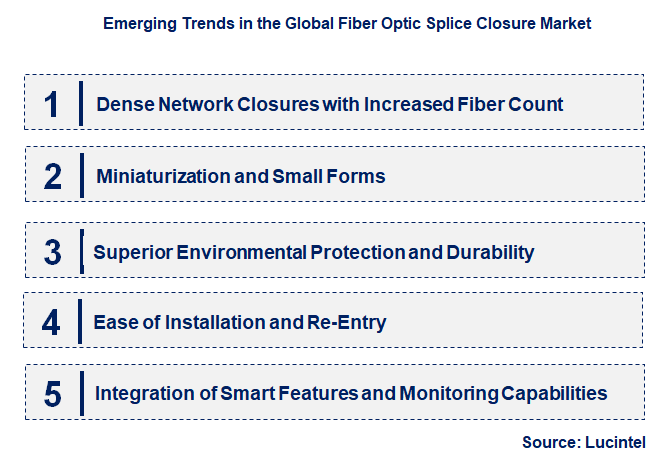
• Dense Network Closures with Increased Fiber Count: The rapid growth in data traffic and fiber extension to the X (FTTX) deployments are fueling the need for higher fiber count splice closures. This trend affects the market by influencing manufacturers to create more space-saving but voluminous closures, frequently with advanced fiber management schemes such as smaller splice trays or compatibility with ribbon fibers. These dense closures are imperative for achieving maximum usage of fibers within existing ducts in a network and minimizing the physical footprint of the network plant in high-density locations.
• Miniaturization and Small Forms: The need for smaller, more discreet infrastructure, especially in urban environments and for deployments within limited spaces such as micro ducts, is driving the trend toward miniaturized and compact splice closure designs. These smaller closures are easier to install in confined spaces, reduce visual impact, and can be more cost-effective for certain applications. This trend drives material selection, sealing systems, and fiber routing inside the closure for efficient use of space while providing strong environmental protection for the splices.
• Superior Environmental Protection and Durability: With fiber optic networks being installed in ever more varied and hostile environments, the trend is towards splice closures that provide higher environmental protection and durability. These involve enhanced resistance against water penetration (IP ratings), high and low temperatures, UV exposure, and mechanical loads. Advanced materials and sealing solutions are being employed by manufacturers to make sure that closures are able to sustain long-term exposure to the elements, thus raising the long-term reliability and decreasing the maintenance burden of the fiber optic network infrastructure.
• Ease of Installation and Re-Entry: In order to drive faster network deployment and lower labor expenses, the industry is experiencing a robust trend towards splice closures that support fast, toolless, and simple installation. This encompasses products such as one-piece gasket systems, Snap-On parts, and ease of cable entry mechanisms. In addition, maintenance or network upgrade re-entry ease is key, as it reduces disruption and makes fieldwork simpler. This trend results in quicker deployment cycles, fewer errors during installation, and lower total operational costs for network operators.
• Integration of Smart Features and Monitoring Capabilities: One of the upcoming trends is the creation of "smart" splice closures that include sensors or other embedded technologies to monitor network conditions in real time. These smart closures may be able to track parameters like temperature, humidity, vibration, or even fiber integrity without the need for physical re-entry into the cabling. Such a trend affects the market by facilitating proactive maintenance, improved fault localization, and better network performance management, eventually decreasing downtime and ensuring greater reliability of the fiber-optic infrastructure. These trends are essentially redefining the fiber optic splice closure market by driving towards more efficient, strong, and intelligent solutions. They are facilitating quicker and more reliable installation of high-capacity fiber optic networks, supporting higher fiber density, improving protection against environmental stresses, and streamlining operational features such as installation and maintenance, in aiding the creation of a robust global digital infrastructure.
• High-Density Splice Closure Development: One of the most recent developments is the development of splice closures that can handle much higher numbers of fibers. With the fiber optic cables themselves becoming denser (e.g., ribbon fiber, microcubes), closures are being developed to process hundreds or thousands of splices in a single housing. This advancement affects the market in that it enables network operators to make greater utilization of existing duct infrastructure, decrease the physical footprint of network kit, and decrease costs of deployment through fewer, but more-capacity, closures.
• Advancements in Sealing and Environmental Protection: New developments in material science and sealing technology have resulted in splice closures that offer even better environmental protection. Suppliers are creating closures with better ingress protection (IP ratings) against dust and water, better resistance to ultraviolet radiation, and improved resistance to hostile temperatures and chemical exposure. This is key to providing long-term reliability and long life for the fiber optic networks installed in unforgiving outdoor or underground conditions that decrease the necessity for regular maintenance.
• Emphasis on Tool-less and Quick Installation Designs: To ease deployment and lower manpower expenses, a major recent innovation is the development of splice closures optimized for faster, easier, and in many cases tool-free installation. One-piece gasket systems, snap-locking systems, and self-explanatory cable entry points are becoming routine. This innovation has a direct impact on the market in the form of faster fiber optic network rollouts, lower field technician time and expertise, and overall lower operating costs for telecommunication providers.
• Increasing Compatibility with Specialty Fiber Types: The market is experiencing recent innovations in splice closures that are compatible with new and advanced fiber optic cable types like bend-insensitive fibers and microcubes. These closures are specifically designed to handle these fragile fibers without causing signal loss by bending or applying too much pressure. This innovation allows the newest fiber technologies to be incorporated easily into current or new networks with the best performance and reliability throughout the whole fiber infrastructure.
• Scalability and Modularity in Closure Designs: Recent advancements involve more focus on modular and scalable splice closure architecture. Such closures provide versatile configurations, where technicians are able to install or remove splice trays and cable entry ports as network demands change. This modularity influences the market by offering network operators more flexibility in future growth and upgrade capabilities without installing an entire closure, resulting in more economical and future-proofed network installations. These innovations are practically transforming the fiber optic splice closure industry by increasing the capacity, strength, and simplicity of these key pieces of hardware. They are making it possible to deploy fiber optic networks faster, more robustly, and more cheaply around the world, to further fuel the steady growth of high-speed data and 5G connectivity to service mounting levels of data requirements.
• Fiber to the Home and Fiber to the Building Deployments: The widespread worldwide trend towards FTTH and FTTB connectivity for delivering high-speed broadband to residential and business customers is the largest growth opportunity. Splice closures are critical in such deployments for joining feeder, distribution, and drop cables. The ongoing build out of FTTH/FTTB networks, particularly in developing countries and upgrading existing copper infrastructures, drives a sustained long-term demand for a range of splice closure types.
• 5G Network Rollouts and Backhaul Infrastructure: Global deployment of 5G mobile networks is one of the growth drivers. Dense fiber optic backhaul infrastructure to accommodate the high bandwidth and low latency of 5G is a prerequisite. Splice closures play a key role in interconnecting multiple small cells, macro towers, and core network components through fiber. The application calls for closures that are strong, compact, and have high fiber capacity to accommodate the complex and distributed nature of 5G network densification.
• Data Center Interconnect and Intra-Data Center Cabling: The growth of data centers and the demand for high-speed interconnections between them (DCI) and intra-data center cabling represent a major opportunity for growth. Although the majority of data center connections involve pre-terminated cables, splices remain necessary to configure links, make repairs, and facilitate combinations of fiber types. Splice closures applied in such situations need to provide superior protection and frequently high fiber density in clean indoor environments.
• Smart City and IoT Infrastructure: Smart city expansion and growth in Internet of Things (IoT) implementations are opening up new opportunities for expanding fiber optic networks. This covers fiber for smart streetlights, observation cameras, traffic monitoring systems, and other sensor networks. Splice closures play a crucial role in joining these scattered fiber points. Closures used for such applications tend to be ones that are small, weatherproof, and can be readily integrated into existing urban infrastructure.
• Rural Broadband and Underserved Area Connectivity: Government and telecommunications companies worldwide are significantly investing in connecting rural and underserved areas to broadband. This entails the installation of new fiber-optic infrastructure across rugged terrain and long distances. Splice closures for endurance in diverse outdoor environments, with simple installation, are highly sought after for such projects, which present a large growth prospect as digital inclusion gains prominence. These strategic expansion prospects are deeply influencing the fiber optic splice closure market by propelling innovation in terms of denser, stronger, and simpler-to-install solutions. They are speeding up the growth and diversification of the market, making sure that splice closures are a basic and dynamic element in the worldwide quest to create pervasive, high-capacity fiber optic networks.
• CommScope
• Corning
• 3M
• Fujikura
• Furukawa Electric
• Sumitomo Electric
• NWC
• 1enclose
• ZTT Group
• Fiberhome Telecommunication
• Dome
• Horizontal
• Aerial
• Underground
• Others
• North America
• Europe
• Asia Pacific
• The Rest of the World
• United States: The US fiber optic splice closure market is developing strongly with the push coming from aggressive broadband expansion projects, such as government subsidization of rural broadband rollouts. Top trends involve innovation in splice closure designs to enable better sealing mechanisms, increased durability, and smaller sizes to enable high-density fiber deployment. Players such as Corning are launching offerings that maximize capital and operating expenses for network operators through ease of deployment and compatibility with high-fiber-count cables in future-proof networks.
• China: China continues to lead the fiber optic splice closure market due to its huge telecommunication infrastructure build-out, large FTTH deployments, and aggressive 5G roll-out. The Chinese market is typified by high volume, low-cost production of splice closure models of various types, such as horizontal and dome types. Chinese manufacturers are continually developing to address needs for greater fiber counts and harsher environmental conditions for better performance as well as faster deployment times in highly populated urban and large rural areas.
• Germany: Germany's fiber optic splice closure industry is witnessing high growth owing to high investments in the expansion of fiber optic networks, especially in fiber to the building (FTTB) and FTTH projects. The emphasis in Germany is on strong, good-quality splice closures that can resist extreme environmental conditions and provide long-term network security. The advancements are focused on cost-effective and simple solutions that facilitate the quick build-out of fiber infrastructure in the country, fueled both by telecom operators and by private investment groups.
• India: India fiber optic splice closure industry is growing aggressively, driven by the country's spurring digital growth, rising internet penetration, and aggressive 5G rollout. Splice closures that can handle high fiber density and support varied installation conditions, such as aerial and underground installations, are in strong demand. Indian operators and international players in India are looking for cost-efficient yet effective solutions that enable the mass deployment of fiber networks to cover both urban and rural masses.
• Japan: Japan's fiber optic splice closure market is fueled by continuous investments in high-speed internet infrastructure, such as widespread FTTH deployments and advanced 5G networks. Japanese companies are well recognized for their high-precision engineering and dedication to creating splice closures that provide enhanced reliability and performance, even in severe seismic conditions. Recent breakthroughs involve advancements in bend-insensitive and low-loss fiber compatible closure applications and ongoing initiatives to enhance ease of handling as well as long-term stability in critical communication infrastructure.


• CommScope
• Corning
• 3M
• Fujikura
• Furukawa Electric
• Sumitomo Electric
• NWC
• 1enclose
• ZTT Group
• Fiberhome Telecommunication Q5. Which fiber optic splice closure market segment will be the largest in future? Answer: Lucintel forecasts that, within the type category, horizontal is expected to witness higher growth over the forecast period. Q6. In fiber optic splice closure market, which region is expected to be the largest in next 5 years? Answer: In terms of region, APAC is expected to witness the highest growth over the forecast period. Q7. Do we receive customization in this report? Answer: Yes, Lucintel provides 10% customization without any additional cost.


Choose a license that fits your team. Instant PDF delivery.
Prices exclude taxes. Instant delivery. Custom licensing available on request.
Market Report · July 22, 2026
Market Report · July 17, 2026
Market Report · July 17, 2026
Trusted partner for strategic intelligence and business growth


Receive a complimentary market analysis tailored to your industry. Our analysts will identify key growth opportunities and competitive dynamics specific to your business.

Market size, growth rate, and key trend analysis for your specific sector.

Top competitor positioning and market share analysis.

Strategic recommendations backed by data-driven insights.
Get curated market intelligence and competitive moves straight to your inbox.
By subscribing, you agree to receive our monthly insights. Unsubscribe anytime.
Receive a complimentary market analysis tailored to your industry. Our analysts will identify key growth opportunities and competitive dynamics specific to your business.
Market size, growth rate, and key trend analysis for your specific sector.
Top competitor positioning and market share analysis.
Strategic recommendations backed by data-driven insights.
Get curated market intelligence, emerging trends, and competitive moves straight to your inbox each month.
By subscribing, you agree to receive our monthly insights. Unsubscribe anytime.
We'll send your sample report shortly.