
Market Report · July 29, 2026

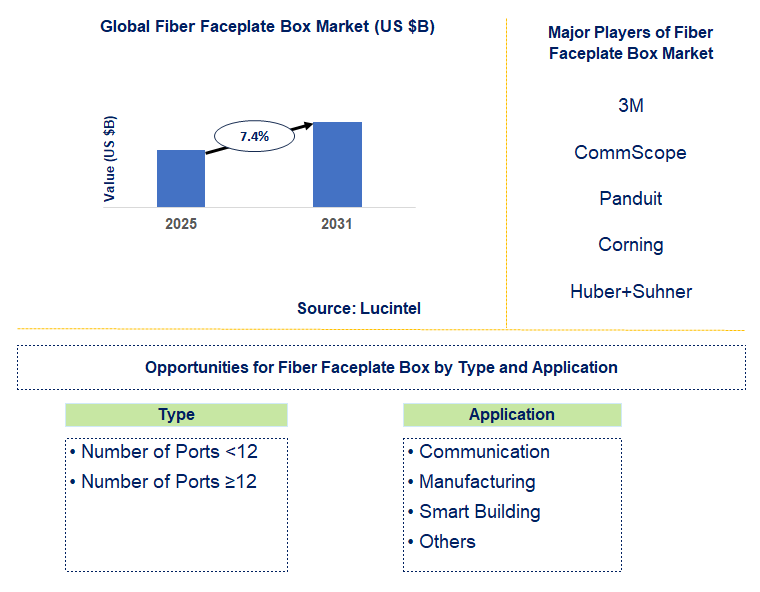
Key data points: The growth forecast = 7.4% annually for the next 7 years. Scroll below to get more insights. This market report covers trends, opportunities and forecasts in fiber faceplate box market to 2031 by type (number of ports <12 and number of ports ≥12), application (communication, manufacturing, smart building, and others), and region (North America, Europe, Asia Pacific, and the Rest of the World)
We'll send your sample report shortly.
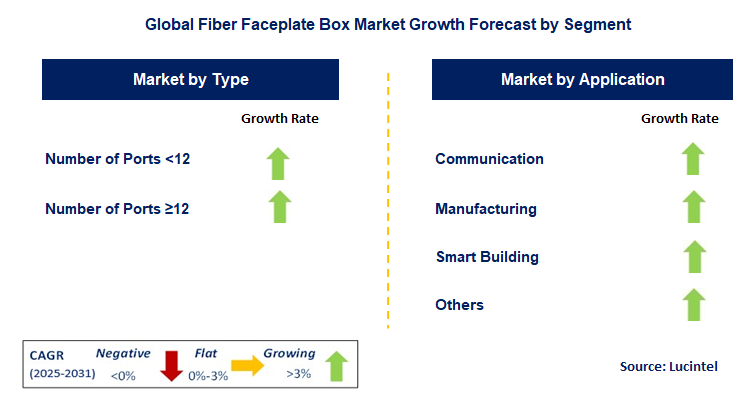
• Lucintel forecasts that, within the type category, number of port <12 is expected to witness higher growth over the forecast period.
• Within the application category, smart building is expected to witness the highest growth.
• In terms of region, APAC is expected to witness the highest growth over the forecast period. Gain valuable insights for your business decisions with our comprehensive 150+ page report. Sample figures with some insights are shown below.
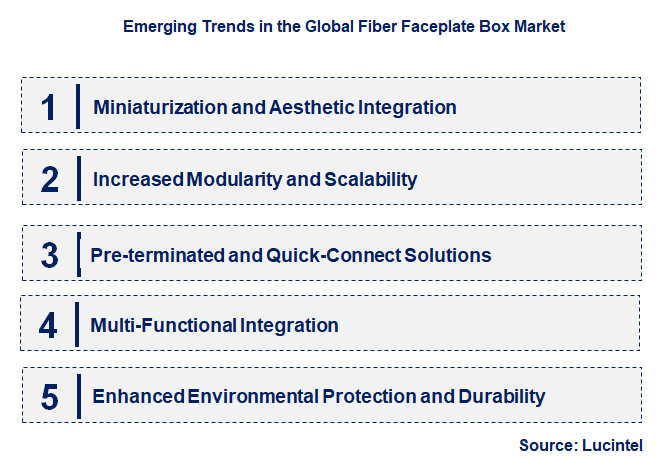
• Miniaturization and Aesthetic Integration: This is the trend of creating fiber faceplate boxes that are much smaller, more unobtrusive, and that can be integrated into contemporary interior designs. This is done through thinner profiles, color choices, and designs that mimic standard electrical outlets. The effect is increased user acceptability and simplification of deployment in homes and businesses where aesthetic appeal counts. This trend assists in minimizing visual noise and making fiber installations less obtrusive, allowing for wider FTTH adoption.
• Increased Modularity and Scalability: The direction is toward designing fiber faceplate boxes with modular units that enable flexible configuration and straightforward upgrades. This involves changeable adapter plates, splice trays built in, and provision to add or subtract fiber ports as the situation dictates. The effect is greater flexibility to meet changing subscriber requirements and future technology developments, minimizing the necessity of full box replacement during network upgrades or capacity additions. It also makes inventory easier to manage and reduces installation complexity for service providers.
• Pre-terminated and Quick-Connect Solutions: There is increased focus on pre-terminated fiber faceplate boxes that arrive at the customer with factory-installed connectors or include tool-less, quick-connect features. This does away with on-site fiber splicing or termination processes. The effect is drastically minimized installation time and labor expense, as well as decreased demand for highly trained technicians. This trend streamlines FTTH rollout, especially in mass deployments, by making the last connection point less complicated.
• Multi-Functional Integration: This trend is about incorporating more functions other than just fiber termination into the faceplate box. This can be integrated Wi-Fi access points, power plugs, or even connectivity of smart home devices. The effect is a more functional in-home network center that eliminates the necessity for several discrete pieces like this and streamlines the installation as a whole. This adds value to the end-user and makes the fiber faceplate box a core device of smart living spaces.
• Enhanced Environmental Protection and Durability: Although intended mainly for indoor applications, there is a subtle move towards enhancing the dust and small liquid splash protection of faceplate boxes, and also their flame retardant quality and overall material resilience. This guarantees the durability and dependability of the fiber connection even in unfavorable indoor conditions. The effect is increased peace of mind for both end-users and installers, lowering maintenance calls and providing a more reliable last-mile connection. These trends are deeply transforming the fiber faceplate box market by demanding increased user-friendliness, visual attractiveness, functional diversity, and deployment efficiency. The ongoing development of these subtle yet vital building blocks is part of the broad and successful uptake of high-speed fiber-optic networks.
• Miniaturization for Concealed Installation: One recent trend is a dramatic reduction in the size and profile of fiber faceplate boxes. Manufacturers are creating very compact units that can be discreetly mounted on walls, usually looking like regular electrical outlets. The effect is improved aesthetic beauty for homes and office spaces with less visual intrusion of fiber optic installations. This innovation allows for easier uptake of FTTH services by resolving issues of bulky network hardware within residential or commercial premises.
• Focus on Quick-Connect and Tool-less Solutions: There has been a significant move to create fiber faceplate boxes that can be installed with few tools and specialized expertise. Examples include Snap-On cover designs, fiber adapters pre-loaded into the box, and quick-splice or no-splice fiber termination solutions. The result is a considerable decrease in installation time and cost for service providers. This speeds up the rollout of fiber networks, allowing for more rapid subscriber connections and enhanced efficiency of large-scale FTTH deployments.
• Modular and Expandable Architecture: Recent trends involve widespread usage of modular architectures that support flexible configurations and easy future expansion of the fiber connections. Such boxes usually have interchangeable fiber adapter plates or internal trays to handle extra splices or connectors. The effect is added flexibility for network operators to change according to changing customer requirements or new technological advancements without having to replace the complete faceplate box. This maximizes the use of resources and adds to the life cycle of the installed infrastructure.
• Enhanced Material Quality and Aesthetics: Plastics with higher quality, frequently flame-resistant, and new finishing methods are becoming more widely used to produce faceplate boxes that are aesthetically more appealing and more durable. The availability of multiple colors and textures is more prevalent. The effect is more seamless incorporation of the fiber termination points into contemporary interior looks, thus improving user satisfaction. The better material quality also increases the reliability and lifespan of the termination point, lowering maintenance needs.
• Integration of Multiple Services/Ports: In addition to more fiber optic ports, certain newer fiber faceplate boxes are integrating more than one outlet, like RJ45 ports for Ethernet or even USB charge ports, into a more integrated home networking approach. The result is greater functionality and convenience to the end user, building one central point for multiple connectivity purposes. This development places the Fiber Faceplate Box at the center of the smart home enablement, making cable management at ease while providing added value. These new innovations are collectively transforming the fiber faceplate box market by spurring innovations in design, functionality, and deployment simplicity. Emphasis on small size, user friendliness, and versatility is important in facilitating the ubiquitous deployment of high-speed fiber optic broadband to homes and businesses worldwide.
• Residential FTTH/FTTB Deployments: The biggest growth potential is in the current and future large-scale deployment of Fiber-to-the-Home (FTTH) and Fiber-to-the-Building (FTTB) networks across the globe. When increasingly more households and multi-dwelling units (MDUs) become connected to fiber, the need for good-looking, simple-to-install fiber faceplate boxes will rise. The effect is a permanent high-bandwidth market for producers with the need for scalable manufacture and solutions that service both new builds and retrofits, providing customizable solutions for various interior designs.
• Commercial and Enterprise Connectivity: Increasing business dependence on high-speed, secure internet for cloud services, data exchange, and video conferencing is spurring fiber use in commercial structures and enterprise networks. This offers a prospect of faceplate boxes for office settings, possibly with more port numbers or being integrated into structured cabling systems. The effect is a need for more secure, stronger, and possibly multi-purposes fiber faceplate boxes to handle different business uses and greater data traffic densities, usually necessitating more subtle or professional-look aesthetic designs.
• Data Center Interconnects and Edge Computing: Although generally not for standard "faceplate" application, concepts of structured fiber termination apply to smaller environment data centers and edge computing facilities where management of the fiber at the point of termination is important. This can be specialized, compact termination enclosures that provide similar functionality to faceplate boxes but for more dense applications. The effect is a high-value, niche opportunity for manufacturers to offer strong, high-performance termination solutions for these important infrastructure points with minimal signal loss and high reliability.
• Smart Home and IoT Integration: As smart home technology and Internet of Things devices grow in usage, there is an increasing opportunity to integrate fiber faceplate boxes into these ecosystems. This might include adding Wi-Fi functionality, power connectors, or even intelligent sensors to the faceplate. The effect is to convert the faceplate box from a passive fiber connection point into an active, multi-purpose smart home device offering greater value to consumers and new revenue opportunities for manufacturers through more sophisticated products.
• Rural Broadband and Under-Served Area Connections: Efforts to deliver high-speed fiber broadband to rural and under-served communities are presenting a substantial growth opportunity. Such deployments can present distinctive challenges, such as extreme environmental conditions and the need for economical, rugged solutions. The result is a need for ruggedized, but user-friendly, fiber faceplate boxes that are hardened for exposure to external elements and easy to install in the field, enabling digital inclusion and economic growth in these communities. These growth opportunities are having a profound influence on the fiber faceplate box market by stimulating design innovation, functionality, and use. Emphasis on various environments of deployment, from urban homes to rural countryside and sophisticated commercial facilities, guarantees the expansion and progression of the market as fiber connectivity becomes pervasive.
• 3M
• CommScope
• Panduit
• Corning
• Huber+Suhner
• Rosenberger
• Nexans
• Huawei
• ZTE
• FiberHome
• Number of Ports <12
• Number of Ports ≥12
• Communication
• Manufacturing
• Smart Building
• Others
• North America
• Europe
• Asia Pacific
• The Rest of the World
• United States: In the United States, growth for the market of fiber faceplate boxes is being driven by aggressive broadband expansion plans and widespread FTTH adoption. Current trends are centered on extremely modular and versatile designs to ease installation in varied residential and business environments. Companies are promoting slim, visually appealing designs that can be easily integrated into contemporary interior design. There is also a trend toward pre-terminated solutions and tool-less installation capabilities to save deployment time and service providers' labor expenses in order to facilitate the country's initiative to enhance rural and urban connectivity.
• China: As a world leader in deploying fiber optic networks, China dominates the fiber faceplate box market. Recent advances have seen the mass production of highly affordable and functionally durable faceplate boxes to meet its vast FTTH and 5G infrastructure. Chinese manufacturers are designing multi-functional products combining fiber termination with other connectivity functions (e.g., RJ45 ports) and emphasize materials that provide good fire resistance and longevity. Deployment scale in China continues to accelerate manufacturing efficiency improvements and product flexibility.
• Germany: Germany's fiber faceplate box market is dominated by a focus on precision engineering, heavy-duty construction, and adherence to stringent European safety and quality standards. New trends involve the use of high-quality, heavy-duty materials that provide long-term reliability and signal integrity. German manufacturers are targeting discrete, space-efficient designs that are simple to install and maintain for residential and commercial spaces. There is also a movement towards solutions that are supportive of passive optical networks with little or no signal loss, with guaranteed high-performing broadband delivery.
• India: India's fast-growing fiber optic network, driven by government programs such as Digital India and Bharat Net, is a strong driver for the faceplate box market for fiber. Some recent trends have been a strong boost in demand for affordable and tough faceplate boxes that work in different climatic and installation environments. Domestic production is increasing to address the booming demand, with emphasis on simple, rugged designs for easy and quick as well as extensive deployment in urban as well as rural areas. Demand is also increasing for boxes that have space for multiple fiber connections to ensure future-proof scalability.
• Japan: Japan's fiber faceplate box market is very mature as well as innovative, with strong emphasis on ultra-high-speed broadband and space-conserving solutions. New trends include improvements in ultra-miniature designs that integrate well with wall outlets already installed, frequently with dedicated fiber connectors for low footprint and high performance. Japanese vendors are concentrating on product offerings that provide extremely low insertion loss and high return loss for immaculate signal quality to support next-generation services. There is also a shift towards green materials and solutions that are simple for technicians to install and maintain in high-density urban environments.


• 3M
• CommScope
• Panduit
• Corning
• Huber+Suhner
• Rosenberger
• Nexans
• Huawei
• ZTE
• FiberHome Q5. Which fiber faceplate box market segment will be the largest in future? Answer: Lucintel forecasts that, within the type category, number of port <12 is expected to witness higher growth over the forecast period. Q6. In fiber faceplate box market, which region is expected to be the largest in next 5 years? Answer: In terms of region, APAC is expected to witness the highest growth over the forecast period. Q7. Do we receive customization in this report? Answer: Yes, Lucintel provides 10% customization without any additional cost.


Choose a license that fits your team. Instant PDF delivery.
Prices exclude taxes. Instant delivery. Custom licensing available on request.
Market Report · July 29, 2026
Market Report · July 20, 2026
Market Report · July 20, 2026
Trusted partner for strategic intelligence and business growth


Receive a complimentary market analysis tailored to your industry. Our analysts will identify key growth opportunities and competitive dynamics specific to your business.

Market size, growth rate, and key trend analysis for your specific sector.

Top competitor positioning and market share analysis.

Strategic recommendations backed by data-driven insights.
Get curated market intelligence and competitive moves straight to your inbox.
By subscribing, you agree to receive our monthly insights. Unsubscribe anytime.
Receive a complimentary market analysis tailored to your industry. Our analysts will identify key growth opportunities and competitive dynamics specific to your business.
Market size, growth rate, and key trend analysis for your specific sector.
Top competitor positioning and market share analysis.
Strategic recommendations backed by data-driven insights.
Get curated market intelligence, emerging trends, and competitive moves straight to your inbox each month.
By subscribing, you agree to receive our monthly insights. Unsubscribe anytime.
We'll send your sample report shortly.