
Market Report · July 15, 2026

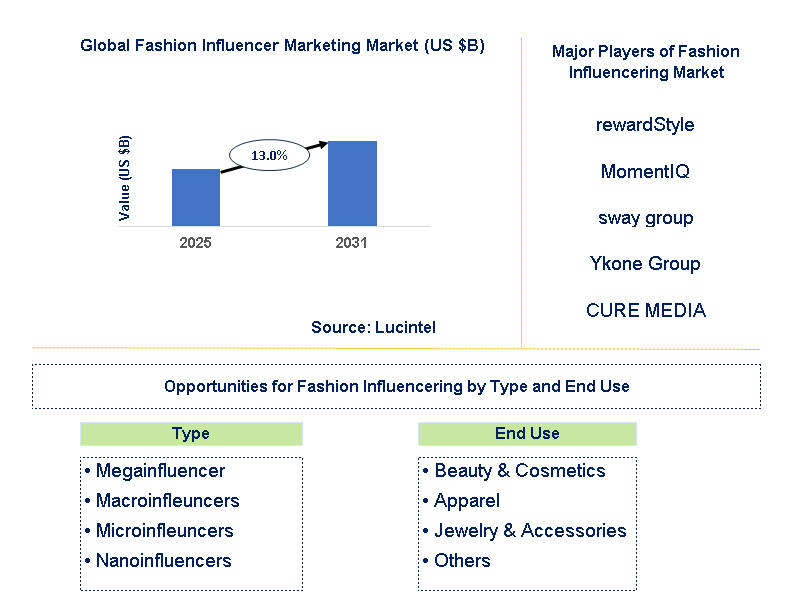
Key data points: The growth forecast = 13% annually for the next 7 years. Scroll below to get more insights. This market report covers trends, opportunities and forecasts in fashion influencer marketing market to 2031 by type (megainfluencer, macroinfleuncers, microinfleuncers, and nanoinfluencers), end use (beauty & cosmetics, apparel, jewelry & accessories, and others), and region (North America, Europe, Asia Pacific, and the Rest of the World)
We'll send your sample report shortly.
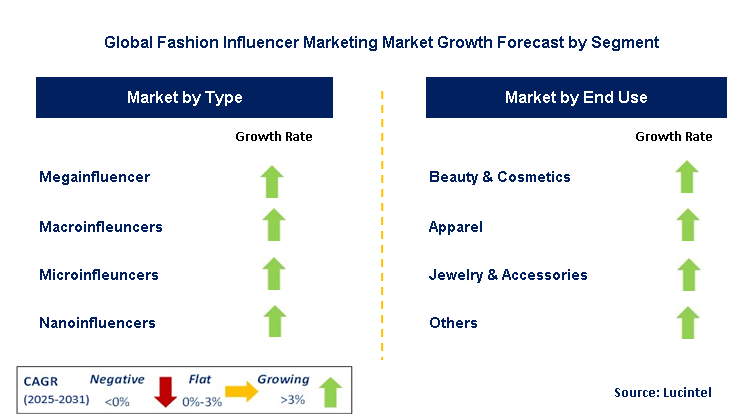
• Lucintel forecasts that, within the type category, megainfluencer is expected to witness the highest growth over the forecast period.
• Within the end use category, beauty & cosmetic is expected to witness the highest growth.
• In terms of region, North America is expected to witness the highest growth over the forecast period. Gain valuable insights for your business decisions with our comprehensive 150+ page report. Sample figures with some insights are shown below.
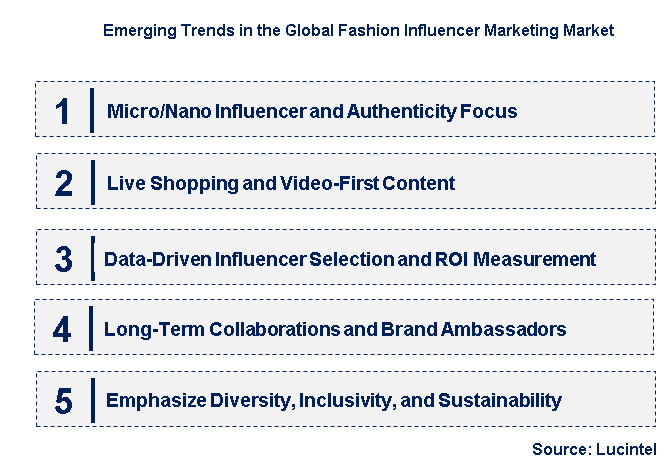
• Micro/Nano Influencer and Authenticity Focus: Mega-influencers are on the decline, and micro and nano influencers are on the rise. These micro and nano creators with 1,000 to 100,000 followers have stronger engagement rates and a more engaged, targeted following. Their messaging is viewed as being more authentic and reliable since their suggestions read like a friend’s counsel as opposed to a paid-for advertisement. Brands are realizing that authentic connection and familiarity fuel higher conversion rates, resulting in more targeted and effective campaigns.
• Live Shopping and Video-First Content: The popularity of short-form video apps such as TikTok and Instagram Reels is transforming fashion influencer content. Videos provide engaging means to present outfits, styling advice, and product assessments. Additionally, live shopping, particularly widespread in markets such as China, enables influencers to sell goods in real-time during live streams, providing real-time engagement and immediate buys. This trend combines entertainment with commerce to provide rich shopping experiences that generate instant purchases and engagement.
• Data-Driven Influencer Selection and ROI Measurement: Brands are shifting away from mere follower numbers to make data analytics and artificial intelligence-driven influencer selection. Platforms have now evolved to provide advanced tools for auditing audience demographics, engagement rates, sentiment analysis, and conversion. This data-driven method enables brands to identify influencers whose audience actually shares their target market, maximizing campaign effectiveness and presenting clear measures of return on investment, making influencer marketing accountable.
• Long-Term Collaborations and Brand Ambassadors: Rather than single collaborations, fashion brands are now more interested in long-term collaborations and making influencers their brand ambassadors. This creates stronger relationships between the influencer and the brand, resulting in more regular and authentic promotion in the long run. These long-term collaborations provide the opportunity for influencers to organically incorporate products into their lifestyle, gaining more trust and loyalty with their audience, and achieving consistent brand visibility and customer interaction.
• Emphasize Diversity, Inclusivity, and Sustainability: Consumers are now more demanding that brands and the influencers they pick emulate various body types, ethnicities, and backgrounds. Transparency about sustainable practices is also in high demand. Influencers who promote inclusivity and sustainable fashion are gaining much attention. Brands are actively looking for creators who genuinely stand for these values, not only to expand their reach but also to align with changing consumer ethics and create a more ethically responsible brand image. These new trends are deeply transforming the fashion influencer marketing industry by focusing on authenticity, data-driven approach, and diverse content form. The movement toward micro and nano influencers, as well as video and live commerce, is creating more direct and interactive marketing. In addition, the emphasis on long-term collaborations and values like diversity and sustainability is creating more solid, more credible bridges between brands, influencers, and consumers, ultimately leading to a more authentic and impactful marketing environment.
• TikTok Emergence as a Leading Platform: TikTok has become a force to be reckoned with in fashion influencer marketing, rapidly overtaking established platforms such as Instagram for its trend-starting propensity and capacity to generate organic movements. Its short-form, interactive video content enables influencers to present outfits, styling advice, and fashion hauls in an extremely dynamic and shareable manner. Brands are heavily investing in TikTok campaigns to reach younger demographics and participate in trending challenges, leading to unprecedented levels of brand visibility and consumer engagement.
• Greater Focus on Genuine Storytelling and Relatability: The industry is shifting away from extremely polished, celebrity-based endorsements towards more relatable and genuine content. Shoppers are looking more and more for real recommendations by influencers with like-lifestyle or like-aesthetic values. This trend has supported the growth of micro and nano influencers, whose material comes across as more intimate and reliable. Brands are engaging in longer-term collaborations with such creators to create authentic stories about their products.
• Merging of E-commerce Capabilities and Live Shopping: Social media sites are increasingly building more intrinsic e-commerce capabilities into their sites, like shopping posts, in-app checkouts, and live shopping events. This innovation really does shorten the purchase path from discovery. Now influencers can connect products directly, host live streams where viewers can purchase items directly and in real time, and monitor sales driven by their content, making social media potent retail channels and delivering clear ROI to brands.
• Advanced Performance Measurement and Analytics Tools: The sector is witnessing a growth in advanced analytics platforms that help brands quantify the impact of their influencer campaigns more accurately. These tools deliver detailed insights into the demographics of the audience, engagement, sentiment analysis, and conversion rates. This innovation enables brands to refine their strategies, determine the most effective influencers, and provide clear evidence of return on investment for influencer marketing campaigns, making campaigns more fact-based.
• Increasing Interest in Niche and Specialist Influencers: In addition to overall fashion influencers, there’s an increasing interest in creators specializing in very niche areas such as sustainable fashion, plus-size fashion, vintage wear, or certain aesthetic visual styles. This trend opens up opportunities for brands to reach very precise consumer cohorts with highly specific content. Niche influencers tend to have very committed followings who are more likely to purchase, so such collaborations are very effective for connecting to niche consumer groups. These innovations are deeply influencing the fashion influencer marketing industry by making it more integrated, measurable, and e-commerce-enabled. The transformation to video-centric platforms, along with the need for authenticity and niche content, is revolutionizing fashion brand communication with their customers. The business is getting more complex, with data and native shopping integrations used to fuel both brand visibility and actual sales, making influencer marketing an irreplaceable part of contemporary fashion marketing tools.
• Direct-to-Consumer (D2C) Brand Promotion: D2C fashion brands have the potential to heavily utilize influencer marketing in order to promote brand awareness and boost sales independent of the traditional retail avenue. Influencers can feature products in actual environments, produce organic reviews, and send traffic straight to the brand’s e-commerce platform. This use provides a budget-friendly and highly targeted option for D2C brands to gain credibility, create direct customer relationships, and expand their reach cost-effectively in an competitive marketplace.
• Ethical and Sustainable Fashion Campaigning: With increasing consumer awareness and demand for sustainable and ethically made fashion, there is a strong potential for influencers to campaign for such companies. Influencers can enlighten their followers regarding environmentally friendly materials, open supply chains, and circular fashion systems. This use enables brands to speak the language of their values, earn the trust of green-conscious consumers, and stand out in a saturated market by jumping on a strong social cause.
• Luxury Fashion Storytelling and Exclusivity: Luxury fashion brands are able to leverage influencers to craft aspirational content, share compelling brand narratives, and preserve an air of exclusivity while connecting with wider, digitally-native audiences. Influencers are able to share behind-the-scenes at fashion shows, highlight craftsmanship, and embed products within high-end lifestyle content. This use enables luxury brands to span the divide between their heritage and contemporary digital consumption, increasing luxury accessibility without diluting its perceived value.
• Personal Styling and Trend Forecasting: Influencers are experts at personal styling and trend forecasting, presenting a huge growth area for brands. Fashion influencers can develop tutorials, "how to style" instructions, and trend reports showcasing different brands and products. This usage places brands in the vanguard of fashion trends, presents useful value to consumers, and promotes sales by illustrating how items integrate into existing styles. It also creates greater engagement by providing practical fashion tips.
• Emerging Markets Penetration: The market for fashion influencer marketing has tremendous growth prospects in emerging economies with fast-growing internet and social media penetration. Brands can align with local influencers to penetrate new geographies in an effective manner, grasping cultural sensibilities and consumption patterns. This use case helps brands establish trust and salience within a given local community, frame their messaging differently, and tap into new customer bases that may be hard to access through traditional global marketing tactics. These strategic growth prospects are deeply influencing the fashion influencer marketing industry by making its uses diversified and increasing its penetration. These help the brands to reach focused consumer groups, resonate with significant social causes, and evolve their marketing strategies. Through concentration on these prospects, the fashion influencer industry is becoming more niche-based, influential, and a part of the overall business success of fashion businesses across many sectors and geographies.
• rewardStyle
• MomentIQ
• sway group
• Ykone Group
• CURE MEDIA
• AspireIQ
• Brain Labs Digital
• TEAM EPIPHANY
• Billion Dollar Boy
• JMB GLAMSQUAD
• Megainfluencer
• Macroinfleuncers
• Microinfleuncers
• Nanoinfluencers
• Beauty & Cosmetics
• Apparel
• Jewelry & Accessories
• Others
• North America
• Europe
• Asia Pacific
• The Rest of the World
• United States: The United States fashion influencer marketing market is mature and extremely dynamic, with ongoing dominance by platforms such as Instagram and TikTok. There is increased focus on real collaborations, with brands increasingly opting for micro and nano influencers due to their improved engagement rates and specialized audiences. Live shopping experiences and direct-to-consumer collaborations are gaining traction, blurring the content creation-e-commerce divide. Ethical disclosure and transparency in sponsored content are also coming under closer examination.
• China: China’s fashion influencer marketing space is defined by its distinct ecosystem, led by platforms such as Doyin, Xiongs, and WeChat. KOLs and KOCs are key forces, with live commerce being a sales-driving powerhouse. Brands are emphasizing highly localized content and long-term collaborations, frequently fusing multiple levels of influence, from celebrities through to more authentic consumer voices, to appeal to sophisticated, digitally-astute consumer audiences.
• Germany: In Germany, the market for fashion influencer marketing is increasing slowly, with high emphasis on credibility and authenticity. Although international platforms are employed, indigenous influencers who resonate with cultural values of quality and subtlety are preferred. Brands are not only putting money into data-driven approaches to finding appropriate influencers but also monitoring campaign success. Adhering to advertising laws and clear divulgence of partnerships are also top concerns in this market.
• India: India’s fashion influencer marketing industry is growing rapidly, driven by young, digitally-native users and growing internet penetration. Content is getting more authentic as influencers also showcase personal experiences and cultural expression through fashion and beauty. There is significant growth in regional influencers and native content that focuses on India’s diverse languages. YouTube and Instagram are key platforms, with growth in combined shopping experiences via affiliate programs.
• Japan: Fashion influencer marketing in Japan is distinctive, where subtlety, trust, and cultural syncretism are more important than explicit promotion. Influencers tend to be regarded as trusted lifestyle mentors instead of performers. Brands place importance on building long-term relationships and carefully crafted narratives, with LINE, YouTube, and Instagram being essential. The rise of Tubers, virtual avatars voiced by humans, as influencers also represents a unique evolution within the Japanese market, combining human and avatar influence.


• rewardStyle
• MomentIQ
• sway group
• Ykone Group
• CURE MEDIA
• AspireIQ
• Brain Labs Digital
• TEAM EPIPHANY
• Billion Dollar Boy
• JMB GLAMSQUAD Q5. Which fashion influencer marketing market segment will be the largest in future? Answer: Lucintel forecasts that, within the type category, megainfluencer is expected to witness the highest growth over the forecast period. Q6. In fashion influencer marketing market, which region is expected to be the largest in next 5 years? Answer: In terms of region, North America is expected to witness the highest growth over the forecast period. Q7. Do we receive customization in this report? Answer: Yes, Lucintel provides 10% customization without any additional cost.


Choose a license that fits your team. Instant PDF delivery.
Prices exclude taxes. Instant delivery. Custom licensing available on request.
Market Report · July 15, 2026
Market Report · June 26, 2026
Market Report · June 24, 2026
Trusted partner for strategic intelligence and business growth


Receive a complimentary market analysis tailored to your industry. Our analysts will identify key growth opportunities and competitive dynamics specific to your business.

Market size, growth rate, and key trend analysis for your specific sector.

Top competitor positioning and market share analysis.

Strategic recommendations backed by data-driven insights.
Get curated market intelligence and competitive moves straight to your inbox.
By subscribing, you agree to receive our monthly insights. Unsubscribe anytime.
Receive a complimentary market analysis tailored to your industry. Our analysts will identify key growth opportunities and competitive dynamics specific to your business.
Market size, growth rate, and key trend analysis for your specific sector.
Top competitor positioning and market share analysis.
Strategic recommendations backed by data-driven insights.
Get curated market intelligence, emerging trends, and competitive moves straight to your inbox each month.
By subscribing, you agree to receive our monthly insights. Unsubscribe anytime.
We'll send your sample report shortly.