
Market Report · July 29, 2026

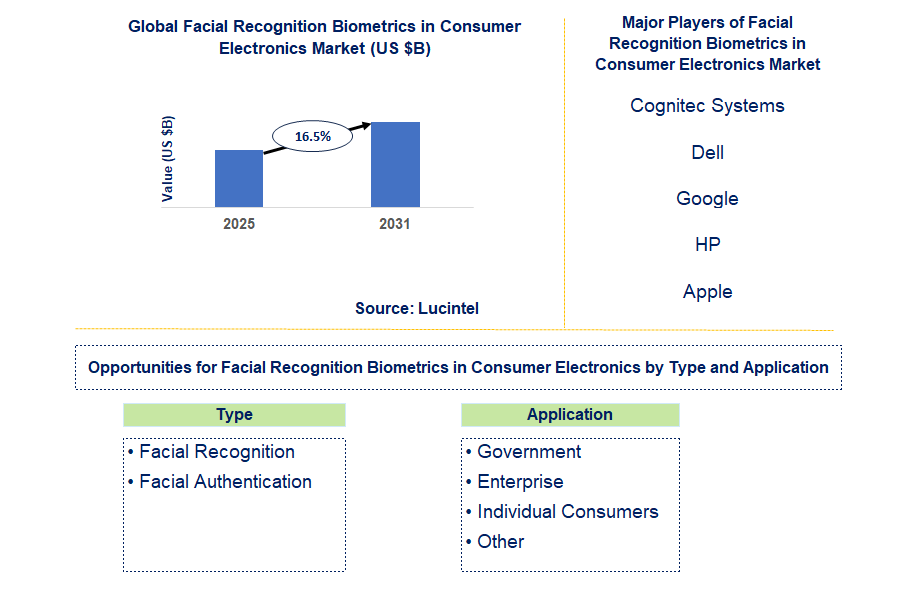
Key data points: The growth forecast = 16.5% annually for the next 7 years. Scroll below to get more insights. This market report covers Trends, opportunity and forecast in facial recognition biometrics in consumer electronics market to 2031 by type (facial recognition and facial authentication), application (government, enterprise, individual consumers, and other), and region (North America, Europe, Asia Pacific, and the Rest of the World)
We'll send your sample report shortly.
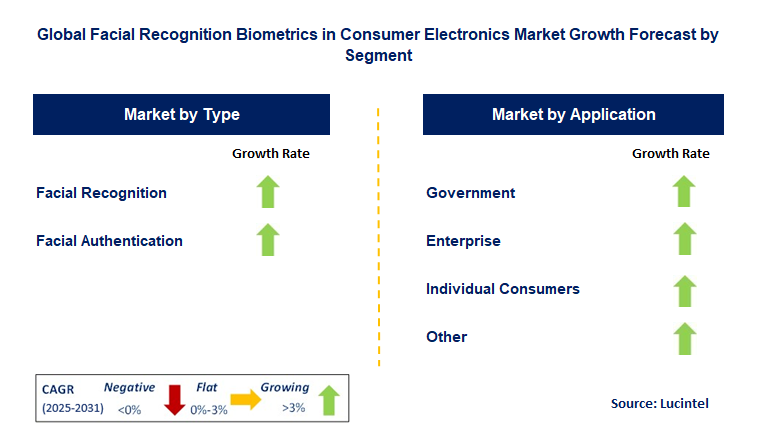
• Lucintel forecasts that, within the type category, facial recognition is expected to witness higher growth over the forecast period.
• Within the application category, the government is expected to witness the highest growth.
• In terms of region, APAC is expected to witness the highest growth over the forecast period. Gain valuable insights for your business decisions with our comprehensive 150+ page report. Sample figures with some insights are shown below.
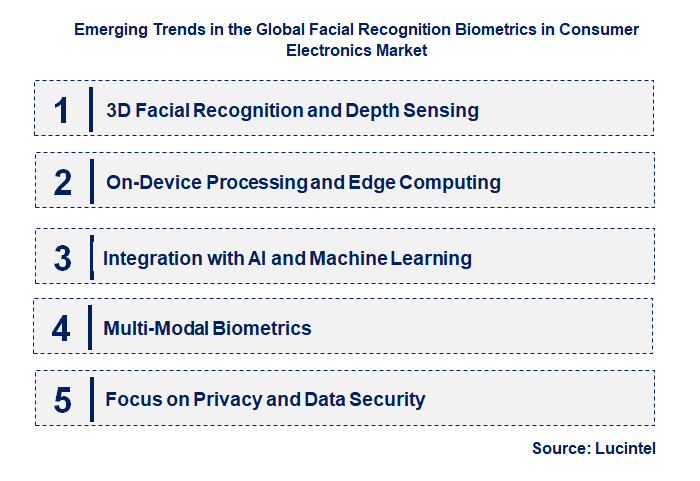
• 3D Facial Recognition and Depth Sensing: Moving beyond 2D image analysis, 3D facial recognition uses depth sensors to create a more accurate and robust representation of a user's face. This significantly enhances security against spoofing attacks using photos or videos, making it a more reliable authentication method for sensitive applications like mobile payments and device unlock.
• On-Device Processing and Edge Computing: Processing biometric data directly on the device, rather than sending it to a remote server, addresses privacy concerns and improves performance. Edge computing reduces latency, enhances security by minimizing data transmission, and allows for offline functionality. This trend is driven by increasing privacy awareness and the need for faster authentication.
• Integration with AI and Machine Learning: AI and machine learning algorithms are being used to improve the accuracy and robustness of facial recognition systems. These algorithms can better handle variations in lighting, facial expressions, and aging. They also enable advanced features like emotion recognition and personalized content delivery.
• Multi-Modal Biometrics: Combining facial recognition with other biometric modalities, such as voice recognition or fingerprint scanning, enhances security and user convenience. This creates a more robust authentication system that is less susceptible to spoofing and provides alternative authentication methods for users with disabilities or in challenging environments.
• Focus on Privacy and Data Security: With increasing concerns about data privacy, there's a growing emphasis on implementing robust data protection measures in facial recognition systems. This includes secure storage of biometric data, encryption, and adherence to privacy regulations. This builds user trust and promotes wider adoption of the technology. These trends are significantly reshaping the facial recognition biometrics market in consumer electronics by driving the development of more secure, accurate, and privacy-conscious solutions. The focus is shifting towards on-device processing, multi-modal authentication, and AI-powered enhancements. This evolution is transforming how users interact with their devices, enabling more personalized, secure, and seamless experiences.
• Improved Accuracy and Performance in Challenging Conditions: Advancements in AI and deep learning algorithms are significantly improving facial recognition accuracy, especially in challenging lighting conditions, with varying facial expressions, and for diverse demographics. This leads to more reliable and consistent authentication experiences for all users, regardless of their environment or individual characteristics.
• Enhanced Anti-Spoofing and Liveness Detection: Advanced liveness detection techniques are being implemented to combat presentation attacks using photos, videos, or masks. These include 3D depth mapping, infrared imaging, and texture analysis, making it significantly harder for attackers to bypass facial recognition systems. This strengthens security and builds user trust in the technology.
• Focus on On-Device Processing and Privacy: Processing biometric data directly on the device, using secure enclaves or dedicated hardware, is becoming increasingly important. This minimizes the transmission of sensitive data to external servers, addresses privacy concerns, and reduces the risk of data breaches. This also improves performance by reducing latency.
• Integration with Other Biometric Modalities: Combining facial recognition with other biometric methods, such as fingerprint scanning, voice recognition, or iris scanning, creates multi-factor authentication systems. This enhances security by requiring multiple forms of verification and provides fallback options for users in different situations.
• Expansion into New Applications Beyond Authentication: Facial recognition is expanding beyond basic authentication to enable new features and user experiences. This includes personalized content recommendations, emotion recognition for adaptive interfaces, and enhanced security features like automated surveillance and intruder detection in smart home devices. These developments are significantly impacting the facial recognition biometrics market in consumer electronics by driving the creation of more robust, secure, and user-friendly solutions. The focus is shifting towards enhanced accuracy, improved anti-spoofing measures, stronger privacy protections, and the exploration of new application areas. This evolution is transforming how users interact with their devices, enabling more personalized, secure, and seamless experiences.
• Enhanced Device Security and Access Control: Facial recognition provides a secure and convenient method for device unlock, app access, and transaction authorization. This enhances security compared to traditional passwords and PINs, reducing the risk of unauthorized access and data breaches. This drives adoption in smartphones, laptops, and other personal devices where security is paramount.
• Personalized User Experiences and Content Delivery: Facial recognition enables personalized content recommendations, adaptive interfaces, and tailored user experiences. By recognizing individual users, devices can customize settings, preferences, and content based on their unique profiles. This enhances user engagement and satisfaction, creating more immersive and personalized experiences.
• Seamless and Contactless Payments: Facial recognition is being integrated into mobile payment systems and point-of-sale terminals, enabling secure and contactless transactions. This eliminates the need for physical cards or PIN entry, providing a faster and more convenient payment experience. This promotes wider adoption of contactless payment methods and enhances transaction security.
• Smart Home Security and Access Control: Facial recognition enhances security and access control in smart home environments. It can be used for automated door unlock, visitor identification, and intruder detection. This improves home security and provides greater convenience for homeowners.
• Gaming and Entertainment Applications: Facial recognition is being used to create more immersive and interactive gaming and entertainment experiences. This includes personalized game profiles, avatar creation, and interactive gameplay based on facial expressions and emotions. This enhances user engagement and creates new possibilities for interactive entertainment. These strategic growth opportunities significantly impact the facial recognition biometrics market in consumer electronics by driving specialization and innovation. Vendors focus on developing tailored solutions for specific application needs, leading to a more diverse and competitive market. The emphasis is on enhanced security, personalized experiences, seamless integration with other technologies, and addressing privacy concerns. This application-driven approach is shaping the future of human-device interaction and creating new possibilities for user engagement across various consumer electronics devices.
• Cognitec Systems
• Dell
• HP
• Apple
• Microsoft
• AMD
• Intel Security
• Cogent Systems
• Allied Time
• Facial Recognition
• Facial Authentication
• Government
• Enterprise
• Individual Consumers
• Other
• North America
• Europe
• Asia Pacific
• The Rest of the World
• United States: The US market is characterized by a focus on convenience and seamless user experiences, with widespread adoption of facial recognition for device unlock and mobile payments. Key developments include advancements in 3D facial recognition, improved performance in low-light conditions, and integration with augmented reality (AR) and virtual reality (VR) applications. There is also increasing scrutiny regarding privacy and data security, leading to calls for stricter regulations.
• China: The Chinese market is experiencing widespread adoption of facial recognition across various consumer electronics applications, including mobile payments, access control, and social media platforms. Key developments include advancements in facial recognition technology for large-scale identification and surveillance, integration with national identity systems, and the use of facial recognition for targeted advertising and personalized content delivery. Privacy concerns are also emerging, though adoption remains high.
• Germany: The German market is characterized by a strong emphasis on data privacy and security, influenced by strict European regulations like GDPR. Key developments include cautious the adoption of facial recognition, focusing on user consent and data minimization. There is a preference for on-device processing of biometric data to minimize privacy risks. Public discourse around the ethical implications of facial recognition is also prominent.
• India: The Indian market is experiencing rapid growth in facial recognition adoption, driven by government initiatives like Aadhaar and increasing smartphone penetration. Key developments include the use of facial recognition for national identification, access control, and attendance tracking. There is also a growing adoption of facial recognition in mobile payments and financial services, particularly in rural areas with limited access to traditional banking infrastructure.
• Japan: The Japanese market focuses on high accuracy, reliability, and user convenience. Key developments include advancements in facial recognition technology for contactless authentication in various consumer electronics devices, including smartphones, laptops, and ATMs. There is also growing interest in using facial recognition for personalized services and marketing while carefully considering privacy implications.


• Cognitec Systems
• Dell
• HP
• Apple
• Microsoft
• AMD
• Intel Security
• Cogent Systems
• Allied Time Q5. Which facial recognition biometrics in consumer electronics market segment will be the largest in future? Answer: Lucintel forecasts that facial recognition is expected to witness higher growth over the forecast period. Q6. In facial recognition biometrics in consumer electronics market, which region is expected to be the largest in next 5 years? Answer: APAC is expected to witness the highest growth over the forecast period. Q7. Do we receive customization in this report? Answer: Yes, Lucintel provides 10% customization without any additional cost.


Choose a license that fits your team. Instant PDF delivery.
Prices exclude taxes. Instant delivery. Custom licensing available on request.
Market Report · July 29, 2026
Market Report · July 20, 2026
Market Report · July 20, 2026
Trusted partner for strategic intelligence and business growth


Receive a complimentary market analysis tailored to your industry. Our analysts will identify key growth opportunities and competitive dynamics specific to your business.

Market size, growth rate, and key trend analysis for your specific sector.

Top competitor positioning and market share analysis.

Strategic recommendations backed by data-driven insights.
Get curated market intelligence and competitive moves straight to your inbox.
By subscribing, you agree to receive our monthly insights. Unsubscribe anytime.
Receive a complimentary market analysis tailored to your industry. Our analysts will identify key growth opportunities and competitive dynamics specific to your business.
Market size, growth rate, and key trend analysis for your specific sector.
Top competitor positioning and market share analysis.
Strategic recommendations backed by data-driven insights.
Get curated market intelligence, emerging trends, and competitive moves straight to your inbox each month.
By subscribing, you agree to receive our monthly insights. Unsubscribe anytime.
We'll send your sample report shortly.