
Facade Market
The future of the global facade market looks promising with opportunities in the commercial and residential markets. The global facade market is expected to reach an estimated $520 billion by 2035 with a CAGR of 5.3% from 2026 to 2035. The major drivers for this market are the increasing urban construction driving facade demand, the rising investment in sustainable building projects and the growing adoption of energy efficient facade.
• Lucintel forecasts that, within the type category, ventilated will remain the largest segment over the forecast period as the rising adoption of sustainable facade solutions.
• Within the end use category, commercial will remain the largest segment due to the the growing demand for modern facade systems.
• In terms of regions, APAC will remain the largest region over the forecast period due to the the rising commercial construction boosting facade adoption.
Gain valuable insights for your business decisions with our comprehensive 150+ page report.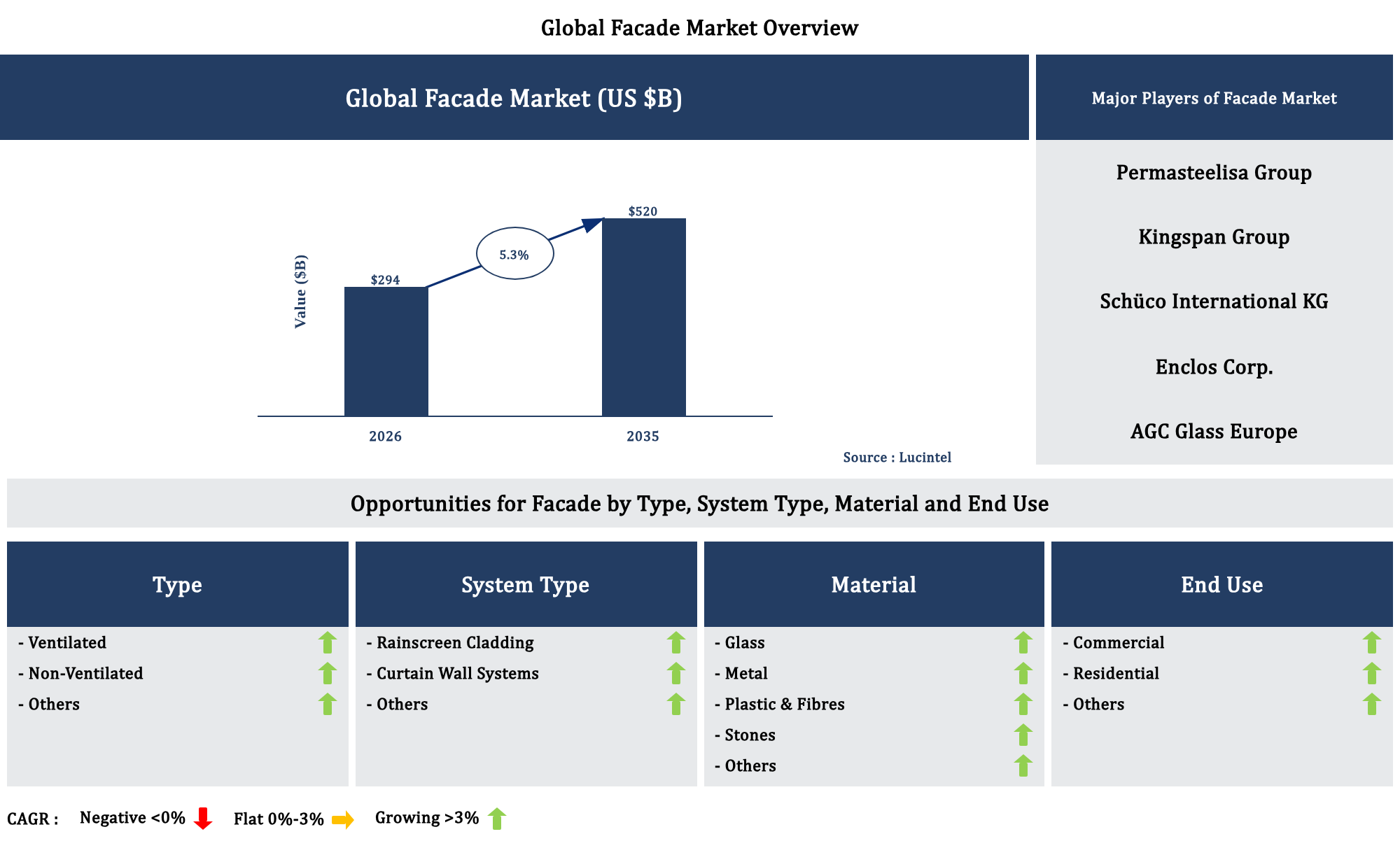
Emerging Trends in the Facade Market
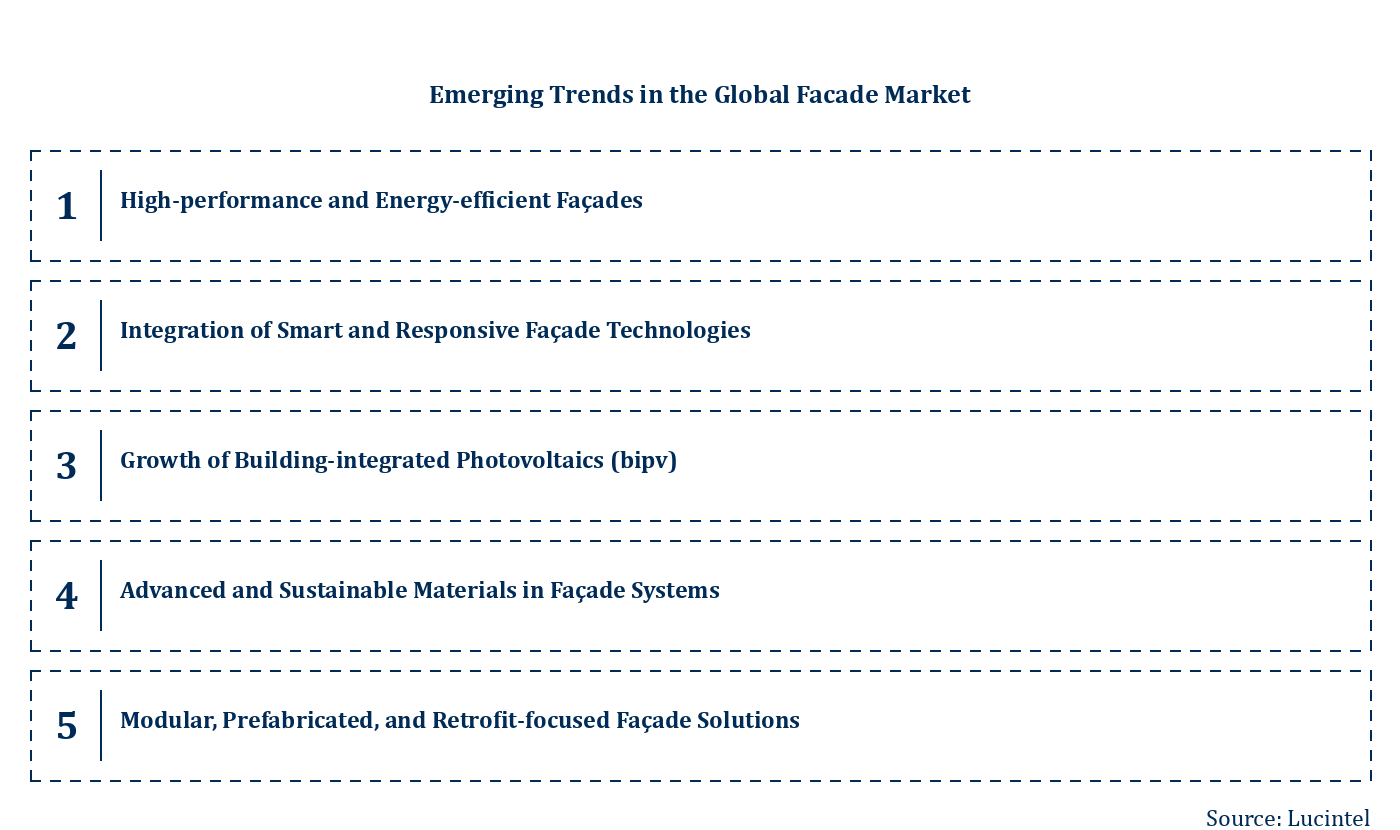
The facade market is undergoing a rapid transformation driven by stricter energy codes, advances in materials science, and growing expectations for high-performance, visually distinctive buildings. Stakeholders are prioritizing façades that do more than provide enclosure, emphasizing functions such as energy generation, climate responsiveness, and digital connectivity. At the same time, urbanization and retrofitting needs are boosting demand for solutions that are lightweight, modular, and easy to install on existing structures. Together, these developments are reshaping how architects, developers, and manufacturers conceive and deliver the facade market, with innovation focusing on both sustainability and long-term asset performance.
Recent Developments in the Facade Market
The facade market is undergoing rapid transformation as developers, architects, and regulators demand higher performance, sustainability, and aesthetics from building envelopes. Globally, the facade market is shaped by stricter energy codes, urban densification, and the need to retrofit aging building stock. Technological innovations in materials, digital design, and prefabrication are redefining how facades are engineered, procured, and maintained across both commercial and residential segments. At the same time, climate resilience and occupant well-being are becoming central design drivers. These recent developments collectively influence cost structures, competitive dynamics, and long-term value creation for stakeholders in the facade market.
Strategic Growth Opportunities in the Facade Market
The facade market is evolving as architects, developers, and regulators prioritize performance, sustainability, and aesthetics across residential, commercial, industrial, and institutional buildings. Demand is rising for high-performance building envelopes that enhance energy efficiency, occupant comfort, and brand differentiation while meeting stricter codes. Digital design, advanced materials, and prefabrication are reshaping façade solutions and expanding addressable applications. Retrofits of aging building stock, the growth of smart buildings, and climate resilience mandates are further accelerating innovation in the facade market. Companies that align offerings with these application-specific needs can capture value through specialized systems and long-term service partnerships.
Facade Market Drivers and Challenges
The global facade market is shaped by a dynamic mix of technological, economic, and regulatory influences that affect both demand and competitive positioning. Advancements in building materials, energy-efficient systems, and digital design tools are opening new opportunities for higher performance and aesthetic differentiation. At the same time, macroeconomic trends, sustainability mandates, and evolving building codes create both tailwinds and barriers for market participants. Stakeholders must balance cost, compliance, and innovation while addressing growing expectations for energy efficiency, durability, and safety. Understanding these drivers and challenges is essential for manufacturers, contractors, and developers seeking long-term success in the global facade market.
The factors responsible for driving the facade market include:
The challenges facing this facade market include:
The global facade market is being propelled by strong construction activity, rising energy-efficiency requirements, material and system innovation, and supportive sustainability policies, yet it must contend with sizable challenges related to high upfront costs, regulatory complexity, and supply chain and labor constraints. These opposing forces shape competitive strategies, pushing industry participants to invest in R&D, prefabrication, digital design, and lifecycle cost optimization to deliver compliant, high-performance solutions at manageable costs. Companies that can align advanced technologies with regulatory demands and budget realities are best positioned to capture growing opportunities across both mature and emerging construction markets.
List of Facade Market Companies
Companies in the market compete on the basis of product quality offered. Major players in this market focus on expanding their manufacturing facilities, R&D investments, infrastructural development, and leverage integration opportunities across the value chain. Through these strategies facade market companies cater increasing demand, ensure competitive effectiveness, develop innovative products & technologies, reduce production costs, and expand their customer base. Some of the facade market companies profiled in this report include-
Facade Market by Segment
The study includes a forecast for the global facade market by type, system type, material, end use, and region.
Country Wise Outlook for the Facade Market
The global facade market is evolving rapidly as urbanization, sustainability regulations, and advanced building technologies reshape how building envelopes are designed and delivered. Developers and architects are prioritizing high‑performance facades that improve energy efficiency, support net‑zero targets, and enhance occupant comfort. Digital design tools, prefabrication, and smart materials are enabling more complex geometries and faster installation while controlling costs. At the same time, stricter fire, seismic, and weather‑resilience codes are influencing material choices and system engineering. Across major economies, facade innovation reflects local climate needs, policy frameworks, and construction practices, creating distinct yet interconnected regional trajectories.
Features of the Facade Market
Article
Facade Market: Which Forces Are Quietly Redrawing the Skyline?
Dallas, June 5, 2026 – The facade market is undergoing a structural shift as cities densify, sustainability regulations tighten, and digital design tools converge with advanced materials. What once was treated as a static building envelope is rapidly becoming an intelligent, adaptive interface between occupants, climate, and urban infrastructure. Architectural firms, material suppliers, technology vendors, and real estate developers are all repositioning around a new generation of facades that promise lower emissions, richer data, and differentiated aesthetics.
How Are Performance-Driven Facades Redefining Design Priorities?
A defining trend in the facade market is the pivot from purely aesthetic cladding to high-performance building skins engineered for energy efficiency, daylight optimization, and occupant comfort. Governments are tightening building energy codes, investors are pushing for ESG-linked returns, and tenants are challenging landlords to prove green credentials with measurable outcomes. That combination is driving rapid adoption of high-performance glazing, composite panels with improved insulation, and envelopes designed through simulation-led workflows.
Commercial real estate is experiencing the strongest near-term impact, as owners seek to avoid “brown discounts” on inefficient buildings. Institutional investors are increasingly treating facade performance as a core lever for achieving net-zero and resilience commitments, pushing the market toward more standardized, performance-verified systems.
Why Are Smart and Responsive Facades Emerging as the New Interface Layer?
Alongside performance, digitalization is reshaping how facades behave and how stakeholders interact with them. Smart facades, embedded with sensors, actuators, and connectivity, are turning the building envelope into a data-rich, actively managed system rather than a static barrier. These facades can modulate shading, ventilation, and transparency in response to weather conditions, occupant behavior, or grid signals.
The commercial office sector is again at the forefront, particularly in premium developments that use smart facades as a differentiator for wellness and user experience. Hospitality, healthcare, and high-end residential are close followers, valuing adaptive daylight, privacy, and thermal control. Over time, widespread adoption of smart facades could disrupt conventional glazing and shading suppliers that lack embedded electronics and software capabilities.
Can On-Site and Modular Fabrication Disrupt Traditional Facade Supply Chains?
Manufacturing and installation models for facades are also evolving as the industry experiments with prefabricated, modular, and even 3D-printed elements. Cost pressures, labor shortages, and urban construction constraints are pushing stakeholders to move more work offsite into controlled environments.
These innovations are poised to disrupt conventional site-based facade contractors and small-scale fabricators that rely on manual processes. Large urban infrastructure and public-sector projects, including transit hubs, cultural centers, and institutional campuses, stand to benefit from reduced construction time, higher precision, and tighter integration between design and production.
How Is the Façade Market Integrating Clean Energy and Circular Materials?
Sustainability pressures are pushing the facade market to integrate energy generation and circular material flows directly into envelope design. Photovoltaic integration and low-embodied-carbon materials are no longer niche experiments; they are moving toward mainstream specification in forward-looking projects.
Industrial and logistics facilities, universities, and public-sector buildings that are under pressure to demonstrate visible sustainability measures are early adopters of facade-integrated solar solutions. Over time, insurance providers and regulators may further accelerate this shift by embedding resilience and carbon performance into risk models and compliance frameworks.
Where Do Technology-Driven Use Cases Create New Value in Facades?
The technology industry is both a key customer and a catalyst for facade innovation. Data centers, R&D labs, and corporate campuses present complex environmental and security requirements that drive advanced facade solutions, while technology vendors themselves are supplying the digital tools that enable these designs.
In parallel, software companies specializing in digital twins, parametric design, and computational fluid dynamics are enabling highly optimized facades that respond to microclimate, urban context, and lifecycle performance goals. These tools are becoming standard in large complex projects, gradually reshaping expectations around design rigor and measurable outcomes.
What Challenges Could Slow Momentum in the facade market?
Despite strong innovation, multiple structural challenges risk slowing adoption of advanced facades or concentrating benefits in a narrow set of markets and projects. Capital costs, skills gaps, and regulatory uncertainty all play a role in shaping the trajectory of this market.
Technology complexity introduces additional challenges, especially for smart facades. Cybersecurity concerns, interoperability issues among different hardware and software platforms, and long-term maintenance of sensor networks raise questions for owners and facility managers. Ensuring performance over decades in harsh outdoor environments requires robust standards, warranties, and service models that are only beginning to mature.
Where Are the Most Attractive Opportunities Emerging?
At the same time, the push toward more intelligent and sustainable facades is creating clear opportunity corridors for innovators across the value chain. Companies that can combine materials expertise, digital capabilities, and financing creativity stand to gain disproportionate advantage.
Emerging markets with fast-paced urbanization could leapfrog directly to higher-performance facade solutions if financing and policy support align, while mature markets with aging building stock represent a significant retrofit opportunity. Green bonds, energy performance contracts, and public-private partnerships may play critical roles in unlocking these opportunities at scale.
What Recent Developments Signal the Direction of the Façade Market?
Recent developments across projects, partnerships, and product launches indicate that the facade market is entering a phase of accelerated experimentation and consolidation. New combinations of design, materials, and digital technologies are moving from pilot to pipeline.
In the technology arena, several software vendors have released enhanced facade simulation tools within building information modeling ecosystems, allowing architects and engineers to assess energy, daylight, glare, and cost implications in a single environment. Concurrently, real estate investors are embedding facade performance metrics into acquisition and asset management platforms, elevating the building skin from a cost line item to a strategic lever for value creation.
As these developments converge, the facade market is poised for a period of disruption in which digitally enabled, energy-generating, and modular building skins gain share over traditional static cladding. Stakeholders that embrace integrated design, data-driven operations, and flexible business models are likely to shape the next generation of urban skylines and set new benchmarks for building performance worldwide.
Top 5 Companies
1. Permasteelisa Group
Permasteelisa Group is a global leader in high-performance building envelopes and curtain wall systems, with headquarters in Vittorio Veneto, Italy and several thousand employees across Europe, North America, the Middle East, and Asia-Pacific. The company specializes in design, engineering, project management, manufacture, and installation of complex bespoke facades for high-rise and landmark buildings, including unitized curtain walls, double-skin facades, structural glass walls, and advanced cladding systems that integrate energy efficiency and sustainability features. Permasteelisa operates through well-known brands such as Permasteelisa, Gartner, and Scheldebouw, giving it a strong geographic presence in key facade markets including the United Kingdom, Germany, the United States, the United Arab Emirates, Hong Kong, China, and Australia. Its portfolio increasingly emphasizes high-performance glazing, shading devices, integrated photovoltaics, and solutions that meet stringent green building certifications. The company has expanded geographically through project-based entry into emerging facade markets in the Middle East and Asia, often supported by local engineering and installation partnerships. Over past years it has been involved in ownership changes and restructuring transactions, notably the historical acquisition by Japan’s LIXIL Group and subsequent divestment processes, which reshaped its capital structure but maintained its core focus on complex facades. While no recent transformative facade-specific merger has been publicly reported in 2024 or 2025, Permasteelisa continues to pursue collaborative ventures with architects, developers, and system suppliers to expand its technical and geographic reach in the global facade market.
2. Kingspan Group
Kingspan Group, headquartered in Kingscourt, Ireland, is a major global supplier of high-performance insulation and building envelope solutions, with tens of thousands of employees and operations in more than 70 countries across Europe, the Americas, the Middle East, Asia, and Oceania. Within the facade market, Kingspan’s portfolio focuses on insulated metal panels, architectural wall panels, rainscreen facade systems, high-performance insulation products, and integrated building envelope solutions that enhance thermal efficiency and fire performance. The company addresses both new-build and retrofit facade applications for commercial, industrial, logistics, and high-tech buildings. Kingspan’s global growth strategy has long been driven by acquisitions and greenfield expansions, giving it a strong presence in North America and continental Europe in particular. Notable historical mergers and acquisitions related to the facade and building envelope space include multiple purchases of panel and insulation manufacturers in Europe and the United States, which expanded its reach into architectural facades and high-spec insulated panel systems. In recent years it has continued to invest in new manufacturing facilities and capacity expansions in markets such as Eastern Europe, the Middle East, and Latin America, aiming to meet demand for energy-efficient facades and net-zero ready buildings. Kingspan also emphasizes low-carbon materials, circularity, and digital tools for facade design and performance optimization, positioning itself as a key player in sustainable building envelopes globally.
3. Schüco International KG
Schüco International KG, headquartered in Bielefeld, Germany, is a leading provider of system-based solutions for windows, doors, and facades, employing thousands of people and working with an extensive network of fabricators, architects, and developers in more than 80 countries. In the facade market, Schüco offers aluminum and steel curtain wall systems, unitized and stick systems, structural glazing solutions, ventilated facades, and integrated building envelope technologies including solar shading and building-integrated photovoltaics. Schüco systems are widely used in high-rise office towers, residential developments, institutional buildings, and advanced sustainable architecture across Europe, the Middle East, Asia-Pacific, and the Americas. The company focuses strongly on energy efficiency, thermal insulation, airtightness, and intelligent facade integration, including digital planning tools and automation for operable elements. Over the years, Schüco has expanded geographically through subsidiaries and partner networks in markets such as China, Southeast Asia, the United States, and the Gulf region, strengthening its facade presence through localized technical support and training. While the group’s growth has been primarily organic and partnership-driven, it has complemented this with targeted acquisitions and investments in related technologies such as facade automation, mechatronics, and digital configuration platforms to broaden its value proposition. The company continues to innovate with facade systems that address stringent sustainability regulations, acoustic performance, and resilience, thereby reinforcing its position as a premium solution provider in the global facade market.
4. Enclos Corp.
Enclos Corp., headquartered in Eagan, Minnesota, is a prominent US-based specialty contractor focused exclusively on custom building facades and curtain wall systems, employing several thousand professionals in engineering, fabrication, and field installation. The company operates nationwide in the United States and selectively on international projects, serving major metropolitan markets and working on complex, architecturally distinctive buildings such as high-rise offices, cultural institutions, airports, and stadiums. Enclos’s facade portfolio includes unitized curtain walls, structural glass walls, cable-net facades, skylights, canopies, and advanced high-performance envelopes integrating custom metalwork, high-spec glazing, and environmental control systems. The firm is recognized for its expertise in design-assist and design-build delivery, digital engineering, and sophisticated performance testing for complex facades. Enclos has expanded its geographic and capability footprint through regional offices and fabrication facilities across the United States, supporting closer proximity to key urban facade markets including New York, San Francisco, Los Angeles, Chicago, and others. Over time it has participated in corporate changes and ownership transitions within the US construction and engineering sector, but remains focused on facade contracting rather than diversified construction services. While there have been no widely publicized large-scale merger or acquisition events specifically tied to Enclos in 2024 or 2025, its historical growth has included strategic integrations of engineering talent, regional facade specialists, and technology partnerships to enhance its capabilities in parametric design, high-performance glass, and complex geometry facades.
5. AGC Glass Europe
AGC Glass Europe, headquartered in Louvain-la-Neuve, Belgium, is the European branch of AGC Inc., one of the world’s largest flat glass producers, employing thousands of people across numerous plants and processing facilities in Europe and serving facade markets globally. The company supplies a comprehensive range of glass products for building facades, including high-performance insulating glass units, low-emissivity coated glass, solar control glass, laminated safety glass, structural glazing solutions, spandrel glass, decorative glass, and glass for double-skin and unitized curtain wall systems. AGC Glass Europe serves architects, facade contractors, and system manufacturers across Europe, the Middle East, and other export markets, supporting both new construction and renovation projects. Its geographic presence includes manufacturing sites and sales offices in key European countries such as Belgium, France, Germany, Italy, Spain, and Central and Eastern Europe, along with distribution networks that reach facade projects worldwide. The company continuously invests in coating technology, sustainable glass production, and circularity initiatives, including low-carbon glass for energy-efficient building envelopes. AGC has a track record of mergers and acquisitions at the group level related to glass and building materials, historically integrating European glass producers to form a unified AGC Glass Europe entity and streamlining its facade market offering. Recent strategic moves have focused more on technology partnerships, capacity optimization, and targeted investments in new furnaces and coating lines in Europe rather than headline-grabbing M&A, all aimed at strengthening its competitiveness in high-performance architectural glazing for facades.
Table of Contents
List of Figures
List of Tables
Methodology
Lucintel has been in the business of market research and management consulting since 2000 and has published over 1000 market intelligence reports in various markets / applications and served over 1,000 clients worldwide. This study is a culmination of four months of full-time effort performed by Lucintel's analyst team. The analysts used the following sources for the creation and completion of this valuable report:
- In-depth interviews of the major players in this market
- Detailed secondary research from competitors' financial statements and published data
- Extensive searches of published works, market, and database information pertaining to industry news, company press releases, and customer intentions
- A compilation of the experiences, judgments, and insights of Lucintel's professionals, who have analyzed and tracked this market over the years.
Extensive research and interviews are conducted across the supply chain of this market to estimate market share, market size, trends, drivers, challenges, and forecasts. Below is a brief summary of the primary interviews that were conducted by job function for this report.

Thus, Lucintel compiles vast amounts of data from numerous sources, validates the integrity of that data, and performs a comprehensive analysis. Lucintel then organizes the data, its findings, and insights into a concise report designed to support the strategic decision-making process. The figure below is a graphical representation of Lucintel's research process.

Buy Now
Choose a license that fits your team. Instant PDF delivery.
Prices exclude taxes. Instant delivery. Custom licensing available on request.
Frequently Asked Questions
What is the Facade Market size?
What is the growth forecast for Facade Market?
What are the major drivers influencing the growth of the Facade Market?
What are the major segments for Facade Market?
Who are the key Facade Market companies?
Which Facade Market segment will be the largest in future?
In Facade Market, which region is expected to be the largest in next 9 years?
Do we receive customization in this report?
Key Questions
- • What are some of the most promising, high-growth opportunities for the Facade Market by Type (Ventilated, Non-Ventilated, and Others), System Type (Rainscreen Cladding, Curtain Wall Systems, and Others), Material (Glass, Metal, Plastic & Fibres, Stones, and Others), End Use (Commercial, Residential, and Others), and region (North America, Europe, Asia Pacific, and the Rest of the World)?
- • Which segments will grow at a faster pace and why?
- • Which region will grow at a faster pace and why?
- • What are the key factors affecting market dynamics? What are the key challenges and business risks in this market?
- • What are the business risks and competitive threats in this market?
- • What are the emerging trends in this market and the reasons behind them?
- • What are some of the changing demands of customers in the market?
- • What are the new developments in the market? Which companies are leading these developments?
- • Who are the major players in this market? What strategic initiatives are key players pursuing for business growth?
- • What are some of the competing products in this market and how big of a threat do they pose for loss of market share by material or product substitution?
- • What M&A activity has occurred in the last 9 years, and what has its impact been on the industry?


