
Market Report · July 24, 2026

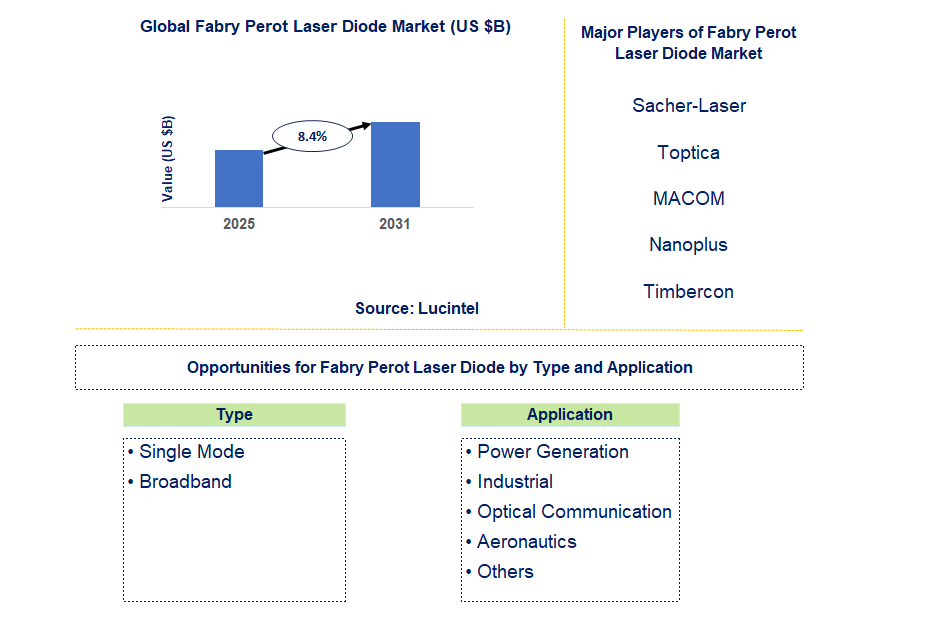
Key data points: The growth forecast = 8.4% annually for the next 7 years. Scroll below to get more insights. This market report covers trends, opportunities and forecasts in fabry perot laser diode market to 2031 by type (single mode and broadband), application (power generation, industrial, optical communication, aeronautics, and others), and region (North America, Europe, Asia Pacific, and the Rest of the World)
We'll send your sample report shortly.
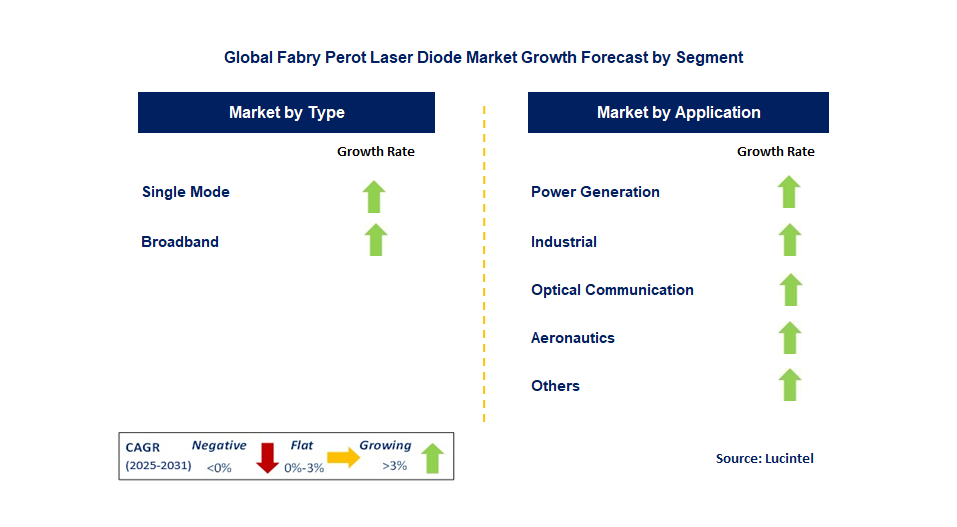
• Lucintel forecasts that, within the type category, single mode is expected to witness higher growth over the forecast period due to widespread industry adoption.
• Within the application category, industrial is expected to witness the highest growth due to its wide application across multiple sectors.
• In terms of region, APAC is expected to witness the highest growth over the forecast period due to being a leading electronics and semiconductor manufacturing hub. Gain valuable insights for your business decisions with our comprehensive 150+ page report. Sample figures with some insights are shown below.
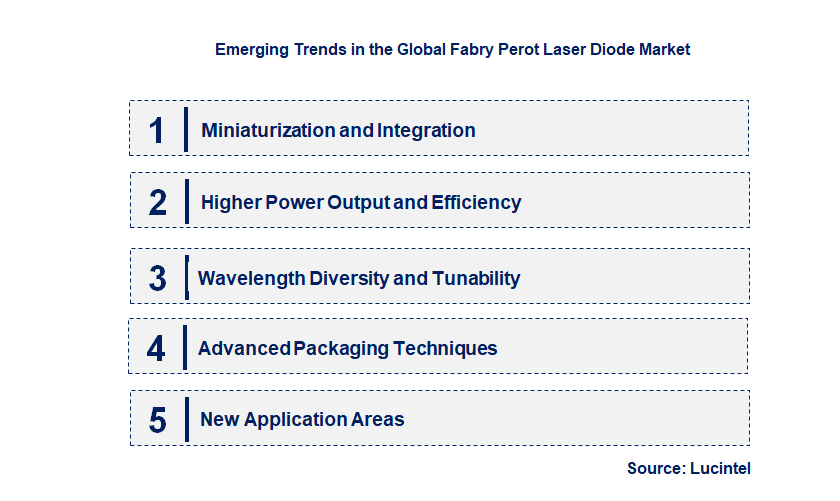
• Miniaturization and Integration: This trend features the creation of smaller, more compact Fabry Perot laser diodes that are easily integratable into diverse systems. The effect is massive across consumer electronics, medical devices, and IoT applications where space and form factors are paramount. By reducing the size of FP-LDs and packaging them along with other photonic devices, companies can produce highly functional, power-efficient modules. This enables the creation of smaller, lighter, and more portable devices, opening up greater potential applications and stimulating widespread use in high-density integration application areas.
• Higher Power Output and Efficiency: This trend deals with increasing the optical power output and energy conversion efficiency of Fabry Perot laser diodes. Increased power allows for more challenging applications like material processing, surgical medicine, and high-speed optical communications over long distances. Efficiency enhancement lowers power consumption and heat generation, which is important to increase device life and minimize operational expenses. This innovation is critical in industrial applications where reliable and strong laser sources are required, as well as in telecommunications, to provide faster and more efficient transmission of data.
• Wavelength Diversity and Tunability: This trend is to broaden the spectrum of wavelengths accessible to Fabry Perot laser diodes and to engineer technologies that enable accurate tuning of their emission wavelength. This is especially significant to applications such as spectroscopy, chemical sensing, and sophisticated medical diagnostics, which need unique wavelengths for maximum performance. Tunable FP-LDs provide more flexibility and accuracy, making new scientific research and industrial process control applications possible where the fine adjustment of light sources is needed to achieve accurate measurements and precise treatments.
• Advanced Packaging Techniques: This trend aims at enhancing the packaging of Fabry Perot laser diodes in order to improve their thermal management, reliability, and integration simplicity. Improved packaging provides reliable operation even in extreme environments and extends the operating life of the devices. It also allows for simpler assembly into high-level systems with lower manufacturing complexity and costs. This tendency is essential for use in automotive (LiDAR), defense, and industrial environments where environmental toughness and long-term stability are essential for reliable operation.
• New Application Areas: This trend identifies the growth of Fabry Perot laser diodes into new application areas outside of conventional telecommunications and industrial applications. This encompasses increasing use in such areas as augmented reality (AR) and virtual reality (VR) hardware, advanced driver-assistance systems (ADAS), and quantum computing. The flexibility and changing capabilities of FP-LDs are making new things possible with these emerging technologies, fueling innovation and opening up completely new market segments for these devices. This diversification sustains ongoing market expansion and exploration of niche FP-LDs. These new trends are transforming the fabry perot laser diode by propelling innovation toward more powerful, smaller, efficient, and versatile devices. The focus on miniaturization and integration is facilitating their applications in portable and high-density electronic systems. Higher power and efficiency are broadening their uses in demanding industrial and telecommunications markets. Wavelength diversity and sophisticated packaging methods are increasing their accuracy and reliability, whereas their introduction in new application spaces such as AR/VR and ADAS is expanding their market size and creating large growth opportunities. Ultimately, these trends are leading the market towards more advanced and responsive laser diode solutions.
• Emerging Trends in Material Science and Fabrication: Recent advancements entail breakthroughs in semiconductor materials like Aluminum Indium Nitride (AlInN) and quantum dot technology, which drastically improve the efficiency of Fabry Perot laser diodes. These material breakthroughs allow for greater conversion efficiency, higher beam quality, and operation at novel wavelengths. Together with this, more advanced nanofabrication methods enable better device structure control, which results in enhanced thermal management and improved reliability. This in turn affects the market by making FP-LDs stronger and more efficient, applicable for a wider variety of challenging applications.
• Integration with Photonic Integrated Circuits (PICs): One important trend is the increasing integration of Fabry Perot laser diodes onto photonic integrated circuits. Such integration enables the manufacturing of high-performance, compact optical modules that integrate several photonic functions on a single chip. The effect is profound in downsizing optical systems, minimizing their cost, and enhancing their overall functionality and reliability. This evolution is essential for future developments in data centers, optical communication networks, and sensors, enabling greater data throughput and more sophisticated functions in less space.
• Evolution towards Greater Power and Wider Wavelengths: Recent research has aimed at breaking the limits of power output and increasing the range of available wavelength for Fabry Perot laser diodes. This innovation is powered by the demand for brighter light sources in industrial cutting, welding, and medical treatments and the need for varied wavelengths for spectroscopy and sensing applications. The capability to deliver higher power at specific or tunable wavelengths brings new opportunities for next-generation industrial processes and specialized diagnostic devices, broadening the market with a broader level of technical specifications.
• Improved Reliability and Lifespan: There have been many advancements in enhancing the long-term reliability and working life of Fabry Perot laser diodes. This is done through enhanced thermal management designs, improved packaging processes, and more reliable material compositions. Elevated reliability lowers maintenance expenses and guarantees performance consistency, which is paramount for mission-critical applications in telecommunications networks, automotive LiDAR, and military systems. This advancement directly addresses industry needs for robust and stable components, thus enhancing market confidence and increasing adoption in challenging environments.
• Cost Savings through Manufacturing Advances: Recent advancements in manufacturing process technology, including enhanced epitaxial growth and automated assembly methods, are resulting in economies of production cost for Fabry Perot laser diodes. This cost economy makes FP-LDs more viable for high-volume applications and new market segments. The capability to make these advanced devices cheaper enables greater adoption in consumer electronics, mass-market sensing applications, and cheaper communication modules. This technology serves directly to facilitate market growth through making advanced laser technology more universally affordable and competitive. These advances are indeed driving the fabry perot laser diode by improving product performance, lowering costs, and increasing application potential. Developments in materials and production result in more effective and consistent diodes. PIC integration makes miniaturization and increased functionality possible. Increased power and wider wavelengths open up new commercial and scientific applications. Enhanced reliability guarantees longer working life, which is essential for critical infrastructure. Last but not least, cost savings make the technologies more affordable, stimulating greater use in other applications. Overall, these advances are creating a more diverse and flexible marketplace for FP-LDs.
• Growth in Optical Communication and Data Centers: One major growth opportunity is in the growing optical communication industry, especially with the deployment of 5G networks and the ongoing growth of data centers. Fabry Perot laser diodes are critical building blocks for high-speed data transmission in fiber optic networks. The growing need for bandwidth, higher rates of data, and effective data processing in cloud infrastructure drives a continuous requirement for high-performance and economically priced FP-LDs. Strategic investments in research and development in this field, such as the creation of higher speed and energy-saving solutions, will command huge returns.
• Expansion in LiDAR and Automotive Applications: The automotive sector, as it relates to the production of autonomous vehicles and advanced driver-assistance systems (ADAS), is an enormous growth prospect for Fabry Perot laser diodes in LiDAR applications. FP-LDs provide the accuracy and bandwidth necessary for precise distance measurement and mapping in such applications. The use of autonomous technology is increasing rapidly, so will demand for heavy-duty, high-reliability, and affordable laser diodes that are purpose-built for automotive environments with challenging temperature and vibration profiles.
• Growing Adoption in Healthcare and Medical Devices: The healthcare and medical industry provides immense growth opportunities, with Fabry Perot laser diodes being used more and more for diagnostics, surgical devices, and therapeutic procedures. Their accuracy, least invasive nature, and capacity to provide discrete wavelengths have made them perfect for laser-based surgery, medical imaging, and photodynamic therapy. With advancing healthcare technology, there would be more need for specialized FP-LDs for use in compact, portable, and highly accurate devices.
• Diversification into Industrial Sensing and Processing: The manufacturing industry opens plenty of doors for Fabry Perot laser diodes in a range of sensing and material processing applications. These include industrial automation, quality inspection, precision cutting, welding, and 3D printing. FP-LDs provide the stability, power, and wavelength flexibility needed in these challenging industrial applications. As industries move towards automation and intelligent manufacturing procedures, the demand for high-performance and reliable laser sources for precise control and efficient operations will further drive market growth.
• Consumer Electronics and Augmented/Virtual Reality Growth Opportunity: The consumer electronics industry, especially the new segments of augmented reality (AR) and virtual reality (VR), presents an exciting growth opportunity. Fabry Perot laser diodes are essential in miniature projection systems, depth sensing, and eye-tracking in AR/VR headsets and other intelligent devices. With the rise of these technologies into the mainstream, the necessity for miniaturized, low-power, and cost-effective FP-LDs will increase. Strategic emphasis on creating diodes that satisfy the particular form factor and performance of consumer-level devices will be essential for market share penetration. These opportunities for growth are significantly influencing the Global Fabry Perot Laser Diode Market by broadening its streams of revenue and spurring technological advancements. The move into optical communication and data centers guarantees consistently high-volume demand. Advancements in LiDAR and medical use propel high-performance and demand for application-specialization diodes. Expansion into industrial sensing and consumer electronics increases the market base and demands miniaturization and low costs. Together, these strategic fronts are driving ongoing research and development, promoting competitive markets, and eventually transforming the market towards more specialized and broader use of FP-LD technology.
• Sacher-Laser
• Toptica
• MACOM
• Nanoplus
• Timbercon
• Single Mode
• Broadband
• Power Generation
• Industrial
• Optical Communication
• Aeronautics
• Others
• North America
• Europe
• Asia Pacific
• The Rest of the World
• United States: The US market for Fabry Perot laser diodes is witnessing strong growth with high investment in telecommunications infrastructure, especially the deployment of 5G and strong R&D in advanced photonics. US companies are working towards creating high-power, high-efficiency FP-LDs for data centers, LiDAR systems for autonomous vehicles, and medical applications. New trends involve new generations of FP-LDs with enhanced conversion efficiency and beam quality to support stringent applications such as fluorescence microscopy and spectroscopy. Integration with other photonic devices is also a trend towards miniaturized, high-function systems.
• China: China dominates the market for Fabry Perot laser diodes, with one characterized by high-speed industrialization and high investment in communication infrastructure. The nation is experiencing a boom in demand fueled by expanding optical communication networks, medical application growth, and mounting industrial automation. Chinese companies are actively researching high-power and high-efficiency FP-LDs, as well as strong miniaturization and integration efforts. The industry also observes the advent of Vertical-Cavity Surface-Emitting Lasers (VCSELs) for facial recognition and proximity sensing applications.
• Germany: Germany's Fabry Perot laser diode market is centered on high-precision and specialized use, with a distinct emphasis on industrial production, scientific research, and medical technology. German industries are renowned for their proficiency in the manufacture of high-quality and dependable laser diodes, typically engineered for demanding industrial processes such as material processing, as well as advanced medical diagnostic and therapeutic technologies. Recent innovations consist of ongoing enhancements in performance and thermal control of high-performance FPs-LDs, and a strong focus on embedding cost-effective diodes in intricate photonic devices.
• India: India's market for Fabry Perot laser diodes is witnessing large-scale growth, driven by the fast development of its digital ecosystem, especially 5G network development, and the growing use of the technology in healthcare and manufacturing segments. Public initiatives and research funding are further stimulating the market. Key trends are a move towards high-power and power-efficient laser diodes for industrial and military markets and increased demand for miniature and integrated modules for consumer and IoT markets.
• Japan: Japan has a leading position in the Fabry Perot laser diode market, with an emphasis on high-performance and high-reliability devices for sophisticated applications in telecommunications, consumer electronics, and industrial markets. Japanese firms are leaders in the research and development of novel laser diode technologies such as quantum well and quantum dot-based FP lasers. Some recent examples are the fabrication of FP-LDs with improved power output and stability for demanding applications such as industrial sensing and high-speed data transmission, commonly encapsulated in industry-standard packages.


• Sacher-Laser
• Toptica
• MACOM
• Nanoplus
• Timbercon Q5. Which fabry perot laser diode market segment will be the largest in future? Answer: Lucintel forecasts that, within the type category, single mode is expected to witness higher growth over the forecast period due to widespread industry adoption. Q6. In fabry perot laser diode market, which region is expected to be the largest in next 5 years? Answer: In terms of region, APAC is expected to witness the highest growth over the forecast period due to being a leading electronics and semiconductor manufacturing hub. Q7. Do we receive customization in this report? Answer: Yes, Lucintel provides 10% customization without any additional cost.


Choose a license that fits your team. Instant PDF delivery.
Prices exclude taxes. Instant delivery. Custom licensing available on request.
Market Report · July 24, 2026
Market Report · July 20, 2026
Market Report · July 20, 2026
Trusted partner for strategic intelligence and business growth


Receive a complimentary market analysis tailored to your industry. Our analysts will identify key growth opportunities and competitive dynamics specific to your business.

Market size, growth rate, and key trend analysis for your specific sector.

Top competitor positioning and market share analysis.

Strategic recommendations backed by data-driven insights.
Get curated market intelligence and competitive moves straight to your inbox.
By subscribing, you agree to receive our monthly insights. Unsubscribe anytime.
Receive a complimentary market analysis tailored to your industry. Our analysts will identify key growth opportunities and competitive dynamics specific to your business.
Market size, growth rate, and key trend analysis for your specific sector.
Top competitor positioning and market share analysis.
Strategic recommendations backed by data-driven insights.
Get curated market intelligence, emerging trends, and competitive moves straight to your inbox each month.
By subscribing, you agree to receive our monthly insights. Unsubscribe anytime.
We'll send your sample report shortly.