
Market Report · July 15, 2026

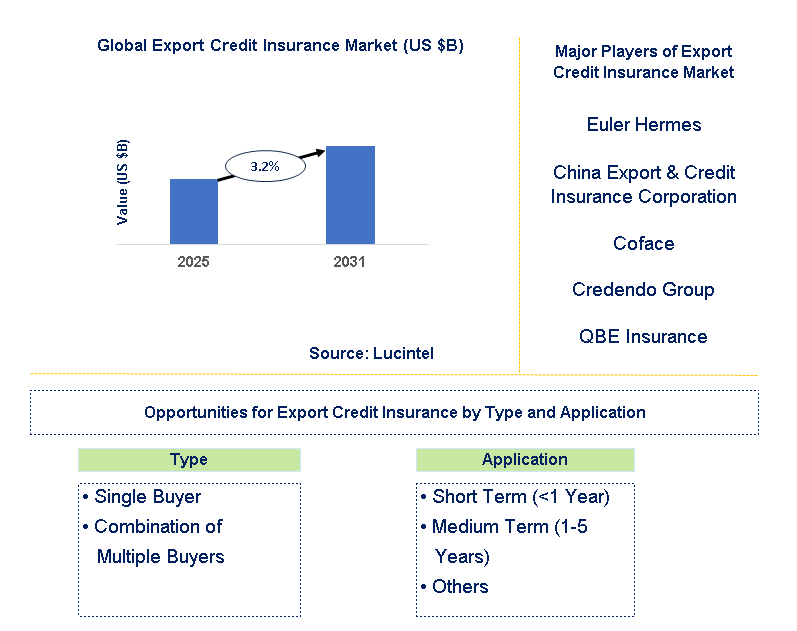
Key data points: The growth forecast = 3.2% annually for the next 7 years. Scroll below to get more insights. This market report covers trends, opportunities and forecasts in export credit insurance market to 2031 by type (single buyer and combination of multiple buyers), application (short term (<1 year), medium term (1-5 years), and others), and region (North America, Europe, Asia Pacific, and the Rest of the World)
We'll send your sample report shortly.
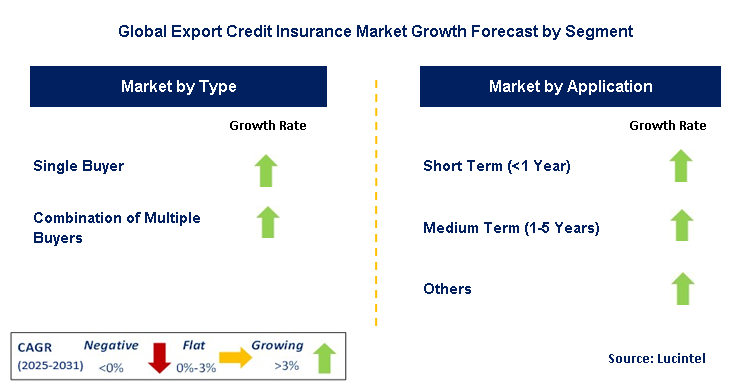
• Lucintel forecasts that, within the type category, single buyer is expected to witness higher growth over the forecast period.
• Within the application category, short term (<1 year) is expected to witness higher growth.
• In terms of region, Europe is expected to witness the highest growth over the forecast period. Gain valuable insights for your business decisions with our comprehensive 150+ page report. Sample figures with some insights are shown below.
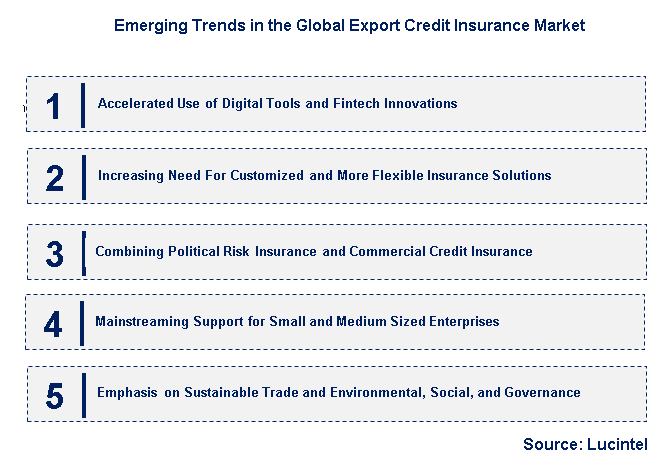
• Accelerated Use of Digital Tools and Fintech Innovations: A greater focus is placed on digital solutions and fintech integration for easier application, underwriting, and policy management of export credit insurances. Unquestionably, this is helping businesses increase efficiency as processing times and administrative workloads are lowered. Exporters, especially SMEs, have better access to aid. Enhanced data analytics and risk assessment allow digital platforms to offer tailored and competitive insurance services.
• Increasing Need For Customized and More Flexible Insurance Solutions: A growing number of exporters have expressed the desire for more flexible and specific insurance products that meet the unique demands of every industry and market. The impact is more classic policies being replaced with customizable ones that address specific risks and provide optimum coverage. This includes coverage for newly emerging forms of trade like ecommerce exports well as more refined assessments of debt and political risk in targeted areas.
• Combining Political Risk Insurance and Commercial Credit Insurance: So as to address rising geopolitical uncertainties, there is a trend towards combining political risk insurance with commercial credit insurance. The effect is more comprehensive risk mitigation for exporters, improving their confidence to venture into more competitive markets by protecting them against buyer insolvency but also against currency inconvertibility, expropriation, and political violence. ‘Comprehensive’ means that exporters can focus more on fulfilling their obligations more and less on being non-compliant with volatile international trade laws.
• Mainstreaming Support for Small and Medium Sized Enterprises : What are SMEs categorized as enterprises with limited resources, small to medium size enterprises (SMEs) are often regarded as the backbone of a nation. Bearing in mind the significance of SMEs as drivers of export growth, there is more emphasis placed on developing export credit insurance products and procedures specific to SMEs. The impact is improved access to insurance for SMEs that in many cases find it more difficult to manage export-related risks than bigger corporations. This involves more responsive and accessible education, application processes, documentation requirements, and structure of premiums.
• Emphasis on Sustainable Trade and Environmental, Social, and Governance Factors: Export credit agencies and private insurers are beginning to incorporate sustainability and ESG elements into their risk evaluation and underwriting methodologies. As a result, there seems to be a change in the availability and pricing of insurance, where exporters and projects more aligned with social and environmental considerations are likely to receive more favorable terms. This development is part of a more responsible global approach to business and an understanding that sustainability affects long-term creditworthiness and political risk. These trends are caused by the drilling down of Customization and Scope of Risks applied to export credit insurance making these services more digital, integrated, accessible to SMEs, comprehensive in risk coverage, and aligned with sustainable trade practices, thus redefining the export credit insurance market. The goal is to empower exporters with the tools and confidence they need to help them sail through the complexities brought about by international trade.
• Expansion of Coverage for Non-Traditional Risks: Recent developments include the broadening of export credit insurance to cover non-traditional risks such as supply chain interruptions, changes in trade policy, and violations of intellectual property rights. The impact is more holistic protection for exporters functioning within intricate global value chains and encountering new forms of trade related risks.
• Greater Adoption of Data Analytics and Artificial Intelligence (AI): There is a growing tendency to utilize data analytics and AI for assessment, streamlining underwriting, and even detecting fraud in export credit insurance. The impact is expedited and precise evaluations of risks, effective policy issuance, and greater protection for insurers and exporters.
• Creation of Digital Platforms for Stakeholder Collaboration: Recent developments concern the design of export finance that allow greater collaboration and information dissemination among exporters, insurers, banks, and even government institutions in relation with export finance. The impact is enhanced collaboration and streamlined service delivery, which addresses the issue of information asymmetry.
• Prioritize Providing Solutions for Emerging and Developing Markets: Due to the opportunities and risks an emerging or developing market possesses, there is more attention directed to crafting specific tailored export credit insurance solutions for these markets. The result is greater support for exporters seeking to penetrate these markets, increasing trade and investment in high-risk economies.
• Development of Specialized Insurance Products for Individual Industries: Specialized sector-based export credit insurance products focusing on industries such as renewable energy, technological innovation, and agriculture are emerging in the market. This enables more accurate and effective risk management for exporters in these sectors that need more attention to sustain growth, leading to increased international competition and innovation. These changes are affecting the export credit insurance market by increasing the insurers’ scope of risk exposure, applying sophisticated technologies and data precision to streamline processes, enhancing cooperation and support among industry players, broadening support for emerging market economies, and customizing support for specific industries.
• Supporting E-Commerce Exports for SMEs: This segment stands out for the development of simple, tailored export credit insurance solutions that are designed for easy access by SME’s partaking in cross border e-commerce. The impact is helping smaller businesses to expand their online sales internationally and overcome payment risks.
• Providing Coverage for Sustainable and Green Exports: There is a growing opportunity to provide export credit insurance for goods, services and projects that are eco-friendly because of the heightened focus on sustainability across the globe. This will provide incentives for sustainable trade practices and aid the advancement of businesses that are supporting a greener global economy.
• Tafari Mapfumo yak Bashara Ketika Sook Jiya: There is ample opportunity in the development of new and agile products like underwriting policies that protect exporters from losses due to changes in political and commercial risks over trade and business relations with emerging and frontier markets. All of these measures can encourage exporters to cover these regions, contributing towards economic development and diversification of trade.
• Providing the Most Comprehensive Coverage Underwrite Policies: Providing tailored export credit insurance for project finance and infrastructure exports in developing countries is an example of a burgeoning market. The premiums collected in these markets will aid the realization and financing of crucial development projects to economic growth and international cooperation.
• Providing along with logistic services to purchase order financing moving with supply chain finance along with export credit insuring form a strategy for capture new markets. Offering integrated cooperation coupled with protecting accounts receivables solutions form pathways towards attaining these goals. The exported goods after their delivery shift therefore aligned shift the risk onto the exporters managing risks as a unit across the replacement parts chain. These e commerce strategic initiatives underscore the importance and specific focus areas for growing opportunities in the export credit insurance market such as: promoting trade sustainability, aiding emerging market participation, infrastructure financing, and providing comprehensive financial services.
• Euler Hermes
• China Export & Credit Insurance Corporation
• Coface
• Credendo Group
• QBE Insurance
• Atradius
• Cesce
• Swiss Export Risk Insurance SERV
• Allianz Trade
• ARI Global
• Single Buyer
• Combination of Multiple Buyers
• Short Term (<1 Year)
• Medium Term (1-5 Years)
• Others
• North America
• Europe
• Asia Pacific
• The Rest of the World
• United States: Exports Credit Insurance in the United States is financed through the Ex-Im Bank of the United States (EXIM) and private insurance companies. Some of the latest changes are EXIM increasing attention for supporting Small and Medium Sized Enterprises (SMEs) and attempts to slow China's export credit dominance. There is also growing concern about digital platforms that ease the application process and management of export credit insurance policies. Specialized export credit insurance per sector and political risk insurance with commercial credit risk are increasingly provided by private insurers.
• China: The export credit insurance market in China is led by a government body called China Export and Credit Insurance Corporation (SINOSURE). Recently, SINOSURE has extended its coverage due to the growing Chinese Belt and Road Initiative to aid Chinese exporters in emerging markets. There is also an increased consideration in developing more flexible and customized insurance covers to new investments and trade which employs novel actions by these exporters. Service digitalization is also rapidly growing.
• Germany: The Germany export credit insurance market is the responsibility of Euler Hermes (now Allianz trade), on behalf of the German government (Bundeskreditgarantien). Recent Developments focus more on exports related to non EU countries and seems to have greater attention towards supporting German SMEs. There is also a focus on creating policies that can protect and foster sustainable trade and investment. Risk evaluation and policy management functions are further enhanced using digital platforms for better efficiency and access enabling the exporter.
• India: The market for export credit insurance is primarily catered to by the Export Credit Guarantee Corporation of India (ECGC) in India. ECGC has been trying to improve its export coverage to include more difficult and new markets. There is also an emphasis on streamlining policies and providing better risk management tools to Indian exporters. Efforts to promote the use of export credit insurance amongst SMEs, as well as the creation of digital service delivery platforms, are currently in progress.
• Japan: The market of export credit insurance for Japan is served by the Nippon Export and Investment Insurance (NEXI), which is a government body. NEXI has also concentrated its attention on Japanese businesses venturing into new and strategic regions, especially in Asia and Africa, for Shinto expansion since those areas are relatively new. There is a growing trend of removing rigid requirements and structures within policies and services offered, increasing customization of the insurance products as well as higher levels of digitization of services for exporters from Japan.


• Euler Hermes
• China Export & Credit Insurance Corporation
• Coface
• Credendo Group
• QBE Insurance
• Atradius
• Cesce
• Swiss Export Risk Insurance SERV
• Allianz Trade
• ARI Global Q5. Which export credit insurance market segment will be the largest in future? Answer: Lucintel forecasts that, within the type category, single buyer is expected to witness higher growth over the forecast period. Q6. In export credit insurance market, which region is expected to be the largest in next 5 years? Answer: In terms of region, Europe is expected to witness the highest growth over the forecast period. Q7. Do we receive customization in this report? Answer: Yes, Lucintel provides 10% customization without any additional cost.


Choose a license that fits your team. Instant PDF delivery.
Prices exclude taxes. Instant delivery. Custom licensing available on request.
Market Report · July 15, 2026
Market Report · June 26, 2026
Market Report · June 24, 2026
Trusted partner for strategic intelligence and business growth


Receive a complimentary market analysis tailored to your industry. Our analysts will identify key growth opportunities and competitive dynamics specific to your business.

Market size, growth rate, and key trend analysis for your specific sector.

Top competitor positioning and market share analysis.

Strategic recommendations backed by data-driven insights.
Get curated market intelligence and competitive moves straight to your inbox.
By subscribing, you agree to receive our monthly insights. Unsubscribe anytime.
Receive a complimentary market analysis tailored to your industry. Our analysts will identify key growth opportunities and competitive dynamics specific to your business.
Market size, growth rate, and key trend analysis for your specific sector.
Top competitor positioning and market share analysis.
Strategic recommendations backed by data-driven insights.
Get curated market intelligence, emerging trends, and competitive moves straight to your inbox each month.
By subscribing, you agree to receive our monthly insights. Unsubscribe anytime.
We'll send your sample report shortly.