
Market Report · July 16, 2026

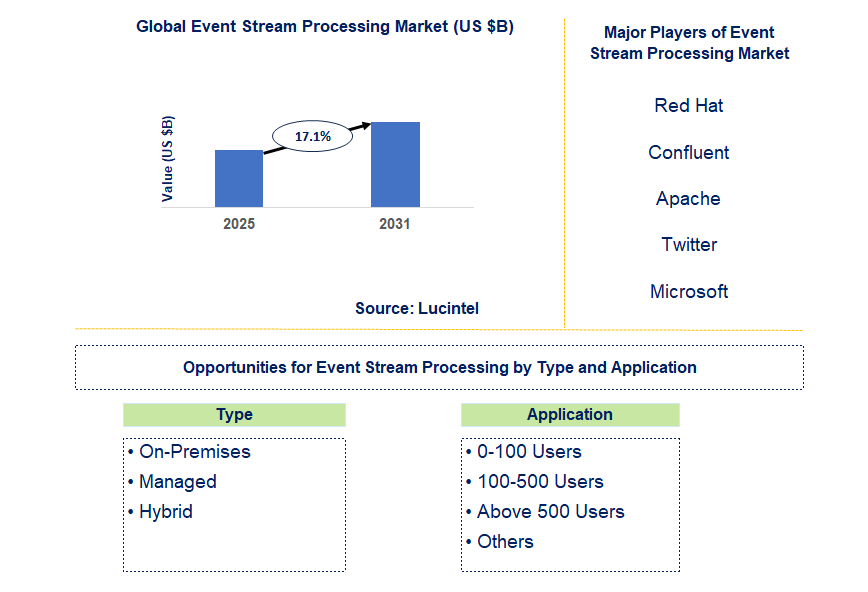
Key data points: The growth forecast = 17.1% annually for the next 7 years. Scroll below to get more insights. This market report covers trends, opportunities and forecasts in event stream processing market to 2031 by type (on-premises, managed, and hybrid), application (0-100 users, 100-500 users, above 500 users, and others), and region (North America, Europe, Asia Pacific, and the Rest of the World)
We'll send your sample report shortly.
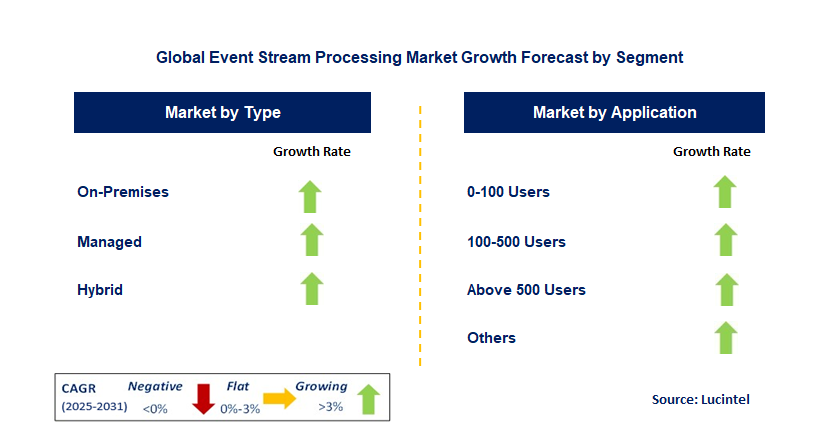
• Lucintel forecasts that, within the type category, hybrid is expected to witness the highest growth over the forecast period.
• Within the application category, 100-500 user is expected to witness the highest growth.
• In terms of region, APAC is expected to witness the highest growth over the forecast period. Gain valuable insights for your business decisions with our comprehensive 150+ page report. Sample figures with some insights are shown below.
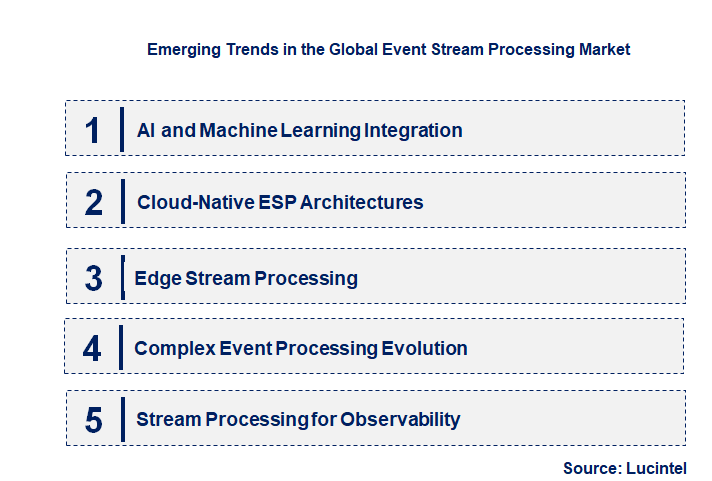
• AI and Machine Learning Integration: The incorporation of AI and ML techniques into ESP platforms allows for intelligent anomaly detection, predictive analytics, and automated decision-making based on real-time event streams, enhancing the value derived from the processed data.
• Cloud-Native ESP Architectures: The adoption of cloud-native architectures for ESP provides scalability, elasticity, and cost-effectiveness, enabling organizations to handle massive and fluctuating data streams without significant upfront infrastructure investment.
• Edge Stream Processing: Processing event streams closer to the data source (at the edge) reduces latency, conserves bandwidth, and enables real-time decision-making for IoT and distributed systems, crucial for time-sensitive applications.
• Complex Event Processing Evolution: CEP is evolving to handle more intricate patterns and temporal relationships within event streams, allowing for the detection of sophisticated insights and the triggering of more nuanced actions.
• Stream Processing for Observability: ESP is increasingly being used for observability in complex IT environments, enabling real-time monitoring of system performance, identification of issues, and faster incident response. These emerging trends—AI/ML integration, cloud-native architectures, edge processing, CEP evolution, and stream processing for observability—are collectively reshaping the event stream processing market by making it more intelligent, scalable, distributed, and integral to real-time analytics and operational intelligence.
• Increased Adoption of Open-Source ESP Frameworks: The growing popularity of open-source ESP platforms like Apache Kafka Streams, Flink, and Spark Streaming is lowering the barrier to entry and fostering innovation within the community.
• Development of Easier-to-Use ESP Tools: Vendors are focusing on creating more user-friendly interfaces and development tools for ESP, making it accessible to a wider range of users beyond specialized developers.
• Integration with Data Lakes and Data Warehouses: ESP systems are increasingly being integrated with data lakes and warehouses, allowing for both real-time analytics and historical data analysis in a unified environment.
• Support for Diverse Data Formats and Sources: Modern ESP platforms are expanding their ability to ingest and process data from a wide variety of sources and in different formats, including structured, semi-structured, and unstructured data.
• Enhanced Scalability and Fault Tolerance Features: ESP solutions are incorporating advanced mechanisms for horizontal scaling and fault tolerance to ensure reliable processing of high-velocity and high-volume event streams. These key developments—the rise of open-source frameworks, easier-to-use tools, integration with data lakes/warehouses, support for diverse data, and enhanced scalability/fault tolerance—are impacting the event stream processing market by making it more accessible, versatile, and robust for real-time data analysis.
• Industrial IoT and Predictive Maintenance: Applying ESP to analyze sensor data from industrial equipment for real-time monitoring, anomaly detection, and predictive maintenance offers significant growth in manufacturing and energy sectors.
• Real-Time Fraud Detection in Finance: Utilizing ESP to analyze financial transactions in real-time for identifying and preventing fraudulent activities presents a crucial growth opportunity in the banking and insurance industries.
• Personalized Customer Experience in Retail and E-commerce: Leveraging ESP to analyze customer interactions in real-time to provide personalized recommendations, offers, and support enhances customer engagement and drives sales.
• Smart City Initiatives: Employing ESP to process data from various city sensors (traffic, environment, utilities) in real-time can enable intelligent urban management and improve citizen services.
• Real-Time Healthcare Monitoring: Using ESP to analyze patient data from wearables and medical devices in real-time allows for continuous monitoring, early detection of health issues, and timely interventions. These strategic growth opportunities across industrial IoT, finance, retail/e-commerce, smart cities, and healthcare highlight the broad applicability of event stream processing and its potential to drive significant value across various sectors by enabling real-time intelligence and action.
• Red Hat
• Confluent
• Apache
• Microsoft
• LGCNS
• Pivotal
• Striim
• StreamSets
• On-Premises
• Managed
• Hybrid
• 0-100 Users
• 100-500 Users
• Above 500 Users
• Others
• North America
• Europe
• Asia Pacific
• The Rest of the World
• United States: The US market is at the forefront of ESP adoption, with strong growth in sectors like finance, e-commerce, and IoT. Recent developments include the increasing use of serverless ESP architectures and the integration of advanced analytics capabilities directly within streaming platforms for real-time insights.
• China: China’s ESP market is rapidly expanding, fueled by massive IoT deployments and the growth of real-time applications in e-commerce and smart cities. Recent developments include the development of high-throughput, low-latency ESP platforms by domestic tech giants and government initiatives promoting digital infrastructure.
• Germany: In Germany, recent developments in ESP focus on its application within Industry 4.0, emphasizing real-time monitoring and control in manufacturing. There’s also a growing interest in ESP for smart mobility and logistics, leveraging real-time data for optimization and predictive maintenance.
• India: India’s ESP market is emerging, driven by increasing digitalization across industries like telecommunications, retail, and finance. Recent developments include the adoption of open-source ESP frameworks and a growing awareness of the value of real-time data analytics for business intelligence.
• Japan: Japan’s ESP market sees steady adoption, particularly in manufacturing for quality control and predictive maintenance, as well as in the financial sector for fraud detection. Recent developments include a focus on highly reliable and low-latency ESP systems and the integration with existing enterprise infrastructure.


• Red Hat
• Confluent
• Apache
• Microsoft
• LGCNS
• Pivotal
• Striim
• StreamSets Q5. Which event stream processing market segment will be the largest in future? Answer: Lucintel forecasts that, within the type category, hybrid is expected to witness the highest growth over the forecast period. Q6. In event stream processing market, which region is expected to be the largest in next 5 years? Answer: In terms of region, APAC is expected to witness the highest growth over the forecast period. Q7. Do we receive customization in this report? Answer: Yes, Lucintel provides 10% customization without any additional cost.


Choose a license that fits your team. Instant PDF delivery.
Prices exclude taxes. Instant delivery. Custom licensing available on request.
Market Report · July 16, 2026
Market Report · May 18, 2026
Market Report · May 18, 2026
Trusted partner for strategic intelligence and business growth


Receive a complimentary market analysis tailored to your industry. Our analysts will identify key growth opportunities and competitive dynamics specific to your business.

Market size, growth rate, and key trend analysis for your specific sector.

Top competitor positioning and market share analysis.

Strategic recommendations backed by data-driven insights.
Get curated market intelligence and competitive moves straight to your inbox.
By subscribing, you agree to receive our monthly insights. Unsubscribe anytime.
Receive a complimentary market analysis tailored to your industry. Our analysts will identify key growth opportunities and competitive dynamics specific to your business.
Market size, growth rate, and key trend analysis for your specific sector.
Top competitor positioning and market share analysis.
Strategic recommendations backed by data-driven insights.
Get curated market intelligence, emerging trends, and competitive moves straight to your inbox each month.
By subscribing, you agree to receive our monthly insights. Unsubscribe anytime.
We'll send your sample report shortly.