
Market Report · July 24, 2026

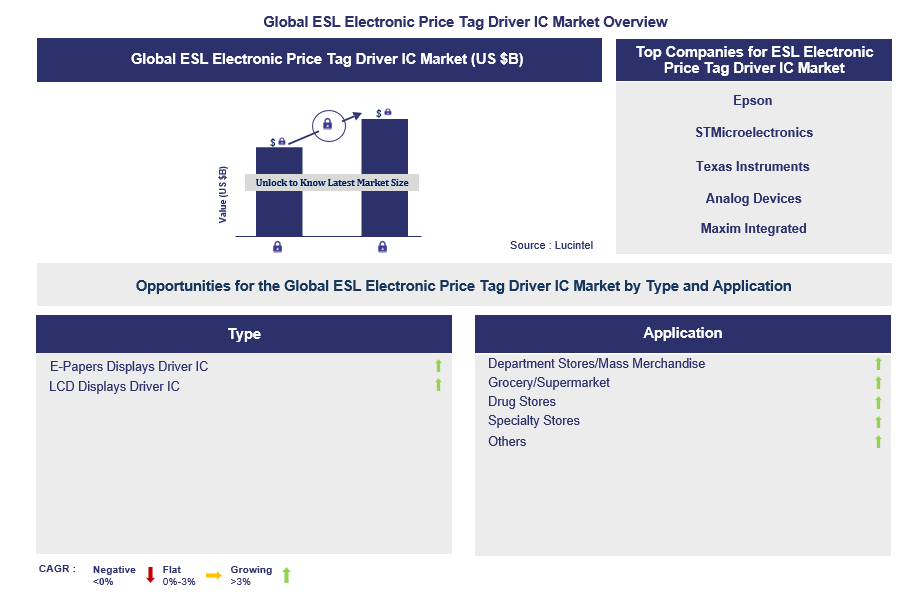
Key data points: The growth forecast = 21.0% annually for the next 7 years. Scroll below to get more insights. This market report covers trends, opportunities, and forecasts in the global esl electronic price tag driver ic market to 2031 by type (E-papers displays driver IC and LCD displays driver IC), application (department stores/mass merchandise, grocery/supermarket, drug stores, specialty stores, and others), and region (North America, Europe, Asia Pacific, and the Rest of the World)
We'll send your sample report shortly.
• Lucintel forecasts that within the type category, E-paper displays driver IC is expected to witness the highest growth over the forecast period due to energy efficiency and display visibility.
• Within the application category, grocery/supermarket will remain the highest segment due to the widespread adoption of ESL for dynamic pricing and inventory management.
• In terms of regions, APAC is expected to witness the highest growth over the forecast period due to rapid retail digitization and widespread adoption of ESLs. Gain valuable insights for your business decisions with our 150+ page report.
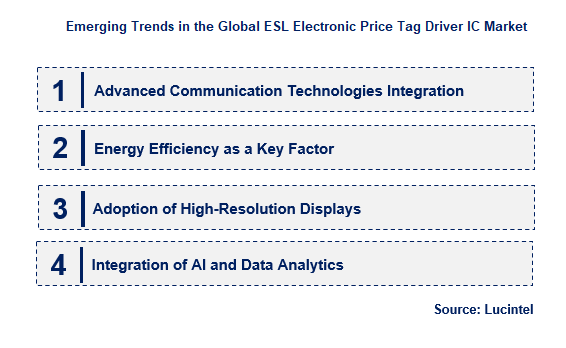
• Advanced Communication Technologies Integration: Advanced communication technologies included in ESL systems, such as BLE and NFC, further develop their functionality. These technologies enable faster updates of price tags that are more reliable, thereby improving operational efficiency and customer engagement within retail environments.
• Energy Efficiency as a Key Factor: Energy efficiency is one of the main trends developing in the manufacture of driver ICs, which minimizes power consumption and extends battery life. This trend is driven by a need to reduce operating costs and improve the sustainability of ESL systems.
• Adoption of High-Resolution Displays: Recently, the demand for ESL systems with high-resolution e-paper displays has risen. This means that price tags need to be clearer, more readable, and more aesthetically pleasing within the retail space.
• Integration of AI and Data Analytics: The integration of AI and data analytics into ESL systems is enabling retailers to gain valuable insights regarding pricing trends and customer behaviors. This trend will help in developing dynamic pricing strategies and personalized customer experiences. The key emerging trends shaping the future of ESL electronic price tag driver ICs are advanced communication technologies, energy efficiency, high-resolution displays, AI integration, and increased security. These latest trends are innovative factors that will further enhance the sophistication and functionality of ESL systems in response to the demands of modern retailing.
• Enhanced Wireless Communication Integration: The integration of advanced wireless communication technologies, such as BLE and NFC, into ESL driver ICs will further enhance price update efficiency and data transfer. This development allows for real-time price updating and improves functional efficiency in ESL systems.
• High-Resolution Display Support: Recent developments include driver ICs for high-resolution e-paper displays, which ensure that the price tags are clearer and more appealing. This will further enhance the aesthetic appeal of ESL systems, ensuring visibility and user readability in keeping with demands for high-quality displays.
• Better Energy Efficiency: Advances in energy-efficient driver ICs are extending battery life and reducing power consumption. This trend meets the demand for sustainable and affordable ESL solutions while ensuring safe operation in multiple retail environments.
• Added Value Features for Enhanced Data Security: Advanced security features are being integrated into ESL driver ICs to protect against data breaches and unauthorized access. In this development, the integrity of price information is ensured, addressing the growing concern over data security.
• Integration of AI and Data Analytics: The inclusion of AI and analytics capabilities into ESL systems now provides retailers with deep insights into pricing trends and consumer behavior, enabling dynamic pricing and a personalized customer experience. The recent developments in the ESL electronic price tag driver IC market include advanced communication technologies, high-resolution displays, energy efficiency, advanced security, and AI integration. These advancements drive innovations in ESL systems and further improve their functionality to address the needs of modern-day retailers while enhancing the effectiveness of the overall ESL solution.
• Emerging Market Expansions: Growth opportunities are available in emerging markets, given that these regions adopt modern retail technologies. ESL solutions tailored to local needs and preferences can be key drivers for market entry and growth in those regions.
• Development of Cost-Effective Solutions: The development of cost-effective ESL driver ICs will also attract small and medium-sized retailers. In their efforts to provide affordable solutions without compromising functionality, new market entrants will be able to expand their reach and further support the growing adoption of ESLs.
• Integration with IoT and Smart Retail Systems: ESL systems can be further empowered and made more attractive by integrating with IoT and smart retail technologies. This includes IoT integration to support advanced features such as real-time inventory management and personalized customer experiences.
• Emphasis on Energy-Efficient Technologies: Investing in energy-efficient driver ICs reduces operating costs and helps achieve sustainability goals. The emphasis on energy efficiency can attract environmentally conscious retailers and create better market competitiveness overall.
• Expanding AI and Data Analytics Capabilities: Developing AI and data analytics capabilities can offer more valuable insights into ESL systems for retailers, in addition to providing a strong impetus for dynamic pricing. This development will improve the efficiency of ESL systems and further create innovation in the market. Strategic growth opportunities exist for ESL electronic price tag driver ICs to capture emerging markets through the development of cost-effective solutions, integration with IoT technologies, a focus on energy efficiency, and expansion of AI capabilities. Capitalizing on these opportunities will boost the market's growth and further enhance product offerings to meet changing retail requirements.
• Technological Advances in Communication: Advanced communication technologies, such as BLE (Bluetooth Low Energy) and Near Field Communication, uplift ESL systems. They enable updates to be performed more efficiently and with fewer errors, greatly improving the overall functionality and flexibility of ESL solutions. With the evolution of communication technologies, ESL systems are increasingly capable of handling real-time data and seamlessly integrating with other retail technologies, which in turn fosters their adoption.
• Growing Demand for Automation in Retail: ESL systems address the increasing demand for automation solutions necessary for retailers to streamline operations and improve efficiency. Advanced driver ICs enhance ESL systems by providing dynamic pricing capabilities, real-time updates, and integration into store management systems. This shift toward automation reduces operational costs for retailers, improves customer experience, and enhances competitiveness, thereby boosting the ESL market.
• Energy Efficiency as a Key Concern: Energy efficiency has emerged as a significant priority in the ESL market. Power-consuming driver ICs are now being designed to be more power-efficient, prolonging battery life and minimizing concerns over operational costs related to environmental impact. Energy-efficient solutions lower the total cost of ownership not only for retailers but also support sustainability goals, thus attracting environmentally conscious consumers and businesses.
• Growth in Smart Retail Solutions: Developing smart retail technologies, including IoT and AI, promise enormous growth opportunities for ESL systems. In smart retail solutions, ESLs enable advanced analytics, automate inventory management, and provide personalized marketing. All of this enhances the functionality and value of ESL systems, prompting wider adoption and extended use in modern retail settings.
• Growing Adoption of High-Resolution Displays: ESL systems employ high-resolution e-paper displays for clearer and more colorful price tags. The need for improved visualization increases customer interaction. Driven by advancements in display technology, ESL systems with high-resolution displays enhance readability and aesthetic appeal, supporting implementation in various retail environments. Challenges in the ESL electronic price tag driver IC market include:
• High Production Costs: The high development costs of technology, advanced materials, and complex manufacturing processes contribute to the elevated production costs of advanced ESL driver ICs. Due to these increased costs, ESL systems may become unaffordable, affecting adoption by small and medium-sized retailers. Controlling production costs without compromising product quality and competitiveness remains a significant challenge for industry players.
• Supply Chain and Logistics Issues: Supply chain interruptions and logistics problems have adversely affected the ESL market, impacting the availability and timely delivery of driver ICs. Other issues that could disrupt production and create ripple effects in market dynamics include component shortages, transportation delays, and inefficiencies within supply chains. A resilient and efficient supply chain is critical for meeting market demand while ensuring operational stability.
• Regulatory Compliance and Standards: The need to adhere to various regulatory standards and multiple industry guidelines poses challenges and incurs expenses. ESL systems must comply with safety, quality, and labeling norms for each region, adding to the operational challenges manufacturers face. Meeting regulatory requirements and ensuring compliance amidst growing cost management pressures without compromising product standards is a primary challenge in the market. In conclusion, the ESL electronic price tag driver IC market is driven by factors such as advances in communication technology, demand for retail automation, energy-efficient solutions, smart retailing innovations, and the need for high-resolution display technologies. However, bottlenecks such as manufacturing costs, supply chain constraints, and adherence to regulations also impact the market. Addressing these drivers and challenges head-on will be critical for ESL stakeholders seeking growth, innovation, and competitiveness.
• Epson
• STMicroelectronics
• Texas Instruments
• Analog Devices
• Maxim Integrated
• Solomon Systech
• UltraChip
• E-Papers Displays Driver IC
• LCD Displays Driver IC
• Department Stores/Mass Merchandise
• Grocery/Supermarket
• Drug Stores
• Specialty Stores
• Others
• North America
• Europe
• Asia Pacific
• The Rest of the World
• US: There are significant developments in the US regarding the integration of ESL electronic price tag driver IC with leading-edge wireless communication technologies such as BLE and NFC, which offer seamless updates and real-time price changes. Furthermore, much emphasis is placed on driver IC developments that offer high-resolution displays and energy-efficient operations to meet smart retail demands. In the U.S. market, ESL systems also find an increased fit in various retail outlets, from grocery stores to specialty shops.
• China: The Chinese ESL electronic price tag driver IC market is experiencing rapid growth, mainly driven by the expansion of the country's retail sector and innovations in technology, including low-cost, high-integration driver IC development, which enables large-scale ESL deployment. There is also a focus on enhancing the robustness of communication protocols to support high volumes of data and updates. Additionally, Chinese manufacturers are focusing on adding AI capabilities to ESL systems to gain better insights into data analytics and customer behavior.
• Germany: Germany continues to develop ESL electronic price tag driver IC technology with accurate and power-efficient features. German companies are developing driver ICs that support high-definition e-paper displays, providing clear, sharp, and rich-priced tags. Robust security features are also under development to guard against data breaches and unauthorized access. Much development is occurring for the integration of ESL systems with store management software, which helps in effective price updates and inventory management.
• India: Affordability and scalability are two of the most important trends in recent ESL electronic price tag driver IC offerings in India. Indian manufacturers offer affordable driver ICs to meet the needs of small and medium retailers. There is increasing attention toward adapting ESL technologies to Indian retail practices and demands. In developing energy-efficient solutions, it is relevant to ensure their usability under fluctuating power supplies and to maintain operability in different physical environments. Interest in ESL systems is growing in the Indian market, where retailers are looking to upgrade and increase operational efficiency.
• Japan: Japan leads the way in integrating advanced technologies into ESL electronic price tag driver IC. The major driving factors here are precision and user experience. Recently, it has adopted advanced display technologies and communication protocols to enhance functional features for ESL systems. Japanese companies, in particular, are also focusing on driver ICs that feature low power consumption and battery longevity to meet the demands of high-density retail. In fact, the growing usage of ESL systems has been observed in the Japanese market for various types of stores selling electronic products and staples, driven by the country's technological advancement and demand for innovative solutions in retail.


• Epson
• STMicroelectronics
• Texas Instruments
• Analog Devices
• Maxim Integrated
• Solomon Systech
• UltraChip Q5. Which ESL electronic price tag driver IC market segment will be the largest in future? Answer: Lucintel forecasts that E-paper displays driver IC is expected to witness highest growth over the forecast period due to energy efficiency and display visibility. Q6. In ESL electronic price tag driver IC market, which region is expected to be the largest in next 5 years? Answer: APAC is expected to witness highest growth over the forecast period due to rapid retail digitization and widespread adoption of ESLs. Q.7 Do we receive customization in this report? Answer: Yes, Lucintel provides 10% customization without any additional cost.


Choose a license that fits your team. Instant PDF delivery.
Prices exclude taxes. Instant delivery. Custom licensing available on request.
Market Report · July 24, 2026
Market Report · July 20, 2026
Market Report · July 20, 2026
Trusted partner for strategic intelligence and business growth


Receive a complimentary market analysis tailored to your industry. Our analysts will identify key growth opportunities and competitive dynamics specific to your business.

Market size, growth rate, and key trend analysis for your specific sector.

Top competitor positioning and market share analysis.

Strategic recommendations backed by data-driven insights.
Get curated market intelligence and competitive moves straight to your inbox.
By subscribing, you agree to receive our monthly insights. Unsubscribe anytime.
Receive a complimentary market analysis tailored to your industry. Our analysts will identify key growth opportunities and competitive dynamics specific to your business.
Market size, growth rate, and key trend analysis for your specific sector.
Top competitor positioning and market share analysis.
Strategic recommendations backed by data-driven insights.
Get curated market intelligence, emerging trends, and competitive moves straight to your inbox each month.
By subscribing, you agree to receive our monthly insights. Unsubscribe anytime.
We'll send your sample report shortly.