
Market Report · July 15, 2026

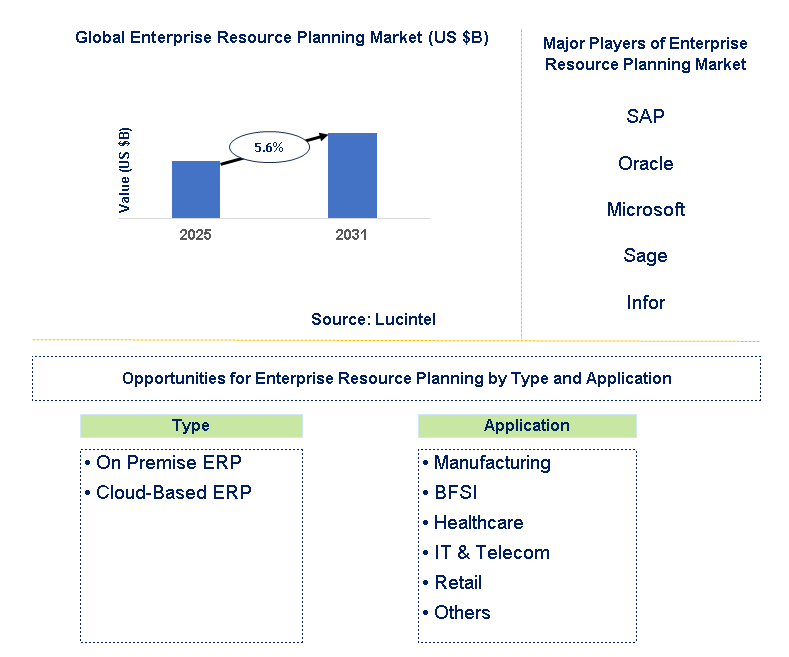
Key data points: The growth forecast = 5.6% annually for the next 7 years. Scroll below to get more insights. This market report covers trends, opportunities and forecasts in enterprise resource planning market to 2031 by type (on premise ERP and cloud-based ERP), application (manufacturing, BFSI, healthcare, IT & telecom, retail, and others), and region (North America, Europe, Asia Pacific, and the Rest of the World)
We'll send your sample report shortly.
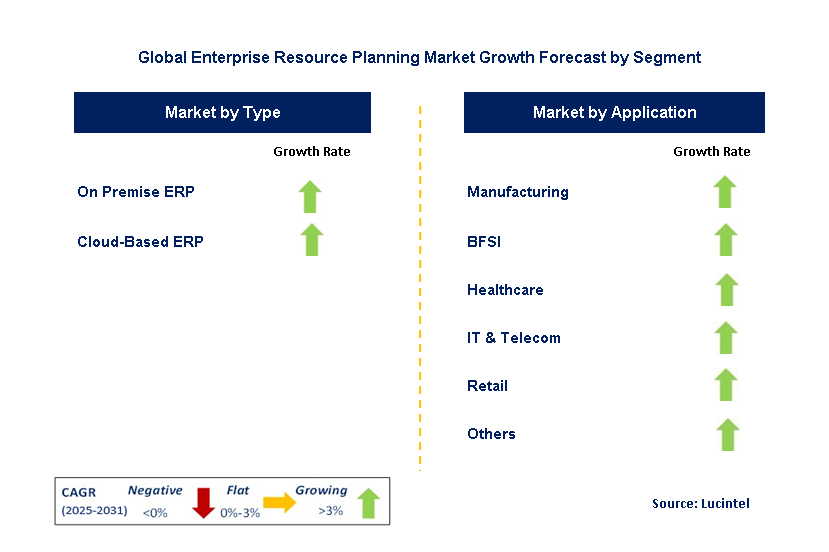
• Lucintel forecasts that, within the type category, cloud-based ERP is expected to witness higher growth over the forecast period.
• Within the application category, manufacturing is expected to witness the highest growth.
• In terms of region, North America is expected to witness the highest growth over the forecast period. Gain valuable insights for your business decisions with our comprehensive 150+ page report. Sample figures with some insights are shown below.
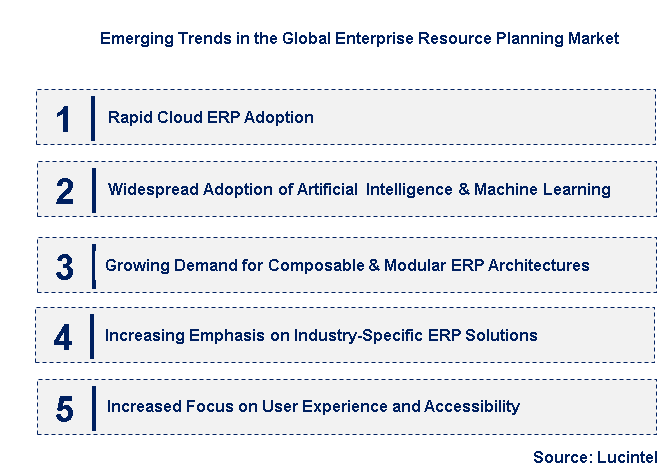
• Rapid Cloud ERP Adoption: Cloud ERP is more scalable, agile, and cost-effective than the on-premise setup, thus fueling its fast adoption in small, medium, and large businesses. Cloud deployments allow convenient access, self-updating, and smoother integration with other cloud applications. For example, SMEs are using cloud ERP to avail enterprise-level features at no major infrastructure investment. This movement is increasing the accessibility and flexibility of ERP for businesses.
• Widespread Adoption of Artificial Intelligence & Machine Learning: AI and ML are increasingly being infused into ERP systems to automate processes, offer predictive analysis, drive decision-making, and enhance overall efficiency. For instance, AI-driven modules can predict demand, optimize inventory, and identify fraudulent transactions. This integration is making ERP shift from a system of record to an intelligent business platform.
• Growing Demand for Composable & Modular ERP Architectures: Organizations are demanding more flexible and responsive ERP systems that can be customized to meet their unique needs. Composable ERP, through its modular and standalone modules, enables organizations to choose and stitch together the functions they need, providing higher flexibility and customization. For example, an organization can opt for best-of-breed modules for finance, HR, and supply chain and integrate them together seamlessly. It gives companies more control and flexibility over their ERP environment.
• Increasing Emphasis on Industry-Specific ERP Solutions: Realizing that various industries have distinct operational needs, there is an increasing need for ERP systems that are tailored to meet the challenges and opportunities of specific industries, including manufacturing, retail, healthcare, and finance. Industry-specific solutions tend to have pre-configured functionalities and best practices specific to the industry. This trend makes ERP systems more relevant and effective for specialized businesses.
• Increased Focus on User Experience and Accessibility: Contemporary ERP systems are more and more centered around delivering intuitive, user-friendly interfaces that enhance user adoption and productivity. Accessibility features, including mobile access and personalized dashboards, are becoming increasingly crucial as well. For example, role-based interfaces can present users with only the data and functionalities important to their particular tasks. This trend seeks to make ERP systems simpler to use and more ingrained in day-to-day workflows. These new trends are redefining the enterprise resource planning market by bringing ERP systems within reach, making them smart, flexible, industry-specific, and easy to use. The market is evolving towards a day when ERP becomes a dynamic, versatile platform empowering companies to prosper in the digital world.
• Low-Code/No-Code Platform Emergence for ERP Customization: Low-code and no-code platforms are being coupled with ERP packages, enabling business users to design workflows, develop applications, and define reports without deep-level coding expertise. This enables higher agility and quicker ERP adaptation to targeted business requirements. For instance, a marketing department might develop a tailored campaign monitoring module in the ERP application without much dependence on IT.
• Growing Inclusion of Internet of Things (IoT) Data: The inclusion of IoT device data in ERP systems is providing real-time visibility and automation for different business processes, most notably in manufacturing and supply chain management. As an example, production line sensor data may invoke automated maintenance routines or change inventory levels in the ERP system. This inclusion raises operating efficiency and offers rich insights.
• Increasing Significance of Sustainability Functionality: With rising environmental concerns and regulations, ERP vendors are adding sustainability functionality to their solutions. These capabilities enable companies to monitor their ecological footprint, use resources effectively, and meet requirements for sustainability reporting. For instance, an ERP system may monitor carbon emissions linked to various manufacturing processes.
• Greater Emphasis on Mobile ERP Capabilities: Access to ERP functions via mobile devices is becoming ever more important for allowing employees to accomplish tasks, view information, and make decisions while on the move. New ERP systems are providing stronger mobile applications with an array of capabilities, ranging from sales order entry to inventory control. This improves workforce productivity and mobility.
• Blockchain Technology Applications Development: Blockchain technology is being investigated for its ability to increase security, transparency, and traceability in ERP systems, most notably in supply chain management and financial transactions. Blockchain may, for example, create an unalterable history of product origin or facilitate more efficient cross-border payments. Although at a nascent stage, this development has great potential for the future of ERP. These advancements are making a considerable difference in the enterprise resource planning market by making ERP solutions more flexible, intelligent, sustainable, accessible, and secure. The market is transforming to give companies more robust and versatile tools to address the intricacies of the new business environment.
• Micro and Small Business ERP Solutions: The MSB market tends to have more diverse needs and budget limitations than larger businesses. Creating cost-effective, user-friendly, and scalable ERP solutions specifically tailored for MSBs is an interesting growth proposition. Solutions would concentrate on essentials and streamlined processes adapted to smaller enterprises.
• Niche ERP Systems for the Non-Profit Industry: Non-profit organizations have distinct requirements when it comes to fund accounting, grant tracking, donor management, and program management. Providing ERP systems specifically designed to meet these particular needs is an increasingly attractive opportunity, since numerous non-profits are looking for improved tools to run their operations and show impact.
• Industry-Specific Cloud ERP Solutions with Pre-Configured Best Practices: Creating cloud ERP solutions pre-configured with industry best practices and workflows can significantly lower implementation times and minimize customization activities for companies operating in industry-specific sectors such as manufacturing, retail, and healthcare. Industry relevance increases the value proposition and brings businesses looking for quick deployment and established processes.
• Combining Advanced Analytics and Business Intelligence Capabilities: Incorporating advanced analytics and business intelligence functions natively within ERP systems equips users with real-time insights and enables data-driven decision making across business functions. Providing end-to-end analytics tools as part of the ERP suite is a major growth opportunity.
• Enterprise ERP Implementation and Consulting Services: Effective implementation and adoption of an ERP system is crucial for leveraging its benefits. Offering comprehensive consulting services that span project planning, customization, data migration, user training, and change management presents a major growth opportunity, as most companies need expert help to drive successful ERP implementations and gain user acceptance. These strategic growth areas are influencing the enterprise resource planning market by taking its reach to underserved markets such as MSBs and non-profits, increasing industry applicability through customized solutions, offering more value through integrated analytics, and fulfilling the key need for expert implementation and change management support. These domains have tremendous scope for market expansion and differentiation.
• SAP
• Oracle
• Microsoft
• Sage
• Infor
• Workday
• Epicor
• Totvs
• Dassault Systemes
• YonYou
• On Premise ERP
• Cloud-Based ERP
• Manufacturing
• BFSI
• Healthcare
• IT & Telecom
• Retail
• Others
• North America
• Europe
• Asia Pacific
• The Rest of the World
• United States: The US ERP market is also seeing quick uptick in the adoption of cloud-based ERP solutions among small and medium businesses (SMEs). There is increasing focus on embedding AI and ML functionalities in ERP systems for predictive analysis, automation of mundane tasks, and better business insights. Industry-focused ERP solutions, designed for industries such as manufacturing, healthcare, and retail, are also proving increasingly popular. In addition, data security and regulatory compliance continue to be top concerns for ERP deployments.
• China: The Chinese ERP market is marked by an emerging need for local solutions to meet the unique requirements of Chinese companies, such as local regulation and business practices support. Adoption is rising in real-time cloud ERP, though traditional on-premise solutions remain prevalent. There is intense emphasis on integrating ERP with other enterprise technologies, including e-commerce platforms and supply chain management systems. Government policies encouraging digitalization are also fueling ERP adoption.
• Germany: The German ERP market, with its strong manufacturing base, focuses on robust and highly customizable ERP systems. Although on-premise solutions have been the traditional choice, cloud ERP adoption is increasingly growing, especially among SMEs. Integration with Industry 4.0 technologies like IoT and industrial automation is a priority area. Data privacy and security, as per European regulations, are essential areas of consideration for ERP implementations.
• India: India's ERP market is also witnessing tremendous growth as more businesses go digital in sectors like finance, manufacturing, and services. Cloud-based ERP solutions are being widely adopted by businesses because they are cost-effective and scalable, particularly among small and medium-sized enterprises. The demand for ERP systems to accommodate intricate tax compliance and complex business processes is increasing. ERP solutions for mobile platforms and alignment with new and upcoming technologies are also prominent trends.
• Japan: The Japanese ERP market has long been dominated by on-premise solutions, but there is a slow movement towards cloud ERP, led by the demand for increased flexibility and cost savings. Integration with current legacy systems is still a major concern. There is also increasing interest in ERP solutions that can accommodate global operations and multilingual support. Data security and reliability are top priorities for Japanese companies.


• SAP
• Oracle
• Microsoft
• Sage
• Infor
• Workday
• Epicor
• Totvs
• Dassault Systemes
• YonYou Q5. Which enterprise resource planning market segment will be the largest in future? Answer: Lucintel forecasts that, within the type category, cloud-based ERP is expected to witness higher growth over the forecast period. Q6. In enterprise resource planning market, which region is expected to be the largest in next 5 years? Answer: In terms of region, North America is expected to witness the highest growth over the forecast period. Q7. Do we receive customization in this report? Answer: Yes, Lucintel provides 10% customization without any additional cost.


Choose a license that fits your team. Instant PDF delivery.
Prices exclude taxes. Instant delivery. Custom licensing available on request.
Market Report · July 15, 2026
Market Report · June 26, 2026
Market Report · June 24, 2026
Trusted partner for strategic intelligence and business growth


Receive a complimentary market analysis tailored to your industry. Our analysts will identify key growth opportunities and competitive dynamics specific to your business.

Market size, growth rate, and key trend analysis for your specific sector.

Top competitor positioning and market share analysis.

Strategic recommendations backed by data-driven insights.
Get curated market intelligence and competitive moves straight to your inbox.
By subscribing, you agree to receive our monthly insights. Unsubscribe anytime.
Receive a complimentary market analysis tailored to your industry. Our analysts will identify key growth opportunities and competitive dynamics specific to your business.
Market size, growth rate, and key trend analysis for your specific sector.
Top competitor positioning and market share analysis.
Strategic recommendations backed by data-driven insights.
Get curated market intelligence, emerging trends, and competitive moves straight to your inbox each month.
By subscribing, you agree to receive our monthly insights. Unsubscribe anytime.
We'll send your sample report shortly.