
Market Report · July 22, 2026

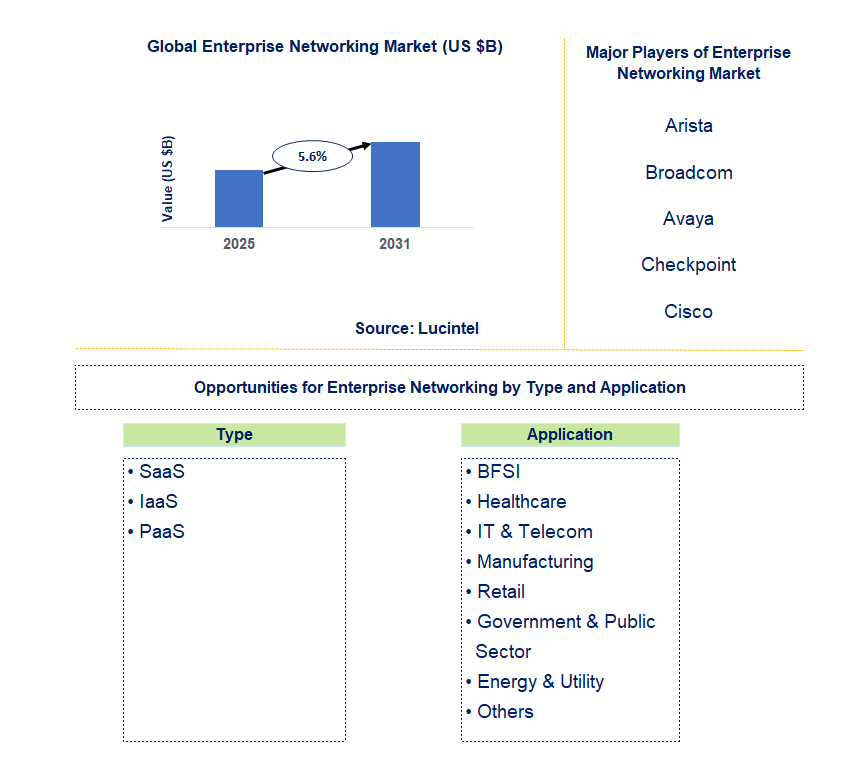
Key data points: The growth forecast = 5.6% annually for the next 7 years. Scroll below to get more insights. This market report covers trends, opportunities and forecasts in enterprise networking market to 2031 by type (SaaS, IaaS, and PaaS), application (BFSI, healthcare, IT & telecom, manufacturing, retail, government & public sector, energy & utility, and others), and region (North America, Europe, Asia Pacific, and the Rest of the World)
We'll send your sample report shortly.
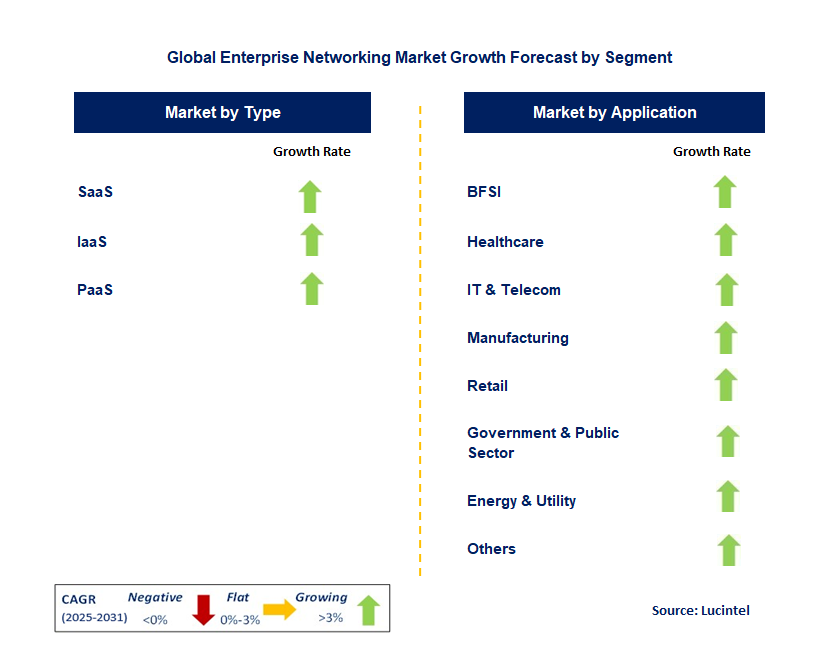
• Lucintel forecasts that, within the type category, IaaS is expected to witness the highest growth over the forecast period.
• Within the application category, it & telecom is expected to witness the highest growth.
• In terms of region, APAC is expected to witness the highest growth over the forecast period. Gain valuable insights for your business decisions with our comprehensive 150+ page report. Sample figures with some insights are shown below.
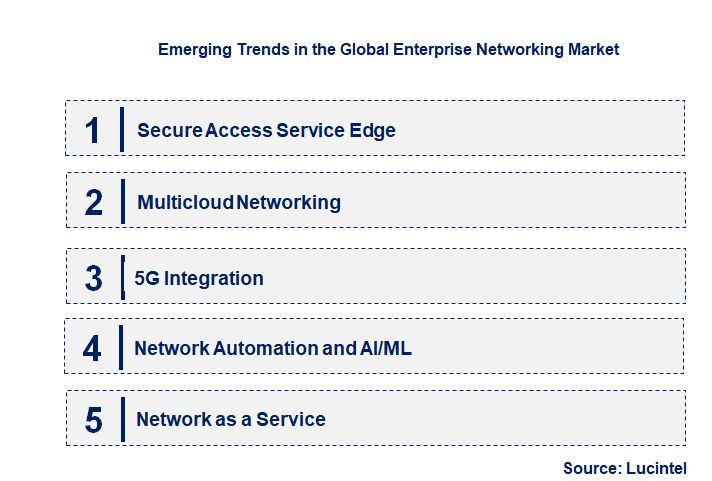
• Secure Access Service Edge: SASE unifies networking and security functions into a single, cloud-delivered service, enabling secure and efficient access for users regardless of their location. This integrated approach simplifies network management, enhances threat protection, and provides consistent policy enforcement across distributed environments, crucial for hybrid work.
• Multicloud Networking: As organizations leverage multiple public and private cloud environments, multicloud networking focuses on seamless connectivity and consistent management across these diverse infrastructures. It addresses challenges like complexity, visibility, and security, allowing enterprises to optimize application performance and data flow across different cloud providers.
• 5G Integration: The rollout of 5G networks is revolutionizing enterprise connectivity by offering higher bandwidth, ultra-low latency, and increased capacity. 5G enables new use cases like autonomous vehicles, industrial IoT, and real-time edge computing, driving the need for enterprise networks that can seamlessly integrate and leverage these advanced capabilities.
• Network Automation and AI/ML: Automation, powered by Artificial Intelligence and Machine Learning, is becoming critical for managing increasingly complex networks. AI/ML enables predictive maintenance, anomaly detection, automated provisioning, and dynamic resource allocation, significantly improving network efficiency, reducing manual errors, and enhancing overall operational agility.
• Network as a Service: NaaS offers networking capabilities on a subscription basis, shifting from CapEx to OpEx models. This provides enterprises with greater flexibility, scalability, and reduced management overhead. NaaS simplifies network deployment and operations, allowing businesses to consume network resources on demand and adapt quickly to changing business requirements. These trends are profoundly reshaping the enterprise networking market by shifting it towards more agile, secure, and cloud-centric models. They enable businesses to support evolving work styles, manage escalating data volumes, and mitigate sophisticated cyber threats, ultimately fostering greater operational efficiency, innovation, and digital resilience.
• Hybrid Cloud and Multi-cloud Adoption: Enterprises are increasingly adopting hybrid and multi-cloud strategies, demanding networks that seamlessly connect on-premises infrastructure with various public cloud services. This requires advanced routing, segmentation, and security solutions that can span diverse environments while maintaining performance and consistent policy enforcement.
• Rise of Secure Access Service Edge: SASE converges networking functions (like SD-WAN) with security services (like ZTNA, CASB, FWaaS) into a single, cloud-delivered platform. This simplifies management, enhances security for remote and mobile users, and improves overall network agility by providing consistent policies from edge to cloud.
• Expansion of Wi-Fi 6/6E and Wi-Fi 7: The proliferation of wireless devices and high-bandwidth applications is driving the rapid adoption of Wi-Fi 6/6E, offering increased capacity, speed, and efficiency. The emerging Wi-Fi 7 promises even greater performance, catering to ultra-high-density environments and advanced applications requiring extremely low latency.
• Increased Focus on Network Automation: Automation, often leveraging AI and Machine Learning, is becoming essential for managing complex enterprise networks. This includes automated provisioning, configuration, monitoring, and troubleshooting, which reduces operational costs, minimizes human error, and accelerates network deployment and issue resolution.
• Enhanced Cybersecurity Integration: With escalating cyber threats, cybersecurity is no longer an add-on but an integral part of network design. This involves implementing zero-trust architectures, advanced threat detection, intrusion prevention systems, and granular access controls directly within the network infrastructure to protect sensitive data and assets. These developments are profoundly impacting the enterprise networking market by pushing it towards more software-defined, cloud-native, and security-centric architectures. They empower organizations to build resilient, agile, and secure networks capable of supporting future digital initiatives, distributed workforces, and the ever-growing demand for connectivity.
• Cloud Connectivity Optimization: With pervasive cloud adoption, optimizing connectivity to IaaS, PaaS, and SaaS applications is a key growth area. This involves solutions like SD-WAN for efficient routing, direct cloud connect services, and network performance monitoring to ensure low latency and high throughput for critical cloud-based workloads.
• IoT and Edge Computing: The proliferation of IoT devices and the rise of edge computing demand robust networking at the network’s periphery. Opportunities lie in providing secure, scalable edge infrastructure, specialized gateways, and low-latency connectivity solutions that can process data closer to its source, enabling real-time analytics and applications.
• Hybrid Work Enablement: Supporting secure and productive hybrid workforces presents significant growth opportunities. This includes solutions like Zero Trust Network Access (ZTNA) for secure remote access, high-performance Wi-Fi 6/6E for office environments, and collaboration-optimized networks that ensure seamless communication and application access for distributed teams.
• AI/ML Workload Support: The increasing adoption of AI and Machine Learning applications, especially in data centers and at the edge, requires high-bandwidth, low-latency, and highly programmable networks. Growth opportunities involve providing networking infrastructure optimized for AI training and inference, including specialized switches and network fabrics.
• Operational Technology Integration: Integrating IT and OT networks, particularly in manufacturing and industrial sectors, offers substantial growth. This focuses on secure, reliable networking solutions that can connect industrial control systems, sensors, and machinery, enabling data exchange, automation, and predictive maintenance while ensuring operational continuity. These application-centric growth opportunities are profoundly impacting the enterprise networking market by driving the development of specialized, high-performance, and secure network solutions. They enable organizations to fully leverage emerging technologies and adapt their infrastructure to meet the unique demands of modern digital applications and business models.
• Arista
• Broadcom
• Avaya
• Checkpoint
• Cisco
• Dell Technologies
• Extreme Networks
• F5 Networks
• FireEye
• Fortinet
• SaaS
• IaaS
• PaaS
• BFSI
• Healthcare
• IT & Telecom
• Manufacturing
• Retail
• Government & Public Sector
• Energy & Utility
• Others
• North America
• Europe
• Asia Pacific
• The Rest of the World
• United States: The U.S. market is propelled by rapid cloud adoption and the widespread shift to hybrid work. Investments in SD-WAN, 5G, and network automation are crucial for scalability and efficiency. Increasing data consumption and IoT integration further necessitate robust network upgrades to meet evolving digital transformation initiatives.
• China: China’s enterprise networking market is experiencing robust growth, driven by extensive digital transformation initiatives and a strong IT sector. The country’s rapid adoption of cloud services and focus on advanced manufacturing fuel demand for high-performance networking solutions. Significant investments in 5G infrastructure also play a vital role.
• Germany: In Germany, the enterprise networking market is characterized by a strong emphasis on Industry 4.0 and digital transformation across traditional manufacturing sectors. There’s a growing need for secure, reliable networks to support automation, IoT, and cloud integration, with a focus on data privacy and sovereign cloud solutions.
• India: India’s market sees substantial growth driven by increasing internet penetration, rapid digitalization across various sectors, and the adoption of cloud-managed networks. The demand for robust Wi-Fi solutions, particularly for hybrid work environments and decentralized teams, is a key driver, alongside a focus on cost-effective, scalable solutions.
• Japan: Japan’s enterprise networking landscape is evolving with a focus on smart cities, advanced industrial automation, and digital government initiatives. Investments in 5G and secure, high-speed networks are paramount to support innovation and data-intensive applications, while addressing an aging infrastructure and cybersecurity concerns.


• Arista
• Broadcom
• Avaya
• Checkpoint
• Cisco
• Dell Technologies
• Extreme Networks
• F5 Networks
• FireEye
• Fortinet Q5. Which enterprise networking market segment will be the largest in future? Answer: Lucintel forecasts that, within the type category, IaaS is expected to witness the highest growth over the forecast period. Q6. In enterprise networking market, which region is expected to be the largest in next 5 years? Answer: In terms of region, APAC is expected to witness the highest growth over the forecast period. Q7. Do we receive customization in this report? Answer: Yes, Lucintel provides 10% customization without any additional cost.


Choose a license that fits your team. Instant PDF delivery.
Prices exclude taxes. Instant delivery. Custom licensing available on request.
Market Report · July 22, 2026
Market Report · July 17, 2026
Market Report · July 17, 2026
Trusted partner for strategic intelligence and business growth


Receive a complimentary market analysis tailored to your industry. Our analysts will identify key growth opportunities and competitive dynamics specific to your business.

Market size, growth rate, and key trend analysis for your specific sector.

Top competitor positioning and market share analysis.

Strategic recommendations backed by data-driven insights.
Get curated market intelligence and competitive moves straight to your inbox.
By subscribing, you agree to receive our monthly insights. Unsubscribe anytime.
Receive a complimentary market analysis tailored to your industry. Our analysts will identify key growth opportunities and competitive dynamics specific to your business.
Market size, growth rate, and key trend analysis for your specific sector.
Top competitor positioning and market share analysis.
Strategic recommendations backed by data-driven insights.
Get curated market intelligence, emerging trends, and competitive moves straight to your inbox each month.
By subscribing, you agree to receive our monthly insights. Unsubscribe anytime.
We'll send your sample report shortly.