
Market Report · July 15, 2026

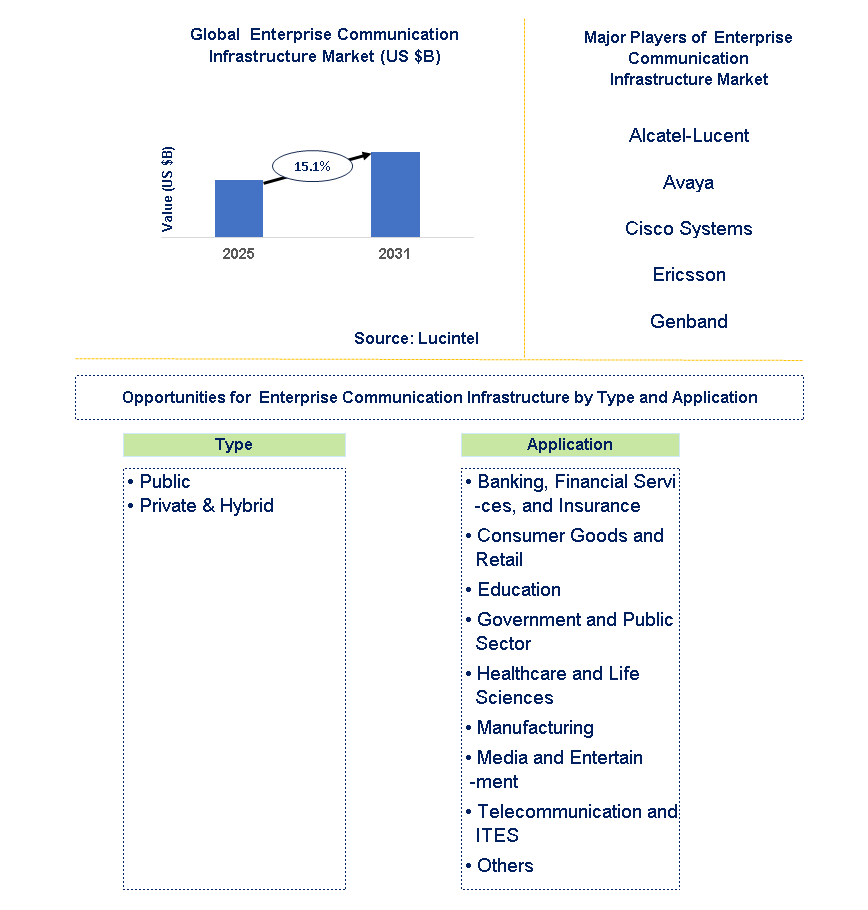
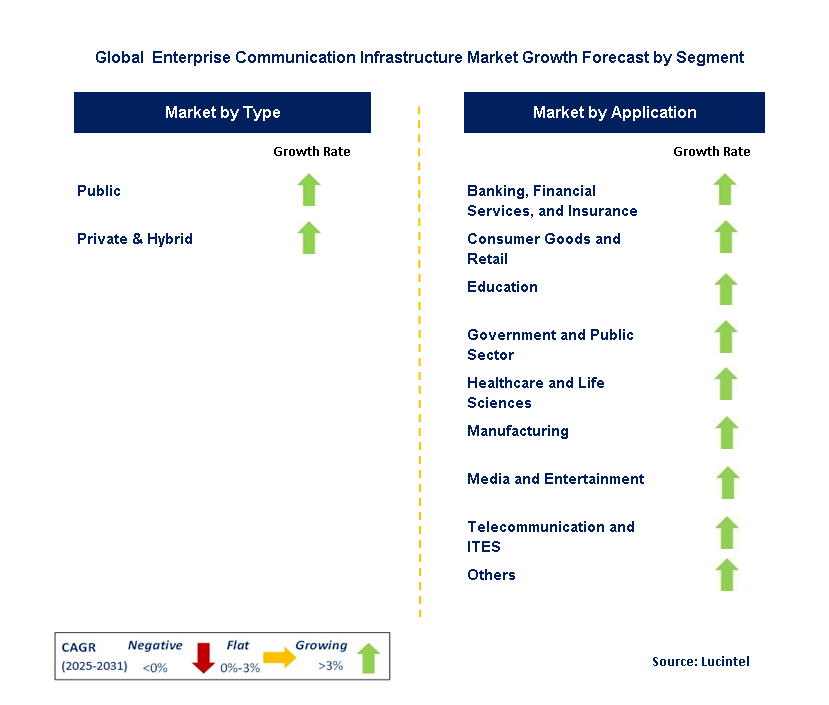
Key data points: The growth forecast = 15.1% annually for the next 7 years. Scroll below to get more insights. This market report covers Trends, opportunity and forecast in enterprise communication infrastructure market to 2031 by type (public and private & hybrid), application (banking, financial services, and insurance, consumer goods and retail, education, government and public sector, healthcare and life sciences, manufacturing, media and entertainment, telecommunication and ites, and others), and region (North America, Europe, Asia Pacific, and the Rest of the World)
We'll send your sample report shortly.
• Cloud Communication Solutions: With the increasing adoption of remote and hybrid work models, cloud-based communication tools are gaining popularity. These solutions offer scalability, flexibility, and cost efficiency, making them attractive for businesses looking to enhance collaboration across different locations. As businesses move away from on-premise communication systems, cloud platforms provide real-time communication, seamless integration with other business tools, and improved data storage and accessibility. This growth in cloud communication solutions is likely to create even more streamlined and efficient communication channels for enterprises.
• AI Integration for Better Communication: Artificial Intelligence is transforming the communication landscape for the enterprise, where automated responses, intelligent routing, and advanced analytics are creating value. AI-based chatbots, voice assistants, and virtual meeting assistants have become the perfect agents for better efficiency in communication and workflow management. In summary, AI helps organizations improve their decision-making process, customer services, and staff collaboration by breaking down communication patterns and data analysis. As this technology continues to advance, its role in enterprises will be further integrated into an enterprise's communications strategy, driving productivity and responsiveness.
• 5G and IOT Connectivity: The rollout of 5G networks and IoT devices is bound to change enterprise communication infrastructure. With faster data transmission speeds, 5G networks will allow real-time communication, improved video conferencing, and remote collaboration with minimal latency. IoT connectivity will further enhance communication by allowing seamless integration between devices, sensors, and communication platforms. These advancements will support the growing need for more connected and agile business operations, offering enterprises new opportunities for innovation and efficiency.
• Cybersecurity and Data Privacy: The growing digitalization of enterprise communication has highlighted the importance of cyber security and data privacy. Organizations are investing in advanced security protocols, such as encryption, multi-factor authentication, and secure communication platforms, to defend sensitive data from possible cyber threats. Greater threats of cyberattacks and data breaches will call for even stricter regulatory requirements, forcing more businesses to develop secure communication solutions. Data protection is now becoming a priority for enterprises in terms of compliance and reputation, which makes cybersecurity an important consideration in communication infrastructure planning.
• Unified Communication and Collaboration Platforms: As businesses look to enhance internal and external communication, the demand for integrated communication and collaboration tools is on the rise. UCaaS platforms are a central solution where voice, video, messaging, and even file sharing offer teams unprecedented ways to collaborate across different devices and locations. It increases productivity, minimizes communication silos, and streamlines business processes. The growth in remote work and digital transformation will determine the way enterprise communication goes forward with the adoption of these unified communication platforms.
Emerging trends are transforming the Enterprise Communication Infrastructure market. Cloud communication, AI integration, 5G and IoT connectivity, cybersecurity, and unified collaboration tools are reshaping how organizations communicate, collaborate, and innovate. Businesses must adapt to these trends to remain competitive and improve operational efficiency. As these technologies evolve, they will continue to drive digital transformation, creating new opportunities and challenges for enterprises worldwide.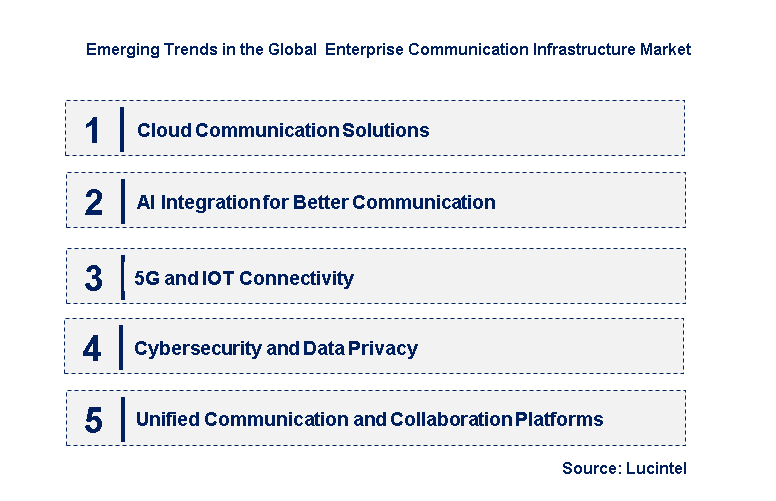
• Cloud-Based Communication Solutions: The most significant trend in the Enterprise Communication Infrastructure market has been a remarkable shift toward cloud-based communication tools. They help centralize communications and provide scalability for size, as well as flexibility to accommodate the remote and hybrid work environment. The connection of cloud platforms with other enterprise tools like CRM systems, productivity software, and security solutions has improved collaboration and streamlined workflows. Cloud communication solutions will be the center of action in the market as businesses continue to become more receptive to digital transformation.
• AI Integration: Many companies are increasingly adopting Artificial Intelligence (AI) in enterprise communication systems to automate routine activities and analyze data while improving the quality of customer interactions. Chatbots, virtual assistants, and intelligent routing powered by AI are enhancing communication efficiency. These tools allow businesses to streamline operations, reduce the manual workload, and improve the overall quality of customer service. AI also offers advanced analytics capabilities that provide valuable insights into the patterns of communications and help better decision-making. AI is anticipated to become a vital part of enterprise communication infrastructures as the technology continues to evolve.
• 5G and IoT-Driven Innovations: The expansion of 5G networks is happening, while IoT technologies are becoming increasingly deployed. This development is driving innovation in the Enterprise Communication Infrastructure market. With the potential to operate faster, with lower latency, and more reliably with connectivity, 5G allows for smooth real-time communication and collaboration. Through IoT devices attached to the communication system, data sharing and monitoring are increased and make operations smoother. Thus, the benefit of 5G-IoT technology is particularly important in industries such as manufacturing, logistics, and health care, where fast, secure communication is crucial. Enterprise communication infrastructure is further enhanced by embedding 5G and IoT.
• Cybersecurity and Data Privacy: In recent times, as organizations have increased their use of sophisticated forms of communication technologies, there has been a growing emphasis on cybersecurity and data protection. As such, the rising incidents of cyberattacks and data breaches have made securing communication channels and protecting sensitive information a top priority. Companies invest in encryption, secure communication platforms, and multi-factor authentication to mitigate risks. The data privacy regulatory environment, such as the General Data Protection Regulation (GDPR) in the European Union, will force businesses to have more secure communication practices. Cybersecurity will be a very significant factor in the development of enterprise communication infrastructure.
• Hybrid and Remote Work Communication Solutions: The new shift toward remote and hybrid work models has led to the development of new communication solutions designed to support flexible working environments. Video conferencing, team messaging platforms, and cloud-based collaboration tools have become essential for maintaining productivity and communication among geographically dispersed teams. With a changing work style that is to be adopted over the long run, the demand for these tools is expected to grow. Therefore, enterprise communication infrastructure needs to adapt to accommodate new work styles by providing remote work environments that are seamless, scalable, and secure.
The present developments point towards the ongoing revolution in the Enterprise Communication Infrastructure market. Cloud, AI, 5G, IoT, and cybersecurity measures drive the market to move forward with hybrid work solutions. All of these are generating new opportunities for businesses to upgrade collaboration, operate more efficiently, and secure communication networks. Enterprise communication will evolve further through the use of all these technologies• Cloud Communication Solutions: The need for remote work and hybrid work models has opened up a significant growth opportunity for cloud communication solutions. Scalable, flexible, and cost-efficient platforms allow businesses to centralize their communication systems and improve collaboration. Integration with other enterprise tools is driving further adoption. Cloud communication will further become a growth driver as digital transformation continues for businesses, unifying communication at an organizational level, enhancing the productivity and efficiency of operations in the organization.
• AI-Powered Communication Tools: AI-driven communication tools are likely to grow much as organizations are looking to automate routine tasks and improve customer interactions. Tools like chatbots, virtual assistants, and intelligent routing systems enhance communication efficiency by giving real-time responses and personalized experiences. AI-powered analytics also offer valuable insights into communication patterns, helping businesses optimize their processes. The growing demand for automation and smarter communication solutions presents a major growth opportunity in the market.
• Cybersecurity Solutions for Communication Systems: As cybersecurity concerns continue to rise, businesses are investing in secure communication solutions to protect sensitive information and comply with data privacy regulations. Growth opportunities exist in developing advanced security protocols, encryption techniques, and secure communication platforms. As enterprises increasingly rely on digital communication tools, ensuring the integrity and confidentiality of communication data becomes critical. The need for a strong cybersecurity solution is one area of great potential for growth in the enterprise communication infrastructure market.
• 5G and IoT Integration: Businesses can use integration with 5G networks and IoT devices as an opportunity for growth in developing communication systems with better connectivity. 5G offers faster data transmission speeds, low latency, and more reliable communication, thereby benefiting industries where real-time communication is necessary. IoT further expands the infrastructure of communication, as it brings devices and sensors together to facilitate data sharing, thereby enhancing better decision-making. 5G and IoT together will drive innovations and open more avenues for companies to upgrade enterprise communication infrastructure.
• Unified Communication Solution: The integration of voice, video, messaging, and collaboration tools in one unified communication platform is in much demand. As businesses strive to simplify their communication and collaborate better across departments, UCaaS solutions are becoming increasingly popular. These platforms enable seamless communication, reduce silos, and enhance team productivity. The growth of remote and hybrid work models further accelerates the adoption of unified communication solutions, providing a major growth opportunity in the enterprise communication infrastructure market.
The enterprise communication infrastructure market is witnessing significant growth opportunities across various applications. Cloud communication solutions, AI-powered tools, cybersecurity innovations, 5G and IoT integration, and unified communication platforms are driving market expansion. By focusing on these areas, businesses can enhance their communication infrastructure, improve collaboration, and stay competitive in an increasingly digital world.• Alcatel-Lucent
• Avaya
• Cisco Systems
• Ericsson
• Genband
• Ibm
• Microsoft
• Nec
• Mitel
• Unify
• Public
• Private & Hybrid
• Banking, Financial Services, And Insurance
• Consumer Goods And Retail
• Education
• Government And Public Sector
• Healthcare And Life Sciences
• Manufacturing
• Media And Entertainment
• Telecommunication And Ites
• Others
• North America
• Europe
• Asia Pacific
• The Rest of the World
• United States: The U.S. has experienced significant growth in its Enterprise Communication Infrastructure market, driven by the need for cloud-based communication systems, remote work solutions, and increased demand for security. The top players are embracing AI-powered tools and collaboration platforms for better internal as well as external communication. Improvements in integrating IoT devices, advanced analytics have also enhanced the decision-making capability and operational efficiency. As organizations continue to undergo digital transformation, U.S.-based companies have been shifting attention to scalable flexible infrastructure solutions for hybrid work models and seamless user experiences.
• China: Enterprise Communication Infrastructure market in China is growing at a fast pace. This is due to the rapidly growing digital economy in the country. More and more Chinese companies are embracing cloud communications, Artificial Intelligence, and 5G technology for improved collaboration and communication efficiency. Government initiatives in smart cities and 5G rollout are further promoting the transition towards integrated communication infrastructures. Chinese firms are paying attention to cybersecurity solutions in order to prevent this increasingly looming threat of cyberattacks. Therefore, China is going to take a lead in enterprise communication innovation.
• Germany: Presently, Germany is witnessing significant developments in its Enterprise Communication Infrastructure market-Industrials and Manufacturing. Secure and reliable communication channels are needed with the explosive increase in IoT devices and automation. German companies are attaining improved efficiency in communication through AI, cloud solutions, and edge computing. Moreover, strong data protection and privacy regulations in Germany ensure that it is looked into prior to anything else when implementing such new technologies of communication. The rate of change toward Industry 4.0 is leading to an accelerated need for advanced communication solutions.
• India: The Enterprise Communication Infrastructure market is growing rapidly in India due to the country's growing digital workforce and the adoption of cloud and mobile communication technologies. Indian companies are implementing hybrid communication solutions to support remote work and improve collaboration across geographically dispersed teams. The government's focus on improving digital infrastructure and connectivity is also fueling the market's growth. More and more enterprises will be digitizing their operations. Hence, seamless communication tools and secure communication networks are expected to increase in demand.
• Japan: The enterprise communication infrastructure market in Japan is characterized by an interest in 5G, IoT, and AI. Automation and remote collaboration tools are significantly invested in by Japanese companies in order to make workplaces more productive and reduce the costs of operation. Japan strongly emphasizes data security and privacy, which also influences the development of enterprise communication solutions. With a growing demand for digital transformation, Japanese businesses are increasingly adopting cloud communication solutions and enterprise resource planning systems to integrate communication across many organizational functions.


• Alcatel-Lucent
• Avaya
• Cisco Systems
• Ericsson
• Genband
• Ibm
• Microsoft
• Nec
• Mitel
• Unify
Q5. Which enterprise communication infrastructure market segment will be the largest in future?

Choose a license that fits your team. Instant PDF delivery.
Prices exclude taxes. Instant delivery. Custom licensing available on request.
Market Report · July 15, 2026
Market Report · June 26, 2026
Market Report · June 24, 2026
Trusted partner for strategic intelligence and business growth


Receive a complimentary market analysis tailored to your industry. Our analysts will identify key growth opportunities and competitive dynamics specific to your business.

Market size, growth rate, and key trend analysis for your specific sector.

Top competitor positioning and market share analysis.

Strategic recommendations backed by data-driven insights.
Get curated market intelligence and competitive moves straight to your inbox.
By subscribing, you agree to receive our monthly insights. Unsubscribe anytime.
Receive a complimentary market analysis tailored to your industry. Our analysts will identify key growth opportunities and competitive dynamics specific to your business.
Market size, growth rate, and key trend analysis for your specific sector.
Top competitor positioning and market share analysis.
Strategic recommendations backed by data-driven insights.
Get curated market intelligence, emerging trends, and competitive moves straight to your inbox each month.
By subscribing, you agree to receive our monthly insights. Unsubscribe anytime.
We'll send your sample report shortly.