
Market Report · July 15, 2026

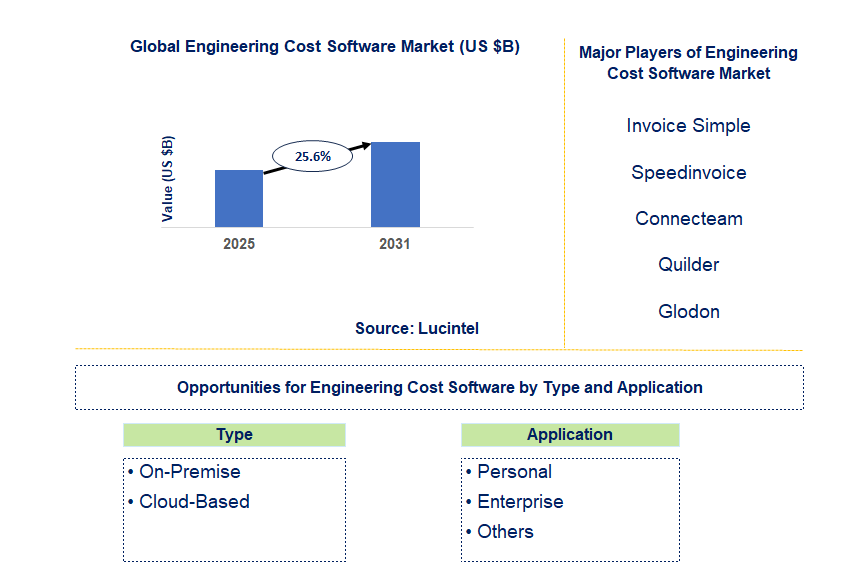
Key data points: The growth forecast = 25.6% annually for the next 7 years. Scroll below to get more insights. This market report covers trends, opportunities and forecasts in engineering cost software market to 2031 by type (on-premise and cloud-based), application (personal, enterprise, and others), and region (North America, Europe, Asia Pacific, and the Rest of the World)
We'll send your sample report shortly.
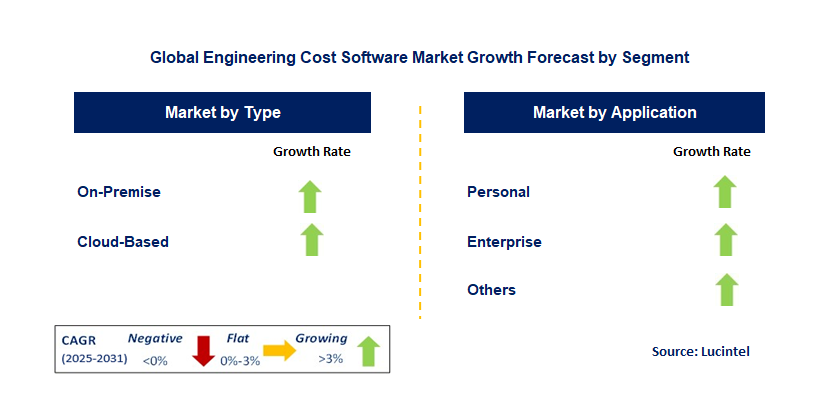
• Lucintel forecasts that, within the type category, cloud-based is expected to witness higher growth over the forecast period.
• Within the application category, enterprise is expected to witness higher growth.
• In terms of region, APAC is expected to witness the highest growth over the forecast period. Gain valuable insights for your business decisions with our comprehensive 150+ page report. Sample figures with some insights are shown below.
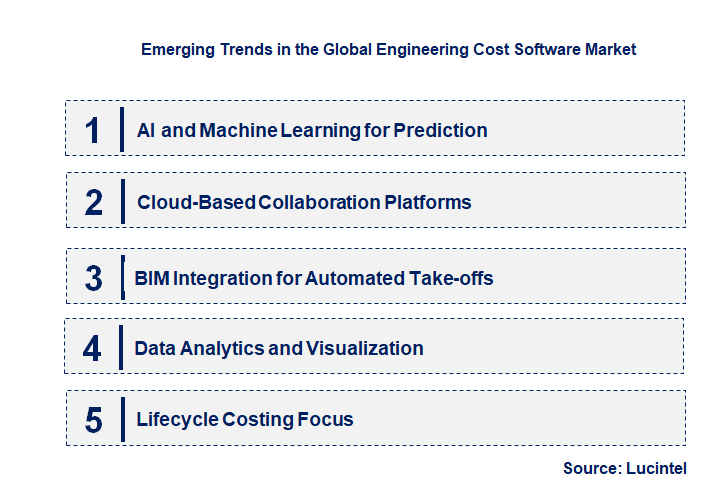
• AI and Machine Learning for Prediction: AI and machine learning are revolutionizing cost estimation by analyzing historical data, market trends, and project variables to provide highly accurate cost predictions. This reduces human error, identifies potential cost overruns early, and optimizes resource allocation for complex engineering projects.
• Cloud-Based Collaboration Platforms: The shift to cloud-based platforms facilitates real-time collaboration among geographically dispersed teams and stakeholders. This enables instant access to cost data, fosters seamless communication, and ensures all project participants work with the most up-to-date information, improving efficiency and decision-making.
• BIM Integration for Automated Take-offs: Deeper integration with Building Information Modeling (BIM) allows for automated quantity take-offs and detailed cost breakdowns directly from 3D models. This significantly enhances accuracy, reduces manual effort, and ensures that cost estimates are consistently aligned with the latest design changes.
• Data Analytics and Visualization: Advanced data analytics and visualization tools are providing deeper insights into project costs. This trend helps identify cost drivers, analyze variances, and present complex financial data in an easily digestible format, enabling better strategic planning and proactive cost control throughout the project lifecycle.
• Lifecycle Costing Focus: There’s a growing emphasis on lifecycle costing within engineering cost software, moving beyond initial capital expenditure to include operational, maintenance, and disposal costs. This provides a holistic view of total cost of ownership, enabling more informed decision-making for long-term project viability and sustainability. These trends are profoundly reshaping the engineering cost software market by making it more intelligent, interconnected, and comprehensive. They are enabling engineers and project managers to make more accurate predictions, optimize resource allocation, and gain a holistic financial perspective, ultimately leading to more successful project outcomes.
• AI and Machine Learning Integration: A key development is the significant integration of AI and machine learning capabilities into cost estimation software. This enables more accurate predictive analytics, automated data analysis from past projects, and identification of cost-saving opportunities, leading to smarter, more data-driven estimations.
• Enhanced Cloud-Based Solutions: The proliferation of cloud-based engineering cost software platforms is a major development. These solutions offer improved accessibility, scalability, and real-time collaboration features, enabling global teams to work concurrently on projects, share data seamlessly, and access tools from anywhere.
• Deeper BIM Connectivity: Recent advancements have focused on achieving deeper and more seamless integration between engineering cost software and Building Information Modeling (BIM) platforms. This allows for automated quantity take-offs directly from BIM models, ensuring greater accuracy and reducing manual errors in cost calculations.
• Focus on Data Analytics and Reporting: There’s a growing emphasis on robust data analytics and customizable reporting functionalities within engineering cost software. This development provides project stakeholders with comprehensive insights into cost performance, identifies variances, and supports informed decision-making throughout the project lifecycle.
• Specialization for Niche Industries: A notable development is the emergence of more specialized engineering cost software solutions tailored for specific industries, such as oil and gas, infrastructure, or renewable energy. These niche solutions cater to unique industry requirements, offering more precise cost models and regulatory compliance features. These developments are collectively impacting the engineering cost software market by fostering greater automation, enhancing predictive capabilities, improving data accuracy, and enabling more informed financial management. They are critical in empowering engineering firms to navigate complex projects with improved cost control and efficiency.
• Infrastructure Project Estimation: There’s a substantial growth opportunity in developing specialized software for large-scale infrastructure projects (e.g., roads, bridges, utilities). These solutions require robust capabilities for complex material quantities, labor costs, and long-term maintenance estimates, meeting the demand for accurate budgeting in public and private sector projects.
• Industrial Plant Costing: The industrial sector, including manufacturing, energy, and chemicals, offers strong growth potential for engineering cost software. Solutions tailored for industrial plants need to account for specialized equipment, complex supply chains, and operational expenses, enabling precise cost control for capital-intensive projects.
• Building & Construction Project Costing: The broad building and construction industry provides a foundational growth opportunity. Software that integrates seamlessly with BIM, offers real-time cost tracking, and manages subcontractor bids efficiently can significantly enhance project profitability and reduce overruns for commercial, residential, and institutional buildings.
• Resource and Labor Cost Management: Developing advanced modules for resource and labor cost management within engineering cost software is a key opportunity. This includes features for tracking labor productivity, optimizing resource allocation, and forecasting labor costs based on project schedules, crucial for managing project budgets effectively.
• Feasibility Studies and Conceptual Estimating: Growth lies in providing sophisticated tools for early-stage feasibility studies and conceptual estimating. These solutions enable engineers to quickly assess project viability, compare alternative designs, and provide rough order of magnitude estimates, crucial for initial project planning and investment decisions. These strategic growth opportunities are impacting the engineering cost software market by driving the development of more specialized, integrated, and intelligent solutions. They are vital for empowering engineering firms to achieve greater financial predictability, optimize project execution, and meet the evolving demands of various industries.
• Invoice Simple
• Speedinvoice
• Connecteam
• Quilder
• Glodon
• UDA Technologies
• Bluebeam
• RedTeam
• Microsoft
• JBKnowledge
• On-Premise
• Cloud-Based
• Personal
• Enterprise
• Others
• North America
• Europe
• Asia Pacific
• The Rest of the World
• United States: The U.S. market is witnessing strong adoption of cloud-based engineering cost software, integrating AI and machine learning for predictive cost analytics. There’s a growing emphasis on real-time data accessibility and collaboration tools to enhance accuracy and efficiency in large-scale infrastructure and construction projects.
• China: China’s engineering cost software market is experiencing rapid growth, fueled by massive infrastructure investments and smart city initiatives. The focus is on developing domestic software solutions that incorporate BIM integration and data analytics for more precise cost control in complex, large-scale engineering endeavors.
• Germany: Germany’s market for engineering cost software is driven by a strong emphasis on precision, efficiency, and compliance. There’s increasing integration of BIM with cost estimation tools and a rising adoption of cloud-based platforms for seamless data exchange and collaboration across project stakeholders, particularly in manufacturing and construction.
• India: India’s engineering cost software market is expanding significantly due to rapid urbanization, industrial growth, and a push for modernizing infrastructure. There’s a growing demand for cost-effective and scalable software solutions that can handle diverse project complexities, with a focus on improving project profitability and reducing overruns.
• Japan: Japan’s engineering cost software market is characterized by a strong drive towards optimizing project costs and schedules, especially in critical infrastructure and manufacturing sectors. Recent developments include the adoption of advanced simulation capabilities and AI for more accurate cost forecasting and risk management in complex engineering designs.


• Invoice Simple
• Speedinvoice
• Connecteam
• Quilder
• Glodon
• UDA Technologies
• Bluebeam
• RedTeam
• Microsoft
• JBKnowledge Q5. Which engineering cost software market segment will be the largest in future? Answer: Lucintel forecasts that, within the type category, cloud-based is expected to witness higher growth over the forecast period. Q6. In engineering cost software market, which region is expected to be the largest in next 5 years? Answer: In terms of region, APAC is expected to witness the highest growth over the forecast period. Q7. Do we receive customization in this report? Answer: Yes, Lucintel provides 10% customization without any additional cost.


Choose a license that fits your team. Instant PDF delivery.
Prices exclude taxes. Instant delivery. Custom licensing available on request.
Market Report · July 15, 2026
Market Report · June 26, 2026
Market Report · June 24, 2026
Trusted partner for strategic intelligence and business growth


Receive a complimentary market analysis tailored to your industry. Our analysts will identify key growth opportunities and competitive dynamics specific to your business.

Market size, growth rate, and key trend analysis for your specific sector.

Top competitor positioning and market share analysis.

Strategic recommendations backed by data-driven insights.
Get curated market intelligence and competitive moves straight to your inbox.
By subscribing, you agree to receive our monthly insights. Unsubscribe anytime.
Receive a complimentary market analysis tailored to your industry. Our analysts will identify key growth opportunities and competitive dynamics specific to your business.
Market size, growth rate, and key trend analysis for your specific sector.
Top competitor positioning and market share analysis.
Strategic recommendations backed by data-driven insights.
Get curated market intelligence, emerging trends, and competitive moves straight to your inbox each month.
By subscribing, you agree to receive our monthly insights. Unsubscribe anytime.
We'll send your sample report shortly.