
Market Report · July 24, 2026

Key data points: The growth forecast = 5.1% annually for the next 7 years. Scroll below to get more insights. This market report covers trends, opportunities, and forecasts in the global embedded storage control chip market to 2031 by type (UFS31, eMMC51, and SPI NAND), application (consumer electronics, industrial control, data communication, smart IOT, and others), and region (North America, Europe, Asia Pacific, and the Rest of the World)
We'll send your sample report shortly.
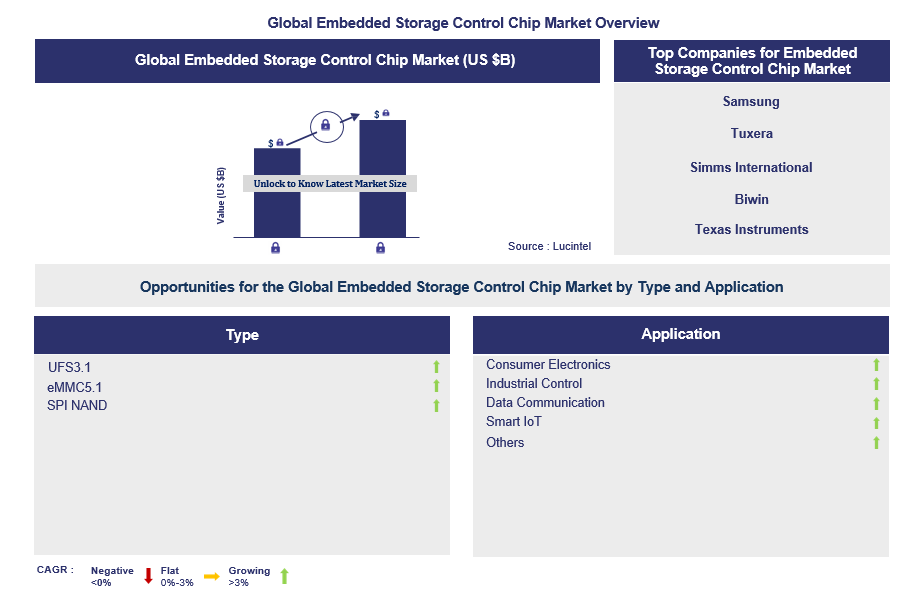
• Lucintel forecasts that within the type category, UFS3.1 is expected to witness the highest growth over the forecast period as it provides higher data transfer speeds.
• Within the application category, smart IOT is expected to witness the highest growth.
• In terms of regions, APAC is expected to witness highest growth over the forecast period due to increasing penetration of smartphones, rapid deployment of 5F technology, and strong manufacturing capabilities of China. Gain valuable insights for your business decisions with our 150+ page report.
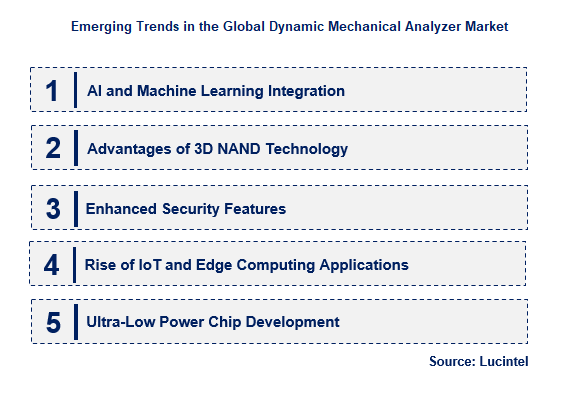
• AI and Machine Learning Integration: While AI and machine learning find a place in embedded storage control chips, there is boundless improvement in data processing capabilities, allowing support for advanced analytics and predictive maintenance, which further enhances the overall efficiencies of systems in applications ranging from data centers to industrial automation.
• Advantages of 3D NAND Technology: Advancements in 3D NAND technology allow for higher storage densities with increased performance provided by embedded storage controller chips. This trend is essential as the demand for mobile devices, consumer electronics, and automotive systems rises with the need for compact, high-capacity storage solutions.
• Enhanced Security Features: Embedded storage controllers are becoming gateways to advanced security features. With data breaches and other forms of cyber threats being growing concerns, manufacturing companies are integrating advanced encryption and authentication techniques to protect sensitive information and ensure data integrity.
• Rise of IoT and Edge Computing Applications: IoT and edge computing raise a high demand for embedded storage control chips that have low power consumption and are highly dependable. The chips are currently being developed for low-power electronics in support of numerous edge devices, in addition to enabling local data processing at the edge for reduced latency and increased efficiency.
• Ultra-Low Power Chip Development: Ultra-low power embedded storage control chip design is highly in demand for increasing battery life and improving energy efficiency in portable devices. This trend is becoming increasingly important in wearable technology and other battery-operated applications, where any form of power conservation is indispensable. AI integration, transition to 3D NAND technology, enhanced security, developments in IoT and edge computing applications, and ultra-low power chip development are all structural elements in the embedded storage control chip market. These latest trends drive innovation to meet the growing demands of several sectors and further increase growth and segmentation in the overall market.
• Adoption of 5G Technology: The adoption of 5G technology in the embedded storage control chip market has influenced the use of high-speed and high-capacity storage solutions. Consequently, chips are designed for 5G networks to enable higher data throughput while reducing latency in performance.
• Automotive Application Expansion: Applications in the automotive sector are growing, with embedded storage controllers finding uses in ADAS and IVI systems. The electronics used in the automotive sector are becoming increasingly complex. The need for data processing has grown and must be appropriately trustworthy.
• Growth in Smart Home Devices: This trend has created rising demand for chips in embedded storage control, driven by recent interest in smart homes. Applications such as smart home-based security systems, voice assistants, home automation, and others require high-performance processing with lower power consumption. Hence, the development of chips supporting various smart home applications is necessary.
• Growing R&D Investments: As more innovative methods are introduced into embedded storage control chips, increased investment in research and development is taking place. Therefore, enterprises are trying to develop next-generation chips by adding advanced features like high storage capacity and fast processing ability to stay ahead in market competition.
• Focus on Customization and Integration: Currently, much attention is given to customizing and integrating embedded storage control chips according to the needs of specific industries. Companies are offering customized solutions for consumer electronics, automotive, and industrial systems to address particular needs and optimize performance. The market is further promoted by the adoption of 5G, expansion of automotive applications, rise of smart home devices, increasing investment in R&D, and a focus on customization. These changes within the market itself demonstrate that the players are responsive to technological advancements and consumer needs.
• Entering Automotive Electronics: Automotive electronics presents a lucrative growth opportunity with an increased deployment of advanced storage solutions in modern vehicles. Embedded storage control chips are crucial for ADAS, IVI systems, and autonomous driving technologies, thus leading to the demand seen in this industry segment.
• Development of Solutions for IoT Devices: Developing solutions for IoT devices is an avenue for growth, since the number of connected devices will continue to rise. In IoT applications, the embedded storage control chip must meet the needs for low power consumption, high reliability, and small form factors.
• Consumer Electronics Growth: The increased demand for smartphones, tablets, and wearables creates more potential areas in which embedded storage control chips can be utilized. Further innovation in these storage solutions to provide higher capacity and better performance will address the growing demands for these applications.
• Emphasis on Data Center Solutions: Data center solutions are a focus, providing an avenue for growth in embedded storage control chips. The storage solutions in a data center must be high-performance to manage large volumes of data and support cloud computing services, thus driving the demand for advanced storage control technologies.
• Advances in Industrial Automation: The advancement of industrial automation opens up prospects for embedded storage control chips applied in machinery and control systems. Chips used in industry need to provide robustness, reliability, and high performance to support complex automation processes. Strategic growth opportunities in the embedded storage control chip market include expansion into automotive electronics, development of solutions for IoT devices, growth in consumer electronics, focus on data center solutions, and advances in industrial automation. These opportunities can drive innovation and growth, with compatibility with emerging trends and changing industrial requirements.
• Technological Advancements: Innovations in semiconductor design and materials, along with infrastructural advancements, are major driving factors in the embedded storage control chip market. Improvements in 3D NAND technology, together with the integration of AI and machine learning capabilities, enhance chip performance, density, and application support. This, in turn, facilitates better efficiency in data processing and management, thereby extending the demand for embedded storage devices within consumer electronics, automotive applications, and data centers.
• Increasing Demand: With the exponential growth in connected devices and applications generating data, there is a rising demand for advanced embedded storage control chips. This trend enhances the need for high-performance and reliable storage solutions due to the proliferation of applications like cloud computing, IoT, and smart devices. The growth of innovation and investment in storage technology, spurred by this demand, pushes the market toward expansion and development.
• IoT and Smart Devices on the Rise: The increase in IoT devices and smart applications creates a robust market for embedded storage control chips. These devices require effective, compact, and low-power solutions to manage the vast volumes of data generated and processed. With the rapid development of smart home appliances, wearables, and industrial IoT, the demand for specialized chips designed for these applications continues to rise.
• Growth in Automotive Electronics: The rapid evolution of the automotive industry, especially in sectors like ADAS (Advanced Driver Assistance Systems) and IVI (In-Vehicle Infotainment), necessitates more powerful storage solutions. Embedded storage controller chips are critical for processing the vast amounts of data generated by sensors and infotainment systems within vehicles. The growth of automotive electronics has significantly accelerated the demand for efficient, high-performance storage chips.
• Rise in Investment in R&D: Investment in research and development encourages innovation in embedded storage control chips. New technologies are being developed, and existing ones are being refined to meet the needs of various industries. R&D efforts have improved chip performance, energy efficiency, and integration capabilities, further enhancing market growth and competition. Challenges in the embedded storage control chip market include:
• Increased Production Costs: The rising cost of raw materials and advanced process equipment for embedded storage control chips results in higher production costs. These increased costs affect profitability and pricing, particularly for manufacturing companies facing intense competition. Efficient methods to reduce production costs while meeting the required quality and performance standards are critical to achieving sustainable market potential.
• Supply Chain Disruptions: Supply chain disruptions—such as semiconductor shortages and logistical challenges—continue to affect the availability and pricing of embedded storage control chips. These conditions can cause delays in production and delivery, impeding market stability and customer satisfaction. Only a resilient supply chain capable of adapting can withstand such challenges.
• Regulatory and Compliance Issues: Regulatory and compliance-related challenges, including data protection laws and environmental regulations, pose obstacles to the embedded storage control chip market. Variations in international standards and regulations complicate market operations; hence, additional resources may be needed to comply with these standards. Navigating such regulatory landscapes is essential for market access and avoiding potential legal disputes. The driving factors for the embedded storage control chip market include advanced technology development, increased data storage demand, IoT and smart devices, the expansion of automotive electronics, and rising investments in research and development. Conversely, high production costs, supply chain disruptions, and government regulations may pose challenges for this sector. By addressing these drivers and challenges, market players can realize growth opportunities and overcome obstacles that could impede such growth, enabling them to remain continuously innovative and competitive in an ever-changing market environment.
• Samsung
• Tuxera
• Simms International
• Biwin
• Texas Instruments
• Maxio
• Yeestor
• UFS3.1
• eMMC5.1
• SPI NAND
• Consumer Electronics
• Industrial Control
• Data Communication
• Smart IoT
• Others
• North America
• Europe
• Asia Pacific
• The Rest of the World
• US: The chip for embedded storage control in the US is a function of developing high-performance computing and data center-related applications. Companies are developing, as part of these applications, chips with better processing capabilities, including increased efficiency in storing information. A great deal of investment is going into research and development to integrate advanced security features into chips that will handle storage control amidst growing concerns about data protection.
• China: There is a strong push for self-reliance in semiconductor technology within the Chinese market. The country is not sparing any resources in developing its very own embedded storage control chips to reduce dependence on foreign technologies. This represents a broader strategy to fortify the domestic tech industry. Chinese companies have also recently focused on high-performance chips designed for mobile devices and smart appliances, reflecting the growing consumer electronics market.
• Germany: Due to the development of automotive electronics and industrial automation, the growth trajectory of the embedded storage control chip market is higher in Germany. Companies in Germany are designing chips embedded with intelligence for processing and managing advanced data in vehicles and industrial machinery. A great deal of importance has been placed on the reliability and efficiency of chips, with German companies constructing chips that meet strict automotive and industrial standards.
• India: Due to the high growth of the electronics and information technology sectors, the Indian market continues to grow significantly. A growing demand for embedded storage control chips is seen in consumer electronics, including smartphones and smart home devices. Indian companies also respond to opportunities by developing low-cost chips to meet the needs of budget-sensitive markets, providing better access and affordability.
• Japan focuses on integrating embedded storage control chips into advanced consumer electronics and robotics. The miniaturization of body size and efficiency in energy consumption characterize the market, wherein Japanese companies lead innovation in chip design for compact and high-performance applications. Moreover, the development of chips that support next-generation technologies such as 5G and IoT is gaining considerable emphasis.


• Samsung
• Tuxera
• Simms International
• Biwin
• Texas Instruments
• Maxio
• Yeestor Q5. Which embedded storage control chip market segment will be the largest in future? Answer: Lucintel forecasts that UFS3.1 is expected to witness the highest growth over the forecast period as it provides higher data transfer speeds. Q6. In embedded storage control chip market, which region is expected to be the largest in next 5 years? Answer: APAC is expected to witness highest growth over the forecast period due to increasing penetration of smartphones, rapid deployment of 5F technology, and strong manufacturing capabilities of China. Q.7 Do we receive customization in this report? Answer: Yes, Lucintel provides 10% customization without any additional cost.


Choose a license that fits your team. Instant PDF delivery.
Prices exclude taxes. Instant delivery. Custom licensing available on request.
Market Report · July 24, 2026
Market Report · July 20, 2026
Market Report · July 20, 2026
Trusted partner for strategic intelligence and business growth


Receive a complimentary market analysis tailored to your industry. Our analysts will identify key growth opportunities and competitive dynamics specific to your business.

Market size, growth rate, and key trend analysis for your specific sector.

Top competitor positioning and market share analysis.

Strategic recommendations backed by data-driven insights.
Get curated market intelligence and competitive moves straight to your inbox.
By subscribing, you agree to receive our monthly insights. Unsubscribe anytime.
Receive a complimentary market analysis tailored to your industry. Our analysts will identify key growth opportunities and competitive dynamics specific to your business.
Market size, growth rate, and key trend analysis for your specific sector.
Top competitor positioning and market share analysis.
Strategic recommendations backed by data-driven insights.
Get curated market intelligence, emerging trends, and competitive moves straight to your inbox each month.
By subscribing, you agree to receive our monthly insights. Unsubscribe anytime.
We'll send your sample report shortly.