
Market Report · July 24, 2026

Key data points: The growth forecast = 8.9% annually for the next 7 years. Scroll below to get more insights. This market report covers trends, opportunities and forecasts in electronic consumer device semiconductor market to 2031 by product type (integrated circuits, discrete semiconductors, optoelectronics, sensors, and others), application (smartphones, laptops, tablets, wearables, home appliances, and others), and region (North America, Europe, Asia Pacific, and the Rest of the World)
We'll send your sample report shortly.
• Lucintel forecasts that, within the product type category, sensor is expected to witness the highest growth over the forecast period.
• Within the application category, wearable is expected to witness the highest growth.
• In terms of region, APAC is expected to witness the highest growth over the forecast period. Gain valuable insights for your business decisions with our comprehensive 150+ page report. Sample figures with some insights are shown below.

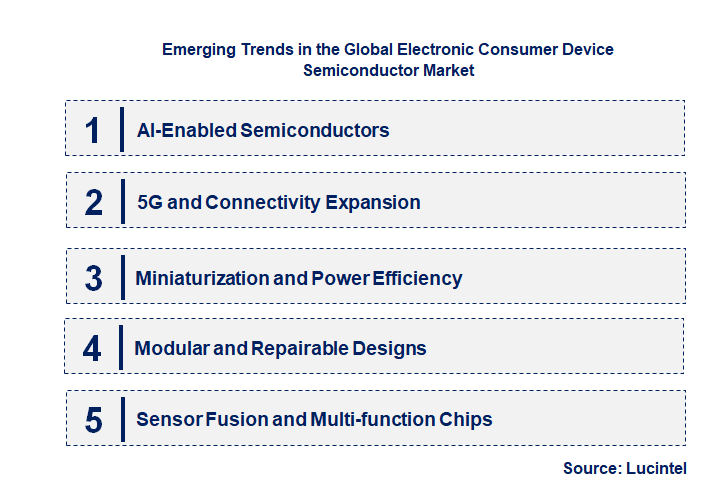
• AI-Enabled Semiconductors: AI integration within chips expands device intelligence, enabling real-time inferencing and personalized user experiences. This enhances performance in wearables, smartphones, and smart home products, pushing demand for custom architectures and neural processing units (NPUs) in consumer devices.
• 5G and Connectivity Expansion: The surge in 5G smartphone adoption fuels demand for advanced SoCs combining multiple functionalities. Lower latency and higher bandwidth drive richer multimedia applications and seamless IoT interoperability across consumer electronics.
• Miniaturization and Power Efficiency: Shrinking chip sizes enable integration in compact devices while reducing power consumption. This trend supports longer battery life and new form factors, essential for wearables and portable consumer electronics.
• Modular and Repairable Designs: Growing right-to-repair legislation encourages the development of modular semiconductors, facilitating easier device upgrading and repair, reducing electronic waste and fostering sustainable consumption patterns.
• Sensor Fusion and Multi-function Chips: Increasing use of sensors and MEMS devices in consumer electronics supports richer input data and expanded device capabilities, such as augmented reality and improved health monitoring, driving rapid growth in this segment. These five key trends converge to enhance functionality, sustainability, and user experience in the consumer device semiconductor market. Embracing AI, connectivity, compactness, repairability, and sensor integration is transforming how semiconductors empower next-generation electronics globally.
• AI Chip Specialization: Custom AI accelerators and NPUs integrated into consumer device chips offer performance boosts tailored to machine learning tasks, enhancing device responsiveness and enabling novel applications in smart electronics.
• 5G SoC Volume Growth: Massive 5G smartphone shipments escalate demand for complex SoCs combining modem, CPU, GPU, and AI engines, encouraging foundry investment in advanced 3nm and 4nm nodes to improve efficiency and capabilities.
• Advanced Miniaturization: Transition to smaller semiconductor nodes, coupled with heterogeneous in-package stacking, allows incorporation of premium features in mid-range devices, optimizing cost and performance across market segments.
• Modular Chiplet Adoption: Modular chip architectures facilitate flexible, upgradeable device designs that support evolving consumer demands and simplify manufacturing, aligning with sustainability and repair policy trends.
• Sensor-Driven Innovation: Growth in MEMS and sensor integration enables rich environmental interaction and health monitoring features in consumer electronics, broadening use cases and fostering new app ecosystems. These advances are accelerating innovation speed, enhancing device capabilities, and fostering broader adoption across price tiers, fundamentally reshaping consumer electronics with smarter, efficient, and versatile semiconductor components.
• Automotive Infotainment Growth: Increasing vehicle electronics complexity demands semiconductors for audio, navigation, connectivity, and safety features, presenting significant opportunities for advanced ICs tailored to automotive consumer electronics.
• Wearables Adoption Increase: Rising health monitoring and fitness trends drive semiconductor demand for low-power, highly integrated chips supporting sensors and wireless communication in wearables.
• IoT Consumer Devices Expansion: Broadening deployment of connected home gadgets stimulates demand for semiconductors enabling edge computing, secure communication, and device interoperability in diverse consumer electronics.
• Smart Home Appliance Integration: Growth in intelligent appliances requires semiconductors for AI-powered control, connectivity, and energy management, creating market opportunities for specialized chip solutions.
• AR/VR Electronics Development: Emerging augmented and virtual reality applications rely on high-performance, sensor-rich semiconductors to deliver immersive user experiences, opening new avenues for semiconductor innovation and revenue. These strategic growth areas leverage semiconductor innovations to meet evolving consumer needs, accelerating market expansion and fostering diversified use cases across electronic consumer devices globally.
• Intel Corporation
• Samsung Electronics
• Qualcomm Incorporated
• Broadcom
• Texas Instruments Incorporated
• Integrated Circuits
• Discrete Semiconductors
• Optoelectronics
• Sensors
• Others
• Smartphones
• Laptops
• Tablets
• Wearables
• Home Appliances
• Others
• North America
• Europe
• Asia Pacific
• The Rest of the World
• United States: The U.S. remains a key innovator, focusing on AI-powered semiconductors and advanced SoCs for smartphones and wearables. Large private-sector investments and strong R&D drive growth in edge AI, enabling smarter home appliances and enhanced connectivity, while support for fabricated chiplet architectures and modular designs boosts device versatility and energy efficiency.
• China: Chinas consumer semiconductor market benefits from government-backed efforts to scale manufacturing capacity and develop indigenous chip technologies. The rapid adoption of 5G smartphones and expansion of IoT devices incentivize innovations in power-efficient ICs and multi-function sensors, with emphasis on cost competitiveness and domestic supply chain resilience amid global market pressures.
• Germany: Germany prioritizes high-quality semiconductor components for automotive infotainment, industrial consumer devices, and smart home systems. Collaboration with EU initiatives and focus on right-to-repair mandates encourage modular chip designs and sustainability. The country advances precision sensor development supporting AR/VR applications and energy-efficient electronics aligned with green technology goals.
• India: Growing consumer electronics demand and government policy support improve India’s semiconductor ecosystem. Emphasis on smartphone affordability, wearable health devices, and localized manufacturing accelerates IC adoption. Investment in manufacturing infrastructure and fabless design companies fosters innovation, targeting emerging middle-class consumer segments with tailored low-power and multi-feature semiconductors.
• Japan: Japan leverages its expertise in precision sensor technology and semiconductor manufacturing for consumer electronics, including robotics and smart appliances. Integration with AI and IoT drives sophisticated chip designs featuring ultra-low power consumption and enhanced durability. Strategic partnerships enhance global supply chains while cultivating innovation in display drivers and image sensors.


• Intel Corporation
• Samsung Electronics
• Qualcomm Incorporated
• Broadcom
• Texas Instruments Incorporated Q5. Which electronic consumer device semiconductor market segment will be the largest in future? Answer: Lucintel forecasts that, within the product type category, sensor is expected to witness the highest growth over the forecast period. Q6. In electronic consumer device semiconductor market, which region is expected to be the largest in next 5 years? Answer: In terms of region, APAC is expected to witness the highest growth over the forecast period. Q7. Do we receive customization in this report? Answer: Yes, Lucintel provides 10% customization without any additional cost.


Choose a license that fits your team. Instant PDF delivery.
Prices exclude taxes. Instant delivery. Custom licensing available on request.
Market Report · July 24, 2026
Market Report · July 20, 2026
Market Report · July 20, 2026
Trusted partner for strategic intelligence and business growth


Receive a complimentary market analysis tailored to your industry. Our analysts will identify key growth opportunities and competitive dynamics specific to your business.

Market size, growth rate, and key trend analysis for your specific sector.

Top competitor positioning and market share analysis.

Strategic recommendations backed by data-driven insights.
Get curated market intelligence and competitive moves straight to your inbox.
By subscribing, you agree to receive our monthly insights. Unsubscribe anytime.
Receive a complimentary market analysis tailored to your industry. Our analysts will identify key growth opportunities and competitive dynamics specific to your business.
Market size, growth rate, and key trend analysis for your specific sector.
Top competitor positioning and market share analysis.
Strategic recommendations backed by data-driven insights.
Get curated market intelligence, emerging trends, and competitive moves straight to your inbox each month.
By subscribing, you agree to receive our monthly insights. Unsubscribe anytime.
We'll send your sample report shortly.