
Market Report · May 18, 2026

This market report covers trends, opportunities, and forecasts in the global electron microscopy and sample preparation market to 2031 by technology (scanning electron microscopy (sem), transmission electron microscopy (tem), cryo-electron microscopy (cryo-em), focused ion beam (fib), and others), end use industry (semiconductor and electronics, life sciences and biology, materials science, automotive, and others), and region (North America, Europe, Asia Pacific, and the Rest of the World)
We'll send your sample report shortly.
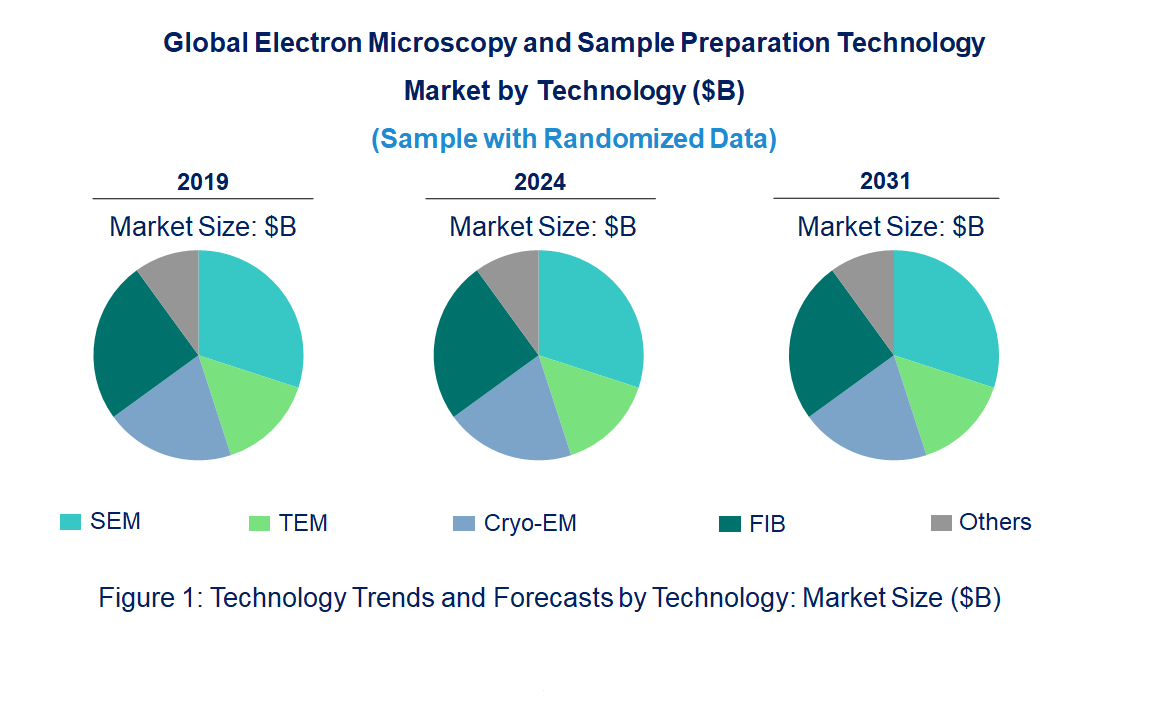
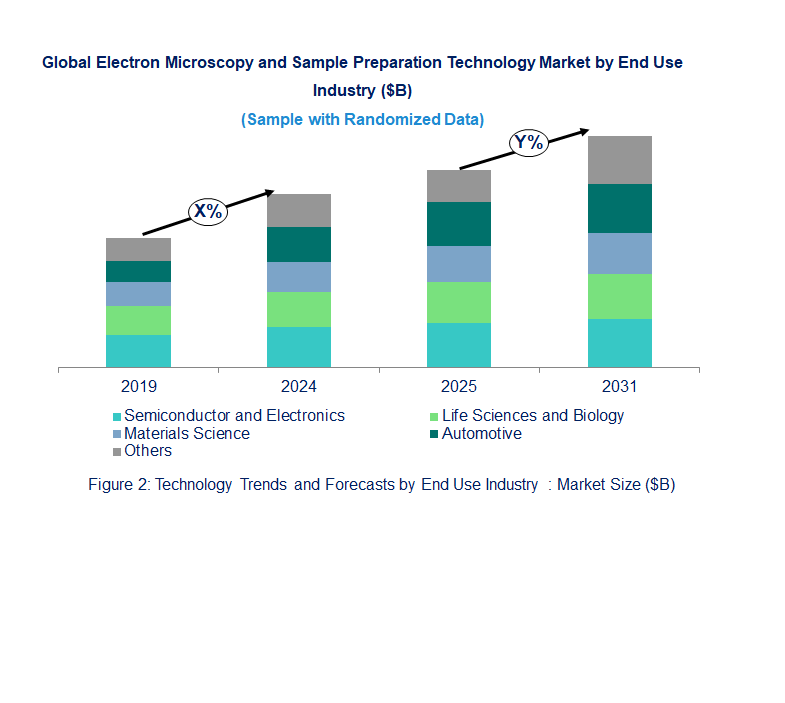
• Integration of SEM and FIB Technologies: Combining SEM with FIB allows for simultaneous imaging and precise sample modification, leading to improved analysis and preparation workflows.
• Advancements in Cryo-EM: Cryo-EM has achieved atomic-level resolution, enabling detailed visualization of biological macromolecules in their native states without the need for staining or fixation. These trends are collectively transforming the electron microscopy and sample preparation market, enabling more detailed, faster, and efficient analyses across various scientific and industrial applications.
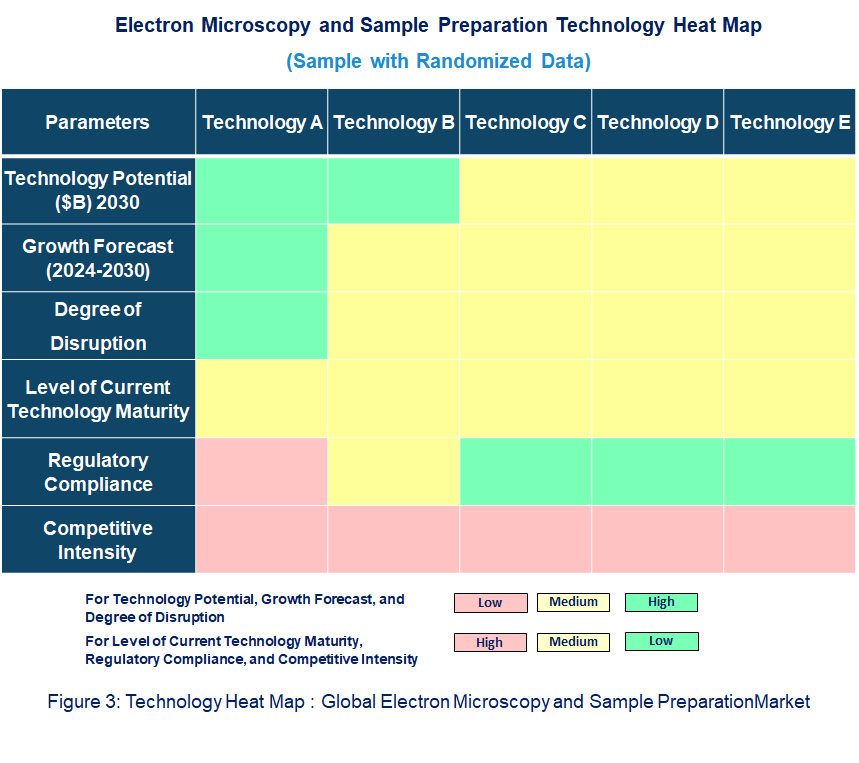
• Technology Potential : Electron microscopy and sample preparation technologies possess immense potential due to their ability to deliver atomic- and nanoscale imaging critical for scientific and industrial applications. Technologies such as scanning electron microscopy (SEM), transmission electron microscopy (TEM), cryo-electron microscopy (Cryo-EM), and focused ion beam (FIB) are foundational tools in materials science, life sciences, semiconductors, and nanotechnology.
• Degree of Disruption: Their degree of disruption is particularly high in structural biology and nanomaterials, where Cryo-EM and high-resolution TEM enable visualization of complex biomolecular structures and atomic-level material defects, transforming drug discovery and materials design.
• Current Technology Maturity Level: In terms of maturity, SEM and TEM are well-established, with decades of development behind them and broad commercial availability. Cryo-EM, though relatively newer, has achieved rapid adoption in academia and pharma due to Nobel Prize-winning breakthroughs and increasing affordability. FIB, while more specialized, is mature in semiconductor and sample preparation workflows.
• Regulatory Compliance: Regulatory compliance is stringent, especially in biomedical and pharmaceutical domains. Instruments must meet standards for laboratory safety, electromagnetic emissions, and environmental disposal. Export controls also affect distribution due to the advanced nature of this equipment. Overall, electron microscopy technologies are mature but continue to evolve rapidly, with ongoing innovation enhancing automation, resolution, and data integration, reinforcing their critical role across research and industrial domains.
• Danish Micro Engineering (DME) has introduced new automation features in its atomic force and electron microscopy systems, improving throughput and reducing manual intervention in nanoscale analysis. This advancement caters to industrial and academic users seeking faster sample inspection and analysis cycles.
• Thermo Fisher Scientific launched its Helios 5 EXL DualBeam system, integrating plasma FIB and SEM technologies for faster sub-micron sample prep and 3D analysis. This enhances semiconductor failure analysis and advanced materials research, reinforcing Thermo Fisher’s leadership in cross-platform EM solutions.
• Hitachi High Technologies Corp. unveiled its SU8600 SEM with enhanced resolution and user interface upgrades. These improvements support rapid imaging with minimal training, broadening access to high-end microscopy across research labs and manufacturing environments.
• JEOL Ltd. introduced the JEM-Z300FSC, a cryo-TEM with enhanced direct electron detection, ideal for structural biology and drug discovery. This system advances JEOL’s capabilities in high-throughput cryo-EM imaging at molecular resolutions.
• Leica Microsystems expanded its EM sample preparation portfolio with automated ultramicrotomy solutions, boosting precision in biological and materials sectioning. These developments aim to standardize sample quality, crucial for high-resolution EM workflows. These innovations collectively demonstrate how top manufacturers are pushing the boundaries of imaging performance, automation, and application versatility in the evolving field of electron microscopy and sample preparation.
• Advancements in Imaging Technologies: Continuous improvements in resolution and imaging capabilities are expanding applications across industries.
• Growing Demand in Life Sciences and Nanotechnology: Increased research in structural biology and nanomaterials is fueling the need for advanced microscopy tools.
• Automation and Efficiency: The push for automated systems enhances throughput and reduces human error, meeting the demands of high-volume research environments. Challenges:
• High Costs: The expense of acquiring and maintaining advanced microscopy equipment can be prohibitive for smaller institutions.
• Technical Complexity: Operating sophisticated microscopy systems requires specialized training and expertise, posing a barrier to widespread adoption.
• Regulatory Compliance: Ensuring adherence to regulatory standards, especially in clinical and pharmaceutical applications, adds complexity to system implementation. Addressing these challenges is essential for the continued growth and accessibility of electron microscopy technologies across various sectors.
• Danish Micro Engineering (Dme)
• Thermo Fisher Scientific
• Hitachi High Technologies Corp.
• Jeol Ltd.
• Leica Microsystems
• Technology Readiness by Technology Type: Technology readiness varies across electron microscopy types. SEM is highly mature, widely used in materials science and industrial inspection, supported by robust regulatory frameworks. TEM, while mature, requires specialized expertise and infrastructure, limiting broader adoption. Cryo-EM is rapidly advancing, with increasing commercial availability and regulatory acceptance in pharmaceuticals and structural biology. FIB technology is well-developed for semiconductor and materials prep but remains niche. Emerging hybrid techniques face early-stage adoption challenges but show strong potential. All technologies emphasize compliance with safety, environmental, and quality standards, with applications ranging from basic research to industrial quality control and drug development, reflecting diverse market maturity and competition levels.
• Competitive Intensity and Regulatory Compliance:Electron microscopy and sample preparation remains high, driven by a mix of established players and innovative startups. SEM and TEM markets are dominated by mature companies with advanced product portfolios and global reach. Cryo-EM, rapidly growing due to its revolutionary impact on life sciences, attracts significant investment and new entrants, increasing competition. FIB technology is specialized, with moderate competition focused on niche applications like semiconductor fabrication. Regulatory compliance includes strict standards for laboratory safety, instrument calibration, and sample handling, particularly in biomedical applications. Compliance with environmental and export regulations is also crucial due to sophisticated equipment. Market leaders emphasize innovation and regulatory adherence to maintain competitive advantage.
• Disruption Potential by Technology Type: The disruption potential of electron microscopy and sample preparation technologies such as scanning electron microscopy (SEM), transmission electron microscopy (TEM), cryo-electron microscopy (Cryo-EM), focused ion beam (FIB), and others is substantial. SEM revolutionizes surface imaging with high-resolution, 3D-like imaging capabilities, transforming material science and quality control. TEM offers unparalleled atomic-level imaging, enabling breakthroughs in nanotechnology and biological research. Cryo-EM disrupts traditional structural biology by allowing imaging of biomolecules in their native hydrated states without crystallization. FIB technology enables precise sample preparation and nanoscale machining, critical for semiconductor and materials research. Emerging methods like correlative microscopy integrate these technologies, pushing boundaries further. Collectively, these technologies advance research capabilities across industries, enabling faster discoveries, improved diagnostics, and enhanced materials characterization. Their integration with AI and automation increases throughput and analytical precision, redefining microscopy workflows globally.
• Scanning Electron Microscopy (SEM)
• Transmission Electron Microscopy (TEM)
• Cryo-Electron Microscopy (Cryo-EM)
• Focused Ion Beam (FIB)
• Others
• Semiconductor and Electronics
• Life Sciences and Biology
• Materials Science
• Automotive
• Others
• North America
• Europe
• Asia Pacific
• The Rest of the World
• Latest Developments and Innovations in the Electron Microscopy and Sample Preparation Technologies
• Companies / Ecosystems
• Strategic Opportunities by Technology Type


Choose a license that fits your team. Instant PDF delivery.
Prices exclude taxes. Instant delivery. Custom licensing available on request.
Market Report · May 18, 2026
Market Report · May 18, 2026
Market Report · May 18, 2026
Trusted partner for strategic intelligence and business growth


Receive a complimentary market analysis tailored to your industry. Our analysts will identify key growth opportunities and competitive dynamics specific to your business.

Market size, growth rate, and key trend analysis for your specific sector.

Top competitor positioning and market share analysis.

Strategic recommendations backed by data-driven insights.
Get curated market intelligence and competitive moves straight to your inbox.
By subscribing, you agree to receive our monthly insights. Unsubscribe anytime.
Receive a complimentary market analysis tailored to your industry. Our analysts will identify key growth opportunities and competitive dynamics specific to your business.
Market size, growth rate, and key trend analysis for your specific sector.
Top competitor positioning and market share analysis.
Strategic recommendations backed by data-driven insights.
Get curated market intelligence, emerging trends, and competitive moves straight to your inbox each month.
By subscribing, you agree to receive our monthly insights. Unsubscribe anytime.
We'll send your sample report shortly.