
Market Report · July 13, 2026

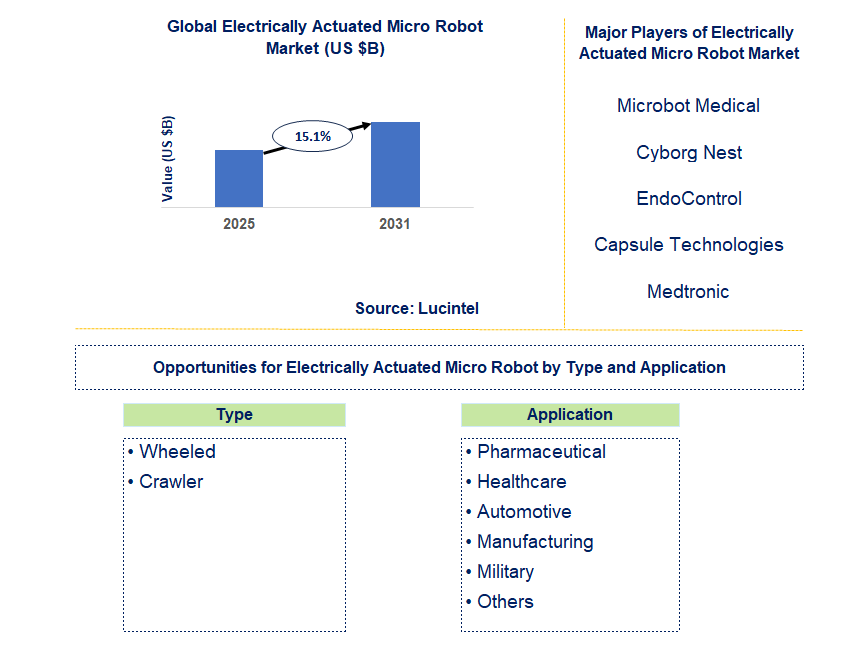
Key data points: The growth forecast = 15.1% annually for the next 7 years. Scroll below to get more insights. This market report covers trends, opportunities and forecasts in electrically actuated micro robot market to 2031 by type (wheeled and crawler), application (pharmaceutical, healthcare, automotive, manufacturing, military, and others), and region (North America, Europe, Asia Pacific, and the Rest of the World)
We'll send your sample report shortly.
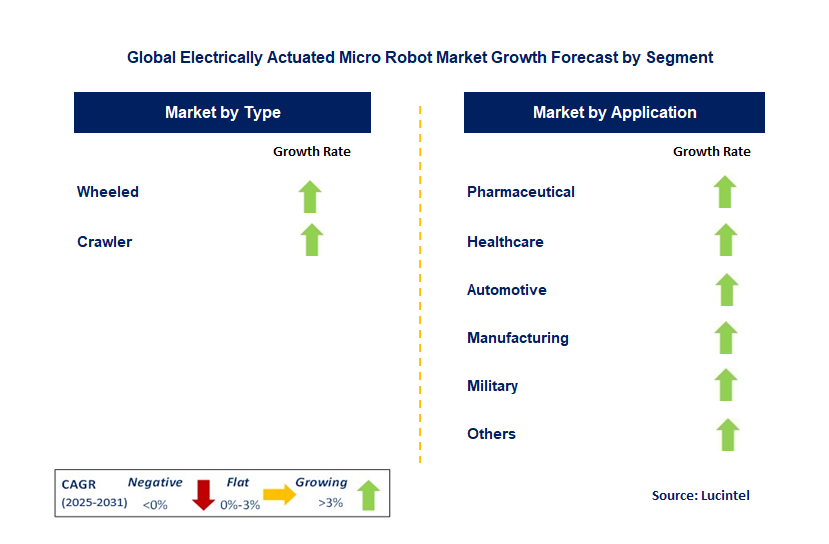
• Lucintel forecasts that, within the type category, crawler is expected to witness higher growth over the forecast period.
• Within the application category, pharmaceutical is expected to witness the highest growth.
• In terms of region, APAC is expected to witness the highest growth over the forecast period. Gain valuable insights for your business decisions with our comprehensive 150+ page report. Sample figures with some insights are shown below.
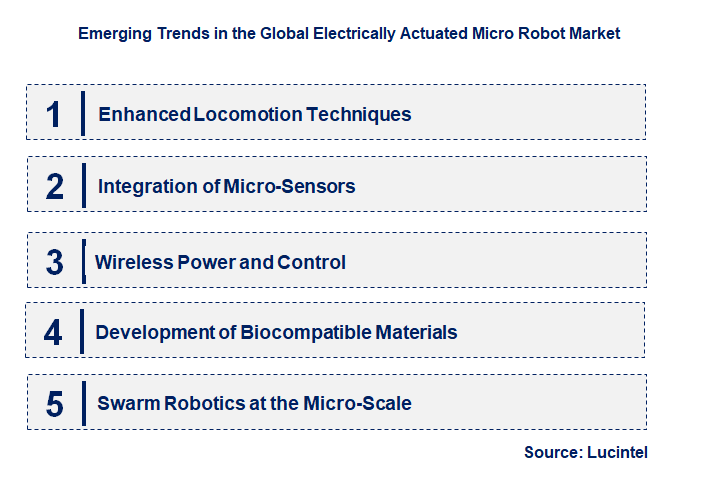
• Enhanced Locomotion Techniques: Development of more efficient and versatile electrical actuation methods for micro robot movement, such as electromagnetic, electrostatic, and piezoelectric actuation, allowing for greater control and maneuverability in diverse environments, including within the human body.
• Integration of Micro-Sensors: Increasing incorporation of miniaturized sensors (e.g., chemical, force, optical) onto electrically actuated micro robots. This enables real-time feedback and more intelligent autonomous behavior for tasks like targeted drug delivery and environmental monitoring at a micro-level.
• Wireless Power and Control: A growing focus on wireless power transfer (e.g., inductive coupling, ultrasound) and wireless communication protocols for controlling micro robots. This eliminates the need for tethering, crucial for in-vivo medical applications and untethered operation in confined spaces.
• Development of Biocompatible Materials: Greater emphasis on using biocompatible and biodegradable materials in the fabrication of electrically actuated micro robots, particularly for biomedical applications. This ensures safety and allows for temporary or resorbable devices within the body.
• Swarm Robotics at the Micro-Scale: Exploration of controlling large numbers (swarms) of electrically actuated micro robots to perform complex tasks collectively. This distributed approach offers redundancy and the ability to tackle challenges that a single micro robot might not be able to handle. These emerging trends are driving the electrically actuated micro robot market towards more capable, autonomous, and biocompatible devices. This evolution is paving the way for their widespread adoption in transformative applications across medicine, manufacturing, and environmental science.
• Advancements in Micro-Actuator Design: Innovations in the design and fabrication of micro-actuators, such as smaller and more powerful electrostatic and piezoelectric actuators, leading to improved force output and more precise movements of micro robots.
• Miniaturization of Power Sources: Progress in developing on-board or near-field wireless power solutions that are sufficiently small and efficient to power micro robots for extended periods, enabling untethered operation for more complex tasks.
• Improved Micro-Fabrication Techniques: The use of advanced micro-fabrication methods like 3D micro-printing and soft lithography to create more intricate and functional micro robot designs with integrated features.
• Development of Real-Time Control Systems: Creation of sophisticated control algorithms and interfaces that allow for precise manipulation and tracking of electrically actuated micro robots, often utilizing external imaging or magnetic fields for guidance.
• Integration of Basic Payload Delivery Mechanisms: Initial developments in incorporating simple mechanisms for carrying and releasing small payloads, such as drugs or diagnostic agents, within micro robots designed for biomedical applications. These developments are making electrically actuated micro robots more practical and versatile, addressing key limitations in their power, control, and ability to perform useful tasks. This is accelerating their potential transition from laboratory research to real-world applications.
• Targeted Drug Delivery: Utilizing electrically actuated micro robots to navigate to specific locations within the body and release therapeutic agents directly at the disease site. This offers the potential for more effective treatments with fewer systemic side effects compared to traditional drug administration.
• Minimally Invasive Diagnostics: Employing micro robots equipped with sensors to perform in-vivo diagnostics, such as imaging or collecting tissue samples, through tiny incisions or natural orifices, reducing patient trauma and recovery time.
• Microsurgery and Cell Manipulation: Developing micro robots capable of performing delicate surgical procedures at a cellular level or manipulating individual cells for research and therapeutic purposes, opening new frontiers in precision medicine.
• Lab-on-a-Chip and Microfluidics: Integrating electrically actuated micro robots within microfluidic devices for automated sample handling, sorting, and analysis, enhancing the efficiency and throughput of laboratory processes.
• Micro-Assembly and Repair: Using micro robots for the precise assembly of micro-scale components in manufacturing or for performing intricate repairs in small and hard-to-reach areas, offering automation at a microscopic level. These strategic growth opportunities highlight the transformative potential of electrically actuated micro robots across diverse fields. By focusing on these applications, the market can leverage the unique capabilities of these tiny machines to address significant challenges and create new possibilities.
• Microbot Medical
• Cyborg Nest
• EndoControl
• Capsule Technologies
• Medtronic
• Epson Robotics
• KUKA
• Seiko Epson Corporation
• Precision Microdrives
• FANUC Corporation
• Wheeled
• Crawler
• Pharmaceutical
• Healthcare
• Automotive
• Manufacturing
• Military
• Others
• North America
• Europe
• Asia Pacific
• The Rest of the World
• United States: The US market is characterized by significant research and development in electrically actuated micro robots for biomedical applications, including targeted drug delivery and microsurgery. Recent advancements include sophisticated control systems and the integration of sensing capabilities into these micro devices, often driven by university research and specialized startups.
• China: China is increasingly investing in the field, with a focus on developing micro robots for industrial inspection and potentially biomedical applications. Recent developments involve advancements in manufacturing techniques to produce these robots at scale and exploring various electrical actuation methods for enhanced mobility at the micro-level.
• Germany: Germany's efforts in electrically actuated micro robots emphasize precision and reliability, particularly for applications in advanced manufacturing and medical technology. Recent developments include micro robots with intricate designs for complex manipulation tasks and integration with established automation systems.
• India: The Indian market is in an earlier stage of development, with growing research interest in electrically actuated micro robots for potential use in diagnostics and specialized industrial tasks. Recent activities include foundational research into actuation methods and basic micro-robotic designs within academic institutions.
• Japan: Japan is a leader in miniaturization and precision engineering, which is reflected in its developments in electrically actuated micro robots for medical devices and micro-assembly. Recent advancements include highly maneuverable micro robots and the exploration of biocompatible materials for in-vivo applications.


• Microbot Medical
• Cyborg Nest
• EndoControl
• Capsule Technologies
• Medtronic
• Epson Robotics
• KUKA
• Seiko Epson Corporation
• Precision Microdrives
• FANUC Corporation Q5. Which electrically actuated micro robot market segment will be the largest in future? Answer: Lucintel forecasts that, within the type category, crawler is expected to witness higher growth over the forecast period. Q6. In electrically actuated micro robot market, which region is expected to be the largest in next 5 years? Answer: In terms of region, APAC is expected to witness the highest growth over the forecast period. Q7. Do we receive customization in this report? Answer: Yes, Lucintel provides 10% customization without any additional cost.


Choose a license that fits your team. Instant PDF delivery.
Prices exclude taxes. Instant delivery. Custom licensing available on request.
Market Report · July 13, 2026
Market Report · July 13, 2026
Market Report · July 2, 2026
Trusted partner for strategic intelligence and business growth


Receive a complimentary market analysis tailored to your industry. Our analysts will identify key growth opportunities and competitive dynamics specific to your business.

Market size, growth rate, and key trend analysis for your specific sector.

Top competitor positioning and market share analysis.

Strategic recommendations backed by data-driven insights.
Get curated market intelligence and competitive moves straight to your inbox.
By subscribing, you agree to receive our monthly insights. Unsubscribe anytime.
Receive a complimentary market analysis tailored to your industry. Our analysts will identify key growth opportunities and competitive dynamics specific to your business.
Market size, growth rate, and key trend analysis for your specific sector.
Top competitor positioning and market share analysis.
Strategic recommendations backed by data-driven insights.
Get curated market intelligence, emerging trends, and competitive moves straight to your inbox each month.
By subscribing, you agree to receive our monthly insights. Unsubscribe anytime.
We'll send your sample report shortly.