
Market Report · July 29, 2026

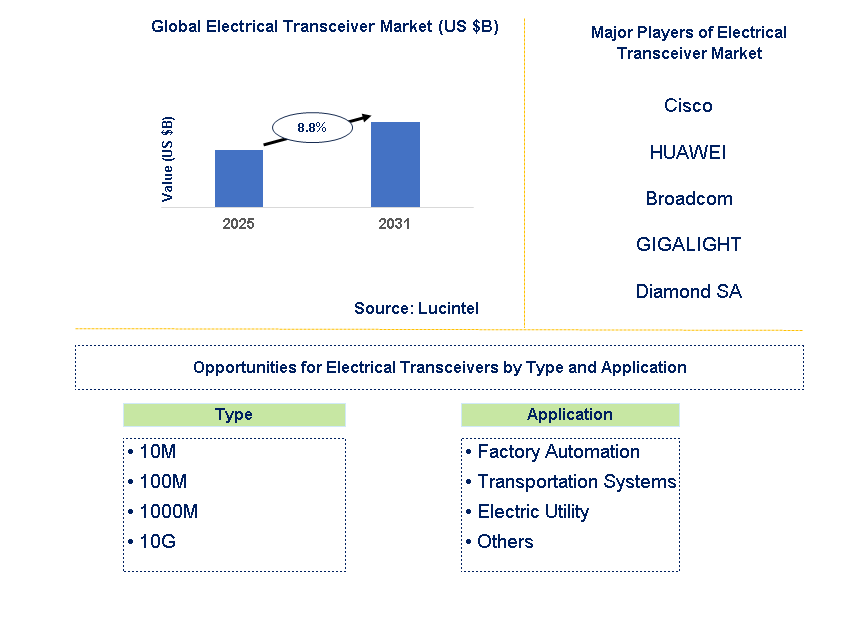
Key data points: The growth forecast = 8.8% annually for the next 7 years. Scroll below to get more insights. This market report covers Trends, opportunity and forecast in electrical transceiver market to 2031 by type (10m, 100m, 1000m, and 10g), application (factory automation, transportation systems, electric utility, and others), and region (North America, Europe, Asia Pacific, and the Rest of the World)
We'll send your sample report shortly.
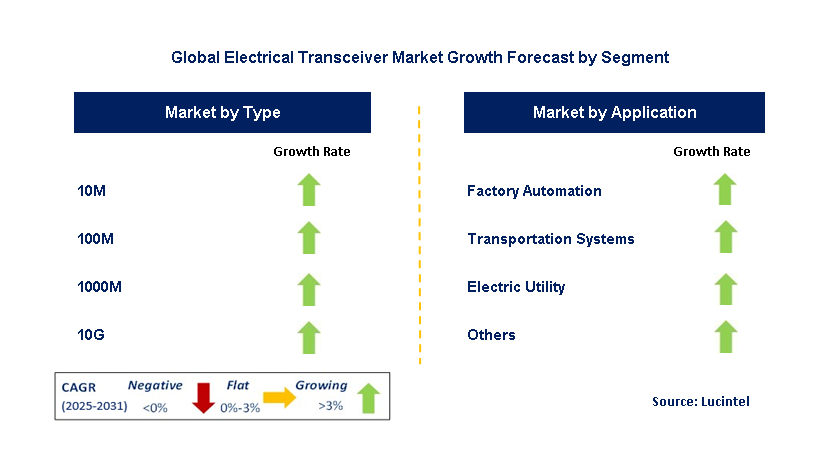
• Lucintel forecasts that, within the type category, 1000m will remain the largest segment over the forecast period due to its wide usage used in various applications, including data centers, telecommunications networks, and industrial automation.
• Within the application category, factory automation is expected to witness the highest growth due to its widespread adoption in advanced technologies like robotics and ai.
• In terms of region, APAC is expected to witness the highest growth over the forecast period due to expanding adoption of cloud computing, big data, and the IoT in the region. Gain valuable insights for your business decisions with our comprehensive 150+ page report. Sample figures with some insights are shown below.
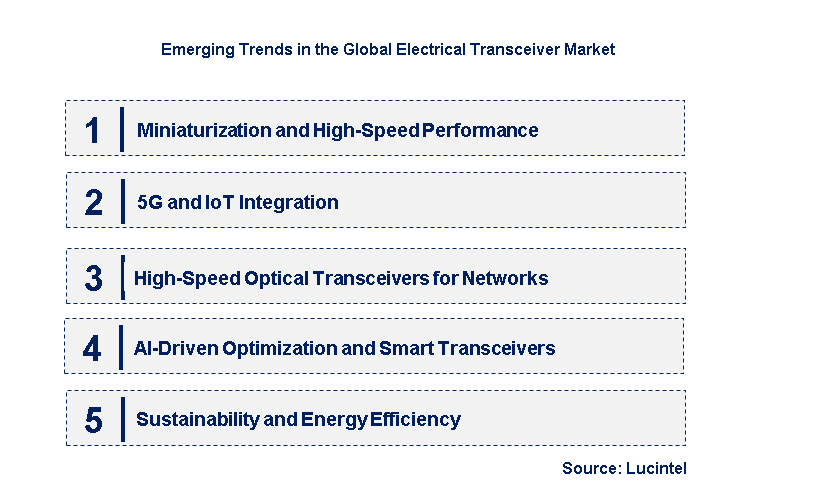
• Miniaturization and High-Speed Performance: Miniaturization is another trend that's driving innovation in the electrical transceiver market. As demand increases for compact devices with high performance, transceivers are miniaturized into smaller, lighter, and efficient devices. Development of miniaturized transceivers with the help of improvements in semiconductor materials and packaging technologies enables higher data transmission speeds without consuming much power. This is particularly relevant to mobile devices, wearable technology, and IoT applications, where both space and power consumption are key considerations.
• 5G and IoT Integration: The 5G and Internet of Things (IoT) technologies integration is opening up new avenues for electrical transceivers. As 5G networks are rolled out globally, the demand for advanced transceiver solutions is on the rise, especially for optical and RF transceivers. IoT devices need reliable and low-power transceivers for effective data transmission in smart cities, industrial automation, and connected devices. As the 5G and IoT technologies accelerate their adoption, demand for transceivers capable of supporting high-speed, low-latency communication increases.
• High-Speed Optical Transceivers for Networks: Optical transceivers play a more critical role in high-speed communication networks, especially in data centers and long-distance telecom applications. These transceivers have much faster data transmission speeds than traditional copper-based solutions, making them perfect for handling the growing data demands of modern networks. With the growth of cloud computing, AI, and big data analytics, optical transceivers are in high demand to support high-capacity, high-speed networks. This trend is expected to continue as more industries adopt fiber-optic technologies.
• AI-Driven Optimization and Smart Transceivers: AI is increasingly integrated into electrical transceivers for the improvement of their performance, energy efficiency, and operational capabilities. AI-based transceivers are capable of dynamic optimization in real-time, based on the instantaneous power consumption, signal quality, and error correction, to enhance the reliability and efficiency of the communication system. Smart transceivers based on AI and machine learning algorithms will be highly pervasive, especially in telecom and data center applications where performance has to be optimized in high-traffic environments
• Sustainability and Energy Efficiency: Sustainability is emerging as a new driver in the development of electrical transceivers. Increasing environmental concerns and energy consumption regulations have led manufacturers to focus on the development of energy-efficient transceivers that consume less power and have a reduced carbon footprint. This trend is particularly relevant in data centers, telecom networks, and mobile devices, where the reduction of energy consumption is critical to meeting sustainability goals. Advancements in low-power transceiver technologies and using environment-friendly material help companies in reducing their environment impact. Trends are also emerging within this electrical transceiver market to make the industry dynamic, ranging from miniaturization and integration of 5G to optical technology, AI-driven optimization, and sustainability. They are enhancing more efficient systems with faster communication means and promoting expansion in sectors like telecom, data centers, and IoT. Such trends, though, would contribute to increased development in these aspects of the electrical transceiver market.
• Advances in 5G Transceivers: The deployment of 5G networks has sparked tremendous growth in electrical transceiver technologies. Transceivers that are fast and low-latency are being designed by manufacturers for the increased data throughput needed for 5G networks. Such transceivers are expected to support the ever-growing demand for mobile broadband and provide faster download speeds, efficient networks, and lower latency. As 5G networks grow across the world, the need for transceivers that are specifically designed for these networks keeps increasing.
• Shift Toward Optical Transceivers for Data Centers: Data centers are increasingly adopting optical transceivers to meet the growing demand for high-speed data transmission and improved bandwidth. Optical transceivers offer faster speeds and greater distance capabilities compared to traditional copper-based solutions, making them ideal for long-distance and high-capacity communication. With the rise of cloud computing and big data analytics, the demand for optical transceivers in data centers is expected to continue rising, driving innovation in this space.
• Development of low power transceivers: Energy efficiency becomes a major priority in the market of transceivers, triggered by the increasingly growing demand for sustainable technologies. Manufacturers are finding ways to engineer low-power transceivers to consume less power while maintaining great performance. Applications such as the Internet of Things, mobile phones, and networks of 5G require this energy-efficient form of transceiver. Low-power transceivers help companies control their operating cost and meet environment sustainability goals.
• Rise of AI and Machine Learning in Transceivers: AI and machine learning are now added to the electrical transceivers to improve performance while optimizing communication processes. AI-driven transceivers can sense the network conditions in real time and make dynamic adjustments for optimal power usage, signal quality, and error correction. Smart transceivers are ideally suited to high-demand applications such as telecom networks and data centers, where efficiency and reliability are paramount.
• Increasing Adoption of RF Transceivers in Wireless Communication: RF (radio frequency) transceivers are gaining traction in wireless communication systems, particularly in applications like 5G, Wi-Fi, and IoT. These transceivers are designed to handle high-frequency signals and support the growing demand for wireless data transmission. As wireless communication continues to expand, the adoption of RF transceivers is expected to grow, driving developments in high-frequency signal processing, miniaturization, and power efficiency. Recent electrical transceiver market development trends include developing 5G technologies, optical transceivers, energy efficiency, AI integration, and wireless communication systems. All of these are transforming the industry and driving faster, more efficient communication systems. These developments will continue to positively impact the growth of the market.
• 5G Infrastructure Deployment: As 5G networks expand, there is a need for high-performance electrical transceivers that can support the increased data throughput and low-latency requirements of 5G technology. This will provide significant growth opportunities for manufacturers specializing in transceivers for telecom networks. The global rollout of 5G is expected to drive a surge in demand for transceivers that can deliver reliable, high-speed communication.
• Data Center Expansion: High-speed growth of cloud computing, big data, and AI will trigger the construction of data centers on a massive scale, with which there would be a tremendous need for high-speed electrical transceivers. High-speed transceivers have always been important, but their usage in the high-bandwidth communication of the present data centers calls for high-bandwidth, high-speed, long-distance, optical transceivers. Thus, with growing traffic, demand will be raised in the transceivers' category, offering significant opportunities to the manufacturers.
• Industrial Automation and IoT: Industrial automation and IoT applications present a significant growth opportunity for electrical transceivers. These technologies require reliable, low-power transceivers to communicate between the devices and machines. As the smart factories, connected infrastructure, and IoT networks grow, demand for efficient and durable transceivers that will support these applications will continue.
• Consumer Electronics: Consumer Electronics-The demand for higher-performance transceivers is increased in mobiles, wearables, and in smart home. Transceivers are very vital to support hassle-free device interconnects with the ecosystem for smart applications. The consumer electronics market is, therefore, very much going to be fueled due to adoption for advanced, power-efficient transceivers.
• Automotive Industry: The automotive industry’s shift toward autonomous vehicles and connected car technologies is creating a new demand for electrical transceivers. These vehicles require high-performance transceivers for communication between sensors, control units, and external networks. As the automotive sector embraces connectivity and automation, manufacturers specializing in automotive-grade transceivers have an opportunity to capitalize on this emerging market. The electrical transceiver market is huge and has ample growth opportunities across various applications such as 5G infrastructure, data centers, IoT, consumer electronics, and the automotive industry. As these sectors continue to expand and evolve, the demand for high-performance transceivers will continue to grow, and thus present enormous opportunities for market players.
• Cisco
• HUAWEI
• Broadcom
• GIGALIGHT
• Diamond SA
• 10M
• 100M
• 1000M
• 10G
• Factory Automation
• Transportation Systems
• Electric Utility
• Others
• North America
• Europe
• Asia Pacific
• The Rest of the World
• United States: In the United States, the electrical transceiver market has faced rapid growth with the ever-growing demand for 5G networks and high-speed data transmission. Companies are increasingly concentrating on developing advanced transceiver technologies, ranging from optical transceivers in data centers, telecom infrastructure, and enterprise applications. Moreover, the country is a forerunner in innovation for semiconductor materials applied in transceivers, leading to enhanced performance, power efficiency, and reduction in size. A rise in the trend toward digital communication along with investment from the government in smart cities and 5G infrastructure is boosting demand for high-performance electrical transceivers.
• China: China is now an important player in the electrical transceiver market due to its robust manufacturing capabilities and the large-scale implementation of 5G technology. Developing the market for optical and RF transceivers, on which optical telecom networks and data centers are mainly based, Chinese companies are pioneering. Government's focus on building a robust 5G infrastructure has created ample demand opportunities for transceiver technologies. Furthermore, China's development of smart cities and Internet of Things (IoT) networks offers further growth opportunities. With focus on low-cost, high-performance transceivers, China is solidifying its pole position in global electronics and telecommunications leadership.
• Germany: The role of Germany is rapidly changing with the national major focus on industrial automation and Industry 4.0 technologies. Transceivers are playing a crucial role in the communication between manufacturing machines and the development of smart factories and industrial IoT. German companies are concentrating on innovation in fiber-optic transceivers to support high-speed, long-distance communication. The country's commitment to advanced manufacturing technologies and smart infrastructure is contributing to a rising demand for reliable, high-speed electrical transceivers in both the industrial and telecommunications sectors.
• India: India is experiencing rapid growth in its electrical transceiver market, fueled by the expansion of its telecom networks and digital infrastructure. Demand for affordable and high performance transceivers is growing as the country makes investments in 4G and 5G rollouts. Moreover, growing Internet of Things adoption, smart city initiatives, and e-commerce are also driving the requirement for reliable communication systems. India also looks to develop indigenous manufacturing capabilities of transceivers, reducing dependency on imports. Further driving the growth of transceiver technologies in India are expansion in data centers and an increase in internet usage.
• Japan: Japan has developed well in the electrical transceiver market, mainly with advanced optical and wireless communication technologies. High-quality transceivers for telecom networks, data centers, and high-speed communication systems are mostly produced by Japanese companies. The country's leadership in 5G technology and autonomous vehicles is also increasing the demand for high-performance electrical transceivers. Moreover, Japan is targeting the integration of cutting-edge technologies such as AI and machine learning into transceiver systems to improve performance and efficiency across various applications.


• Cisco
• HUAWEI
• Broadcom
• GIGALIGHT
• Diamond SA Q5. Which electrical transceiver market segment will be the largest in future? Answer: Lucintel forecasts that 1000m will remain the largest segment over the forecast period due to its wide usage used in various applications, including data centers, telecommunications networks, and industrial automation. Q6. In electrical transceiver market, which region is expected to be the largest in next 5 years? Answer: APAC is expected to witness the highest growth over the forecast period due to expanding adoption of cloud computing, big data, and the IoT in the region. Q7. Do we receive customization in this report? Answer: Yes, Lucintel provides 10% customization without any additional cost.


Choose a license that fits your team. Instant PDF delivery.
Prices exclude taxes. Instant delivery. Custom licensing available on request.
Market Report · July 29, 2026
Market Report · July 20, 2026
Market Report · July 20, 2026
Trusted partner for strategic intelligence and business growth


Receive a complimentary market analysis tailored to your industry. Our analysts will identify key growth opportunities and competitive dynamics specific to your business.

Market size, growth rate, and key trend analysis for your specific sector.

Top competitor positioning and market share analysis.

Strategic recommendations backed by data-driven insights.
Get curated market intelligence and competitive moves straight to your inbox.
By subscribing, you agree to receive our monthly insights. Unsubscribe anytime.
Receive a complimentary market analysis tailored to your industry. Our analysts will identify key growth opportunities and competitive dynamics specific to your business.
Market size, growth rate, and key trend analysis for your specific sector.
Top competitor positioning and market share analysis.
Strategic recommendations backed by data-driven insights.
Get curated market intelligence, emerging trends, and competitive moves straight to your inbox each month.
By subscribing, you agree to receive our monthly insights. Unsubscribe anytime.
We'll send your sample report shortly.