
Market Report · July 22, 2026

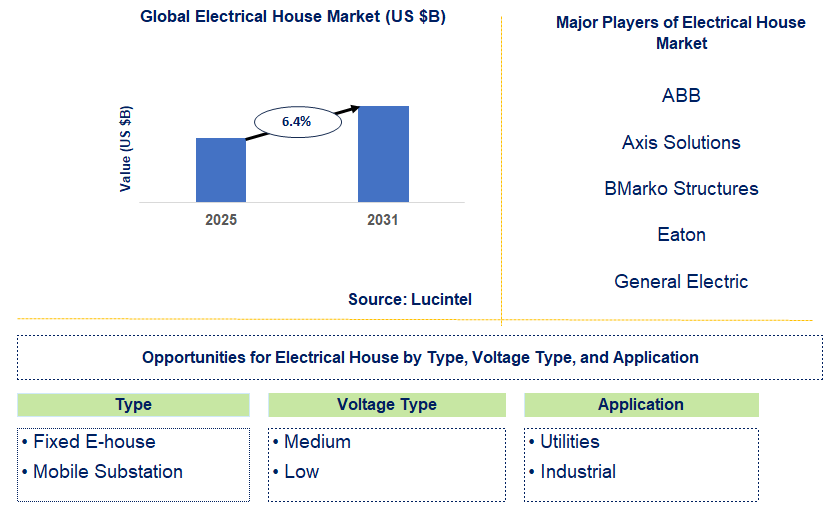
Key data points: The growth forecast = 6.4% annually for the next 7 years. Scroll below to get more insights. This market report covers Trends, opportunities and forecasts in electrical house market to 2031 by type (fixed e-house and mobile substation), voltage type (medium and low), application (utilities and industrial), and region (North America, Europe, Asia Pacific, and the Rest of the World)
We'll send your sample report shortly.
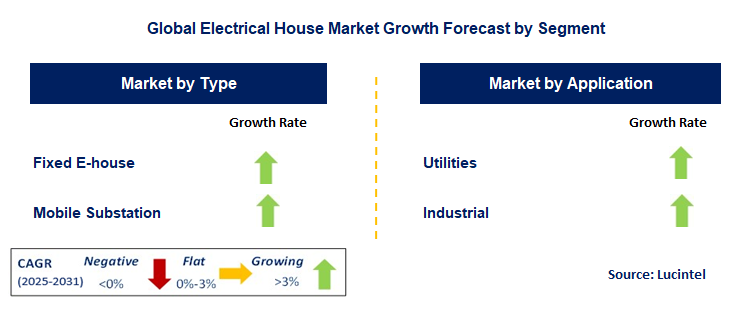
• Lucintel forecasts that, within the type category, fixed e-house is expected to witness higher growth over the forecast period.
• Within the application category, utility is expected to witness higher growth.
• In terms of region, APAC is expected to witness the highest growth over the forecast period.
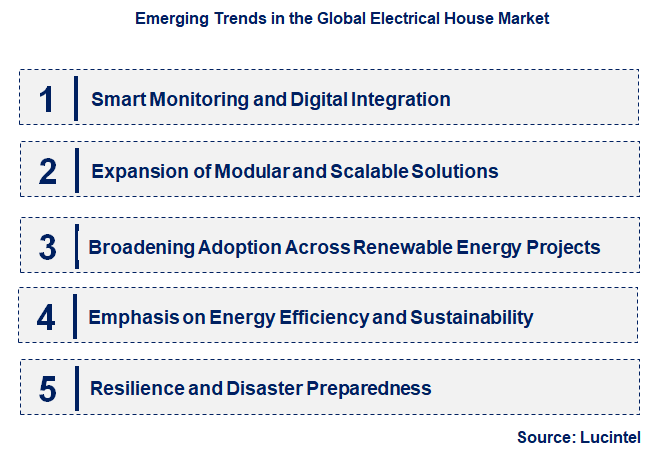
• Smart Monitoring and Digital Integration: E-Houses are increasingly being integrated with smart sensors and IoT technology to enable real-time monitoring and remote management of electrical systems. Digital integration enhances system efficiency, minimizes downtime via predictive maintenance, and supports data-driven decision making. Such features are particularly useful in remote or high-risk locations, where operational visibility and system health monitoring are essential.
• Expansion of Modular and Scalable Solutions: Modular E-Houses provide expandability, as businesses can install or move electric infrastructure on the fly. Such a trend becomes increasingly prominent with industries having shifting power needs such as renewable energy, data centers, and mines. Modular buildings minimize on-site labor, expedite deployment timetables, and provide better customization based on project requirements.
• Broadening Adoption Across Renewable Energy Projects: With the worldwide drive towards clean energy, E-Houses are being used more and more in solar and wind farms. They are used as space-saving solutions for switchgear, transformers, and control equipment housing. Their reliability in extreme environmental conditions makes them perfect for remote renewable installations where space and reliability are priorities.
• Emphasis on Energy Efficiency and Sustainability: Producers are producing E-Houses with enhanced insulation, energy-saving equipment, and green materials. The trend aligns with sustainability initiatives at a global level and assists in mitigating the carbon footprint of power infrastructure. Energy-efficient E-Houses not only save operational expenditures but also support carbon reduction measures in industries.
• Resilience and Disaster Preparedness: Climate events and natural disasters are encouraging industries to embrace mobile and resilient electrical infrastructure. Rapidly deployable E-Houses are restoring power to disaster-stricken areas, thus becoming essential for emergency response, temporary grids, and mobile data centers. The trend is taking hold in regions with high exposures to natural disasters, such as Asia and North America. The trends in the electrical house market that are emerging demonstrate an increasing need for digital, modular, robust, and energy-efficient solutions. These trends are transforming the way industries are designing electrical infrastructure to enable quicker deployment, increased flexibility, and support for environmental objectives. As development goes on, these trends will drive the use and worldwide expansion of E-Houses.
• Prefabricated and Modular Design Development: Manufacturers are investing in prefabricated and modular E-House solutions that decrease construction time and enhance quality control. These are pre-tested and set up off-site, enabling quicker delivery and installation. This innovation assists time-constrained projects, particularly in hard-to-reach or restricted environments, and minimizes overall project cost.
• Greater Investment in Smart Control Systems: E-Houses are being supplied with sophisticated automation, monitoring, and protection systems. Smart control technologies increase energy efficiency, facilitate remote diagnostics, and minimize human intervention. This innovation enables industries to control their operations more cost-effectively and guarantees the continuity of important infrastructure projects.
• Strategic Partnerships and Collaborations: Firms are coming together to create bespoke E-House solutions for particular industries like oil and gas, data centers, and renewables. These partnerships promote innovation and provide access to a greater spectrum of technologies and engineering skills. Consequently, product offerings become more competitive and inclusive.
• Adoption in Urban Infrastructure Projects: Urban growth and smart city initiatives are driving demand for small-form-factor electrical housing solutions. E-Houses are being used in transportation networks, water treatment plants, and city power grids, where space and time are of the essence. This trend opens the market beyond core industrial applications to civic infrastructure.
• Introduction of Environmentally Friendly Materials: Sustainability has emerged as a priority area, with producers employing recyclable and low-carbon materials in E-House building. Green insulation, lower energy consumption, and adherence to environmental regulations are now differentiators. This aligns with corporate social responsibility objectives and enhances brand positioning. All these advancements are redefining the electrical house market by making it more flexible, intelligent, and eco-friendly. Prefabricated designs, smart control systems, and green materials are enhancing efficiency and addressing changing demands of different industries, leading towards long-term development.
• Integration into Renewable Energy: E-Houses supply important infrastructure for wind and solar farms, containing critical equipment such as switchgear and inverters. Their ease of deployment and modularity facilitate scalable renewable developments. With increasing global investment in clean energy, the potential for E-House integration into renewable infrastructure is increasing immensely.
• Applications in the Oil and Gas Industry: In far-flung and offshore oil and gas facilities, E-Houses provide reliable and secure operation of electrical systems. They are employed as motor control centers, control rooms, and power distribution. Their design to withstand the weather and transportability are beneficial in harsh environments, making them conducive to operational efficiency.
• Expansion of Data Centers: With increasing demand for data processing and cloud computing, E-Houses are increasingly employed in the building of modular data centers. They enable power continuity and safe shelter for electrical distribution systems. Flexibility in design and deployment time is essential to such high-velocity tech infrastructure projects.
• Use in Mining and Heavy Industry: Mining activities need to be powered by mobile and rugged power solutions that can perform under harsh conditions. E-Houses meet this need with their ability to provide tailored solutions for equipment protection, process control, and power distribution. This renders them precious resources during both the exploration and extraction stages.
• Emergency and Disaster Recovery Power: In disaster relief situations, E-Houses have the capability to restore electrical infrastructure quickly. Their mobility and plug-and-play design make them ideal for emergency power supply and grid restoration. This use is increasing in regions that experience regular natural disasters and need rapid recovery capabilities. These opportunities for growth reflect the versatility and worth of E-Houses in various industries. Their capability for enabling new infrastructure demands in renewable energy, data management, industrial process, and emergency response will keep on driving market growth and development.
• ABB
• Axis Solutions
• BMarko Structures
• Eaton
• General Electric
• Kasa Analgen
• Panel Built Incorporated
• Schneider Electric
• Siemens
• TECO Corporation
• Fixed E-house
• Mobile Substation
• Medium
• Low
• North America
• Europe
• Asia Pacific
• The Rest of the World
• United States: The United States electrical house market is growing due to higher investments in renewable power, grid modernization, and industrial automation. Prefabricated solutions are becoming more common in the oil and gas, mining, and power generation industries, which prioritize rapid deployment and operational effectiveness. The adoption of digital technologies like IoT and remote monitoring systems in E-Houses is becoming increasingly popular. Government programs promoting infrastructure refurbishment and sustainability objectives are also fueling the demand for advanced electrical housing solutions for industrial and utility-scale applications.
• China: China remains at the forefront of infrastructure development and smart grid deployment, driving demand for electrical house units. China is embracing the use of E-Houses to facilitate its accelerated industrialization and rural and urban electrification. Private companies and state-owned enterprises are investing in prefabricated electrical structures to be used in power distribution centers, wind and solar farms, and manufacturing clusters. Emerging innovation in modular build-out and intelligent automation integration is driving performance, while government support for industrial expansion and energy security is promoting wider market take-up across several industries.
• Germany: Germany's electrical house market is propelled by its emphasis on energy transition, sustainability, and digital manufacturing. E-Houses are being taken up in wind and solar installations to facilitate rapid connection and accommodate decentralized energy distribution. The nation is also experiencing growth in the application of E-Houses in process control systems and industrial automation, focusing heavily on low-carbon technology. German companies are creating bespoke and energy-saving solutions, satisfying stringent environmental criteria and enabling the transition to cleaner and more resilient energy infrastructure.
• India: India is experiencing fast growth in the electrical house market because of its emphasis on electrification, industrialization, and deployment of renewable energy. E-Houses are being utilized in infrastructure projects, oil and gas development, and solar power plants because of their rapid deployment and ease of transportation. The government's efforts like Make in India and Smart Cities Mission are promoting domestic manufacturing and integration of modular electrical solutions. Growth in grid modernization and rural energy access initiatives is fueling the market to a great extent.
• Japan: Japan's electrical house market is transforming as a result of Japan's focus on energy efficiency and disaster resilience. Due to high-frequency natural disasters, interest is growing in portable and compact electrical distribution units with rapid deployment capability. E-Houses find their application more in renewable power plants, data centers, and industrial automation. Japanese companies are emphasizing intelligent features like energy monitoring and remote diagnostics to enhance reliability and efficiency. Robust innovation capabilities and policy incentives towards sustainable energy are providing a healthy climate for the adoption of E-House.


• ABB
• Axis Solutions
• BMarko Structures
• Eaton
• General Electric
• Kasa Analgen
• Panel Built Incorporated
• Schneider Electric
• Siemens
• TECO Corporation Q5. Which electrical house market segment will be the largest in future? Answer: Lucintel forecasts that, within the type category, fixed e-house is expected to witness higher growth over the forecast period. Q6. In electrical house market, which region is expected to be the largest in next 5 years? Answer: In terms of region, APAC is expected to witness the highest growth over the forecast period. Q7. Do we receive customization in this report? Answer: Yes, Lucintel provides 10% customization without any additional cost.


Choose a license that fits your team. Instant PDF delivery.
Prices exclude taxes. Instant delivery. Custom licensing available on request.
Market Report · July 22, 2026
Market Report · July 22, 2026
Market Report · July 17, 2026
Trusted partner for strategic intelligence and business growth


Receive a complimentary market analysis tailored to your industry. Our analysts will identify key growth opportunities and competitive dynamics specific to your business.

Market size, growth rate, and key trend analysis for your specific sector.

Top competitor positioning and market share analysis.

Strategic recommendations backed by data-driven insights.
Get curated market intelligence and competitive moves straight to your inbox.
By subscribing, you agree to receive our monthly insights. Unsubscribe anytime.
Receive a complimentary market analysis tailored to your industry. Our analysts will identify key growth opportunities and competitive dynamics specific to your business.
Market size, growth rate, and key trend analysis for your specific sector.
Top competitor positioning and market share analysis.
Strategic recommendations backed by data-driven insights.
Get curated market intelligence, emerging trends, and competitive moves straight to your inbox each month.
By subscribing, you agree to receive our monthly insights. Unsubscribe anytime.
We'll send your sample report shortly.