
Market Report · July 22, 2026

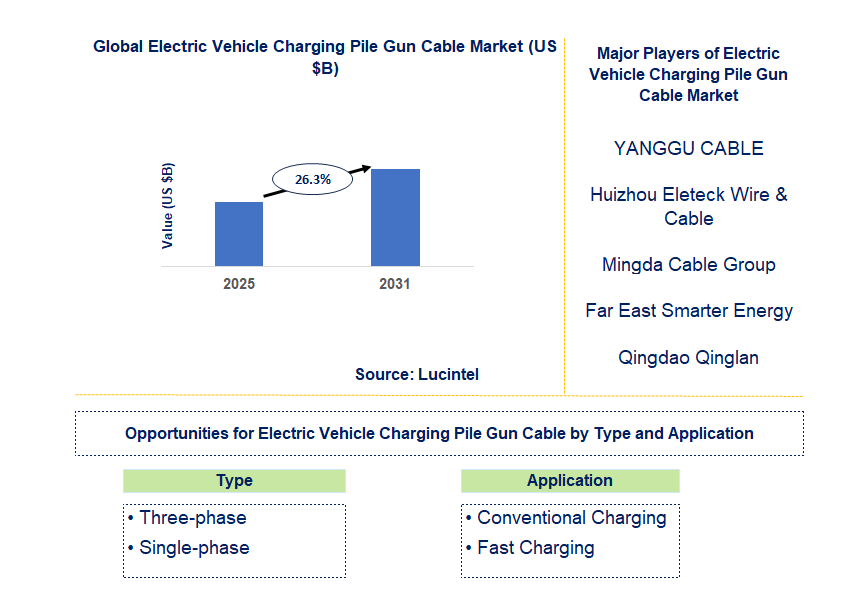
Key data points: The growth forecast = 26.3% annually for the next 7 years. Scroll below to get more insights. This market report covers Trends, opportunities and forecasts in electric vehicle charging pile gun cable market to 2031 by type (three-phase and single-phase), application (conventional charging and fast charging), and region (North America, Europe, Asia Pacific, and the Rest of the World)
We'll send your sample report shortly.
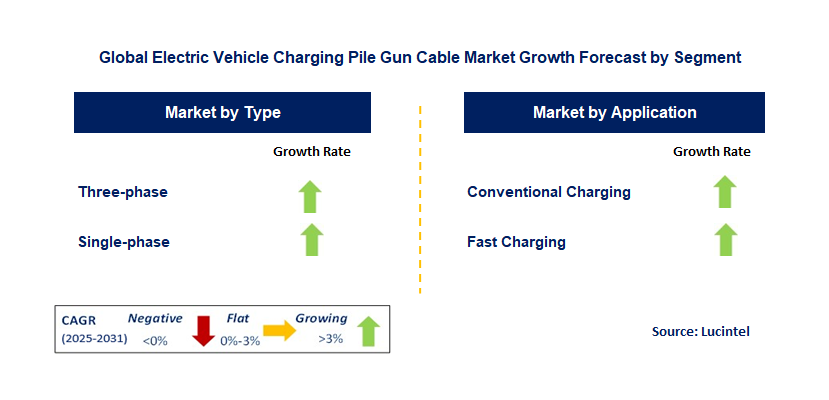
• Lucintel forecasts that, within the type category, three-phase is expected to witness higher growth over the forecast period.
• Within the application category, fast charging is expected to witness higher growth.
• In terms of region, APAC is expected to witness the highest growth over the forecast period.
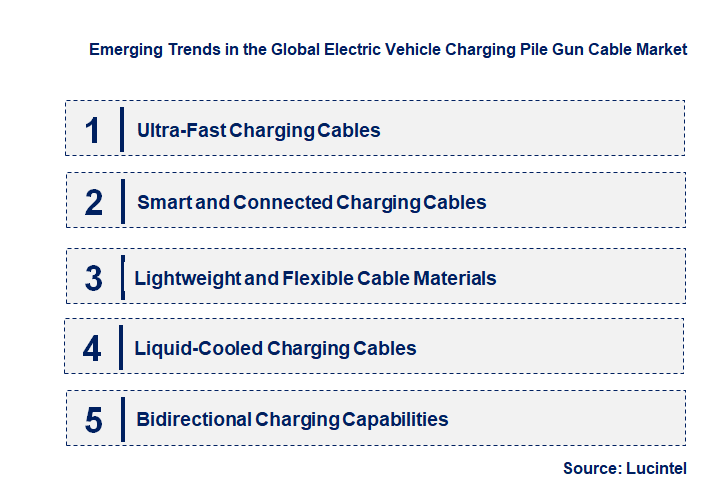
• Ultra-Fast Charging Cables: High-power charging cables capable of handling over 350 kW are becoming more common. These cables reduce charging time significantly, making EVs more practical for long-distance travel. Advanced materials and improved conductivity are helping manufacturers develop cables that can withstand high power loads without overheating. As automakers introduce high-performance EVs, demand for ultra-fast charging solutions is expected to grow, driving further innovation in cable technology.
• Smart and Connected Charging Cables: The integration of smart sensors and communication modules in charging cables is enhancing real-time monitoring and diagnostics. These cables can detect overheating, power fluctuations, and wear, preventing failures and improving safety. Connectivity with mobile apps and cloud-based systems allows users to track charging performance and schedule maintenance. Smart cables are playing a crucial role in optimizing charging efficiency, reducing energy waste, and improving user experience.
• Lightweight and Flexible Cable Materials: Traditional charging cables can be heavy and difficult to handle. New lightweight materials such as carbon fiber and advanced polymers are making cables more flexible and durable. These materials also improve heat dissipation and conductivity, enhancing overall efficiency. The use of lighter cables simplifies installation, reduces strain on charging connectors, and improves portability for users, making electric vehicle charging more convenient.
• Liquid-Cooled Charging Cables: To support ultra-fast charging without overheating, manufacturers are integrating liquid-cooling technology into charging cables. These cables use a coolant to regulate temperature, ensuring safe and efficient power transfer at high charging speeds. Liquid-cooled cables are particularly beneficial for public fast-charging stations, where multiple vehicles charge simultaneously. As charging speeds continue to increase, liquid cooling is expected to become a standard feature in high-power charging cables.
• Bidirectional Charging Capabilities: Bidirectional charging cables enable vehicles to send power back to the grid or home energy systems. This technology supports vehicle-to-grid (V2G) and vehicle-to-home (V2H) applications, allowing EV owners to use their vehicles as mobile energy storage units. Bidirectional charging can enhance grid stability and reduce electricity costs for consumers. As smart grid technology advances, bidirectional charging cables are expected to play a key role in the future of energy management. Emerging trends in electric vehicle charging cables are focused on improving charging speed, safety, and efficiency. Ultra-fast charging, smart connectivity, lightweight materials, liquid cooling, and bidirectional capabilities are shaping the future of electric vehicle charging infrastructure. These innovations are making electric vehicle charging more convenient and reliable, accelerating the global transition to electric mobility.
• Advanced High-Temperature Resistant Materials: Manufacturers are introducing high-performance insulation materials, such as silicone rubber and cross-linked polyethylene (XLPE), to improve heat resistance and durability in charging cables. These materials help withstand higher temperatures and prolonged charging sessions, ensuring longer cable life and better efficiency. With fast-charging networks growing, cables must support higher voltage and current loads while preventing overheating. This development enhances charging reliability, safety, and long-term performance, making compound electric vehicle charging cables essential for next-generation ultra-fast chargers.
• Development of Liquid-Cooled Charging Cables: To support ultra-fast DC charging (350kW and above), companies are developing liquid-cooled charging cables that manage heat dissipation more efficiently. These cables use internal cooling mechanisms to prevent overheating and energy losses, enabling faster and safer electric vehicle charging. Liquid cooling technology is crucial for high-voltage EV architectures (800V+), commercial fleet charging, and high-frequency usage applications. As charging speeds increase, liquid-cooled cables are becoming the preferred choice for high-power charging stations, ensuring optimal performance and extended cable lifespan.
• Integration of Smart Sensors and IoT Connectivity: Modern charging cables are now equipped with built-in sensors and IoT-enabled monitoring systems to provide real-time data on charging status, temperature, and power flow. These smart cables improve charging efficiency, detect faults early, and prevent overheating issues, ensuring enhanced safety and reliability. The integration of smart charging technology is helping charging station operators optimize energy distribution, reduce maintenance costs, and provide a seamless user experience. This development aligns with the industry’s shift towards intelligent electric vehicle charging ecosystems and connected infrastructure.
• Increased Adoption of Ultra-Flexible and Lightweight Cables: New-generation compound charging cables are designed to be more flexible, lightweight, and easier to handle while maintaining high durability and conductivity. These cables utilize advanced polymer compounds that offer greater bend resistance, reduced wear and tear, and improved mechanical strength. With the rise of home charging stations, workplace EV chargers, and portable charging solutions, the demand for user-friendly, compact, and easy-to-store charging cables is growing significantly. This innovation enhances consumer convenience and boosts market adoption of electric vehicle charging solutions.
• Standardization and Regulatory Compliance for Safety: Governments and industry bodies are pushing for standardized charging cable designs that meet international safety and performance regulations. Stricter standards ensure high power transfer efficiency, fire resistance, and protection against electrical hazards. Compliance with IEC, UL, and SAE standards is driving the development of safer and more reliable compound charging cables, improving consumer confidence and accelerating EV adoption. As regulations evolve, manufacturers are focusing on enhancing cable insulation, fireproofing, and electromagnetic shielding technologies to ensure safer and more efficient charging. The Compound electric vehicle charging pile gun cable market is witnessing transformative advancements in material innovation, liquid cooling, smart connectivity, flexibility, and regulatory compliance. These developments are enhancing charging speed, safety, and efficiency, driving the global expansion of fast-charging infrastructure. As demand for high-power, durable, and intelligent charging solutions grows, the market is set to experience significant growth and technological evolution.
• Growth of Fast-Charging Networks: The expansion of DC fast-charging stations (50kW-350kW) globally is driving demand for high-performance charging cables that can handle higher power loads with enhanced durability and thermal management. Governments and private investors are accelerating deployments along highways, urban centers, and commercial hubs, creating a massive market for liquid-cooled and ultra-high-voltage charging cables.
• Adoption of High-Voltage (800V) EVs: Next-generation 800V EV architectures require high-capacity charging cables capable of supporting faster charging times while minimizing energy losses. As automakers shift towards high-voltage platforms, demand for heat-resistant and high-current-rated cables is increasing, providing growth opportunities for manufacturers specializing in advanced conductor materials and insulation technologies.
• Expansion of Public & Commercial Charging Infrastructure: The installation of charging networks in malls, offices, parking garages, and urban centers is creating demand for cost-effective and durable charging cables. Governments worldwide are mandating charging station deployments, leading to large-scale adoption of standardized and modular electric vehicle charging cables for public accessibility.
• Fleet Electrification & Heavy-Duty EV Charging: The transition of commercial fleets, public transportation, and logistics vehicles to electric power is driving the need for high-power megawatt charging systems (MCS) and durable charging cables that support high-frequency usage and faster turnaround times. This shift is pushing advancements in reinforced, flexible, and high-efficiency cables designed for bus and truck charging depots.
• Smart Charging & IoT-Integrated Charging Cables: The integration of IoT-based smart charging systems is increasing demand for charging cables with embedded sensors, real-time diagnostics, and adaptive power delivery. Smart cables optimize energy distribution, reduce overheating risks, and enhance overall charging efficiency, making them crucial for the future of intelligent EV infrastructure. The electric vehicle charging pile gun cable market is evolving with advancements in fast charging, high-voltage vehicle architectures, commercial EV fleets, and smart charging solutions. As EV adoption continues to rise, investment in high-performance, durable, and technology-integrated charging cables will play a key role in supporting the global electrification of transportation.
• YANGGU CABLE GROUP
• Huizhou Eleteck Wire & Cable
• Mingda Cable Group
• Far East Smarter Energy
• Qingdao Qinglan Technology
• Three-phase
• Single-phase
• Conventional Charging
• Fast Charging
• North America
• Europe
• Asia Pacific
• The Rest of the World
• United States: The U.S. is investing heavily in expanding electric vehicle charging infrastructure through federal funding and private partnerships. The focus is on high-power charging cables capable of handling ultra-fast charging speeds. Companies are developing heat-resistant and lightweight cables to improve durability and efficiency. The Biden administration's infrastructure plan includes substantial funding for nationwide EV charger deployment, boosting the demand for advanced charging cables. Standardization efforts for connectors and cables are also gaining traction to ensure compatibility across different charging networks, facilitating seamless EV adoption.
• China: China leads the global EV market and is continuously upgrading its charging cable technology. The country is investing in high-power charging solutions to support its rapidly growing fleet of electric vehicles. Ultra-fast charging cables with higher current capacities are being developed to meet increasing demand. Companies are also working on liquid-cooled cable technology to prevent overheating during fast charging. Government regulations are enforcing stricter safety and performance standards for charging cables, driving innovation and quality improvements. With a vast public and private charging network, China remains at the forefront of electric vehicle charging advancements.
• Germany: Germany is focused on enhancing the efficiency and sustainability of electric vehicle charging cables. Companies are investing in lightweight, flexible, and high-conductivity materials to improve charging performance. The government is supporting research into wireless and bidirectional charging technologies, which could impact future cable designs. Germany's push towards green energy integration is also influencing charging infrastructure developments, with new charging pile cables designed to support renewable energy sources. As the country accelerates its transition to electric mobility, advancements in charging technology are playing a crucial role in improving user experience and charging efficiency.
• India: India's EV market is expanding rapidly, leading to an increased demand for reliable and cost-effective charging cables. The government is focusing on strengthening charging infrastructure under initiatives such as the Faster Adoption and Manufacturing of Hybrid and Electric Vehicles (FAME) program. Local manufacturers are developing durable, weather-resistant charging cables suitable for India's diverse climatic conditions. The push for standardization in electric vehicle charging equipment is gaining momentum, ensuring interoperability among different charging stations. As the EV industry grows, innovations in cable technology will be crucial for reducing charging time and enhancing safety.
• Japan: Japan is emphasizing the development of high-performance charging cables that support ultra-fast charging while maintaining compact and lightweight designs. The country is also advancing wireless charging research, which could influence the design and use of charging pile gun cables in the future. Japanese companies are integrating advanced cooling technologies into charging cables to improve efficiency and durability. The government is collaborating with automakers and charging network providers to develop next-generation charging standards, ensuring compatibility and safety. These advancements are positioning Japan as a leader in reliable and innovative electric vehicle charging solutions.


• YANGGU CABLE GROUP
• Huizhou Eleteck Wire & Cable
• Mingda Cable Group
• Far East Smarter Energy
• Qingdao Qinglan Technology Q5. Which electric vehicle charging pile gun cable market segment will be the largest in future? Answer: Lucintel forecasts that, within the type category, three-phase is expected to witness higher growth over the forecast period. Q6. In electric vehicle charging pile gun cable market, which region is expected to be the largest in next 5 years? Answer: In terms of region, APAC is expected to witness the highest growth over the forecast period. Q7. Do we receive customization in this report? Answer: Yes, Lucintel provides 10% customization without any additional cost.


Choose a license that fits your team. Instant PDF delivery.
Prices exclude taxes. Instant delivery. Custom licensing available on request.
Market Report · July 22, 2026
Market Report · July 22, 2026
Market Report · July 17, 2026
Trusted partner for strategic intelligence and business growth


Receive a complimentary market analysis tailored to your industry. Our analysts will identify key growth opportunities and competitive dynamics specific to your business.

Market size, growth rate, and key trend analysis for your specific sector.

Top competitor positioning and market share analysis.

Strategic recommendations backed by data-driven insights.
Get curated market intelligence and competitive moves straight to your inbox.
By subscribing, you agree to receive our monthly insights. Unsubscribe anytime.
Receive a complimentary market analysis tailored to your industry. Our analysts will identify key growth opportunities and competitive dynamics specific to your business.
Market size, growth rate, and key trend analysis for your specific sector.
Top competitor positioning and market share analysis.
Strategic recommendations backed by data-driven insights.
Get curated market intelligence, emerging trends, and competitive moves straight to your inbox each month.
By subscribing, you agree to receive our monthly insights. Unsubscribe anytime.
We'll send your sample report shortly.