
Market Report · May 18, 2026

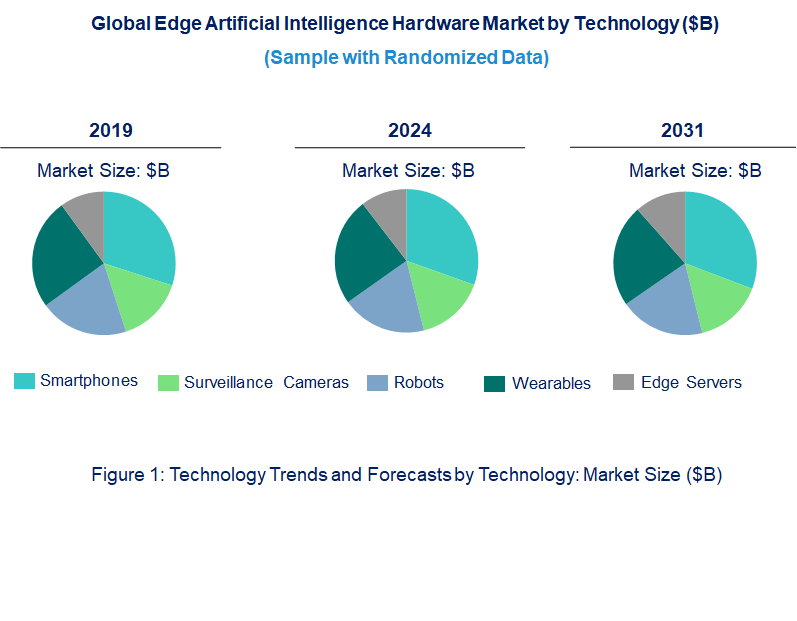
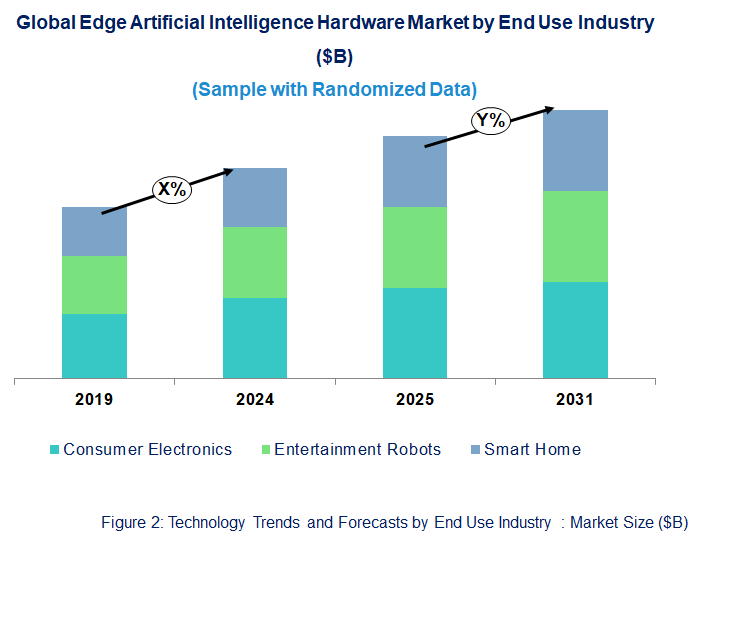
This market report covers trends, opportunities, and forecasts in the global edge artificial intelligence hardware market to 2031 by technology (smartphones, surveillance cameras, robots, wearables, and edge servers), end use industry (consumer electronics, entertainment robots, and smart home), and region (North America, Europe, Asia Pacific, and the Rest of the World)
We'll send your sample report shortly.
• On-Device AI Processing: A key trend is the growing shift from cloud-based AI to local AI processing at the edge, which reduces latency and bandwidth usage while improving privacy and security.
• AI-Powered Wearables: Wearable devices are increasingly integrating AI to provide more personalized experiences, such as real-time health monitoring, fitness tracking, and context-aware functionalities.
• Enhanced Surveillance Systems: AI is being integrated into surveillance cameras to provide smarter security systems, enabling real-time facial recognition, anomaly detection, and predictive analytics.
• Smart Robots: Edge AI is driving innovations in autonomous robots, making them more capable in industries like entertainment, healthcare, and logistics by enabling real-time decision-making.
• Edge AI in Consumer Electronics: With the proliferation of smart home devices, edge AI is enabling personalized experiences, smarter automation, and faster processing capabilities in consumer electronics, such as smart speakers and appliances. These trends are reshaping industries by enabling real-time AI capabilities and enhancing device intelligence across diverse applications in entertainment, healthcare, and smart home solutions.
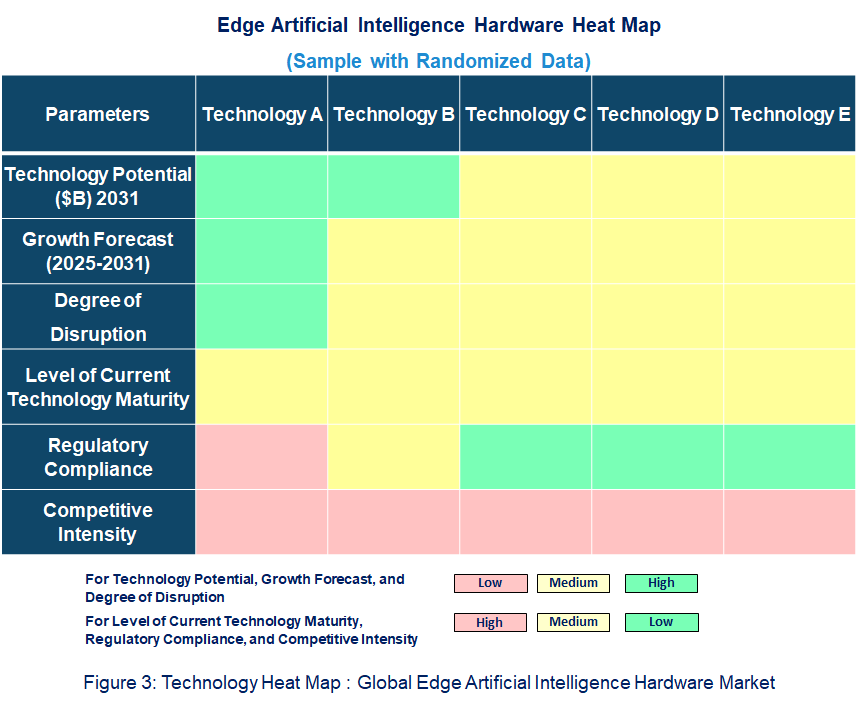
• Technology Potential: Edge artificial intelligence (AI) hardware has immense potential to transform multiple industries by enabling intelligent data processing directly on devices such as smartphones, drones, cameras, robots, and industrial sensors. Unlike traditional cloud-based AI, edge AI hardware offers low-latency decision-making, reduced bandwidth consumption, enhanced privacy, and offline functionality. Its ability to process complex neural networks locally allows real-time performance for applications like facial recognition, predictive maintenance, autonomous navigation, and smart retail analytics. With the expansion of IoT devices and 5G networks, demand for efficient, compact, and energy-efficient AI chips, such as NPUs (Neural Processing Units), FPGAs, and ASICs, is accelerating across consumer, automotive, healthcare, and manufacturing sectors.
• Degree of Disruption: Edge AI hardware is highly disruptive, poised to redefine computing paradigms by shifting intelligence closer to the source of data. This transformation enhances speed, efficiency, and security in mission-critical environments like autonomous vehicles, medical diagnostics, and smart factories. It challenges the dominance of centralized cloud AI models and traditional CPU/GPU-based processing by introducing domain-specific architectures optimized for real-time AI inference at the edge.
• Technology Maturity: The maturity level of edge AI hardware varies. NPUs and ASICs for mobile and embedded applications are commercially mature, with widespread deployment in smartphones and wearables. However, edge hardware for industrial and automotive AI remains in development, with progress dependent on improvements in model compression, thermal management, and power efficiency. The overall ecosystem—including software toolchains and developer support—is rapidly evolving but still maturing compared to cloud AI infrastructure.
• Regulatory Compliance: Regulatory compliance for edge AI hardware centers on safety, data protection, and device interoperability. As edge devices often handle biometric and sensitive information, compliance with privacy regulations such as GDPR, CCPA, and HIPAA is critical. In automotive and industrial applications, hardware must adhere to functional safety standards (e.g., ISO 26262, IEC 61508). For healthcare and consumer devices, certifications like CE, FCC, and FDA may apply. As AI regulation emerges globally, such as the EU AI Act, developers of edge AI systems must also address algorithmic transparency, fairness, and accountability, ensuring responsible deployment and continuous compliance.
• Cisco: Cisco has developed edge computing platforms integrated with AI capabilities, enabling businesses to process data locally and improve operational efficiency.
• IBM: IBM is focusing on creating AI-optimized chips and servers to accelerate real-time decision-making and reduce latency in critical applications such as healthcare and transportation.
• Intel: Intel has introduced powerful AI chips, such as the Intel Nervana platform, designed for edge computing applications that require high performance in a compact form.
• Samsung: Samsung is integrating edge AI into its consumer electronics, including smartphones and wearables, offering users personalized experiences powered by AI.
• Google: Google has developed the Edge TPU, a specialized AI chip for on-device processing, which is helping accelerate edge AI adoption across various industries.
• Microsoft: Microsoft is enhancing its Azure IoT Edge platform to enable AI at the edge, empowering industries to deploy real-time AI applications with minimal latency.
• Micron Technology: Micron is developing memory and storage solutions optimized for edge AI hardware, supporting efficient data processing in IoT and edge applications. These developments are creating new opportunities for businesses to leverage AI at the edge, reducing reliance on cloud infrastructure while providing faster, more efficient solutions.
• Increasing Adoption of IoT Devices The proliferation of IoT devices in homes, industries, and cities is fueling demand for edge AI hardware that can process data locally. This shift reduces reliance on cloud computing, minimizes latency, and improves efficiency, creating new opportunities for intelligent, decentralized decision-making.
• Demand for Real-Time Processing Edge AI hardware supports real-time data processing in mission-critical applications such as autonomous driving and healthcare monitoring. The ability to instantly analyze and act on data improves responsiveness, reliability, and safety, making it indispensable in sectors that depend on immediate insights.
• Enhanced Data Privacy and Security Processing data at the edge reduces the risk of data breaches by minimizing transmission to centralized servers. This aligns with growing regulatory and consumer demands for improved data privacy, particularly in industries like finance, healthcare, and defense.
• Advancements in AI Chipsets and Architectures Continuous innovation in AI-specific chipsets, such as NPUs and TPUs, is driving improved efficiency and power optimization. These technological advancements enable AI capabilities in smaller, portable, and energy-constrained devices, further expanding use cases in mobile, wearable, and embedded systems.
• Growth in Edge-Based Applications (e.g., Surveillance, Industrial Automation) Edge AI hardware is critical for video analytics, predictive maintenance, and robotics. Its integration enables faster, autonomous decision-making in industrial and security settings, supporting scalable and cost-efficient operations while reducing dependence on cloud infrastructure. Major Challenges
• High Cost of Deployment and Customization Edge AI hardware development and deployment involve high R&D and customization costs, which can be a barrier for small and medium-sized enterprises (SMEs). Additionally, integrating these systems into legacy infrastructure can require substantial investment.
• Power Efficiency and Thermal Management Issues Running AI models on edge devices often demands substantial power, creating challenges in mobile or remote deployments. Efficient thermal design and low-power chipsets are essential, but difficult to achieve without compromising performance.
• Integration Complexity Across Diverse Hardware and Software Ecosystems Edge AI applications often require seamless integration between AI hardware, embedded software, and cloud services. Compatibility issues can delay implementation and increase development complexity, particularly in multi-vendor environments.
• Limited Training Capabilities at the Edge While inference is suited for edge devices, training large-scale AI models remains largely cloud-dependent. This limits the adaptability of edge devices to real-time changes, especially in dynamic environments where continuous learning is needed.
• Regulatory and Compliance Challenges Edge AI in sectors like healthcare and surveillance must comply with stringent data and safety regulations. Navigating different jurisdictional rules can complicate product design and deployment strategies, slowing market expansion. The edge AI hardware market is thriving due to rising demand for decentralized, real-time data processing, especially in IoT, autonomous systems, and security applications. Despite technical and regulatory challenges, the growing sophistication of edge devices and evolving chipset architectures are unlocking new possibilities. These opportunities are driving innovation, expanding adoption, and reshaping digital transformation strategies across industries.
• Cisco
• Ibm
• Intel
• Samsung
• Microsoft
• Technology Readiness and Applications: Smartphones and wearables are highly mature for edge AI, widely used in voice assistants, facial unlock, and health tracking. Surveillance cameras are moderately mature, with edge AI powering license plate recognition, intrusion detection, and crowd monitoring. Robots show variable maturity—high in factory automation, emerging in retail and service sectors. Wearables are optimized for low-power AI inference for health and activity monitoring. Edge servers are technologically mature and deployed across sectors for industrial inspection, smart city infrastructure, and autonomous systems. All technologies are transitioning toward real-time, low-latency AI execution, enhancing personalization, safety, and operational efficiency at the network edge.
• Competitive Intensity and Regulatory Compliance: In the edge artificial intelligence hardware smartphones and wearables face fierce competition, driven by rapid innovation from players like Apple, Samsung, and Huawei. Surveillance cameras see intense rivalry in AI-enhanced features among firms like Hikvision and Dahua. Robotics companies compete on precision, response time, and autonomy. Edge servers, led by NVIDIA, Intel, and AMD, dominate in industrial-grade AI hardware. Regulatory compliance spans across device safety (CE/FCC), data privacy (GDPR, CCPA), and AI ethics, especially critical in surveillance and healthcare. Medical wearables require FDA or CE medical device approvals. Regulations are becoming stricter, especially in facial recognition and biometric use, intensifying market entry challenges.
• Disruption Potential: In the Edge AI hardware market, smartphones hold strong disruption potential by embedding AI chips for on-device processing, enabling faster and private decision-making. Surveillance cameras are rapidly evolving with AI-driven analytics at the edge, transforming security and public safety. Robots equipped with edge AI redefine automation in manufacturing and healthcare. Wearables like smartwatches and fitness bands enable real-time health monitoring and contextual intelligence. Edge servers bring centralized AI capabilities closer to devices, lowering latency in industrial and enterprise environments. Collectively, these technologies are accelerating real-time intelligence and reshaping industries by reducing dependence on cloud infrastructure.
• Smartphones
• Surveillance Cameras
• Robots
• Wearables
• Edge Servers
• Consumer Electronics
• Entertainment Robots
• Smart Home
• North America
• Europe
• Asia Pacific
• The Rest of the World
• Latest Developments and Innovations in the Edge Artificial Intelligence Hardware Technologies
• Companies / Ecosystems
• Strategic Opportunities by Technology Type


Choose a license that fits your team. Instant PDF delivery.
Prices exclude taxes. Instant delivery. Custom licensing available on request.
Market Report · May 18, 2026
Market Report · May 18, 2026
Market Report · May 18, 2026
Trusted partner for strategic intelligence and business growth


Receive a complimentary market analysis tailored to your industry. Our analysts will identify key growth opportunities and competitive dynamics specific to your business.

Market size, growth rate, and key trend analysis for your specific sector.

Top competitor positioning and market share analysis.

Strategic recommendations backed by data-driven insights.
Get curated market intelligence and competitive moves straight to your inbox.
By subscribing, you agree to receive our monthly insights. Unsubscribe anytime.
Receive a complimentary market analysis tailored to your industry. Our analysts will identify key growth opportunities and competitive dynamics specific to your business.
Market size, growth rate, and key trend analysis for your specific sector.
Top competitor positioning and market share analysis.
Strategic recommendations backed by data-driven insights.
Get curated market intelligence, emerging trends, and competitive moves straight to your inbox each month.
By subscribing, you agree to receive our monthly insights. Unsubscribe anytime.
We'll send your sample report shortly.