
Market Report · July 15, 2026

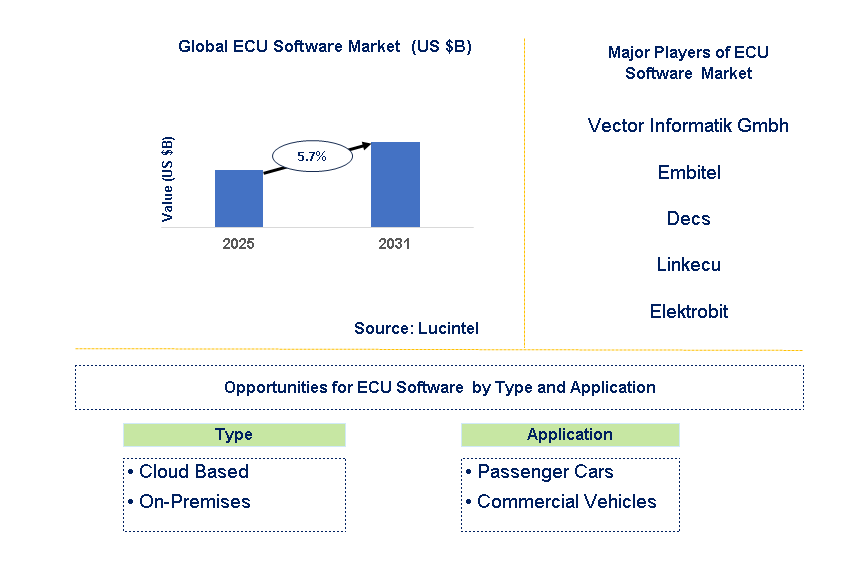
Key data points: The growth forecast = 5.7% annually for the next 7 years. Scroll below to get more insights. This market report covers Trends, opportunity and forecast in ECU software market to 2031 by type (cloud based and on-premises), application (passenger cars and commercial vehicles), and region (North America, Europe, Asia Pacific, and the Rest of the World)
We'll send your sample report shortly.
• Autonomous Driving System Integration: Autonomous driving is one of the most significant trends driving the evolution of ECU software. As vehicles become increasingly autonomous, so does the sophistication of the software that controls these systems—perception, decision-making, and vehicle control. ECU software needs to process enormous amounts of sensor data coming from cameras, LiDAR, and radar to enable a vehicle to decide in real-time without human input. Autonomous vehicles will take the ECU software to the limits of integration of AI and machine learning for creating smarter and safer systems.
• Electrification and Energy Efficiency: With rising mainstream EVs, the ECU software now deals with energy consumption management, battery management systems, and charging protocols. Its role is immensely important in optimizing energy efficiency, speed control during charging, and battery health monitoring of EVs. With the global shift toward sustainability and reduced carbon emissions, ECU software solutions that manage powertrain operations, energy regeneration, and battery optimization are becoming crucial to the success of EVs. This trend will continue to grow as the demand for electric mobility increases.
• Connectivity and Vehicle-to-Everything (V2X) : The development of Vehicle-to-Everything (V2X) communication is transforming the automotive sector. V2X allows vehicles to communicate with each other (V2V) and with infrastructure (V2I), enhancing safety, traffic efficiency, and road usage. ECU software is at the heart of enabling V2X communication, allowing vehicles to share data about road conditions, accidents, and other critical information. The future of connected vehicles will rely on real-time, high-bandwidth data exchange as 5G technology continues to evolve.
• Cybersecurity and Data Privacy: With more vehicles becoming connected, the possibility of cyber attacks has become a serious issue. ECU software is being developed with advanced security features to avoid any potential vulnerability such as hacking into a remote vehicle or unauthorized access to data. Automotive companies are focusing on developing secure ECU software that can protect the vehicle systems, personal data, and misuse of connected vehicle technologies. In line with the trends of smart cities and cloud-based ecosystems, integration of vehicles is going to make cybersecurity a leading trend in ECU software in the future.
• Integration of AI and Machine Learning: AI and machine learning technologies are being integrated into ECU software to enhance the performance, safety, and decision-making of a vehicle. Such technologies enable the ECU system to learn real-time data and improve response time and adapt to various driving conditions. In autonomous vehicles, AI and machine learning algorithms enable the optimization of sensor data processing, path planning, and the detection of obstacles. Integration into ECU software is making smart, intuitive cars that adapt dynamically to changing environments and make a better driving experience.
The general trend in the ECU software market is seen as driven more by advancements in autonomous driving, electrification, connectivity, and AI. It's reshaping the automotive industry by pushing it toward the possibilities that can be created by new technological capabilities while furthering its demand for highly sophisticated ECU software. Hence, these are expected to influence the future of automotive technology more profoundly as it will continue growing fast.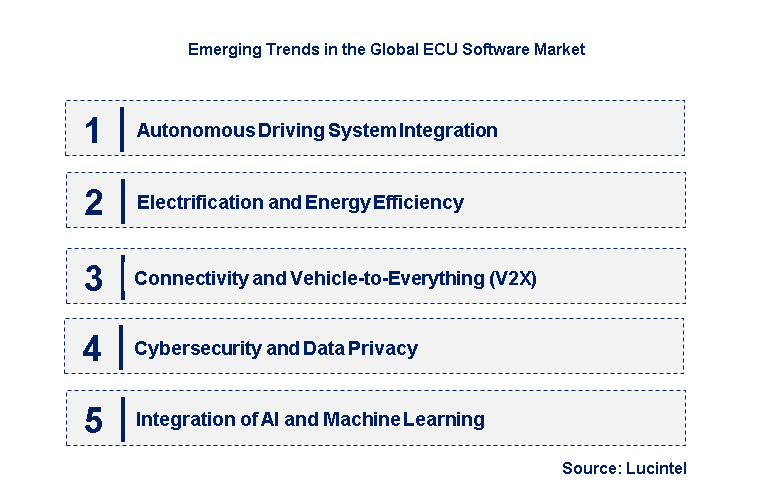
• Integration of Advanced Driver Assistance Systems (ADAS): It is one of the most vital developments in the ECU software market. Semi-autonomous and fully autonomous vehicles bring ADAS features like lane-keeping assist, adaptive cruise control, and automatic emergency braking as standard. Software development for the ECU in these vehicles aims to integrate the features seamlessly with vehicle control systems to ensure safe driving experiences. The ADAS demands strong and reliable ECU software to support real-time processing and decision-making.
• Electric Vehicle Powertrain Management: As adoption of electric vehicles increases, ECU software becomes ever more indispensable for managing the complete powertrain, which will increasingly include managing batteries, energy recovery, and thermal management. Software solutions that focus on optimizing energy and monitoring battery health while controlling charging systems are being developed and hence is a critically important driver in the improvement of electric vehicle range, efficiency, and performance, thus thrusting the growth of the ECU software market in the electric mobility space.
• Over-the-Air (OTA) Update Demand: Over-the-air updates for vehicle software are in growing demand, and automakers can now update the vehicle's ECUs remotely. This reduces service visits and increases the efficiency of software upgrades. OTA technology is revolutionizing the way automakers manage vehicle performance, bug fixes, and feature updates, resulting in significant cost savings and a better customer experience. Hence, ECU software systems are becoming flexible and capable enough to accept frequent modifications.
• Co-operation between car manufacturers and tech firms: Automotive companies are now integrating with tech companies to build such ECU softwares supporting the functions of fully autonomous driving and V2X communication. This collaboration is helping ECU software stretch its limits by having vehicle manufacturers take advantages of the knowledge of software developers that will be merged to innovate real-time data processing, AI integration, and other sorts of connectivity of vehicles. This is key to the furthering of advanced automotive technology and growth in the market of ECU software in the future.
• Standardization and Regulation for ECU Software: As the complexity of ECU software increases, standardization and regulation are being enforced in the automotive industry to provide safety, interoperability, and reliability. In this regard, regulatory frameworks are being developed for the development of ECU software to ensure that the software solution is safe, meets the specified standards, and integrates well with other vehicle systems. This is crucial for the development of widespread adoption of autonomous and connected vehicles since it guarantees the security, compatibility, and reliability of the software solutions.
These changes reflect the growing pace of development in the ECU software market. ADAS, EV management, OTA updates, collaboration between automotive and tech companies, and regulatory efforts contribute to growth and innovation. They are critical in the future development of the automobile industry, offering safer, more efficient, and smarter vehicles.• Autonomous Driving Systems: ECU software will be highly crucial in the automotive industry with the full implementation of autonomous driving. Software solutions that allow for real-time processing of data from sensors, cameras, and LiDAR will be in demand. The scope for growth lies in developing more sophisticated software to support autonomous driving systems and ensure greater safety, efficiency, and reliability.
• Electric Vehicle Solutions: As the use of electric vehicles continues to grow in the coming years, software that takes care of battery systems, energy efficiency, and charging protocols is required. To optimize performance and lifespan, power train management and its energy regeneration are critical for electric vehicles. The demand for green mode of transport can be correlated with growing and developing markets, i.e., sustainable solutions within the EV ECU software market.
• Infotainment and Connected Vehicle Solutions: The rise in demand for in-vehicle connectivity and infotainment systems is a growth opportunity for ECU software developers. As more vehicles become connected to smartphones, cloud platforms, and other IoT devices, there is a growing need for seamless communication, entertainment, and navigation software solutions. Infotainment and connected services integration open avenues for innovation and expansion in the ECU software market.
• V2X Communication: Vehicle-to-Everything (V2X) communication is one of the prominent trends that makes vehicles talk to each other and infrastructure. For ECU software, V2X systems are predominantly important for guaranteeing safety, traffic efficiency, and high speed real-time data exchange. The growth of smart cities and 5G networks will fuel the expansion of V2X solutions and form a wide opportunity for the ECU software market.
• Over the air (OTA) software upgrades: Over-the-air demand is constantly rising as most OEMs prefer over-the-air delivery of seamless changes to its car. Hence ECU developers provide an easy avenue for doing such remote diagnostic operations, also upgradation with even bug correction methods, bringing easy solutions towards betterment both cost-effective solutions as well as user experience development-remoting or updating on-time provides prolonged use and benefits long-term usage increase in ECU software applications.
The strategic growth opportunities that these points represent clearly demonstrate the significance of ECU software in determining the future of the automotive industry. Autonomous vehicles, electric mobility, connected vehicles, V2X communication, and OTA updates will continue to propel demand for innovative ECU software solutions.• Vector Informatik Gmbh
• Embitel
• Decs
• LinkECU
• Elektrobit
• Intellias
• Kpit
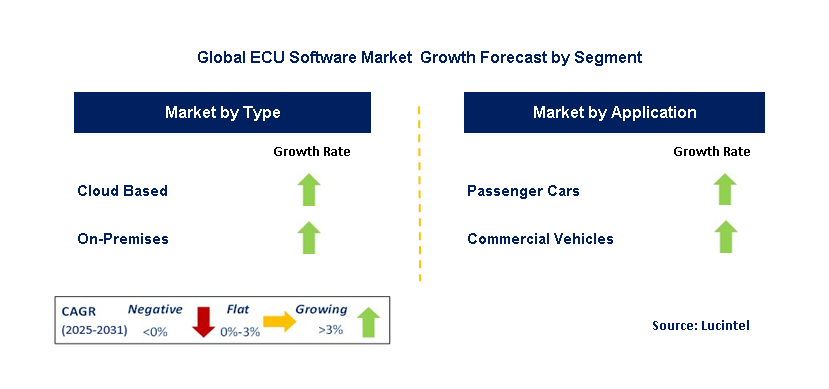
• Cloud Based
• On-Premises
• Passenger Cars
• Commercial Vehicles
• North America
• Europe
• Asia Pacific
• The Rest of the World
• United States: The ECU software market in the United States is flourishing, with a strong push coming from the widespread adoption of autonomous vehicle technology, electric vehicles (EVs), and connected car solutions. The major automotive manufacturers and tech companies are investing in the development of highly advanced ECU software for supporting electric drivetrains, self-driving features, and real-time data analytics. The complexity introduced in the integration of ECUs into automotive platforms requires advanced software systems for V2V and V2I communications. Further, ECU software among US-based companies is being designed to include cybersecurity features given the enhanced concern about data protection and the risk of cyberattacks on connected vehicles.
• China: The automotive industry in China is growing at a faster pace toward electric and intelligent vehicles, thereby increasing the need for advanced ECU software. Chinese automotive major companies and new entrants in the EV space are investing heavily in ECU development, especially focusing on autonomous driving, BMS, and integrated in-vehicle software. A suitable regulatory environment is also being developed to enhance smart city infrastructure in China, thereby encouraging the growth in demand for connected vehicle technology. Chinese companies are emphasizing innovations in ECU software for energy efficiency, safety features, and vehicle-to-grid (V2G) capabilities in EVs.
• Germany: Germany continues to be a leader in the development of ECU software with a focus on optimizing vehicle performance, safety, and user experience. German automobile manufacturers are investing heavily in the development of state-of-the-art ECU software to support new technologies such as electrification and hybridization of vehicles, as well as automated driving and the enhancement of driver assistance systems, (ADAS). Germany is also leading the way in terms of vehicle communication network development, from CAN to Ethernet, for improved V2X communication. This drive towards sustainable mobility is also challenging German companies to enhance ECU software solutions in electric vehicles that help optimize energy consumption.
• India: The country's growing automobile industry, and particularly the advent of electric vehicles (EVs), is leading the demand for ECU software solutions. The nation is adopting cleaner technologies, developing EV infrastructure, and therefore investing in ECU software by Indian companies that allow efficient energy management, battery monitoring, and charging solutions. Indian automotive companies are integrating ECU software with advanced in-car user experience by infotainment and ADAS. Demand for ECU software is likely to grow as the country moves towards smart mobility solutions and connects more connected and autonomous vehicles.
• Japan: In Japan, the automobile sector has more interest in adding ECU software with the integration of advanced features into electric, hybrid, and autonomous vehicles. The ECU software development in ADAS, V2X communication, and energy-efficient vehicle systems is being led by Japanese manufacturers. Japan is also at the forefront of developing autonomous driving technology; automobile companies and tech firms are working on developing ECU software for safe and reliable vehicle operation. Further, the huge focus on robotics and automation in Japan also shapes the overall direction of ECU software developments, especially in the integration of AI and machine learning in ECU, thereby providing more adaptive, intelligent driving experiences.


• Vector Informatik Gmbh
• Embitel
• Decs
• LinkECU
• Elektrobit
• Intellias
• Kpit
Q5. Which ECU software market segment will be the largest in future?Choose a license that fits your team. Instant PDF delivery.
Prices exclude taxes. Instant delivery. Custom licensing available on request.
Market Report · July 15, 2026
Market Report · June 26, 2026
Market Report · June 24, 2026
Trusted partner for strategic intelligence and business growth


Receive a complimentary market analysis tailored to your industry. Our analysts will identify key growth opportunities and competitive dynamics specific to your business.

Market size, growth rate, and key trend analysis for your specific sector.

Top competitor positioning and market share analysis.

Strategic recommendations backed by data-driven insights.
Get curated market intelligence and competitive moves straight to your inbox.
By subscribing, you agree to receive our monthly insights. Unsubscribe anytime.
Receive a complimentary market analysis tailored to your industry. Our analysts will identify key growth opportunities and competitive dynamics specific to your business.
Market size, growth rate, and key trend analysis for your specific sector.
Top competitor positioning and market share analysis.
Strategic recommendations backed by data-driven insights.
Get curated market intelligence, emerging trends, and competitive moves straight to your inbox each month.
By subscribing, you agree to receive our monthly insights. Unsubscribe anytime.
We'll send your sample report shortly.