
Market Report · July 15, 2026

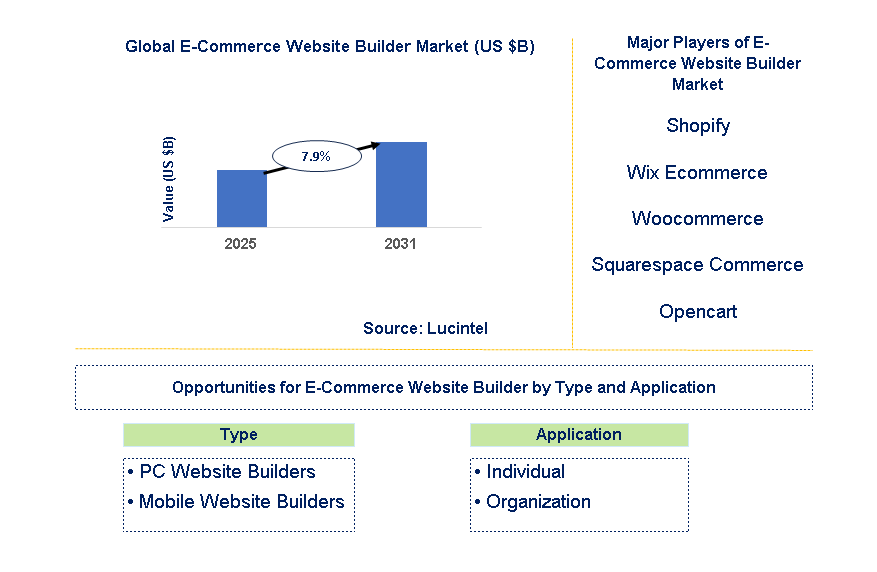
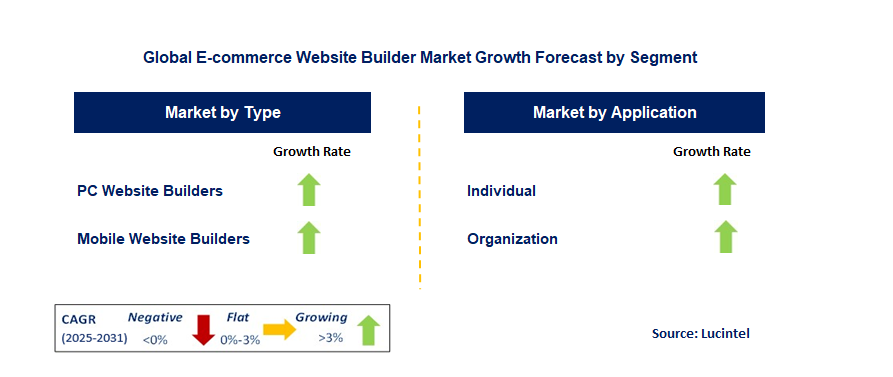
Key data points: The growth forecast = 7.9% annually for the next 7 years. Scroll below to get more insights. This market report covers Trends, opportunity and forecast in e-commerce website builder market to 2031 by type (pc website builders and mobile website builders), application (individual and organization), and region (North America, Europe, Asia Pacific, and the Rest of the World)
We'll send your sample report shortly.
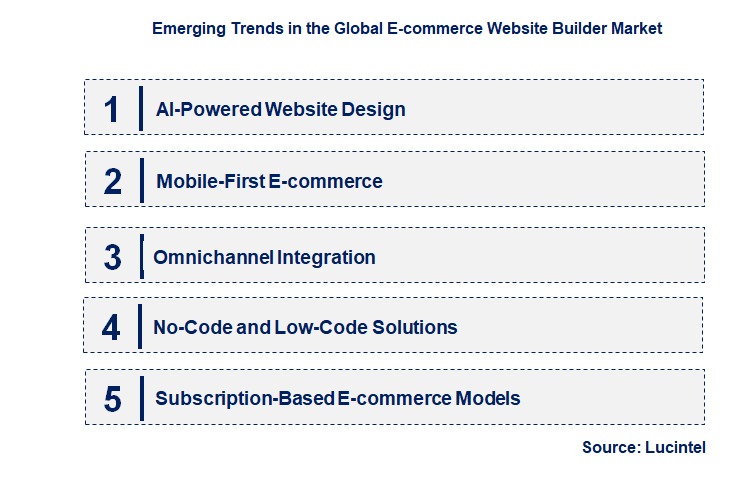
• AI-Powered Website Design: AI-driven design tools are making e-commerce site creation faster and more intuitive. By analyzing business data, these tools generate layouts, product descriptions, and personalized recommendations, reducing the need for manual customization and improving customer engagement with dynamic and adaptive site structures.
• Mobile-First E-commerce: With a majority of shoppers using mobile devices, e-commerce website builders are prioritizing mobile-first designs. Platforms now offer responsive templates, progressive web app (PWA) capabilities, and seamless checkout experiences optimized for small screens, improving user engagement and reducing cart abandonment rates.
• Omnichannel Integration: E-commerce platforms are integrating with social media, messaging apps, and marketplaces to offer a unified shopping experience. This allows businesses to manage multiple sales channels from one dashboard, providing real-time inventory updates, synchronized promotions, and a seamless customer journey across platforms.
• No-Code and Low-Code Solutions: The rise of no-code and low-code website builders is making e-commerce more accessible to small businesses and entrepreneurs. These platforms allow users to create fully functional online stores with drag-and-drop interfaces, eliminating the need for advanced technical skills while speeding up deployment.
• Subscription-Based E-commerce Models: Subscription-based e-commerce is gaining traction, leading to an increased demand for website builders that support recurring payment models. Platforms are introducing built-in features for managing subscriptions, memberships, and automated billing, enabling businesses to create sustainable revenue streams. These trends are transforming the e-commerce website builder market by making website creation more intuitive, personalized, and integrated. Businesses can now launch and scale online stores with minimal effort, ensuring a seamless shopping experience while keeping up with evolving customer expectations.
• AI-Driven Personalization: Advanced AI tools are now embedded in website builders, enabling real-time personalization. These tools analyze user behavior and customize website layouts, product recommendations, and marketing messages, improving engagement and boosting sales conversion rates.
• Faster and Lighter Websites: New developments in coding and hosting technologies are enabling e-commerce websites to load faster. Builders are optimizing content delivery networks (CDNs) and introducing lightweight themes to improve website speed, enhancing user experience and search engine rankings.
• Voice Search Optimization: With voice search on the rise, e-commerce website builders are adding tools for voice-based navigation and product searches. This feature helps businesses cater to users who prefer hands-free browsing, increasing accessibility and engagement.
• Enhanced Security Features: Cybersecurity threats are driving the adoption of advanced security tools. Website builders now include built-in fraud protection, SSL certificates, and automated security updates, ensuring safer transactions and compliance with global data protection laws.
• Integration with Local Payment Solutions: E-commerce website builders are expanding their support for region-specific payment gateways, allowing businesses to accept payments in local currencies and through preferred payment methods, improving conversion rates in global markets. These advancements are making e-commerce website builders more efficient, secure, and user-friendly. By incorporating AI, optimizing for speed, and enhancing security, businesses can create more engaging online stores that cater to the diverse needs of modern consumers.
• B2B E-commerce Expansion: The rise of B2B e-commerce is driving demand for website builders with bulk ordering, invoicing, and account-based pricing features. These solutions enable wholesalers and manufacturers to create professional online platforms tailored to business customers.
• Localized E-commerce Solutions: Website builders that offer multilingual support and local payment integrations are gaining popularity in international markets. Businesses seeking global expansion require tools that cater to different languages, currencies, and regional compliance standards.
• Dropshipping and Print-on-Demand Integration: The demand for dropshipping and print-on-demand businesses is rising, leading to growth opportunities for website builders that seamlessly integrate with suppliers and automate order fulfillment.
• Augmented Reality (AR) Shopping Experiences: E-commerce website builders are integrating AR tools to enhance product visualization. Customers can see how products look in real life before purchasing, reducing return rates and improving engagement.
• AI-Powered Customer Support: AI-driven chatbots and virtual assistants are being embedded into e-commerce websites, allowing businesses to provide 24/7 customer support and streamline sales processes, enhancing the overall shopping experience. These opportunities are driving innovation in the e-commerce website builder market, enabling businesses to create more customized, localized, and engaging shopping experiences while tapping into new revenue streams.
• Shopify
• Wix E-commerce
• WooCommerce
• Squarespace Commerce
• OpenCart
• Prestashop
• Magento
• Weebly E-commerce
• Ecwid
• BigCommerce
• Pc Website Builders
• Mobile Website Builders
• Individual
• Organization
• North America
• Europe
• Asia Pacific
• The Rest of the World
• United States: The U.S. market is seeing increased adoption of AI-powered website builders that automate design and content creation. Companies are integrating advanced analytics tools to improve customer experiences, while partnerships with third-party payment processors and logistics providers are making e-commerce platforms more efficient and scalable for small and large businesses alike.
• China: China is experiencing a surge in mobile-focused e-commerce website builders, driven by the dominance of mobile commerce. Local platforms are integrating with social media apps like WeChat and Douyin for seamless shopping experiences. Additionally, AI-driven chatbots and recommendation engines are improving personalization, increasing customer engagement and conversion rates.
• Germany: In Germany, compliance with GDPR and other data protection laws is influencing e-commerce website builders to offer enhanced security features. Businesses are prioritizing privacy-focused platforms with built-in legal compliance tools. Additionally, localizing websites for multilingual and multi-currency support is becoming essential to cater to the European market’s diverse customer base.
• India: In India, the growing startup ecosystem is fueling demand for cost-effective e-commerce website builders. Platforms are increasingly offering regional language support and easy integration with domestic payment gateways like UPI. The rise of social commerce is also pushing builders to include built-in marketing tools for WhatsApp and Instagram shopping.
• Japan: Japan is focusing on automation and AI-driven e-commerce solutions to enhance user experience. Platforms are incorporating voice search capabilities and virtual assistants to improve navigation. The demand for lightweight, fast-loading websites is rising due to Japan’s emphasis on high-performance digital experiences, influencing the development of minimalist and efficient e-commerce site designs.


• Shopify
• Wix E-commerce
• WooCommerce
• Squarespace Commerce
• OpenCart
• Prestashop
• Magento
• Weebly E-commerce
• Ecwid
• BigCommerce Q5. Which e-commerce website builder market segment will be the largest in future? Answer: Lucintel forecasts that pc website builders is expected to witness higher growth over the forecast period. Q6. In e-commerce website builder market, which region is expected to be the largest in next 5 years? Answer: APAC is expected to witness the highest growth over the forecast period. Q7. Do we receive customization in this report? Answer: Yes, Lucintel provides 10% customization without any additional cost.


Choose a license that fits your team. Instant PDF delivery.
Prices exclude taxes. Instant delivery. Custom licensing available on request.
Market Report · July 15, 2026
Market Report · June 26, 2026
Market Report · June 24, 2026
Trusted partner for strategic intelligence and business growth


Receive a complimentary market analysis tailored to your industry. Our analysts will identify key growth opportunities and competitive dynamics specific to your business.

Market size, growth rate, and key trend analysis for your specific sector.

Top competitor positioning and market share analysis.

Strategic recommendations backed by data-driven insights.
Get curated market intelligence and competitive moves straight to your inbox.
By subscribing, you agree to receive our monthly insights. Unsubscribe anytime.
Receive a complimentary market analysis tailored to your industry. Our analysts will identify key growth opportunities and competitive dynamics specific to your business.
Market size, growth rate, and key trend analysis for your specific sector.
Top competitor positioning and market share analysis.
Strategic recommendations backed by data-driven insights.
Get curated market intelligence, emerging trends, and competitive moves straight to your inbox each month.
By subscribing, you agree to receive our monthly insights. Unsubscribe anytime.
We'll send your sample report shortly.