
Market Report · July 16, 2026

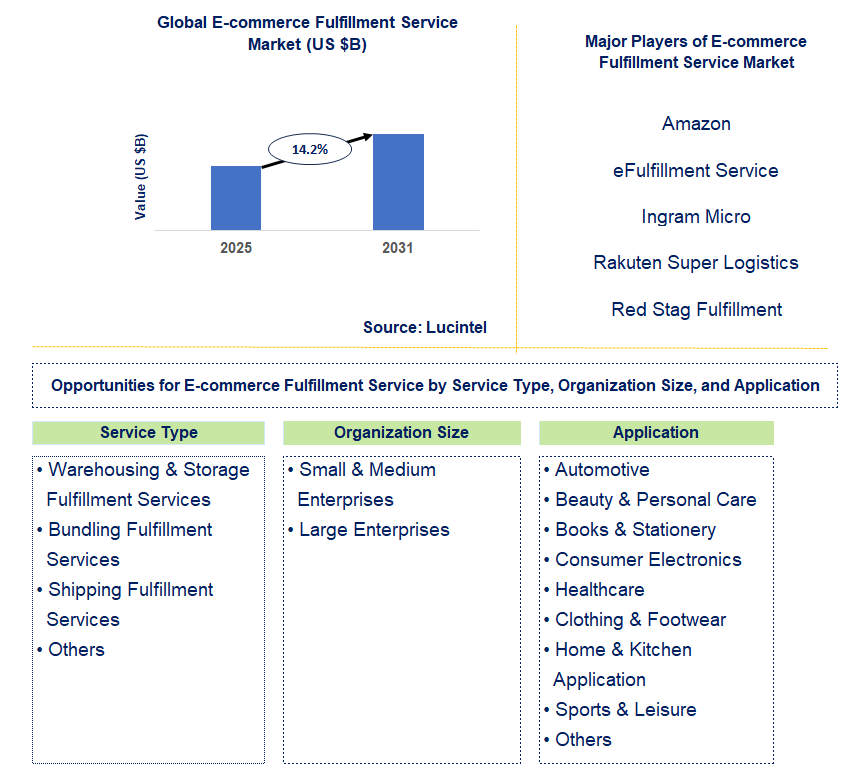
Key data points: The growth forecast = 14.2% annually for the next 7 years. Scroll below to get more insights. This market report covers trends, opportunities and forecasts in E-commerce fulfillment service market to 2031 by service type (warehousing & storage fulfillment services, bundling fulfillment services, shipping fulfillment services, and others), organization size (small & medium enterprises and large enterprises), application (automotive, beauty & personal care, books & stationery, consumer electronics, healthcare, clothing & footwear, home & kitchen application, sports & leisure, and others), and region (North America, Europe, Asia Pacific, and the Rest of the World)
We'll send your sample report shortly.
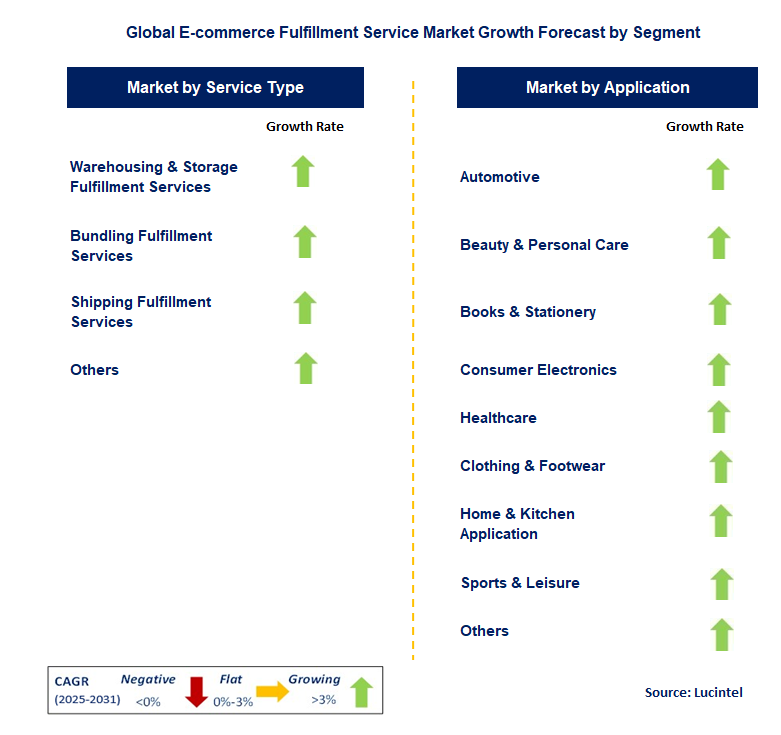
• Lucintel forecasts that, within the service type category, shipping fulfillment service is expected to witness the highest growth over the forecast period.
• Within the application category, consumer electronic is expected to witness the highest growth.
• In terms of region, North America is expected to witness the highest growth over the forecast period. Gain valuable insights for your business decisions with our comprehensive 150+ page report. Sample figures with some insights are shown below.
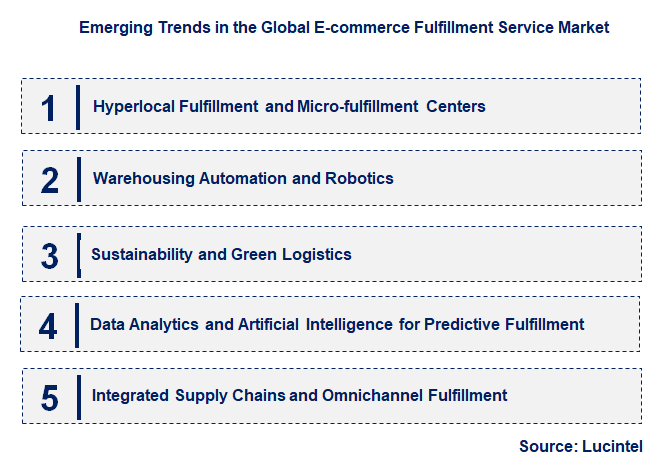
• Hyperlocal Fulfillment and Micro-fulfillment Centers: Hyperlocal fulfillment is a technique of placing smaller warehouses or micro-fulfillment centers in urban settings, close to the end user. This new trend is being driven by the tremendous demand for same-day and even hourly delivery. It allows the minimization of the last-mile distance, and thus, delivery times and costs are dramatically reduced. These small facilities use automation and streamlined inventory management to rapidly process orders, enabling retailers to satisfy customer demands for speed and convenience in high-density areas.
• Warehousing Automation and Robotics: The growing use of automation and robotics in fulfillment centers for E-commerce is a revolutionary trend. This encompasses autonomous mobile robots (AMRs) for sorting and picking, automated storage and retrieval systems (AS/RS), and robotic arms for packing. Automation helps resolve issues like labor shortages, enhances operational efficiency, raises order accuracy, and speeds up the processing of large volumes of orders, particularly during peak periods. It minimizes human error and enables 24/7 operations, maximizes throughput, and lowers per-unit fulfillment cost.
• Sustainability and Green Logistics: Sustainability is now a key E-commerce fulfillment trend, fueled by customers' demand for green practices and mounting regulatory pressures. This includes activities like route optimization to lower fuel usage, electric vehicles for last-mile delivery, recyclable or biodegradable packaging materials, and reverse logistics for smooth returns and recycling. Organizations are making investments in green warehouse solutions and working towards reducing their carbon footprint across the entire fulfillment cycle, improving brand reputation and attracting eco-aware customers.
• Data Analytics and Artificial Intelligence for Predictive Fulfillment: Leveraging data analytics and Artificial Intelligence (AI) for predictive fulfillment is a fast-growing trend. AI engines scan enormous datasets, such as previous sales, seasonal trends, real-time inventory levels, and even weather patterns, to effectively predict demand. This allows companies to purposefully pre-position inventory closer to where there is expected customer demand, saving on shipping time and expense. Predictive analytics also optimizes warehouse operations, staff levels, and delivery routes, resulting in more efficient and proactive fulfillment strategies.
• Integrated Supply Chains and Omnichannel Fulfillment: True omnichannel retail, where customers are able to shop anyplace and still have a seamless experience among online stores, physical stores, and marketplaces, is propelling the movement toward integrated fulfillment. It involves having inventory and order fulfillment managed through all channels from one system. Firms are investing in solutions that give them a single view of inventory and support flexible fulfillment methods, including buy online pick up in store (BOPIS), ship from store, and return in store. These actions increase convenience for customers and maximize inventory use throughout the supply chain. These new trends are in essence transforming the E-commerce fulfillment market. Hyperlocal fulfillment responds to the demand for velocity, while robotics and automation make processes more efficient and precise. The emphasis on sustainability is a response to increased environmental awareness, and data analytics coupled with AI is transforming forecasting and inventory management. Last but not least, omnichannel fulfillment is dissolving channel silos and creating a more unified and customer-centric experience. Collectively, these trends are propelling a faster, smarter, and greener future for E-commerce logistics.
• Growth of Robotics and Automation in Warehouses: One key recent trend is the rapid growth of robotics and automation technology in E-commerce fulfillment warehouses. This encompasses the use of Autonomous Mobile Robots (AMRs) to transport products, robot picking systems, and sophisticated conveyor and sortation systems. This has been spurred by rising order volume, the ongoing issue of labor shortages, and the necessity for increased efficiency and accuracy and eventually accelerating the order fulfillment process and lowering operational expenses.
• Micro-fulfillment Centers and Urban Warehousing Growth: The growth of micro-fulfillment centers (MFCs) and the trend towards urban warehousing is a notable advancement. These smaller, strategically positioned facilities are nearer to urban consumer pools, facilitating ultra-fast delivery options such as same-day or even sub-hour delivery. This trend meets the expanding consumer need for immediacy, minimizes last-mile transportation expenses, and facilitates more efficient inventory deployment segmented to geographic markets.
• Greater Emphasis on Sustainable Fulfillment Strategies: Sustainability has become a point of utmost importance in E-commerce fulfillment. The recent trends involve the use of sustainable packaging materials, route optimization of deliveries to reduce carbon footprint, and investment in electric delivery fleets. Firms are also studying carbon-neutral shipping methods and instituting effective reverse logistics chains for recycling and returns, both due to corporate social responsibility as well as consumer demand for environmentally friendly brands.
• Artificial Intelligence and Data Analytics Integration: Integration of Artificial Intelligence (AI) and data analytics has transformed E-commerce fulfillment. It makes it possible to do better demand forecasting, optimize inventory location, and have smart routing for deliveries. AI can forecast what people will buy, detect where there might be disruptions in the supply chain, and make decisions automatically, resulting in better operational efficiency, less waste, and higher customer satisfaction by proactive management.
• Expansion of Third-Party Logistics Partnerships: Partnerships with Third-Party Logistics (3PL) providers have grown considerably. E-commerce companies, in particular small and medium-sized businesses, are finding it increasingly desirable to outsource their fulfillment operations to 3PLs in order to take advantage of their knowledge, infrastructure, and economies of scale. This permits companies to concentrate on their core competencies while enjoying sophisticated fulfillment technologies, greater distribution networks, and increased efficiency with little capital outlay. All these advancements are having a very deep influence in the E-commerce fulfillment industry by propelling it towards higher efficiency, speed, and sustainability. The higher adoption of automation and micro-fulfillment centers is immediately solving consumers' calls for quicker delivery. The emphasis on sustainability is redefining working patterns, and the adoption of AI and data analytics is making more smart and anticipatory fulfillment possible. Furthermore, the growth of 3PL partnerships is democratizing access to advanced fulfillment capabilities, collectively transforming how products reach consumers worldwide.
• Direct-to-Consumer Brands: The growth of direct-to-consumer (D2C) brands in multiple product categories is a huge growth opportunity. They usually do not have the in-store logistics capabilities that come with larger players and depend significantly on outsourced fulfillment. Growth strategy is to provide flexible, scalable, and personalized fulfillment solutions, such as customized packaging, optimized returns management, and data-driven insights to enable D2C brands to sustain good customer relationships and fast growth without heavy capital expenditures.
• Subscription Box Services: The quick surge in popularity of subscription box services, which provide carefully curated products shipped at regular intervals, presents a special opportunity for fulfillment. Such services demand customized handling, exact kitting, and regular scheduled shipments. Strategic expansion includes designing bespoke fulfillment services that can accommodate recurring billing schedules, tailor product mixes, and enable timely and correct delivery of every subscription box with an emphasis on operational simplicity and the inability to make mistakes.
• Cross-Border E-commerce: The growing international reach of E-commerce, where consumers buy items from global sellers, is a major strategic growth opportunity. Cross-border fulfillment requires the ability to meet complex customs rules, international shipping infrastructure, and varied delivery expectations in various nations. Opportunities exist in establishing strong international fulfillment networks, providing customs clearance services, multi-currency payment processing, and effective reverse logistics for international returns to simplify global trade for online retailers.
• Omnichannel Retailers: For brick-and-mortar stores moving to or growing online, omnichannel fulfillment provides a growth opportunity. This includes syncing online and offline inventory and order management to enable seamless customer experiences like buy online, pick up in store (BOPIS) or ship from store. Strategic expansion here is in building advanced fulfillment systems that coordinate stock across all channels, route orders for maximum efficiency, and provide flexible delivery and return capabilities, driving maximum sales and convenience to customers.
• Returns Management: The increasing amount of E-commerce returns, typically an expensive and complicated aspect of the fulfillment process, is a critical, yet frequently ignored, strategic growth potential. Effective reverse logistics solutions are essential in managing returns, examining products, re stocking, or dealing with repairs/disposals. Creating efficient, low-cost, and eco-friendly returns handling services can create considerable value for E-commerce companies, assisting them in offsetting losses and improving client satisfaction by creating convenient return experiences. These growth opportunities, strategic in nature, are actually transforming the E-commerce fulfillment industry. Direct-to-consumer and subscription box models are pushing the demand for highly specialized and flexible fulfillment. Cross-border E-commerce is demanding strong international logistics, while omnichannel retail necessitates end-to-end inventory and delivery integration. Additionally, the growing emphasis on efficient returns management indicates a significant area for value-added services. By satisfying the specific requirements of these prominent applications, fulfillment providers can release new streams of revenue and establish their footing in the fast-growing E-commerce landscape.
• Amazon
• eFulfillment Service
• Ingram Micro
• Rakuten Super Logistics
• Red Stag Fulfillment
• ShipBob
• Shipfusion
• Xpert Fulfillment
• Sprocket Express
• FedEx
• Warehousing & Storage Fulfillment Services
• Bundling Fulfillment Services
• Shipping Fulfillment Services
• Others
• Small & Medium Enterprises
• Large Enterprises
• North America
• Europe
• Asia Pacific
• The Rest of the World
• United States: The United States E-commerce fulfillment industry is marked by high investment in automation and robotics in fulfillment centers fueled by labor shortages and the need for speedy delivery. Hyper-scale centers are getting bigger, and there is increasing movement towards regional distribution networks to support same-day and next-day delivery capabilities. Firms are also concentrating on last-mile delivery optimization through collaboration with local carriers and venturing into emerging modes such as drone and autonomous vehicle delivery.
• China: China's electronic commerce fulfillment industry is highly developed, and China is at the forefront of automation, artificial intelligence, and complex logistics networks in the world. There is extensive deployment of smart warehouses equipped with robots for picking and packing. Social commerce and live commerce are integrated intensively with fulfillment and demand extremely rapid and efficient delivery. Cross-border E-commerce fulfillment is also a prominent area of growth with Chinese businesses scaling up to global markets and perfecting international logistics.
• Germany: In Germany, the E-commerce fulfillment industry is highly driven by an emphasis on sustainability and adherence to tough environmental regulations, specifically in packaging. Increased demand for environmentally friendly packaging solutions and optimized shipping routes to minimize carbon emissions is on the rise. Automation in warehouses is on the rise, but with a particular focus on effective space optimization and the incorporation of sophisticated analytics for inventory control, with a view to ensuring consistent and sustainable operations.
• India: India's E-commerce fulfillment industry is experiencing fast growth, driven by rising internet penetration, a burgeoning middle class, and official initiatives to promote digital trade. The important trends include the deployment of micro-fulfillment centers in urban locations for same-day delivery expectations and more investment in third-party logistics (3PL) alliances. Automation is increasingly being implemented to drive efficiency, especially in sorting and stock management, as the market grows to serve burgeoning needs.
• Japan: Japan's E-commerce fulfillment landscape is characterized by its extremely high levels of delivery punctuality and customer service standards. Recent trends involve more investment in cutting-edge inventory management systems as well as advanced last-mile delivery technology to accommodate highly specific time-slot delivery expectations. There is also a trend towards enhancing technology integration for improved parcel tracking and green packaging innovation, all with the typical Japanese focus on scrupulous service quality.


• Amazon
• eFulfillment Service
• Ingram Micro
• Rakuten Super Logistics
• Red Stag Fulfillment
• ShipBob
• Shipfusion
• Xpert Fulfillment
• Sprocket Express
• FedEx Q5. Which E-commerce fulfillment service market segment will be the largest in future? Answer: Lucintel forecasts that, within the service type category, shipping fulfillment service is expected to witness the highest growth over the forecast period. Q6. In E-commerce fulfillment service market, which region is expected to be the largest in next 5 years? Answer: In terms of region, North America is expected to witness the highest growth over the forecast period. Q7. Do we receive customization in this report? Answer: Yes, Lucintel provides 10% customization without any additional cost.


Choose a license that fits your team. Instant PDF delivery.
Prices exclude taxes. Instant delivery. Custom licensing available on request.
Market Report · July 16, 2026
Market Report · May 18, 2026
Market Report · May 18, 2026
Trusted partner for strategic intelligence and business growth


Receive a complimentary market analysis tailored to your industry. Our analysts will identify key growth opportunities and competitive dynamics specific to your business.

Market size, growth rate, and key trend analysis for your specific sector.

Top competitor positioning and market share analysis.

Strategic recommendations backed by data-driven insights.
Get curated market intelligence and competitive moves straight to your inbox.
By subscribing, you agree to receive our monthly insights. Unsubscribe anytime.
Receive a complimentary market analysis tailored to your industry. Our analysts will identify key growth opportunities and competitive dynamics specific to your business.
Market size, growth rate, and key trend analysis for your specific sector.
Top competitor positioning and market share analysis.
Strategic recommendations backed by data-driven insights.
Get curated market intelligence, emerging trends, and competitive moves straight to your inbox each month.
By subscribing, you agree to receive our monthly insights. Unsubscribe anytime.
We'll send your sample report shortly.