
Market Report · July 16, 2026

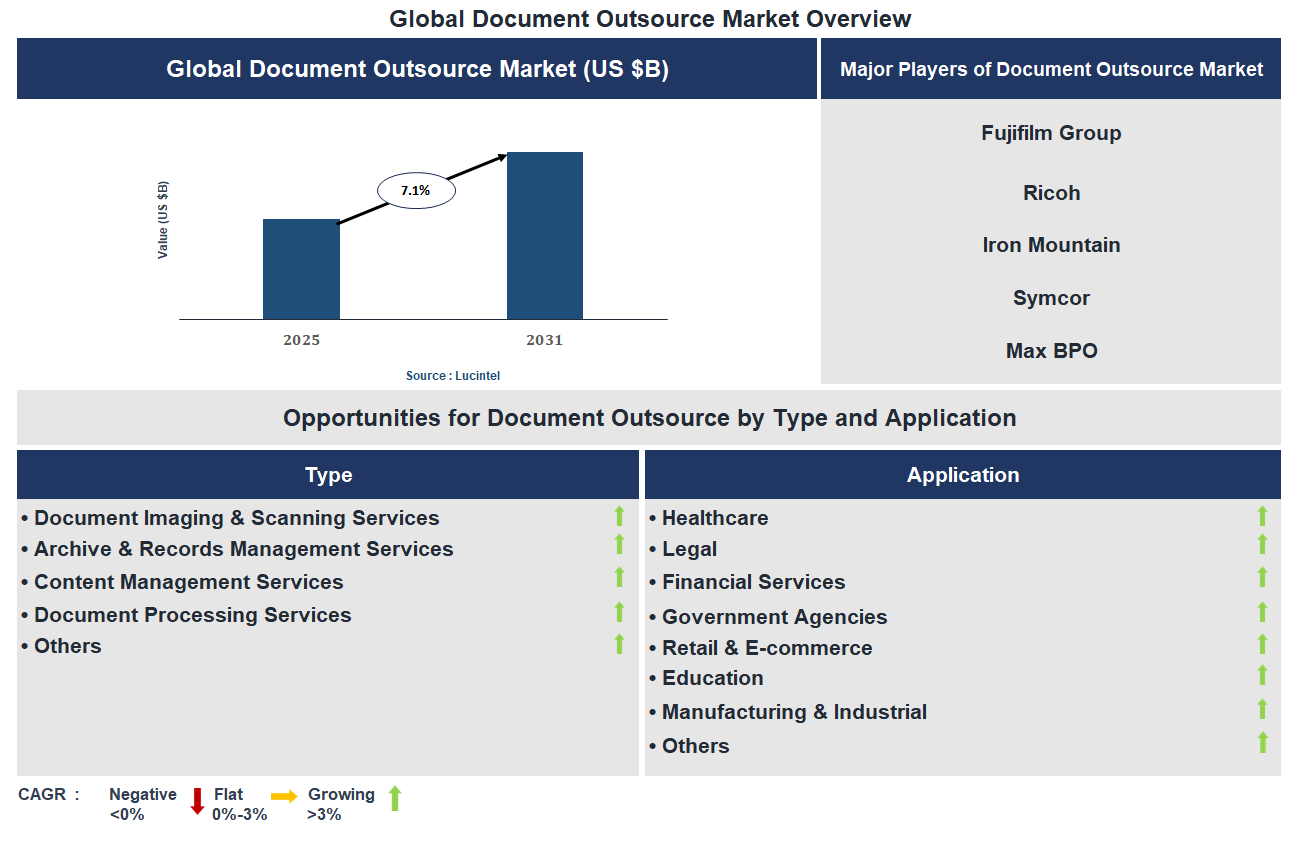
Key data points: The growth forecast = 7.1% annually for the next 7 years. Scroll below to get more insights. This market report covers trends, opportunities and forecasts in document outsource market to 2031 by type (document imaging & scanning services, archive & records management services, content management services, document processing services, and others), application (healthcare, legal, financial services, government agencies, retail & e-commerce, education, manufacturing & industrial, and others), and region (North America, Europe, Asia Pacific, and the Rest of the World)
We'll send your sample report shortly.
• Lucintel forecasts that, within the type category, document imaging & scanning service is expected to witness the highest growth over the forecast period.
• Within the application category, healthcare is expected to witness the highest growth.
• In terms of region, APAC is expected to witness the highest growth over the forecast period. Gain valuable insights for your business decisions with our comprehensive 150+ page report. Sample figures with some insights are shown below.
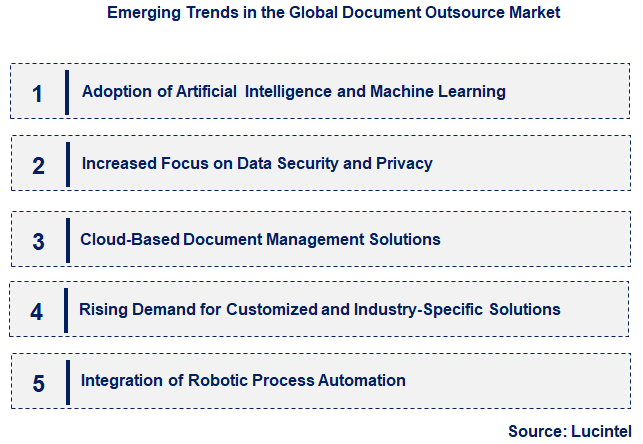
• Adoption of Artificial Intelligence and Machine Learning: AI and machine learning are revolutionizing document processing by enabling automated data extraction, classification, and analysis. These technologies improve accuracy, reduce manual effort, and speed up workflows, leading to cost savings and enhanced productivity. Organizations are increasingly integrating AI-driven solutions to handle large volumes of documents efficiently, which also enhances compliance and reduces errors. As AI continues to evolve, its role in automating complex document tasks will expand, making it a critical component of future outsourcing strategies.
• Increased Focus on Data Security and Privacy: With rising concerns over data breaches and regulatory compliance, security has become a top priority in document outsourcing. Providers are investing in advanced encryption, secure access controls, and compliance frameworks such as GDPR and HIPAA. This trend ensures sensitive information remains protected throughout the document lifecycle. Clients demand transparency and assurance that their data is handled securely, prompting providers to adopt robust security measures. As data privacy regulations tighten globally, security will remain a key differentiator in the market.
• Cloud-Based Document Management Solutions: Cloud technology is transforming document outsourcing by offering scalable, flexible, and cost-effective storage and management options. Cloud-based platforms facilitate remote access, real-time collaboration, and seamless integration with other enterprise systems. This trend reduces the need for physical infrastructure and enables organizations to adapt quickly to changing business needs. The shift to cloud solutions also enhances disaster recovery capabilities and simplifies compliance reporting. As cloud adoption accelerates, providers offering secure, user-friendly cloud services will gain a competitive edge.
• Rising Demand for Customized and Industry-Specific Solutions: Clients increasingly seek tailored document outsourcing services that cater to their unique industry requirements. Providers are developing specialized solutions for sectors such as healthcare, legal, finance, and government, incorporating industry standards and compliance needs. Customization improves efficiency, accuracy, and regulatory adherence, leading to better client satisfaction. This trend encourages providers to deepen industry expertise and develop flexible service models, fostering long-term partnerships. As industries evolve, demand for highly specialized document management solutions will continue to grow.
• Integration of Robotic Process Automation: RPA is being widely adopted to automate repetitive, rule-based document tasks such as data entry, validation, and routing. This technology reduces manual labor, minimizes errors, and accelerates processing times. RPA integration allows for end-to-end automation of document workflows, freeing up human resources for more strategic activities. The impact is significant cost reduction and improved operational efficiency. As RPA technology matures, its adoption will expand across various document management functions, further transforming the outsourcing landscape and enabling smarter, more agile operations. In summary, these emerging trends—AI integration, enhanced security, cloud solutions, industry-specific customization, and RPA adoption—are collectively reshaping the document outsource market. They drive increased efficiency, security, and flexibility, enabling providers to meet evolving client demands and stay competitive in a dynamic environment. These developments are fostering innovation and setting new standards for document management excellence worldwide.
• Adoption of Cloud-Based Solutions: The shift to cloud platforms has revolutionized document outsourcing by offering scalable, flexible, and cost-effective services. Cloud solutions enable real-time access, improved collaboration, and enhanced security, which are critical for global organizations. This development has led to increased market penetration, especially among small and medium-sized enterprises, and has driven down costs while improving service delivery. As cloud technology continues to evolve, providers are integrating AI and automation to further optimize document management processes, making cloud-based outsourcing a dominant trend.
• Integration of Artificial Intelligence and Automation: AI and automation are transforming document outsourcing by enabling intelligent data extraction, classification, and workflow automation. These technologies reduce manual effort, minimize errors, and accelerate processing times. The impact is significant, as organizations can now handle large volumes of documents efficiently while ensuring compliance and security. Providers investing in AI-driven solutions are gaining competitive advantages, leading to improved customer satisfaction and operational efficiencies. This trend is expected to continue as AI capabilities expand and become more sophisticated.
• Focus on Data Security and Compliance: With increasing regulatory requirements such as GDPR and HIPAA, data security and compliance have become top priorities in the document outsource market. Providers are adopting advanced encryption, secure access controls, and audit trails to protect sensitive information. This focus enhances client trust and mitigates legal risks, making security a key differentiator among service providers. The market is witnessing a surge in demand for compliant solutions, prompting providers to innovate and invest heavily in security infrastructure to meet evolving standards.
• Rising Demand from Healthcare and Legal Sectors: The healthcare and legal industries are major drivers of growth in the document outsource market due to their extensive documentation needs. These sectors require secure, accurate, and timely management of sensitive records, which outsourcing providers are now delivering effectively. The demand is fueled by increasing regulatory scrutiny and the need for efficient record-keeping. This trend has expanded the market scope, encouraging providers to develop specialized services tailored to industry-specific requirements, thereby boosting overall market growth.
• Expansion of Nearshore and Onshore Outsourcing: To address concerns related to data security, latency, and regulatory compliance, many organizations are shifting towards nearshore and onshore outsourcing options. These alternatives offer better control, cultural alignment, and faster communication. The trend is driven by the need for more secure and compliant document management solutions, especially in highly regulated industries. This development has diversified the market, creating new opportunities for providers to offer localized services and strengthen client relationships, ultimately enhancing market competitiveness. In summary, these recent developments are significantly impacting the document outsource market by increasing efficiency, security, and compliance. The adoption of cloud and AI technologies is driving innovation, while sector-specific demands and regional outsourcing preferences are broadening market scope. Overall, these trends are fostering a more dynamic, secure, and customer-centric environment, positioning the market for sustained growth and technological advancement.
• Enhanced Data Security and Compliance: Financial institutions require secure document management solutions to meet stringent regulatory standards. Outsourcing enables these organizations to ensure data integrity, reduce fraud risks, and maintain compliance with industry regulations, thereby improving trust and operational efficiency.
• Digital Transformation and Patient Data Management: The healthcare sector benefits from outsourcing by digitizing patient records, streamlining administrative processes, and ensuring data privacy. This improves patient care, reduces errors, and facilitates easier data sharing among providers, ultimately enhancing healthcare delivery.
• Document Automation and E-Discovery: Legal firms are increasingly outsourcing document processing for automation and e-discovery. This reduces manual effort, accelerates case preparation, and improves accuracy, leading to faster legal proceedings and cost savings.
• Supply Chain Documentation and Compliance: Manufacturing companies outsource documentation related to supply chain management, quality control, and regulatory compliance. This ensures timely updates, reduces errors, and supports global trade operations, boosting overall productivity.
• Digital Archiving and Records Management: Governments outsource document archiving to digitize records, improve accessibility, and ensure long-term preservation. This enhances transparency, reduces storage costs, and facilitates quick retrieval of information. In summary, these growth opportunities are significantly impacting the document outsource market by driving innovation, improving efficiency, and enabling organizations to meet evolving regulatory and operational demands. As these applications expand, the market is poised for sustained growth, offering new avenues for service providers and end-users alike.
• Technological Advancements: The rapid evolution of digital technologies, including cloud computing, artificial intelligence, and automation, has transformed document management. These innovations enable organizations to process, store, and retrieve documents more efficiently, reducing manual effort and operational costs. Cloud-based solutions facilitate remote access and collaboration, expanding market reach. AI-powered tools improve accuracy and speed in data extraction and classification, enhancing service quality. As technology continues to evolve, the market benefits from increased scalability, flexibility, and security, making outsourcing more attractive to a broad range of industries seeking digital transformation.
• Cost Efficiency and Focus on Core Activities: Outsourcing document management allows organizations to significantly reduce operational costs associated with in-house processing, such as staffing, infrastructure, and maintenance. By delegating these tasks to specialized providers, companies can reallocate resources toward core business activities, fostering innovation and growth. Cost savings are particularly crucial for small and medium-sized enterprises aiming to remain competitive. Additionally, outsourcing offers predictable expenses and access to advanced technology without substantial capital investment. This economic advantage encourages more organizations to adopt document outsourcing solutions, fueling market expansion.
• Increasing Regulatory and Compliance Requirements: Stringent data security, privacy laws, and industry-specific regulations compel organizations to ensure proper document handling and storage. Outsourcing providers often possess specialized expertise and infrastructure to meet these compliance standards, making them preferred partners. The need for secure document disposal, audit trails, and data encryption drives demand for compliant outsourcing services. As regulatory landscapes become more complex globally, organizations seek reliable partners to mitigate risks and avoid penalties. This regulatory pressure acts as a catalyst for market growth, emphasizing the importance of secure, compliant document management solutions.
• Growing Digital Transformation Initiatives: The global shift toward digital transformation across industries accelerates the adoption of document outsourcing. Companies seek to digitize paper-based processes, improve workflow automation, and enhance data accessibility. Outsourcing providers offer tailored solutions that support these initiatives, enabling seamless migration to digital platforms. This trend is driven by the need for operational agility, improved customer experience, and competitive advantage. As organizations increasingly prioritize digital strategies, the demand for outsourced document management services rises, contributing to market growth and innovation.
• Rising Demand from Various Sectors: Sectors such as healthcare, banking, legal, and government are experiencing increased demand for document outsourcing due to their high volume of sensitive data and regulatory obligations. Healthcare providers outsource patient records management, while banks outsource loan documentation processing. Legal firms rely on outsourcing for case files, and government agencies seek efficient document handling solutions. The sector-specific needs for security, compliance, and efficiency propel market expansion. As these industries continue to digitize and streamline operations, the demand for specialized document outsourcing services is expected to grow, further driving the market. The challenges facing the document outsource market include:
• Data Security and Privacy Concerns: Handling sensitive information through outsourcing raises significant security risks. Data breaches, cyberattacks, and unauthorized access can compromise confidential documents, leading to legal and reputational damage. Organizations are cautious about entrusting third-party providers with critical data, especially in regulated industries. Ensuring robust security measures, compliance with data protection laws, and continuous monitoring is essential but can be costly and complex. These concerns may hinder market growth as companies weigh the risks of outsourcing against potential benefits, emphasizing the need for trusted, secure solutions.
• Regulatory and Legal Complexities: Navigating diverse and evolving regulatory frameworks across regions presents a major challenge. Different countries have varying standards for data privacy, retention, and disposal, complicating compliance efforts for outsourcing providers. Legal ambiguities and jurisdictional issues can lead to delays, penalties, or disputes. Providers must invest heavily in legal expertise and infrastructure to meet these requirements, increasing operational costs. This complexity can act as a barrier for new entrants and limit market expansion, especially for providers lacking global compliance capabilities.
• Technological Integration and Compatibility Issues: Integrating outsourced document management systems with existing enterprise infrastructure can be complex. Compatibility issues, data migration challenges, and system interoperability problems may cause disruptions and delays. Additionally, rapid technological changes require continuous updates and staff training, increasing operational complexity. Organizations may also face resistance to change from employees accustomed to legacy systems. These technical hurdles can impede seamless outsourcing adoption, increase costs, and slow down market growth, emphasizing the need for robust integration strategies and technological investments. In summary, the document outsource market is driven by technological innovation, cost advantages, regulatory compliance, digital transformation, and sector-specific demands. However, concerns over data security, regulatory complexities, and integration challenges pose significant hurdles. The interplay of these drivers and challenges shapes the market’s trajectory, requiring stakeholders to adopt strategic, secure, and compliant solutions to capitalize on growth opportunities while mitigating risks. Overall, the market is poised for continued expansion, provided that these challenges are effectively addressed through technological advancements and robust security frameworks.
• Fujifilm Group
• Ricoh
• Iron Mountain
• Symcor
• Max BPO
• Symcor
• HP
• Lexmark
• Apogee Corporation
• Canon
• Document Imaging & Scanning Services
• Archive & Records Management Services
• Content Management Services
• Document Processing Services
• Others
• Healthcare
• Legal
• Financial Services
• Government Agencies
• Retail & E-commerce
• Education
• Manufacturing & Industrial
• Others
• North America
• Europe
• Asia Pacific
• The Rest of the World
• United States: The US market has seen rapid adoption of AI-powered document processing tools, improving accuracy and speed. Cloud-based solutions are increasingly favored for scalability and remote access. Regulatory compliance, especially in healthcare and finance, remains a key focus, prompting investments in secure document management systems. Major tech firms are expanding their offerings, fostering innovation and competition.
• China: China’s document outsource market is expanding with a focus on automation and smart document solutions. Government initiatives promote digital government services, boosting demand for efficient document handling. Local companies are investing heavily in AI and big data analytics to enhance document processing capabilities. The market is also driven by the rapid growth of e-commerce and digital payments, requiring secure and efficient document management.
• Germany: Germany emphasizes data security and compliance with strict EU regulations like GDPR. The market is characterized by high-quality, customized document outsourcing services tailored for manufacturing, automotive, and financial sectors. There is a growing trend toward integrating document management with enterprise resource planning (ERP) systems. Sustainability and eco-friendly practices are also influencing service providers’ strategies.
• India: India’s document outsource market is booming due to cost advantages and a large, skilled workforce. The adoption of automation and AI is increasing to improve efficiency and reduce manual errors. The government’s push for digital India initiatives is fostering growth in digital document services. The market is also expanding into sectors like healthcare, banking, and telecom, driven by rising demand for secure and compliant document handling.
• Japan: Japan’s market focuses on advanced security features and high-quality service delivery. The adoption of robotic process automation (RPA) is streamlining document workflows. Companies are investing in secure cloud solutions to meet stringent data privacy standards. The aging population and increasing regulatory requirements are prompting innovations in document management, especially in healthcare and finance sectors, emphasizing reliability and security.


• Fujifilm Group
• Ricoh
• Iron Mountain
• Symcor
• Max BPO
• Symcor
• HP
• Lexmark
• Apogee Corporation
• Canon Q5. Which document outsource market segment will be the largest in future? Answer: Lucintel forecasts that, within the type category, document imaging & scanning service is expected to witness the highest growth over the forecast period. Q6. In document outsource market, which region is expected to be the largest in next 5 years? Answer: In terms of region, APAC is expected to witness the highest growth over the forecast period. Q7. Do we receive customization in this report? Answer: Yes, Lucintel provides 10% customization without any additional cost.


Choose a license that fits your team. Instant PDF delivery.
Prices exclude taxes. Instant delivery. Custom licensing available on request.
Market Report · July 16, 2026
Market Report · May 18, 2026
Market Report · May 18, 2026
Trusted partner for strategic intelligence and business growth


Receive a complimentary market analysis tailored to your industry. Our analysts will identify key growth opportunities and competitive dynamics specific to your business.

Market size, growth rate, and key trend analysis for your specific sector.

Top competitor positioning and market share analysis.

Strategic recommendations backed by data-driven insights.
Get curated market intelligence and competitive moves straight to your inbox.
By subscribing, you agree to receive our monthly insights. Unsubscribe anytime.
Receive a complimentary market analysis tailored to your industry. Our analysts will identify key growth opportunities and competitive dynamics specific to your business.
Market size, growth rate, and key trend analysis for your specific sector.
Top competitor positioning and market share analysis.
Strategic recommendations backed by data-driven insights.
Get curated market intelligence, emerging trends, and competitive moves straight to your inbox each month.
By subscribing, you agree to receive our monthly insights. Unsubscribe anytime.
We'll send your sample report shortly.