
Market Report · July 15, 2026

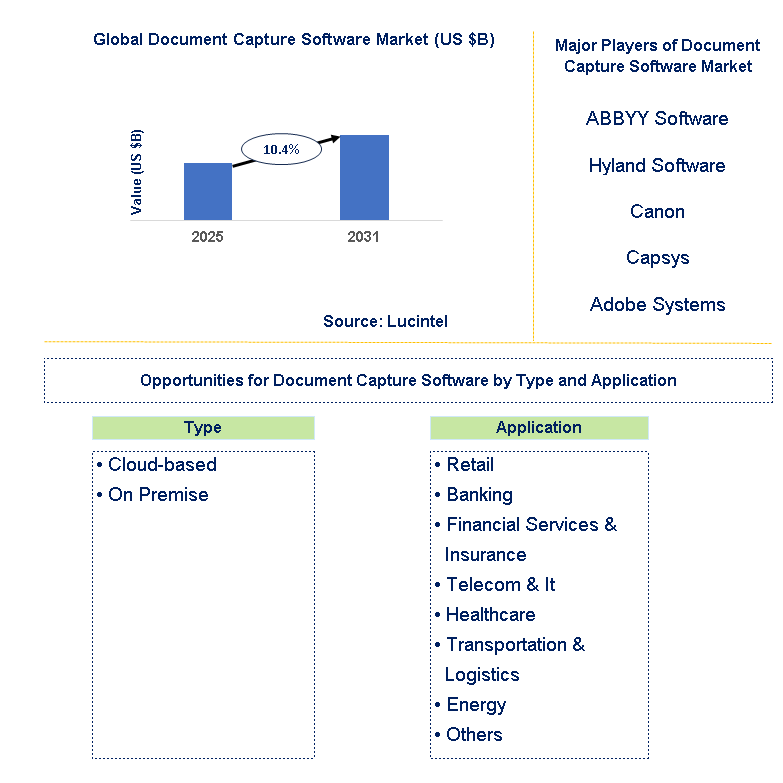
Key data points: The growth forecast = 10.4% annually for the next 7 years. Scroll below to get more insights. This market report covers trends, opportunities and forecasts in document capture software market to 2031 by type (cloud-based and on premise), application (retail, banking, financial services & insurance, telecom & it, healthcare, transportation & logistics, energy, and others), and region (North America, Europe, Asia Pacific, and the Rest of the World)
We'll send your sample report shortly.
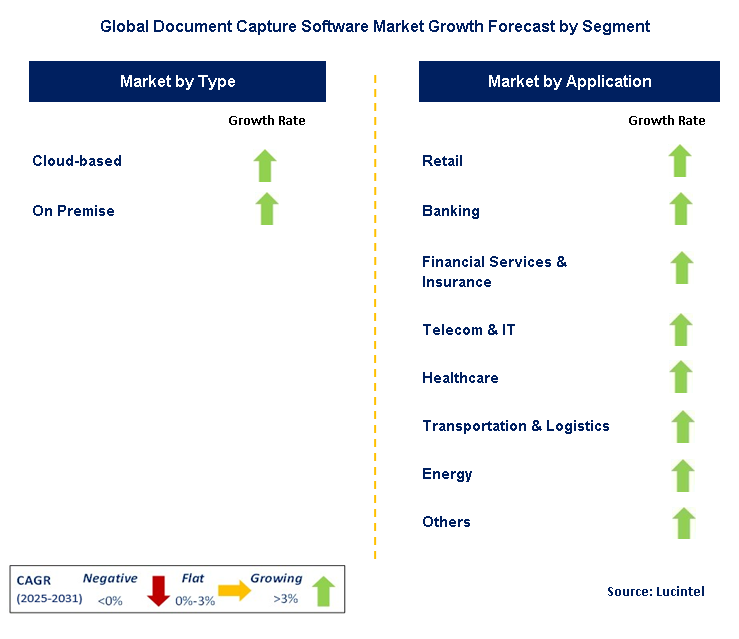
• Lucintel forecasts that, within the type category, cloud-based is expected to witness higher growth over the forecast period.
• Within the application category, financial services & insurance is expected to witness the highest growth.
• In terms of region, North America is expected to witness the highest growth over the forecast period. Gain valuable insights for your business decisions with our comprehensive 150+ page report. Sample figures with some insights are shown below.
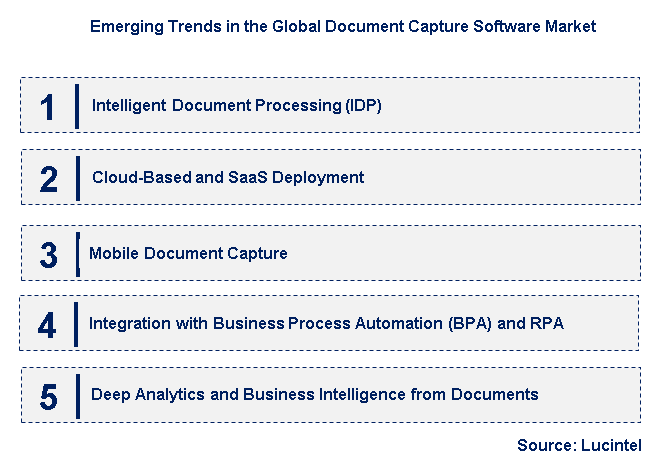
• Intelligent Document Processing (IDP): This direction encompasses the embedding of AI, machine learning, and natural language processing (NLP) within document capture to automatically classify, extract, and validate data from both structured and unstructured documents. In contrast to conventional OCR, IDP is context-aware and learns over time. The effect is a significant decrease in manual data entry and processing errors, speeding up such processes as invoice processing, claims processing, and customer onboarding. It allows organizations to release insightful information from vexing documents, greatly enhancing efficiency and accuracy.
• Cloud-Based and SaaS Deployment: Cloud-based and Software as a Service (SaaS) deployment strategies are a prevalent trend. This enables companies to utilize document capture functionality over the web, eliminating the requirement for on-premise hardware and maintenance. The effect is increased scalability, flexibility, and cost savings. Cloud-based solutions enable remote work, easier updating, and strong disaster recovery. They level the playing field for access to sophisticated document capture capabilities by companies of all sizes, enabling solutions to be more accessible and adaptable to evolving needs.
• Mobile Document Capture: The growth in business use of mobile devices is propelling the mobile document capture trend. It uses the cameras of smartphones or tablets to photograph documents, usually with AI augmenting the image correction and data capture on the move. The effect is greater convenience and real-time data capture anywhere. Mobile capture is especially useful for field workers, sales forces, and customer service, allowing for immediate processing of receipts, forms, and identification documents, speeding up business processes and customer satisfaction.
• Integration with Business Process Automation (BPA) and RPA: Document capture solutions are being integrated more and more with larger Business Process Automation (BPA) and Robotic Process Automation (RPA) suites. This makes captured data enter automated processes in real-time, bypassing manual handoffs and accelerating end-to-end process. The result is seamless workflow automation that greatly enhances efficiency and lowers operational expense. This marriage facilitates organizations to automate document-based processes end-to-end, from extraction of data to approval and archival, building fully digital workflows.
• Deep Analytics and Business Intelligence from Documents: In addition to mere data capture, there is also a growing practice of applying advanced analytics and business intelligence tools to the extracted document data. This enables organizations to make deeper insights into their operations, customer behavior, and compliance status. The outcome is data-driven decision-making and competitive advantage. By studying trends and patterns in seized documents, companies are able to spot the bottlenecks, streamline processes, improve customer service, and enforce compliance more effectively, turning document data into a strategic asset. These evolving trends are individually and collectively redefining the document capture software market by changing it from an innocent digitization tool to a wise, combined, and strategic part of contemporary enterprise activities. The integration of AI, cloud, mobile, automation, and analytics is helping enterprises not only to capture and manage their documents more effectively but also to derive meaningful insights, automate processes, and facilitate digital transformation for the entire enterprise system.
• Ubiquitous Integration of AI and Machine Learning: One of the recent big trends is the universal integration of Artificial Intelligence (AI) and Machine Learning (ML) into document capture solutions. This allows for sophisticated features such as smart document classification, auto-extraction of data from unstructured documents, and improved Optical Character Recognition (OCR) accuracy. The effect is a major decrease in manual intervention, resulting in increased processing speeds, reduced errors, and better scalability for companies handling huge volumes of documents. This converts uncooked documents into formatted, actionable information.
• Cloud-Based and SaaS Solutions: The industry has experienced a quick transition towards cloud-based and Software as a Service (SaaS) deployment types of document capture. This enables businesses to leverage the strength of capture capabilities without having to make costly initial investment in infrastructure, providing scalability and remote access. The effect is increased flexibility, reduced total cost of ownership, and simplified updates and maintenance. Cloud-based offerings are especially appealing to small and medium business (SMB) and distributed workforces, making high-end document processing universally accessible.
• Mobile Document Capture Capabilities Expanded: With smartphones and tablets being pervasive, there has been tremendous evolution in mobile document capture solutions. These solutions utilize device cameras and AI-based image processing to capture documents remotely, often with real-time data extraction and verification. The benefit is greater convenience and real-time data entry, especially for field service, sales, and remote work environments. This speeds up business processes such as expense reporting, client onboarding, and proof of delivery, removing lag associated with paper-based processes.
• Shift to Intelligent Document Processing (IDP) for Unstructured Data: Latest advancements highlight the transition from simple document capture to Intelligent Document Processing (IDP) that is geared towards processing unstructured and semi-structured documents (e.g., invoices, contracts, forms). IDP solutions employ AI, machine learning, and natural language processing (NLP) to read content, pull applicable data, and categorize documents in context. The effect is the capacity to automate complicated, document-bound processes previously not possible, freeing valuable data stuck in unassociated document types and greatly enhancing operational effectiveness.
• Smooth Integration with Enterprise Systems (ERP, CRM, ECM): Document capture software is now being designed with smooth integration for major enterprise systems such as Enterprise Resource Planning (ERP), Customer Relationship Management (CRM), and Enterprise Content Management (ECM). The captured and extracted data flow directly into corresponding business applications. The effect is fewer data silos, better data accuracy, and simplified end-to-end workflows. Such a blend ensures that document-based data becomes part of the business processes, improving decision-making and operational responsiveness. These five important advancements are significantly affecting the document capture software market by driving innovation, improving capabilities, and broadening application areas. They are evolving document capture from an isolated function to an intelligent, embedded part of broader digital transformation initiatives, allowing organizations to realize higher degrees of automation, efficiency, and data leverage.
• BFSI (Financial Services and Banking): The BFSI industry is a significant strategic growth area because of its vast number of paper and electronic documents such as loan requests, account statements, and compliance forms. Document capture technology, particularly with IDP, can streamline customer onboarding, loan origination, and regulatory reporting. The benefits include substantially faster processing times, lower human error, tighter compliance with strict financial regulations, and better customer satisfaction through quicker delivery of services, resulting in huge cost savings and competitive advantage.
• Healthcare and Life Sciences: The healthcare industry provides huge growth opportunities with huge amounts of patient records, insurance claims, prescriptions, and administrative documents. Document capture solutions can digitize patient files, claims, and medical billing automatically. The effect is enhanced accuracy of data for electronic health records (EHRs), more efficient administrative processes, quicker claims adjudication, and improved compliance with privacy regulations such as HIPAA. Ultimately, this enhances the care of patients by making information that is critical to care easier to access and minimizing administrative burdens on care providers.
• Public and Government Sector: The public sector and government departments are another major growth area, with a focus on updating antiquated systems, managing high volumes of citizen documentation (e.g., licenses, permits, applications), and enhancing public service delivery. Document capture software enables form processing, archival, and information retrieval automation across multiple departments. The effect is enhanced efficiency in public administration, quicker processing of citizen requests, less paperwork, and enhanced transparency. This enables the e-governance initiatives and creates a better citizen experience.
• Supply Chain and Logistics: The intricate document flows in supply chain and logistics, including invoices, purchase orders, bills of lading, and customs declarations, represent a huge growth opportunity. Document capture solutions are able to automate data extraction from these key transactional documents. The effect is sped-up processing of goods, better inventory control, minimized payment delay, and greater visibility throughout the supply chain. This results in enhanced efficiency of operations, minimized human intervention, and improved compliance with shipping and trade laws, maximizing the whole logistics process.
• Human Resources (HR) and Legal: The HR and legal functions are responsible for processing vast amounts of documentation, such as employee information, contracts, legal briefs, and compliance forms. Document capture software automates the digitization and processing of these sensitive papers. The effect is streamlined onboarding processes, more secure data for confidential employee information, quicker contract reviews, and more effective compliance with labor laws and legal discovery needs. This decreases administrative expense, minimizes risks of legal exposure, and enables streamlined access to essential HR and legal documents. These strategic growth prospects are strongly influencing the document capture software market through specialization and innovation aligned to the specific requirements of each sector. By solving particular industry issues, industry players are developing greater integration with industry-specific applications, increasing overall operational efficiency, and shifting the way organizations use their document-based information to attain strategic business goals.
• ABBYY Software
• Hyland Software
• Canon
• Capsys
• Adobe Systems
• EMC
• KnowledgeLake
• IBM
• Kofax
• Oracle
• Cloud-based
• On Premise
• Retail
• Banking
• Financial Services & Insurance
• Telecom & It
• Healthcare
• Transportation & Logistics
• Energy
• Others
• North America
• Europe
• Asia Pacific
• The Rest of the World
• United States: The U.S. market for document capture software is a worldwide leader in this sector, with a heavy focus on the incorporation of AI and machine learning to facilitate better data extraction and smart document recognition. Recent trends involved a dramatic increase in the use of cloud-based technology, providing scalable and remote access, essential to the growing remote workforce. Firms are investing heavily in sophisticated analytics to gain more meaningful insights from documents captured, and compliance with data protection and privacy laws is gaining precedence, compelling the need for secure and effective solutions.
• China: The market for document capture software in China is witnessing strong growth, driven by go-for-growth digital transformation strategies in industries and sheer amount of data produced. Recent trends involve growing demand for mobile capture solutions based on convenience and convenience-based data collection. The market is also experiencing growing demand for cognitive capture capabilities through AI automation for document classification, extraction, and verification. Cloud-based platforms are picking up pace, enabling smooth integration and accessibility that is essential for contemporary business processes.
• Germany: Germany's market for document capture software is robust in growth on the back of growing demand for business automation in finance, healthcare, and public administration. Current trends indicate the immense uptake of AI and machine learning-based technologies for real-time data processing and extraction, reducing the impact of human error and improving efficiency. A discernible trend towards cloud-based services for processing documents also indicates improvement in collaboration and teamwork. Conformity to GDPR regulations is one of the major catalysts, driving the demand for automated document processing systems to handle sensitive information.
• India: The Indian document capture software market is expected to experience considerable growth due to high-speed industrialization, urbanization, and a high level of awareness about the advantages of managing documents digitally. The latest developments reflect an increasing demand for SaaS-based document capture solutions owing to their pay-per-use principle and ease of access. The demand is fueled by the growing necessity to efficiently manage data and safeguard it from online attacks. Industries such as healthcare, finance, and IT are increasingly implementing these products to streamline manual operations and enhance data accuracy, minimizing reliance on conventional paperwork.
• Japan: The document capture software market in Japan is expected to see bright growth, with growing demands for digital transformation and automation driving the prospects. Latest trends highlight using AI, machine learning, and Robotic Process Automation (RPA) technologies to improve accuracy and speed of data extraction. Cloud solutions find maximum priority to capitalize on scalability and remote accessibility to suit changing work scenarios. The industry is also witnessing steady adoption across domains such as BFSI and healthcare due to the need for effective document management and strict rule compliance.


• ABBYY Software
• Hyland Software
• Canon
• Capsys
• Adobe Systems
• EMC
• KnowledgeLake
• IBM
• Kofax
• Oracle Q5. Which document capture software market segment will be the largest in future? Answer: Lucintel forecasts that, within the type category, cloud-based is expected to witness higher growth over the forecast period. Q6. In document capture software market, which region is expected to be the largest in next 5 years? Answer: In terms of region, North America is expected to witness the highest growth over the forecast period. Q7. Do we receive customization in this report? Answer: Yes, Lucintel provides 10% customization without any additional cost.


Choose a license that fits your team. Instant PDF delivery.
Prices exclude taxes. Instant delivery. Custom licensing available on request.
Market Report · July 15, 2026
Market Report · June 26, 2026
Market Report · June 24, 2026
Trusted partner for strategic intelligence and business growth


Receive a complimentary market analysis tailored to your industry. Our analysts will identify key growth opportunities and competitive dynamics specific to your business.

Market size, growth rate, and key trend analysis for your specific sector.

Top competitor positioning and market share analysis.

Strategic recommendations backed by data-driven insights.
Get curated market intelligence and competitive moves straight to your inbox.
By subscribing, you agree to receive our monthly insights. Unsubscribe anytime.
Receive a complimentary market analysis tailored to your industry. Our analysts will identify key growth opportunities and competitive dynamics specific to your business.
Market size, growth rate, and key trend analysis for your specific sector.
Top competitor positioning and market share analysis.
Strategic recommendations backed by data-driven insights.
Get curated market intelligence, emerging trends, and competitive moves straight to your inbox each month.
By subscribing, you agree to receive our monthly insights. Unsubscribe anytime.
We'll send your sample report shortly.