
Market Report · July 29, 2026

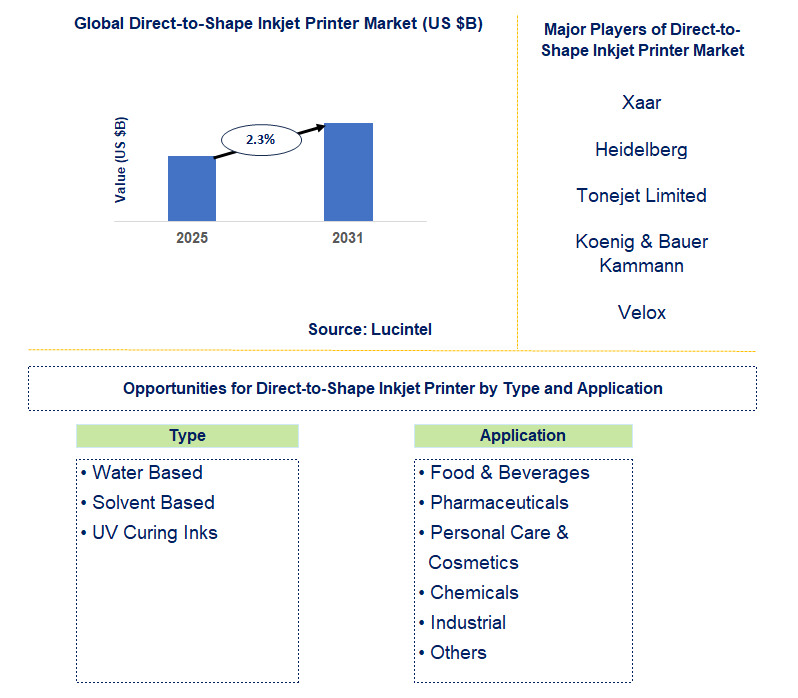
Key data points: The growth forecast = 7.6% annually for the next 7 years. Scroll below to get more insights. This market report covers trends, opportunities and forecasts in direct-to-shape inkjet printer market to 2031 by type (water based, solvent based, and UV curing inks), application (food & beverages, pharmaceuticals, personal care & cosmetics, chemicals, industrial, and others), and region (North America, Europe, Asia Pacific, and the Rest of the World)
We'll send your sample report shortly.
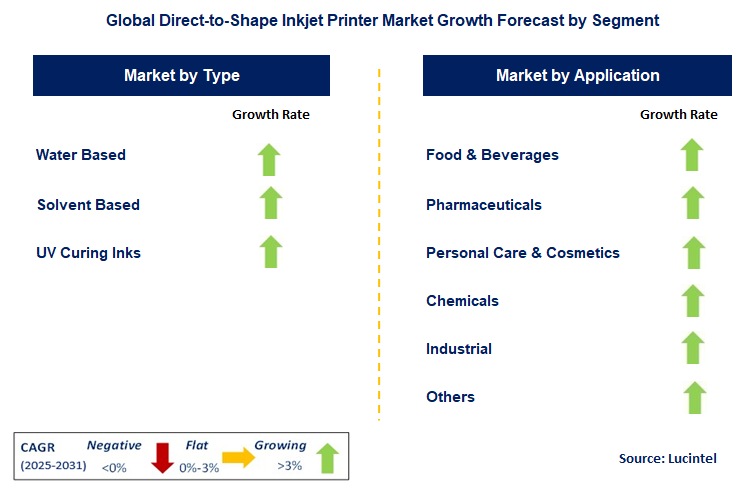
• Lucintel forecasts that, within the type category, UV curing ink is expected to witness the highest growth over the forecast period.
• Within the application category, food & beverage is expected to witness the highest growth.
• In terms of region, APAC is expected to witness the highest growth over the forecast period. Gain valuable insights for your business decisions with our comprehensive 150+ page report. Sample figures with some insights are shown below.
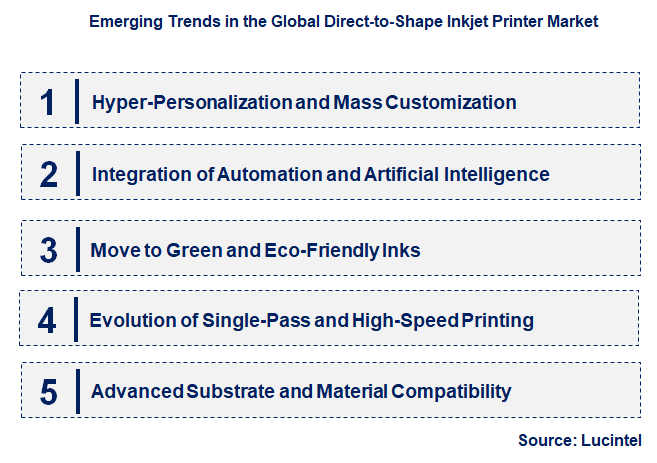
• Hyper-Personalization and Mass Customization: One of the major trends is the need for hyper-personalization and mass customization. Brands are increasingly employing DTS printers to print individual graphics, text, and even variable data like QR codes on single products. This provides for targeted marketing campaigns, limited editions, and personalized packaging. The effect is an enhanced brand-consumer relationship and a market advantage in a saturated marketplace, as customers are happy to pay a premium for customized products.
• Integration of Automation and Artificial Intelligence: Integration of artificial intelligence (AI) and automation is becoming an increasing trend in DTS printing processes. AI software is being employed to control print quality and identify defects in real time. Robots are employed to position and handle objects, which guarantees accurate printing on intricate shapes without the need for human intervention. The effect is an improved production process with greater reliability and efficiency, as well as greater quality control and lowered labor expenses.
• Move to Green and Eco-Friendly Inks: One of the latest trends is the move to eco-friendly and green inks. With increasing environmental legislation and consumer demand for sustainable products, companies are formulating new inks that have lower volatile organic compounds (VOCs), including UV-curable and water-based inks. The result is a lower environmental impact, which assists brands in achieving their sustainability objectives and wins over consumers who are eco-aware.
• Evolution of Single-Pass and High-Speed Printing: One of the major trends is the creation of single-pass and high-speed printing technology. Conventional multi-pass printers involve the printhead making back-and-forth motions over the object, but with single-pass printers, it is possible to print a complete image in a single pass. This dramatically boosts production speed and throughputs. The effect is far more streamlined manufacturing process, and DTS printing becomes economically feasible for high-volume industrial uses and lowers production costs.
• Advanced Substrate and Material Compatibility: There is increasing emphasis on creating printers capable of printing across a broader range of advanced materials and substrates. Glass, metal, plastic, and even more exotic substrates like wood and ceramics are being considered. Advanced adhesion promoters and pretreatment systems are being installed in the printers to create long-lasting and robust prints on these demanding surfaces. The effect is a massive growth of the market into new application domains, including industrial parts and high-end product packaging. These nascent trends are essentially transforming the direct-to-shape inkjet printer market by making it a high-tech, agile, and eco-friendly business. The advent of hyper-personalization and the convergence of AI are enhancing printing to be more intelligent and targeted. The move toward sustainable inks and single-pass technology is meeting the requirements for environmental stewardship and high-speed production. Lastly, the capacity for printing on advanced materials is opening the market up to new application segments. All these trends are combined positioning the market as a vital facilitator of contemporary manufacturing and branding.
• Introduction of Robust Robotic Wafer Handling: One significant innovation is the introduction of sophisticated robotic wafer handling systems. The robots are capable of moving wafers with very high precision and speed, with minimal chances of breakage or contamination. They are provided with sophisticated sensors and vision systems to provide perfect transfer and alignment. This innovation greatly enhances the dependability and efficiency of the manufacturing process, with minimal human intervention and scope for error.
• Integration of In-Situ Process Control and Metrology: A significant development is the integration of in-situ process control and metrology. The new single wafer equipment processing is now being fitted with sensors that can monitor key parameters, including film thickness or chemical concentration, in real time. The process can then be immediately adjusted, providing consistency and a high-quality output. This development is pivotal in addressing the challenging quality requirements of advanced process nodes.
• Introduction of High-Throughput Cluster Tools: One important development is the introduction of new high-throughput cluster tools. They consist of an array of single wafer process chambers interconnected by a central robot, making it possible to execute a set of distinct processes in sequence without vacuum breaking. This improves overall throughput and minimizes the risk of contamination from the environment between steps. This innovation enhances manufacturing efficiency and is critical for high-volume production.
• Development of Environmentally Friendly Processes: One of the latest developments is developing platforms with more environmentally friendly processes within the equipment. This involves using less water and less toxic chemicals in terms of advanced cleaning and deposition methods. Some new equipment, for instance, employs supercritical CO2 or vapor-phase cleaning, which are greener alternatives to wet chemical processes. The development enables companies to reach their sustainability targets while keeping their operating costs down.
• Use of Standardized Communication Protocols: One of the developments is the use of standardized communication protocols, including SEMI, for equipment integration. This enables new automatic single wafer processing equipment to communicate easily with installed factory automation software and other tools within the fabrication plant. This development makes the integration process easy, takes less time for implementation, and enables data sharing at a more efficient rate across the whole manufacturing line. These five major developments are making a significant contribution to the Direct-to-Shape Inkjet Printer market. Bringing in sophisticated robotic handling and in-situ metrology is improving process control and precision. Brining in high-throughput cluster tools and embracing standardized protocols is enhancing efficiency and integration. Also, the creation of eco-friendly processes is solving the issue of sustainability. These advancements are collectively making the market a technologically sophisticated, streamlined, and critical part of the new semiconductor manufacturing environment.
• Packaging of Beverages and Food: The largest growth potential resides in the packaging of beverages and food. With increasing demand for limited-edition and personalized packaging, companies are turning to DTS printers to produce distinctive designs directly onto cans, bottles, and other containers. This avoids labels, minimizes material waste, and enables rapid design modification. This is a key market growth and innovation driver.
• Cosmetics and Personal Care: The cosmetics and personal care market is a top growth opportunity. Companies in this industry depend largely on distinctive, high-quality packaging to differentiate themselves on congested store shelves. DTS printers allow direct-to-product printing of detailed designs, fine print, and variable data onto cosmetic packaging, including bottles, jars, and tubes. This produces high-end finishes and high levels of personalization, which are a main competitive edge.
• Automotive and Industrial Parts: The automotive and industrial parts market is a growth area of importance. DTS printers are employed to print serial numbers, logos, and other identification marks directly onto parts. This use necessitates scratch-resistant and long-lasting inks capable of withstanding tough environments. The direct printing on irregularly shaped parts is the biggest advantage compared to conventional labeling techniques. This market opportunity is opening up the market into high-end industrial segments.
• Pharmaceutical and Medical Devices: Pharmaceutical and medical device is one of the most important growth opportunities. This application demands exact and permanent printing of data including batch numbers, expiration dates, and QR codes for tracing. DTS printers enable direct printing on vials, syringes, and medical devices with high accuracy and regulatory compliance. This application is vital for patient safety and regulatory compliance.
• Electronics and Consumer Products: The electronics and consumer products market is a significant growth area. DTS printers are employed to print on an extensive variety of items, including phone cases, headphones, and home appliances. This enables mass customization and the production of one-off, limited-edition items. The ability to print on various materials, including plastics and metals, is a critical force in this use. These growth strategic opportunities are significantly influencing the direct-to-shape inkjet printer market through specialization and innovation. Focusing on high-growth segments such as beverage packaging and cosmetics, manufacturers are serving the most profitable and demanding markets. The automotive and pharmaceutical applications are propelling the market into key industrial segments. In addition, the emphasis on electronics is creating new opportunities for growth and distinction. This is a strategy that keeps the market alive, cutting-edge, and fundamental to many contemporary industries.
• Xaar
• Heidelberg
• Tonejet Limited
• Koenig & Bauer Kammann
• Velox
• Mimaki Europe
• Xerox Corporation
• Epson America
• Roland DG Corporation
• INX International
• Water Based
• Solvent Based
• UV Curing Inks
• Food & Beverages
• Pharmaceuticals
• Personal Care & Cosmetics
• Chemicals
• Industrial
• Others
• North America
• Europe
• Asia Pacific
• The Rest of the World
• United States: The American market is dominated by a high degree of emphasis on technological advancements and an increase in demand for customized consumer products. Recent innovations have involved emphasis on the integration of DTS printers with state-of-the-art robotics and automation to automate manufacturing processes. The industry is also witnessing increased adoption of UV-curable and green inks to meet stringent environmental regulations. As a result, there has been increased demand in the food and beverage, cosmetic, and automobile industries, where companies are using DTS printing for high-visibility, customized packaging and components.
• China: China's market is dominated by its huge manufacturing base and national drive to industrialize production. Recent trends have involved heavy investment in local R&D to create indigenous DTS printing technology, frequently with an emphasis on speed and cost. The market is witnessing a high growth rate of DTS printer adoption across the electronics, packaging, and consumer goods markets to facilitate high-volume, large-scale production. This is making China a major contributor to the world DTS printer supply chain.
• Germany: Germany's market is Europe's leading market, where there is an emphasis on precision engineering and industrial usage. New trends involve the pursuit of extremely reliable and strong DTS printers that can be easily adopted in a smart factory setting. The market is witnessing a focus on creating machines that are capable of processing a range of substrates, from glass to metal, with great accuracy. This is most applicable to the country's robust auto, pharma, and industrial segments, where quality and longevity are key.
• India: India's market is an upstart giant, driven by speedy industrialization and a growing e-commerce market. Recent growth is centered on the rising demand for unique and on-demand packaging of consumer products. The industry is likely to expand considerably as increasing numbers of manufacturers use DTS printers in order to produce distinctive brand and promotional materials. This is underpinned by expanding investment and a shift towards increasingly effective and new printing technologies in order to meet an extensive and diverse consumer base.
• Japan: Japan's market is the world leader in inkjet technology with its steady innovative spirit and exacting standards of quality. Current trends are to enhance printhead accuracy and establish new ink formulations to obtain more precise detail and greater durability. The market is experiencing emphasis on small-format, high-res printers for specific uses, like printing on complicated geometries and fragile items. This has resulted in new developments in the electronics and precision manufacturing industries, where high-priority printing is a critical requirement.


• Xaar
• Heidelberg
• Tonejet Limited
• Koenig & Bauer Kammann
• Velox
• Mimaki Europe
• Xerox Corporation
• Epson America
• Roland DG Corporation
• INX International Q5. Which direct-to-shape inkjet printer market segment will be the largest in future? Answer: Lucintel forecasts that, within the type category, UV curing ink is expected to witness the highest growth over the forecast period. Q6. In direct-to-shape inkjet printer market, which region is expected to be the largest in next 5 years? Answer: In terms of region, APAC is expected to witness the highest growth over the forecast period. Q7. Do we receive customization in this report? Answer: Yes, Lucintel provides 10% customization without any additional cost.


Choose a license that fits your team. Instant PDF delivery.
Prices exclude taxes. Instant delivery. Custom licensing available on request.
Market Report · July 29, 2026
Market Report · July 20, 2026
Market Report · July 20, 2026
Trusted partner for strategic intelligence and business growth


Receive a complimentary market analysis tailored to your industry. Our analysts will identify key growth opportunities and competitive dynamics specific to your business.

Market size, growth rate, and key trend analysis for your specific sector.

Top competitor positioning and market share analysis.

Strategic recommendations backed by data-driven insights.
Get curated market intelligence and competitive moves straight to your inbox.
By subscribing, you agree to receive our monthly insights. Unsubscribe anytime.
Receive a complimentary market analysis tailored to your industry. Our analysts will identify key growth opportunities and competitive dynamics specific to your business.
Market size, growth rate, and key trend analysis for your specific sector.
Top competitor positioning and market share analysis.
Strategic recommendations backed by data-driven insights.
Get curated market intelligence, emerging trends, and competitive moves straight to your inbox each month.
By subscribing, you agree to receive our monthly insights. Unsubscribe anytime.
We'll send your sample report shortly.