
Market Report · July 29, 2026

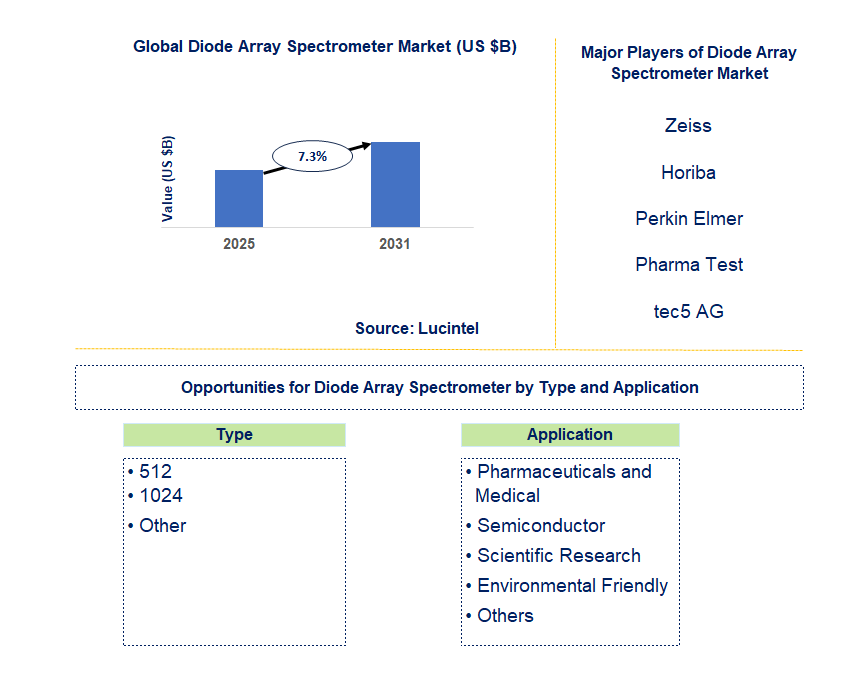
Key data points: The growth forecast = 7.3% annually for the next 7 years. Scroll below to get more insights. This market report covers Trends, opportunity and forecast in diode array spectrometer market to 2031 by type (512, 1024, and others), application (pharmaceuticals and medical, semiconductor, scientific research, environmental friendly, and others), and region (North America, Europe, Asia Pacific, and the Rest of the World)
We'll send your sample report shortly.
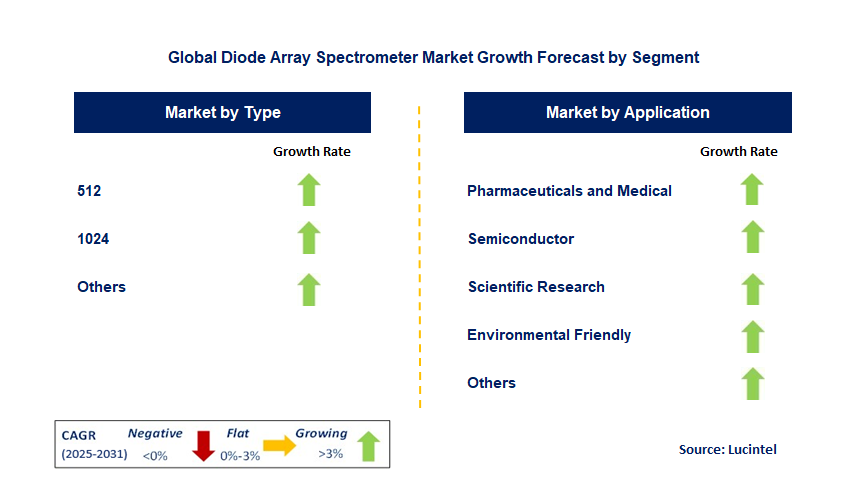
• Lucintel forecasts that, within the type category, 1024 is expected to witness higher growth over the forecast period due to because it is a greater numerical value than 512..
• Within the application category, semiconductor will remain the largest segment due to semiconductors are the largest due to their essential role in various high-growth industries like electronics, automotive, and telecommunications..
• In terms of region, North America is expected to witness the highest growth over the forecast period due to high demand from key industries like pharmaceuticals, biotechnology, and environmental monitoring, along with investments in advanced analytical technologies.. Gain valuable insights for your business decisions with our comprehensive 150+ page report. Sample figures with some insights are shown below.
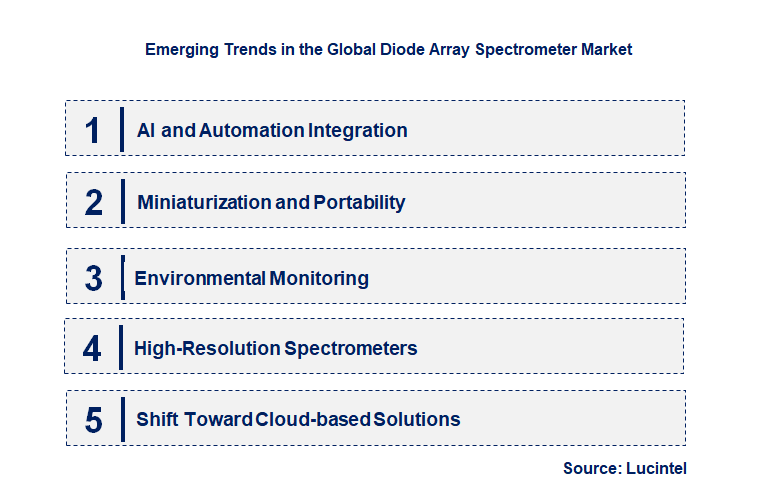
• AI and Automation Integration: One of the top trends seen in the diode array spectrometer market is the integration of artificial intelligence and automation. The application of AI-based algorithms improves the efficiency of data analysis, and it could obtain more accurate results within a shorter period. Automation reduces human errors, increasing throughput in laboratory environments for a very valuable and high-demand commodity like pharmaceutical testing and environmental monitoring.
• Miniaturization and Portability: Diode array spectrometers are being miniaturized nowadays due to increasing demand for field applications. In situations where portability is important, compact spectrometers will be very handy in the space-constrained environments or when mobility becomes a critical feature. This aspect is particularly vital for agriculture, environmental monitoring, and field diagnostics.
• Environmental Monitoring: There is a growing demand for diode array spectrometers in environmental monitoring due to the requirement for real-time, accurate data on air, water, and soil quality. Governments and regulatory bodies are emphasizing environmental sustainability, which is prompting industries to adopt advanced spectrometric technologies. This trend is reshaping industries such as oil and gas, agriculture, and water treatment.
• High-Resolution Spectrometers: The development of high-resolution diode array spectrometers is helping industries achieve better precision in their analysis. This trend is particularly crucial in fields like pharmaceuticals, where precise measurements are necessary for quality control. High-resolution spectrometers are also beneficial in materials science and food testing, allowing for the identification of minute changes in composition.
• Shift Toward Cloud-based Solutions: Cloud-based spectrometer systems are gaining traction as they allow users to store and access data remotely, improving collaboration and efficiency. Cloud computing also provides scalability, enabling users to analyze large datasets without compromising performance. This trend is shaping the future of spectrometer data management, particularly in research and development settings. These trends are reshaping the global diode array spectrometer market by improving the functionality, accessibility, and efficiency of these instruments. Technological advancements, such as AI and automation, are transforming how spectrometers are used across various industries. The growing focus on environmental sustainability and data-driven analysis is driving market expansion, while the push for miniaturization is making spectrometers more versatile and portable.
• Technological Advancements in Resolution and Speed Manufacturers are looking for ways to improve the resolution and speed of diode array spectrometers. This enables customers to carry out more accurate analyses in a relatively shorter period. This is indispensable for industries involved in pharmaceutical products and environmental testing. Higher resolution will, therefore, permit better identification of components in a complex mixture; this is extremely important for quality control and to meet regulatory requirements.
• Expansion in Emerging Markets: With the growth of industrialization in emerging markets, especially in Asia-Pacific and Latin America, the demand for diode array spectrometers is increasing. This is due to the growth of chemicals, pharmaceuticals, and food safety industries. Manufacturers are increasingly focusing on offering cost-effective solutions to cater to the price-sensitive market, driving innovation and market penetration.
• Integration with Other Analytical Instruments: Diode array spectrometers integrated with other analytical instruments, like LC and GC, hold promise. These integrated systems allow for more comprehensive analysis of complex samples; the quality of data is thus superior, enabling researchers and professionals in various industries to deliver their best. It simplifies the lab workflow and raises productivity.
• Increasing Regulatory Standards: The regulatory agencies are tightening the standards for industries such as pharmaceuticals, food, and environmental monitoring. There is a growing demand for high-precision spectrometric instruments. Diode array spectrometers are becoming increasingly essential in helping industries meet regulatory requirements, driving demand for more accurate and reliable instruments. This trend is pushing manufacturers to improve instrument performance and data reporting.
• Advancements in data management and analytics: As more data is being produced by spectrometric tests, manufacturers are starting to implement state-of-the-art software and cloud-based solutions in data management. These advancements allow for the analysis of large datasets better, informed decision-making, and easy sharing across teams and organizations. These are the key developments that are driving the growth of the global diode array spectrometer market. Technological innovations and an expanded market reach are improving the capabilities of the product and making spectrometers accessible to a broader spectrum of industries and applications. Regulatory demands and the integration of spectrometric tools with other analytical instruments create new opportunities for manufacturers and users alike.
• Pharmaceutical Testing: The increasing demand for high precision in quality control within the pharmaceutical industry has led to higher demand for diode array spectrometers in drug testing. Determination of impurities, verification of concentrations, and guarantee of pharmaceutical product uniformity provide for necessary equipment in diagnostic compliance and assurance processes.
• Environmental Monitoring: The call for environmental monitoring instruments, with diode array spectrometers at the center, is coming in due to growing global anxiety about pollution and sustainability. Monitoring of air and water quality or soil quality monitors help industries and contribute to having cleaner and safer environments by complying with environmental regulations.
• Food and Beverage Testing: Diode array spectrometers are being used increasingly in food safety and quality testing. They can detect contaminants, verify ingredient composition, and ensure that products meet safety standards. As the food safety regulations are becoming stringent, the demand for these testing instruments is likely to increase.
• Material Science and Research: Diode array spectrometers are important in material science research, where they are used for the analysis of complex materials, including polymers, metals, and nanomaterials. Their high resolution and precision make them ideal for studying material properties at a molecular level, supporting innovation in various industries, such as aerospace and electronics.
• Chemical and Biochemical Analysis: In chemical and biochemical industries, diode array spectrometers are used to get detailed analysis of complex chemical reactions and compositions. It helps identify unknown substances, measure concentration levels, and monitor chemical processes in real time. This growth opportunity is driven by the increasing complexity of chemical products and the need for faster, more reliable testing methods. These strategic growth opportunities represent the various applications of diode array spectrometers and growing demand across various industries. In a world that is increasingly shifting towards quality assurance, regulatory compliance, and sustainability, the global market for spectrometers has grown, with significant expansion possibilities for manufacturers.
• Zeiss
• Horiba
• Perkin Elmer
• Pharma Test
• tec5 AG
• 512
• 1024
• Others
• Pharmaceuticals And Medical
• Semiconductor
• Scientific Research
• Environmental Friendly
• Others
• North America
• Europe
• Asia Pacific
• The Rest of the World
• United States: Demand for diode array spectrometers has been very high both in academic as well as in industrial circles. The pharmaceutical and biotechnology industries are among the major contributors to this demand, especially in analytical and quality control laboratories. High resolution and fast data acquisition have been the drivers of growth in the market. Technological advancements, including integration with automation and cloud-based data systems, have made these spectrometers more efficient and versatile, meeting the needs of an increasingly digitalized environment.
• China: China’s diode array spectrometer market is growing rapidly due to increased industrialization, a booming pharmaceutical sector, and a strong focus on environmental monitoring. The government’s emphasis on research and development in analytical instruments has led to the adoption of diode array spectrometers in a variety of sectors. Local manufacturers are also expanding their offerings, focusing on providing cost-effective, high-performance spectrometers for both domestic and international markets. As China continues to promote technological development, the demand for high-precision analytical tools, such as diode array spectrometers, will increase.
• Germany: Germany has a strong manufacturing and scientific research sector, which has translated to consistent demand in diode array spectrometers. The German market is influenced by the automotive, pharmaceutical, and environmental sectors, which are all dependent on precise spectrometric data in testing and monitoring. Germany is pushing toward the use of green technologies and taking care of its environmental aspects. These are motivating this market toward high growth rates in the environment as well as industries. Also, strict standards along with an excellent manufacturing setup has helped sustain growth in this market.
• India: There has been huge growth in India for the uptake of diode array spectrometers within the pharmaceuticals, environment, and chemical industries. Demand has gone up, driven by increasing research and development within academic circles, as well as the greater demand for good-quality data among industries. In healthcare, increasing attention from the government combined with increased research infrastructure investments have positively impacted this market. Growing needs for high accuracy in diagnostic tools and in quality control require high-end spectrometric devices, which contributes to the increase in demand within India.
• Japan: Japan is always at the forefront when it comes to the development and adoption of sophisticated scientific instrumentation, for instance, diode array spectrometers. There is a great reliance of this market on research institutions along with pharmaceutical industries, electronics, and materials science. Technologies such as miniaturization and integration of artificial intelligence-driven software for analysis make the instruments even more efficient. Japan’s focus on environmental sustainability is creating demand for diode array spectrometers in environmental testing, which are necessary to monitor the quality of air, water, and soil.


• Zeiss
• Horiba
• Perkin Elmer
• Pharma Test
• tec5 AG Q5. Which diode array spectrometer market segment will be the largest in future? Answer: Lucintel forecasts that 1024 is expected to witness higher growth over the forecast period due to because it is a greater numerical value than 512.. Q6. In diode array spectrometer market, which region is expected to be the largest in next 5 years? Answer: North America is expected to witness the highest growth over the forecast period due to high demand from key industries like pharmaceuticals, biotechnology, and environmental monitoring, along with investments in advanced analytical technologies.. Q7. Do we receive customization in this report? Answer: Yes, Lucintel provides 10% customization without any additional cost.


Choose a license that fits your team. Instant PDF delivery.
Prices exclude taxes. Instant delivery. Custom licensing available on request.
Market Report · July 29, 2026
Market Report · July 20, 2026
Market Report · July 20, 2026
Trusted partner for strategic intelligence and business growth


Receive a complimentary market analysis tailored to your industry. Our analysts will identify key growth opportunities and competitive dynamics specific to your business.

Market size, growth rate, and key trend analysis for your specific sector.

Top competitor positioning and market share analysis.

Strategic recommendations backed by data-driven insights.
Get curated market intelligence and competitive moves straight to your inbox.
By subscribing, you agree to receive our monthly insights. Unsubscribe anytime.
Receive a complimentary market analysis tailored to your industry. Our analysts will identify key growth opportunities and competitive dynamics specific to your business.
Market size, growth rate, and key trend analysis for your specific sector.
Top competitor positioning and market share analysis.
Strategic recommendations backed by data-driven insights.
Get curated market intelligence, emerging trends, and competitive moves straight to your inbox each month.
By subscribing, you agree to receive our monthly insights. Unsubscribe anytime.
We'll send your sample report shortly.