
Market Report · July 22, 2026

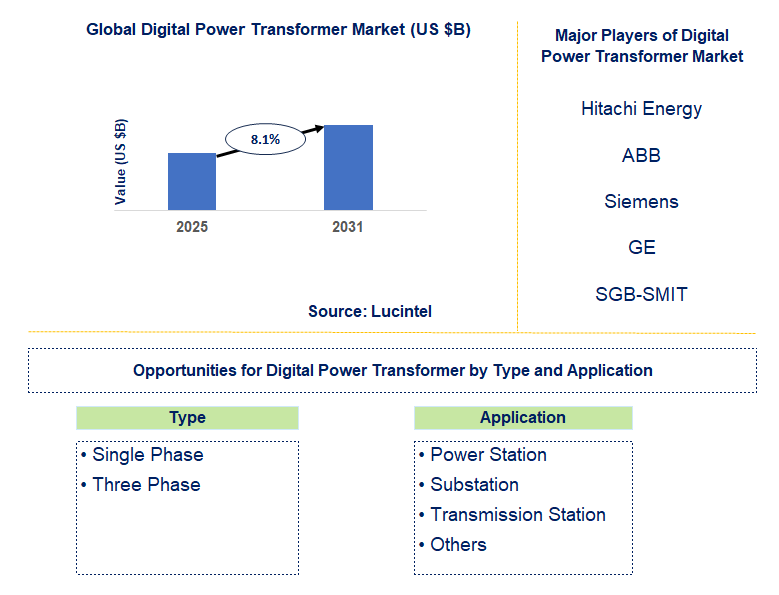
Key data points: The growth forecast = 8.1% annually for the next 7 years. Scroll below to get more insights. This market report covers Trends, opportunities and forecasts in digital power transformer market to 2031 by type (single phase and three phase), application (power station, substation, transmission station, and others), and region (North America, Europe, Asia Pacific, and the Rest of the World)
We'll send your sample report shortly.
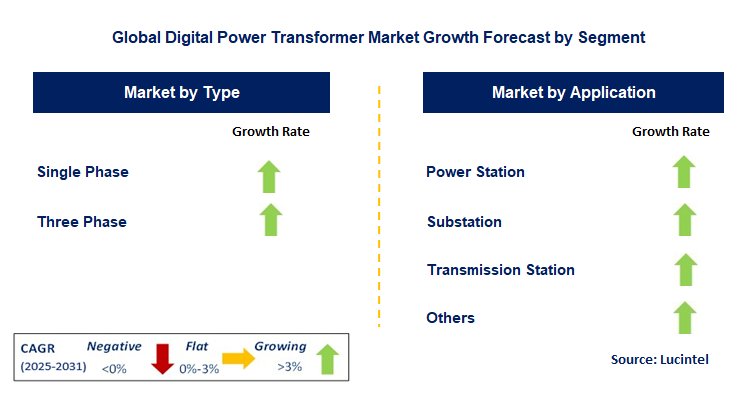
• Lucintel forecasts that, within the type category, three phase is expected to witness higher growth over the forecast period due to its ability for large-scale power generation.
• Within the application category, substation is expected to witness the highest growth.
• In terms of region, APAC is expected to witness the highest growth over the forecast period.
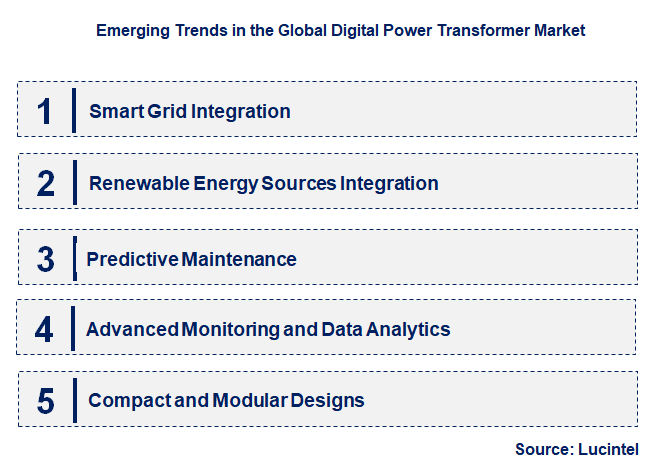
• Smart Grid Integration: One of the megatrends of the market of digital power transformers is the integration into smart grids. With the introduction of smart grids, utilities can now monitor and control the distribution of power in real time. Digital power transformers in conjunction with integrated self-healing capabilities have enabled better load management, fault detection, and overall system stability. With the proliferation of smart grids to different parts of the globe, the need for DPTs will increase with time and further improvements in digital transformer technologies will follow.
• Renewable Energy Sources Integration: Integration of renewables, especially wind and solar power, is another reason for increasing demand for digital power transformers. The increased dependence on renewable power sources makes it critical to have DPTs that can provide data and control services to match the supply and demand on the grid. The possibility to monitor and control the supply voltage in a short period of time is very important to the grid operators handling large amounts of renewable energy.
• Predictive Maintenance: Digital power transformers (DPTs) offer predictive maintenance as one of its primary features. DPTs utilize advanced sensors and analytics to predict potential issues that might lead to transformer failure. This allows utility companies to effectively decrease unproductive downtime, lower maintenance expenses, and prolong the life of their transformers. As utility companies shift to more reliable and cost-efficient operations, predictive maintenance becomes more important.
• Advanced Monitoring and Data Analytics: DPTs can monitor the health status and performance of transformers in real time, which allows utility companies to analyze data as it comes in. Grid operators are now able to make faster, more accurate decisions which in turn helps optimize grid performance. The integration of analytical artificial intelligence (AI) and machine learning (ML) technologies with DPTs result in more precise and effective data analysis, giving utility companies valuable recommendations pertaining to operational efficiency.
• Compact and Modular Designs: As the need for scalable and flexible energy sources rises, the compact and modular designs of digital power transformers is growing in popularity. These designs are easier to integrate into existing power systems, particularly in urban areas, and decentralized energy networks. Modular DPTs are customizable for specific requirements which makes them a cost effective and flexible option for modern power systems. These emerging trends are introducing greater efficiency, reliability, and sustainability into the digital power transformer market. The global focus on the advancement of smart grids and the adoption of renewables will, in turn, necessitate DPT’s to ensure that power transmission and distribution is carried out in the most efficient manner possible.
• Improved Digitalization of Transformers: A noticeable shift in the market of digital power transformers is the increased automation and digitalization of transformers. Manufacturers are now incorporating digital sensors, communication systems, and monitoring technologies for modifying the operational features of transformers. These improvements permit the collection of real-time data and remote diagnostic, which contributes to improved stability of the grid while minimizing the chances of transformer breakdown.
• Focused Improvements on the Enhancing Features of Transformer Protection: Further, the other improvement is in the protection features of transformers. Modern digital power transformers are equipped with advanced protection features such as fault recording, over-voltage and thermal protection. These features assist in damage limitation to power transformers, promote reliability on the grid, and ensure stability within power systems during faulty conditions and overloading.
• System’s Integration with Renewable Energy Sources: To facilitate power transfer regulation, digital power transformers are increasingly integrated with renewable energy systems. These types of transformers provide the necessary infrastructure for the unmanageable output of solar and wind energy to be balanced with conventional power generation. This is integration is paramount with the rapid transition in economy to reliance on renewable sources.
• Shifts towards modular and scalable designs: The market's expansion for modular and scalable designs is on the rise. Manufacturers are creating digital power transformers which can be easily scaled for a range of uses, from small renewable energy systems to larger power grid needs. This adaptability enables more effective use in many environments, including urban and industrial zones.
• Increased Collaboration Between Utilities and Technology Providers; There is a need for more collaboration between technology providers and utilities operations for the improvement of power transformer systems. This collaboration has had a sharp increase with the aim of building stronger and more efficient smarter grids. These collaborations are speeding up the use of digital power transformers in the grids and their interfacing with the smart grid. This progress shines light on the rapid growth seen in the digital power transformer market. This innovation will be vital to the robustness and efficiency of power transmission systems all over the world.
• Development of Smart Grids: The emergence of smart grids is a great growth opportunity for digital power transformers. With the adoption of more sophisticated grid systems, there is a growing requirement for digital transformers with monitoring and automation features. This market potential is particularly evident in developed economies that are working toward improving the resilience and efficiency of their grids.
• Integration of Renewable Energy Sources: The growth shift toward renewable energy sources represents an important opportunity for growth for DPT manufacturers. Digital power transformers are instrumental in moderating the volatility of renewable energy sources. Incorporating these transformers into renewable energy systems enables utilities to improve the stability of the grid and the efficiency of electricity use.
• Various Sectors: Digital power transformers are finding increasing use in various industrial sectors, including manufacturing, mining, and chemical industry for energy efficiency and cost savings. These industries need reliable power transmission systems to run their operations. DPTs are the solution to enrich energy economy and management.
• Projects for Urban Electrification: There is a continued need for more efficient solutions to urbanization. Smart cities rely on Digital power transformers for effective control of grid electricity distribution. These solutions will constantly be in demand as the cities grow and modernize their energy infrastructure.
• Power Storage Systems: The renewable sector is driving the adoption of energy storage systems and in turn, poses a growth potential for digital power transformers. The DPTs are ideal for improving energy efficiency by optimizing the energy flow between the grid and the storage systems. The opportunities discussed above substantiate the imperative need of modernizing the global energy system with digital power transformers. Industries and utilities are increasingly prioritizing efficiency, sustainability, and reliability of the power grid, and therefore, DPTs will be the core of future energy infrastructure changes.
• Hitachi Energy
• ABB
• Siemens
• GE
• SGB-SMIT
• Mitsubishi Electric
• Toshiba
• SPX Transformer Solutions
• CG Power and Industrial Solutions
• Hyosung
• Single Phase
• Three Phase
• Power Station
• Substation
• Transmission Station
• Others
• North America
• Europe
• Asia Pacific
• The Rest of the World
• United States: The integration of digital power transformers in the US is a part of the modernization of the electrical grid. Renewables and smart grid investment is causing the adoption of new DPTs. These transformers are detailed with numerous features such as remote monitoring, fault detection alongside grid resilience and efficiency enhancing predictive maintenance. There is a daunting need for DPTs alongside the government agenda to cut emissions and the adoption of wind and solar power.
• China: China is investing a great deal of its capital into the development of digital power transformers to enhance the energy infrastructure of the country. Smart grid projects that help an entity automate electricity distribution and consumption are rapidly growing in scope. The integration of DPTs into the grid is also required to improve the efficiency of high-voltage electricity transmission. The demand for digitally enabled energy efficient transformers in China is also being driven by the country's carbon neutrality targets for 2060. Renewables such as wind and solar energy are independently controllable, and digital power transformers facilitate optimally coordinated energy flow across the grid.
• Germany: Germany’s DPT market is the most advanced in Europe due to strong support of the energy transition (Evergreened) plans. Germany’s focus on renewable power generation, especially from wind and solar sources, has created a need for adaptable and robust grid solutions. Digital power transformers provide utility companies with real time data analysis on power supply, which helps them anticipate faults to ensure uninterruptible power supply. Germany has been extensive in its rollout of decarbonization strategies and development of smart grids, thus making the country one of the leaders in innovation and adoption of advanced transformer technologies.
• India: India's power system is transforming thanks to the growing adoption of renewable energy sources and a rising demand for electricity. Digital Power Transformers (DPTs) are crucial to the modernization of India’s electrical infrastructure. They are also part of the integration of advanced power distribution systems within the Smart Cities mission. The predictive maintenance offered through modern digital technologies, along with reduced downtime, aids in better management of distributed solar and wind energy systems in India.
• Japan: After the Fukushima disaster in 2011, Japan has been leveraging digital power transformers to enhance energy infrastructure resilience and efficiency. DPTs have proved vital in streamlining Japan’s energy policies that seek to improve energy efficiency and integrate renewable energy. Providing real-time monitoring data and advanced fault detection makes these digital power transformers crucial to achieving Japan’s goal of building a smart, disaster-resistant energy grid. Adopting digital transformers enhances stability that facilitates the integration of renewable power sources into the grid.


• Hitachi Energy
• ABB
• Siemens
• GE
• SGB-SMIT
• Mitsubishi Electric
• Toshiba
• SPX Transformer Solutions
• CG Power and Industrial Solutions
• Hyosung Q5. Which digital power transformer market segment will be the largest in future? Answer: Lucintel forecasts that, within the type category, three phase is expected to witness higher growth over the forecast period due to its ability for large-scale power generation. Q6. In digital power transformer market, which region is expected to be the largest in next 5 years? Answer: In terms of region, APAC is expected to witness the highest growth over the forecast period. Q7. Do we receive customization in this report? Answer: Yes, Lucintel provides 10% customization without any additional cost.


Choose a license that fits your team. Instant PDF delivery.
Prices exclude taxes. Instant delivery. Custom licensing available on request.
Market Report · July 22, 2026
Market Report · July 22, 2026
Market Report · July 17, 2026
Trusted partner for strategic intelligence and business growth


Receive a complimentary market analysis tailored to your industry. Our analysts will identify key growth opportunities and competitive dynamics specific to your business.

Market size, growth rate, and key trend analysis for your specific sector.

Top competitor positioning and market share analysis.

Strategic recommendations backed by data-driven insights.
Get curated market intelligence and competitive moves straight to your inbox.
By subscribing, you agree to receive our monthly insights. Unsubscribe anytime.
Receive a complimentary market analysis tailored to your industry. Our analysts will identify key growth opportunities and competitive dynamics specific to your business.
Market size, growth rate, and key trend analysis for your specific sector.
Top competitor positioning and market share analysis.
Strategic recommendations backed by data-driven insights.
Get curated market intelligence, emerging trends, and competitive moves straight to your inbox each month.
By subscribing, you agree to receive our monthly insights. Unsubscribe anytime.
We'll send your sample report shortly.