
Market Report · July 16, 2026

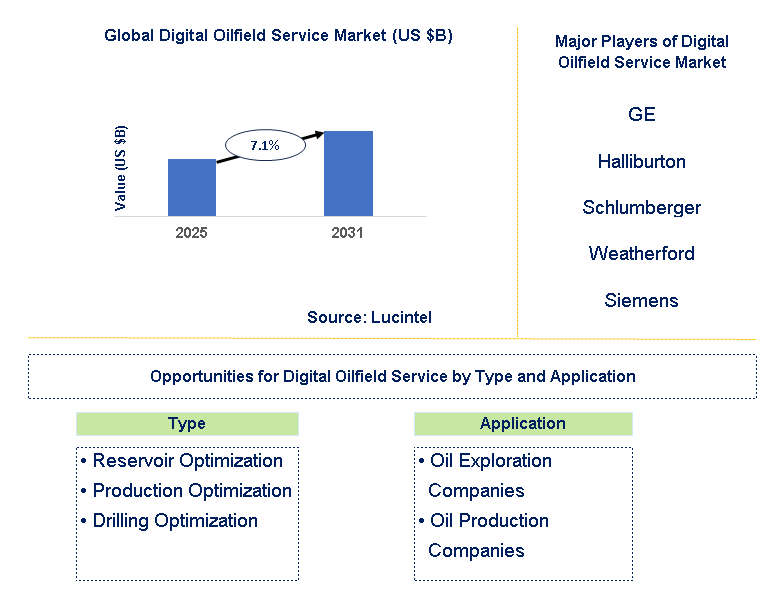
Key data points: The growth forecast = 7.1% annually for the next 7 years. Scroll below to get more insights. This market report covers trends, opportunities and forecasts in digital oilfield service market to 2031 by type (reservoir optimization, production optimization, and drilling optimization), application (oil exploration companies and oil production companies), and region (North America, Europe, Asia Pacific, and the Rest of the World)
We'll send your sample report shortly.
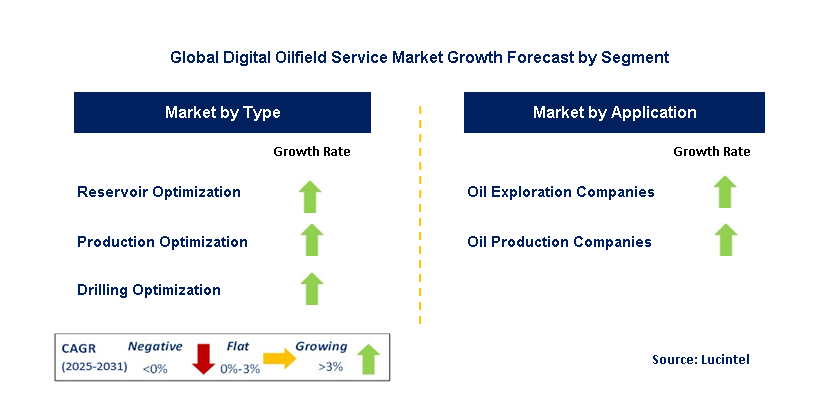
• Lucintel forecasts that, within the type category, production optimization is expected to witness the highest growth over the forecast period.
• Within the application category, oil production company is expected to witness higher growth.
• In terms of region, North America is expected to witness the highest growth over the forecast period. Gain valuable insights for your business decisions with our comprehensive 150+ page report. Sample figures with some insights are shown below.
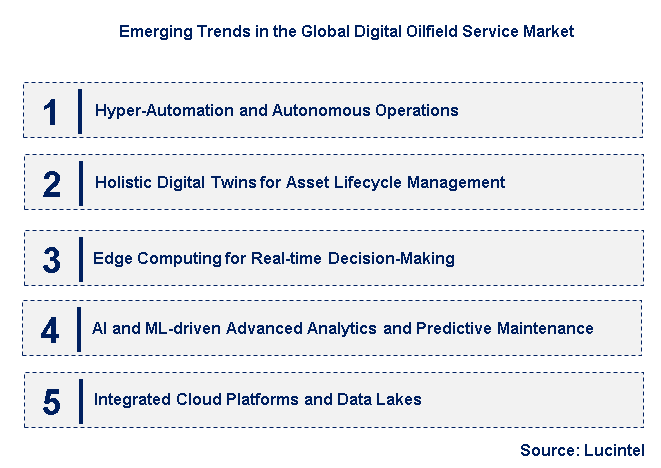
• Hyper-Automation and Autonomous Operations: It refers to the automation of more complex and interrelated processes in oilfield operations towards complete autonomous systems. Robotics, AI, machine learning, and advanced control systems come together to reduce human intervention in repetitive and dangerous operations. The effect is profound: improved safety by taking people away from unsafe environments, optimized operations through real-time optimization, and downtime reduced through anticipatory maintenance and automated troubleshooting, resulting in huge cost savings.
• Holistic Digital Twins for Asset Lifecycle Management: Digital twins, virtual representations of physical assets such as wells, rigs, and pipelines, are being expanded to cover the entire asset lifecycle. Highly sophisticated models combine real-time sensor data, historical performance, and predictive analytics to test different scenarios. Their effect is revolutionary on decision-making, allowing operators to maximize asset performance, anticipate failure with increased certainty, model maintenance plans, and make data-driven investment decisions, lengthen asset life, and optimize recovery.
• Edge Computing for Real-time Decision-Making: As data volumes created at the oilfield increase exponentially, local processing at the "edge" of the network instead of trusting only centralized cloud facilities is becoming increasingly important. Edge computing minimizes latency, facilitating real-time data analysis and decision-making right at the source. This movement makes a great difference in operational responsiveness by facilitating quicker drilling parameter adjustments, quicker anomaly detection, and enhanced safety procedures through instantaneous insights.
• AI and ML-driven Advanced Analytics and Predictive Maintenance: The use of AI and machine learning algorithms on large sets of data from oilfield operations is transforming analytics. These technologies leap from descriptive and diagnostic analytics to predictive and prescriptive insights, foreseeing equipment failures, scheduling production for maximum efficiency, and uncovering hidden potential for gains in efficiency. The effect is dramatic: dramatic decreases in unplanned downtime, optimized resource utilization, and front-foot response to operational issues, resulting in increased profitability and reliability.
• Integrated Cloud Platforms and Data Lakes: Migrating to integrated cloud-based platforms and high-capacity data lakes is a transformative trend. These repository-like environments enable the effortless gathering, storage, and analysis of numerous disparate datasets from multiple oilfield operations without silos. The effect is increased collaboration among teams, better data availability for advanced analytics, and increased scalability to handle large amounts of information. This integration fosters a holistic view of operations, enabling more informed strategic and tactical decisions. These emerging trends are profoundly reshaping the digital oilfield service market by driving unprecedented levels of automation, precision, and efficiency. Hyper-automation and digital twins are revolutionizing operational control and asset management. Edge computing is enabling real-time decision-making at the source, while advanced AI and ML analytics are transforming maintenance from reactive to predictive. Merging of cloud platforms and data lakes is creating unhindered data flow and collaborations. All these trends combined are resulting in safer, less costly, environmentally friendly, and much more productive oilfield operations.
• Extensive Use of IoT Sensors and Connectivity: One key development is the extensive use of Internet of Things (IoT) sensors throughout oilfield assets, such as wells, pipelines, and equipment. The sensors offer real-time information on parameters such as pressure, temperature, flow rates, and equipment health. Such a vast amount of data, made possible through improved connectivity, allows for continuous observation and instant anomaly detection. The effect is enhanced operational visibility, scheduled maintenance in advance, and early detection of future issues, cutting downtime drastically and avoiding expensive failures.
• Better AI and Machine Learning Capabilities: The latest developments in Artificial Intelligence and Machine Learning algorithms have enhanced their use in digital oilfields immensely. These tools are currently more advanced in processing massive, complex data sets from seismic surveys, drilling operations, and production logs. This results in better reservoir characterization, improved drilling trajectories, and extremely accurate production forecasting. The result is improved decision-making, lower exploration risk, and greater hydrocarbon recovery, which means higher profitability for operators.
• Creation of Advanced Predictive Maintenance Solutions: One of the developments is the advancement of predictive maintenance (Pd.M.) solutions. Utilizing AI, machine learning, and real-time sensor inputs, these solutions can identify equipment failure with precision before they actually happen. This facilitates timed maintenance within scheduled downtime, reducing the expense of unexpected outages. The effect is a staggering reduction in operational cost, increased asset life, safer working with the avoidance of catastrophic failure, and overall increased operational reliability throughout all oilfield infrastructure.
• Remote Operations and Control Centers Expansion: Remote monitoring and control of oilfield operations from centralized control centers have made significant advancements. These capabilities encompass remote drilling, remote well monitoring, and remote operation of production facilities. Partly driven by an emphasis on safety and partly by efficiency, these technologies cut the need for people in dangerous environments. The effects are enhanced with increased safety for operators, lower travel expenses, quicker response times to operations, and being able to control many locations economically from one place.
• Cybersecurity for Operational Technology (OT) Focus: With deeper digital penetration, an important advancement is the increased emphasis on cybersecurity for operational technology (OT) networks in oilfields. Safeguarding these systems from the threat of cyber attacks is essential to avoid operational disruptions, data theft, and safety accidents. This includes establishing strong security measures, threat detection mechanisms, and staff training. The effect is increased operational resilience, secure protection of sensitive information, and defense of critical infrastructure, maintaining the integrity and continuity of oil and gas operations. Collectively, these new advancements are collectively contributing to the digital oilfield service market by enabling more intelligent, efficient, and secure operational environments. IoT and sophisticated AI/ML capabilities on a mass scale are fueling data-driven decision-making and predictive maintenance, greatly improving operational performance and lowering expenses. The growth of remote operations is enhancing safety and efficiency, and a high emphasis on OT cybersecurity is enhancing resilience against increasing digital threats. Collectively, these developments are driving the digital oilfield market toward a future of highly productive, optimized, and safe energy extraction.
• Production Optimization Software and Services: A center growth opportunity, optimizing hydrocarbon recovery and limiting downtime operation from current wells. Strategic expansion is in creating and deploying next-generation software solutions that utilize real-time data, AI, and machine learning to drive pump performance, gas lift systems, and flow assurance. Opportunities are in providing predictive analytics for production challenges, optimizing artificial lift systems, and delivering real-time production monitoring dashboards. Those firms that can show real increases in production rates and decreased operating costs will take meaningful market share.
• Drilling Automation and Optimization: Another major opportunity is in increasing the efficiency and safety of drilling operations. This includes the use of digital technologies for automated control of drilling, real-time gesturing, and predictive drill bit wear analysis. Strategic growth involves offering solutions that decrease drilling time, minimize non-productive time, enhance wellbore precision, and avoid expensive accidents. Providing integrated platforms that integrate data from multiple drilling sensors with sophisticated analytics will be in great demand from operators seeking to lower drilling costs and enhance well delivery.
• Reservoir Characterization and Simulation: Opportunities in this application include applying sophisticated digital tools to better understand subsurface reservoirs, resulting in better resource estimation and optimized development planning. These encompass AI-driven seismic interpretation, 3D and 4D reservoir modeling, and very advanced simulation software. Strategic expansion comes from providing solutions that enhance reservoir model accuracy, forecast fluid flow more accurately, and optimize well placement for optimum recovery, allowing for enhanced long-term field development planning.
• Asset Integrity Management and Predictive Maintenance: Maintaining the integrity and prolonging the life of essential oilfield assets is a major growth opportunity. This includes the use of IoT sensors, drones, and AI for round-the-clock monitoring, anomaly detection, and predictive maintenance of rigs, pipelines, and production facilities. Strategic opportunities for growth lie in providing end-to-end asset performance management platforms that incorporate real-time data, offer predictive failure notifications, and optimize maintenance schedules, thus minimizing unscheduled downtime, improving safety, and reducing maintenance expenses.
• Remote Operations and Digital Collaboration Platforms: As teams go more distributed across the world, and remote management becomes increasingly needed, there is a significant opportunity in creating and providing firm digital collaboration platforms. These platforms enable real-time data sharing, remote monitoring, and virtual team collaboration from across varied geographical locations. Strategic expansion entails the delivery of secure, intuitive platforms that facilitate better communications, faster decision-making, and full remote control of operations, essential to today’s globally integrated oil and gas businesses. These strategic expansion opportunities are deeply influencing the digital oilfield service market by stimulating innovation and extending the value proposition of the entire oil and gas value chain. The emphasis on optimization of production and drilling is responding to primary operational efficiency requirements directly. Reservoir characterization opportunities are allowing improved long-term strategic planning. Asset integrity management is enhancing safety and minimizing operational expense, and digital work collaboration platforms are enabling current work arrangements. Overall, these opportunities are driving increased use of digital technology, making the oil and gas sector more efficient, safer, and data-driven.
• GE
• Halliburton
• Schlumberger
• Weatherford
• Siemens
• Rockwell Automation
• Honeywell
• Kongsberg Gruppen
• Emerson
• Pason Systems
• Reservoir Optimization
• Production Optimization
• Drilling Optimization
• Oil Exploration Companies
• Oil Production Companies
• North America
• Europe
• Asia Pacific
• The Rest of the World
• United States: The United States is one of the prime markets for digital oilfield services, driven by its strong oil and gas infrastructure, vast shale reserves, and the high technology adoption culture. Some of the recent developments include pervasive deployment of AI and cloud computing to optimize operations and sustainability. There is high emphasis on production optimization, drilling optimization, and reservoir management using advanced analytics and remote monitoring. Government programs and investments by private players are still driving the growth and implementation of advanced digital technologies in both onshore and offshore activities.
• China: China’s digital oilfield services market is growing very fast with surging energy demand, huge investments in oilfield exploration, and a vigorous government thrust for technology deployment in the energy industry. Major developments involve the extensive implementation of AI, machine learning, and IoT to support data-driven decision-making and predictive maintenance. Cloud-based technologies are increasingly used for centralized data management and real-time analytics that target optimized production processes, lower operational costs, and improved safety in oilfield operations.
• Germany: Germany’s digital oilfield service market is dominated by a strong focus on automation and cutting-edge digital technologies for enhancing operational efficiency and lowering costs. The role of AI and machine learning in analysis of data, as well as the use of IoT for real-time monitoring, is at the forefront. Green practices and energy efficiency are gaining increasing importance, with consequent demand for digital solutions for optimized energy use and environmental compliance. Cloud solutions are also gaining traction for improved operational efficacy.
• India: India’s digital oilfield services market is a nascent but high-growth segment, prompted by the increasing demand for efficiency in operations, cost cutting, and a greater emphasis on remote and automated operations. The use of advanced data analytics, IoT, and AI is gaining rapid traction to maximize production, track assets, and enable predictive maintenance. Domestic oil production promotion and a transition towards cloud-based systems for data integration and collaboration are primary drivers that are defining the market.
• Japan: Japan’s digital oilfield services market is advancing steadily under the thrust of sustainability focus, environmental awareness, and government encouragement of technological advancements. Some of the major developments include the use of IoT, AI, and cloud computing to enhance reservoir management, production optimization, and safety. The use of digital twin technology for real-time monitoring, simulation, and predictive maintenance is on the increase. Strategic partnerships and investments in digital efforts are also influencing the market.


• GE
• Halliburton
• Schlumberger
• Weatherford
• Siemens
• Rockwell Automation
• Honeywell
• Kongsberg Gruppen
• Emerson
• Pason Systems Q5. Which digital oilfield service market segment will be the largest in future? Answer: Lucintel forecasts that, within the type category, production optimization is expected to witness the highest growth over the forecast period. Q6. In digital oilfield service market, which region is expected to be the largest in next 5 years? Answer: In terms of region, North America is expected to witness the highest growth over the forecast period. Q7. Do we receive customization in this report? Answer: Yes, Lucintel provides 10% customization without any additional cost.


Choose a license that fits your team. Instant PDF delivery.
Prices exclude taxes. Instant delivery. Custom licensing available on request.
Market Report · July 16, 2026
Market Report · May 18, 2026
Market Report · May 18, 2026
Trusted partner for strategic intelligence and business growth


Receive a complimentary market analysis tailored to your industry. Our analysts will identify key growth opportunities and competitive dynamics specific to your business.

Market size, growth rate, and key trend analysis for your specific sector.

Top competitor positioning and market share analysis.

Strategic recommendations backed by data-driven insights.
Get curated market intelligence and competitive moves straight to your inbox.
By subscribing, you agree to receive our monthly insights. Unsubscribe anytime.
Receive a complimentary market analysis tailored to your industry. Our analysts will identify key growth opportunities and competitive dynamics specific to your business.
Market size, growth rate, and key trend analysis for your specific sector.
Top competitor positioning and market share analysis.
Strategic recommendations backed by data-driven insights.
Get curated market intelligence, emerging trends, and competitive moves straight to your inbox each month.
By subscribing, you agree to receive our monthly insights. Unsubscribe anytime.
We'll send your sample report shortly.