
Market Report · July 15, 2026

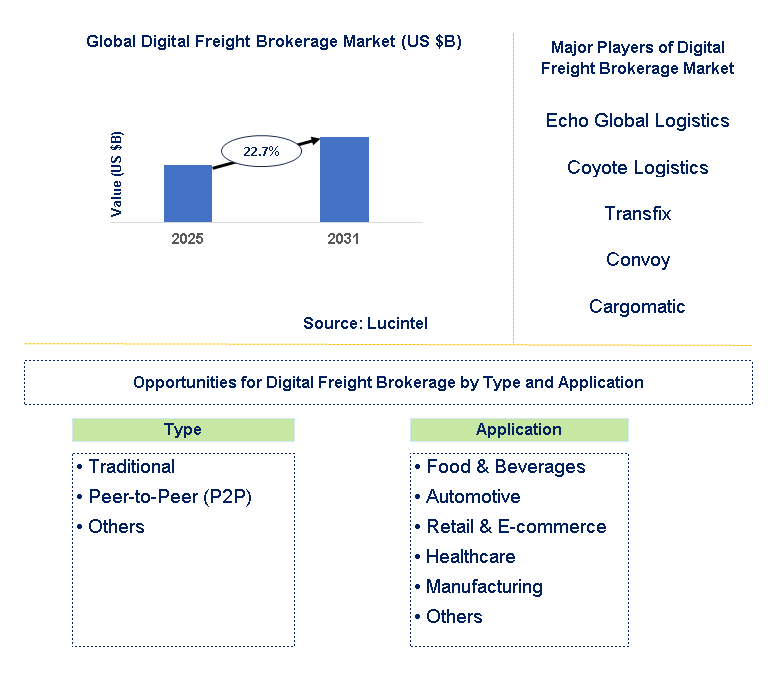
Key data points: The growth forecast = 22.7% annually for the next 7 years. Scroll below to get more insights. This market report covers trends, opportunities and forecasts in digital freight brokerage market to 2031 by type (traditional, peer-to-peer (P2P), and others), application (food & beverages, automotive, retail & E-commerce, healthcare, manufacturing, and others), and region (North America, Europe, Asia Pacific, and the Rest of the World)
We'll send your sample report shortly.
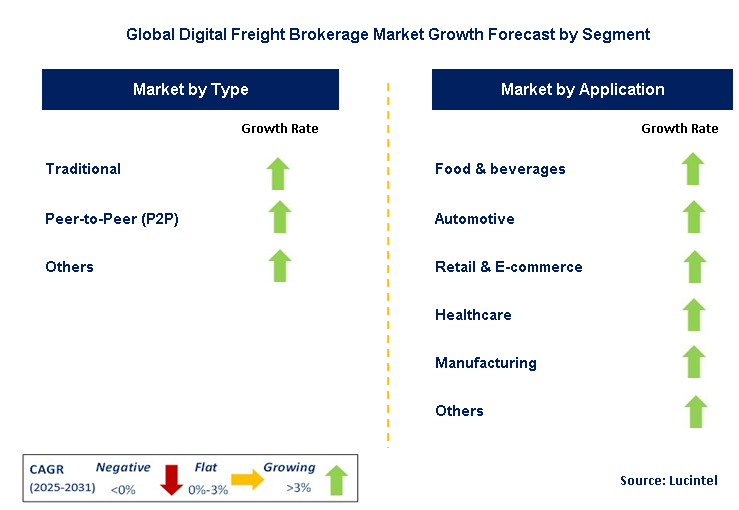
• Lucintel forecasts that, within the type category, traditional is expected to witness higher growth over the forecast period.
• Within the application category, retail & E-commerce is expected to witness the highest growth.
• In terms of region, North America is expected to witness the highest growth over the forecast period. Gain valuable insights for your business decisions with our comprehensive 150+ page report. Sample figures with some insights are shown below.
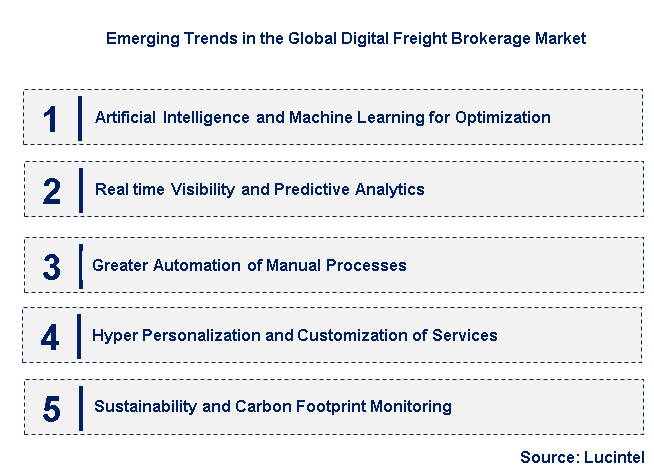
• Artificial Intelligence and Machine Learning for Optimization: The combination of artificial intelligence and machine learning is transforming digital freight brokerage to empower highly advanced optimization. Artificial intelligence algorithms are capable of analyzing huge datasets in order to forecast demand volatility, optimize price strategies, and match loads with carriers more effectively and efficiently. The effect is a substantial decrease in empty miles, enhanced load to truck ratios, and dynamic pricing functionality, resulting in improved profitability for brokers and saving costs for shippers. This trend goes beyond mere matching to smart decision making.
• Real time Visibility and Predictive Analytics: Real time visibility is revolutionizing the market with digital platforms providing end to end tracking of shipments through IoT devices and telematics. This provides real-time location, estimated time of arrival, and possible delays updates. The effect is increased supply chain visibility, enabling shippers to pre-emptively handle disruptions and deliver precise delivery information to their customers. Predictive analytics also enables users by predicting future problems before they happen, allowing users to proactively solve problems and increase service reliability.
• Greater Automation of Manual Processes: Digital freight brokerage is witnessing growth in the automation of long-standing manual, time-consuming processes like quoting, booking, documentation, and invoicing. Routine operations are taken care of by robotic process automation and sophisticated algorithms, which leave little room for human intervention. The effect is greatly magnified operational efficiency, lower administrative expense, and reduced human errors. This trend releases human brokers from mundane work to engage in more sophisticated activities, customer relationship management, and strategic problem solving, thereby facilitating higher scalability for brokerage firms.
• Hyper Personalization and Customization of Services: Online platforms are now providing more hyper personalization and customization of freight services to suit the individual needs of carriers and shippers. This includes custom pricing, favored carrier networks, particular equipment needs, and customized reporting dashboards. The effect is greater customer satisfaction and loyalty, as platforms are now able to match individual client tastes and form closer relationships. This direction is in contrast to one size fits all practices and is now more highly flexible and user-oriented service practices.
• Sustainability and Carbon Footprint Monitoring: One of the increasing trends in digital freight brokering is adding sustainability functionalities to track and optimize carbon footprints. Sites are providing means of selecting cleaner routes, load consolidation for lower emissions, and carbon footprint of shipments data. The effect is a contribution towards environmental objectives as shippers and carriers are able to achieve their sustainability objectives. This trend is aligned with international environmental regulations and end-customer demand for more sustainable logistics offerings. These new trends are essentially transforming the Digital Freight Brokerage Market to make it more intelligent, transparent, efficient, and eco-friendly. They are propelling the shift from conventional, manual processes to highly automated, data-centric operations, bringing considerable advantage to shippers and carriers alike, and ultimately leading to greater overall resilience and responsiveness of global supply chains.
• Spread of AI Driven Matching Algorithms: A recent notable advancement is the widespread adoption of artificial intelligence-driven algorithms for load matching. These high-level algorithms go beyond basic criteria to take into account real-time traffic, weather conditions, carrier preferences, past performance, and even forecasted demand. This innovation drastically enhances the speed and effectiveness of matching shippers with appropriate carriers, eliminating empty backhauls and shaving negotiation time, resulting in greater efficiency and improved resource allocation throughout the freight network.
• Increased Real time Visibility Platforms: The industry has witnessed tremendous advances in real time visibility solutions. Real time visibility solutions combine data from GPS tracking devices, electronic logging units, and other carrier platforms to offer minute by minute, granular tracking of shipments. This innovation provides unmatched visibility for shippers, enabling them to track their freight's progress, anticipate possible delays, and proactively communicate with customers, much diminishing stress and enhancing overall supply chain management and responsiveness.
• Growth of Automated Quoting and Pricing Software: Recent innovations are the universal use of automated pricing and quoting software in digital freight brokerage platforms. With the use of machine learning, these pieces of software sift through massive amounts of market data, rates history, and real-time capacity to offer real-time, dynamic pricing. Such an innovation removes the need for back-and-forth manual rate negotiations, accelerates the booking process, and provides increased transparency in prices, to the advantage of both shippers who want competitive prices and carriers who desire just recompense.
• Greater Emphasis on Niche and Specialized Freight Brokerage: There is a new trend of online freight brokerage platforms that focus on niche markets like temperature controlled freight, oversized loads, or particular industries like pharmaceutical or automotive. This makes it possible for these platforms to provide highly customized solutions and greater expertise, which respond to the unique needs and compliance demands of these specialized markets. The result is a more broken-up but strongly optimized market that offers customized services that cannot easily be replicated by generalist brokers.
• Digital Payment and Financing Solutions Integration: Recent innovations involve adding digital payment and financing capabilities directly to freight brokerage websites. This facilitates quicker, more secure payment processing for carriers and provides shippers with different financing alternatives, including factoring capabilities or extended payment terms. This innovation increases carriers' cash flow, minimizes administrative hassles associated with invoicing and collections, and provides value-added benefits for shippers by making the whole transaction process smoother and streamlined. These new advancements are deeply influencing the Digital Freight Brokerage Market by making it more efficient, transparent, and user-friendly ecosystem. They are instilling competitive advantage in terms of technological supremacy, compelling the industry towards increased automation, and facilitating more specialized and versatile services to address the changing needs of contemporary supply chains.
• E-commerce and Retail Logistics: The e-commerce and retail industries, which have been booming in recent years, present tremendous growth possibilities. With online shopping continuing to grow exponentially, there is a growing demand for rapid, efficient, and transparent delivery options, especially for last mile and reverse logistics. Strategic expansion is about creating digital platforms with high levels of handling smaller volumes of shipments, enabling real time tracking for consumers, and having flexible delivery options. The emphasis is on quick fulfillment and easy returns, paramount for customer satisfaction in the competitive e-commerce market.
• Manufacturing and Automotive Supply Chains: The automotive and manufacturing sectors offer strong opportunities because of their intricate, international supply chains and high demands for just in time delivery and visibility of parts. Strategic expansion includes delivering digital freight brokerage services that can support multiple types of cargo, transport multimode, and integrate with production schedules and manufacturing execution systems. Opportunities lie in the delivery of predictive analytics for component delivery, inbound logistics optimization, and high reliability to avoid production line downtime.
• Transportation of Food and Beverages: The beverage and food industry, with its intense requirement for temperature controlled transportation and compliance with strict food safety regulations, presents a niche opportunity for growth. Strategic expansion is in building digital platforms to handle refrigerated cargo, ensure food safety compliance, and allow real time monitoring of temperature during transit. The emphasis is on upholding product integrity, avoiding spoilage, and delivering perishable products at the right time to retailers and consumers using specialized networks of carriers.
• Third Party Logistics (3PL) Collaboration and Integration: Strategic expansion comes from creating strong alliances and bringing digital freight brokerage platforms together with established third party logistics providers. Most 3PLs are looking to digitize their business and expand their service provision without starting from scratch and creating proprietary technology. Opportunities include offering plug and play digital solutions, white label platforms, or API integration that enables 3PLs to utilize digital matching, tracking, and payment features, thus broadening their reach and efficiency.
• Cross Border Freight Management: Escalating complexity and amounts of cross border commerce represent a key growth opportunity. Handling overseas shipments entails managing complex customs procedures, varied documentation needs, and modes of transportation. Strategic expansion involves building digital platforms that simplify cross border processes, create automated documentation, generate real time customs information, and deliver multi-tariff and trade agreement integrated solutions, enabling more efficient and convenient international logistics for shippers and carriers. These strategic growth prospects are significantly influencing the Digital Freight Brokerage Market by inducing specialization, deeper integration with the specific needs of industries, and broadening the scope of digital services from simple matching. They are forcing digital brokers to be innovative and transform, building more stable, transparent, and efficient supply chains in various economic sectors.
• Echo Global Logistics
• Coyote Logistics
• Transfix
• Convoy
• Cargomatic
• Trucker Path
• J.B. Hunt Transport
• Cargocentric
• Uber Freight
• TGMatrix
• Traditional
• Peer-to-Peer (P2P)
• Others
• Food & Beverages
• Automotive
• Retail & E-commerce
• Healthcare
• Manufacturing
• Others
• North America
• Europe
• Asia Pacific
• The Rest of the World
• United States: The digital freight brokerage business in the United States is a world leader with high technology adoption and intense competition. Examples of new developments include major investments in AI driven platforms for auto load matching, dynamic pricing, and predictive analytics. Strong momentum is also being generated for enhanced transparency and real time visibility for shippers, with stronger compliance monitoring for carriers. The industry is also witnessing consolidation with larger players acquiring tech startups to augment their digital capabilities and service offerings.
• China: China's ambitious digital freight brokerage market is growing at an explosive rate, driven by its gigantic volume of e-commerce and massive logistics infrastructure. Latest trends indicate a robust government drive toward digitalization of the logistics industry, with homegrown tech majors pouring significant investments into platforms for smooth multi-modal integration. One of the focuses is improving last mile delivery for cities and enhancing cross border freight efficiency, with mobile first solutions holding sway over the marketplace.
• Germany: The digital freight brokerage industry in Germany is developing with a focus on reliability, efficiency, and compliance, driven by the country's well-established industrial and manufacturing sector. Recent trends involve greater take-up of digital platforms among small and medium-sized businesses, as well as larger logistics providers. There is a high degree of focus on integrating with incumbent enterprise resource planning systems and maintaining security of data. The industry is also witnessing a shift toward green logistics, with online platforms routing deliveries to minimize emissions.
• India: India's online freight broking market is growing at a fast pace, driven by the country's burgeoning e-commerce industry, accelerating infrastructure development, and the rising demand for structured logistics. Recent trends indicate the proliferation of several local digital platforms that want to organize the highly fragmented trucking business. Improving transparency, minimizing empty miles, and offering real time tracking for intercity as well as intracity freight movement, especially for road freight that holds a majority market share, are a major area of concern.
• Japan: The Japanese online freight brokerage industry is dominated by a keen focus on accuracy, productivity, and high-tech integration. Some of the latest trends involve an increasing use of digital platforms to deal with labor shortages within the logistics industry and streamline highly complicated supply chains. The use of data analytics to optimize routes and cut lead times, especially in highly congested urban regions, is given priority. Japanese players are also venturing into cross modal solutions, such as using high speed rail for light freight.


• Echo Global Logistics
• Coyote Logistics
• Transfix
• Convoy
• Cargomatic
• Trucker Path
• J.B. Hunt Transport
• Cargocentric
• Uber Freight
• TGMatrix Q5. Which digital freight brokerage market segment will be the largest in future? Answer: Lucintel forecasts that, within the type category, traditional is expected to witness higher growth over the forecast period. Q6. In digital freight brokerage market, which region is expected to be the largest in next 5 years? Answer: In terms of region, North America is expected to witness the highest growth over the forecast period. Q7. Do we receive customization in this report? Answer: Yes, Lucintel provides 10% customization without any additional cost.


Choose a license that fits your team. Instant PDF delivery.
Prices exclude taxes. Instant delivery. Custom licensing available on request.
Market Report · July 15, 2026
Market Report · June 26, 2026
Market Report · June 24, 2026
Trusted partner for strategic intelligence and business growth


Receive a complimentary market analysis tailored to your industry. Our analysts will identify key growth opportunities and competitive dynamics specific to your business.

Market size, growth rate, and key trend analysis for your specific sector.

Top competitor positioning and market share analysis.

Strategic recommendations backed by data-driven insights.
Get curated market intelligence and competitive moves straight to your inbox.
By subscribing, you agree to receive our monthly insights. Unsubscribe anytime.
Receive a complimentary market analysis tailored to your industry. Our analysts will identify key growth opportunities and competitive dynamics specific to your business.
Market size, growth rate, and key trend analysis for your specific sector.
Top competitor positioning and market share analysis.
Strategic recommendations backed by data-driven insights.
Get curated market intelligence, emerging trends, and competitive moves straight to your inbox each month.
By subscribing, you agree to receive our monthly insights. Unsubscribe anytime.
We'll send your sample report shortly.