
Market Report · July 15, 2026

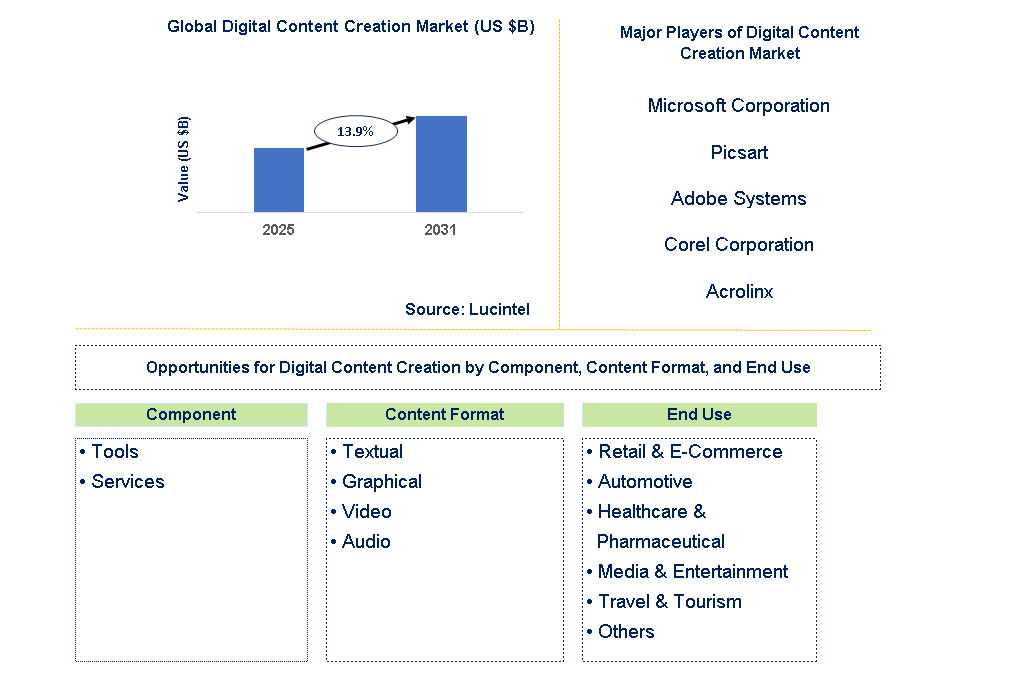
Key data points: The growth forecast = 13.9% annually for the next 7 years. Scroll below to get more insights. This market report covers trends, opportunities and forecasts in digital content creation market to 2031 by component (tools and services), content format (textual, graphical, video, and audio), end use (retail & E-commerce, automotive, healthcare & pharmaceutical, media & entertainment, travel & tourism, and others), and region (North America, Europe, Asia Pacific, and the Rest of the World)
We'll send your sample report shortly.
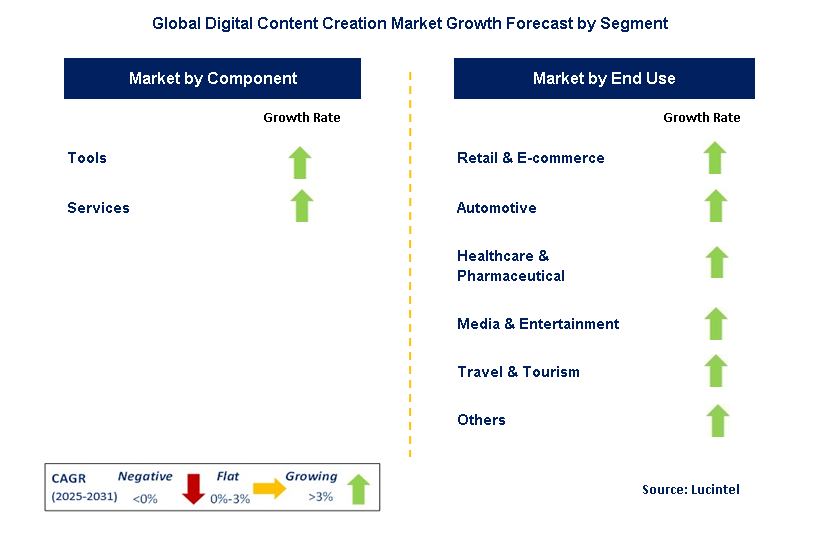
• Lucintel forecasts that, within the component category, tool is expected to witness higher growth over the forecast period.
• Within the application category, retail & E-commerce is expected to witness the highest growth.
• In terms of region, North America is expected to witness the highest growth over the forecast period. Gain valuable insights for your business decisions with our comprehensive 150+ page report. Sample figures with some insights are shown below.
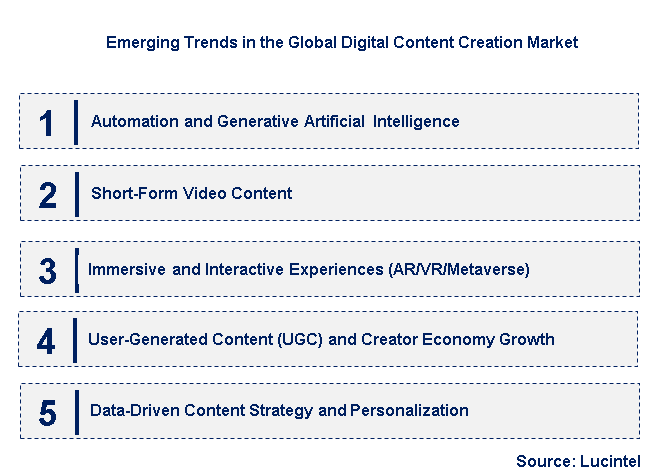
• Automation and Generative Artificial Intelligence: Generative AI applications, like large language models and image generators, are essentially revolutionizing content creation. They are able to quickly create text, images, video scripting, and even audio with little human intervention. This development makes it possible for creators to automate routine tasks, produce content at scale, and test creative concepts more effectively. The effect is drastic productivity gain, low time-to-market of content, and democratization of creation through low-tech skills needed to create great digital assets.
• Short-Form Video Content: Short-form video platforms such as TikTok, Instagram Reels, and YouTube Shorts have led to a surge in this format. These platforms prefer short, compelling, and very shareable video content that is interspersed with popular sounds and challenges. This trend responds to declining attention spans and mobile-first consumption patterns. Its effects are longer organic reach for creators and brands, greater engagement levels, and new prospects for viral marketing and direct selling through built-in shopping features in the video formats.
• Immersive and Interactive Experiences (AR/VR/Metaverse): Digital content is tending more towards immersive and interactive experiences through the use of augmented reality, virtual reality, and the emerging metaverse. This involves the development of 3D environments, interactive filters, virtual events, and digital avatars that enable users to actively interact with content instead of consuming it passively. The impact is heightened user engagement, improved brand storytelling using experiential marketing, and new monetization opportunities within virtual worlds and gaming platforms.
• User-Generated Content (UGC) and Creator Economy Growth: The authority of user-generated content only increases, with customers actively producing and distributing their own content about brands, products, and experiences. This phenomenon is closely tied to the growth of the creator economy, where people amass audiences and monetize their content directly. Its effect is greater authenticity and trust for brands, since UGC is considered more trustworthy than regular advertising. It also democratizes content creation, giving power to multiple voices and promoting strong community involvement.
• Data-Driven Content Strategy and Personalization: Content creators are increasingly relying on data analytics to guide their content strategies. This trend includes examining audience demographics, engagement metrics, consumption behaviors, and performance data to develop content that highly resonates with particular target segments. The result is highly personalized content experiences, enhanced content relevance, and optimized content distribution. This data-driven process makes sure that content investments offer greater returns and improved engagement through content that is customized to individual tastes. These new trends are drastically revolutionizing the digital content creation industry by making content creation more efficient, customized, and engaging. The convergence of AI, the reign of short-form video, the shift towards immersive experiences, democratization through UGC and the creator economy, and dependency on data-driven approaches are revolutionizing the way content is imagined, created, and viewed. It guarantees a dynamic and innovative digital storytelling and brand outreach future.
• Generative AI Tool Explosion: Rapid growth and availability of generative AI tools (e.g., ChatGPT, Mi journey, DALL-E) constitute a tremendous breakthrough. These tools can generate text, images, videos, and even audio automatically based on simple prompts, cutting down time and effort to produce content significantly. This breakthrough is making content creation more democratic in nature, enabling small businesses and individuals to create high-quality assets that would otherwise need significant resources and specialist expertise, thus speeding up the generation of content across industries.
• Short-Form Video Platform Dominance: The rapid emergence and ongoing dominance of platforms such as TikTok, Instagram Reels, and YouTube Shorts have irreversibly changed the face of content creation. These platforms value short, bite-sized video content, compelling creators and brands to use this format for optimal reach and virus potential. This development has led to new storytelling techniques, rapid trend cycles, and innovative monetization strategies through features like live shopping and direct brand partnerships, making video a cornerstone of digital content.
• Creator Economy and Direct Monetization Growth: Growth in the "creator economy," where solo content creators establish audiences and monetize directly, is an important trend. Platforms are providing more advanced tools for subscriptions, tipping, merchandise sales, and direct brand partnerships. This enables creators to establish sustainable careers on their own, driving a rich ecosystem of niche content and real voices, which in turn drives demand for content creation tools and services.
• Rising Demand for Immersive and Interactive Content: There is an increasing trend towards content that enables active user engagement instead of passive viewing. This covers augmented reality (AR) filters, virtual reality (VR) experiences, interactive videos, and content for metaverse platforms. This innovation provides richer, more captivating user experiences, especially for gaming, entertainment, and branded activations, which exceed traditional content formats and create stronger brand-consumer bonds.
• Data-Driven Content Strategy and Personalization: Content creators and brands are increasingly making use of data analytics to drive their content strategies. This means that audience demographics, engagement metrics, and consumption behavior are used to deliver highly personalized and relevant content. This move enables more specific delivery of content, enhanced campaign performance, and enhanced insight into audience preferences, driving optimized content creation and targeted distribution based on individual consumer requirements. These changes are having a deep influence on the market for digital content creation by making it more efficient, accessible, and diverse. The ubiquitous use of AI, the supremacy of short-form video, the empowerment of solo creators, and the emphasis on immersive and data-driven experiences are changing the face of digital storytelling and brand communications. This results in an unprecedented amount and diversity of content, resonating with increasingly discerning and engaged audiences.
• Retail and E-commerce Product Visualization: The e-commerce industry is growing briskly, and there is a huge growth potential for digital content creation in high-definition product visualization. This involves developing interactive 3D models, augmented reality (AR) try-ons of products, and dynamic video demonstrations. This use makes online shopping more engaging, lower returns, and higher conversion rates possible by enabling customers to experience products virtually, closing the gap between online and offline experiences and making consumers more confident.
• Education and E-learning Content Development: The expanding e-learning market offers immense growth potential for creating engaging digital educational content. This includes interactive textbooks, animated explainers, virtual lab simulations, and personalized learning modules. This application supports online courses, corporate training, and K-12 education by making complex subjects more accessible and engaging. It enables scalable, flexible learning solutions that cater to diverse learning styles and improve knowledge retention, creating new avenues for content providers.
• Immersive Gaming and Entertainment Experiences: Gaming and entertainment are significant drivers of digital content creation, and there is tremendous opportunity in the creation of immersive experiences. This involves constructing high-detailed 3D assets for gaming, virtual worlds for the metaverse, interactive stories, and premium visual effects for film and streaming. This application makes use of advanced rendering, animation, and storytelling methods to provide engaging user experiences, generating revenue from the sale of games, in-app purchase, and subscription to digital platforms.
• Corporate Branding and Marketing Communications: Companies of all industries need effective digital content for branding, marketing, and internal communications. This involves the development of compelling website content, social media campaigns, explainer videos, podcasts, and interactive presentations. This tool enables companies to establish brand identity, attract customers, educate stakeholders, and effectively communicate their message in a digitally-first world. Quality content is essential to differentiate oneself in a crowded marketplace and be able to engage loyal customers.
• Creator Monetization and Personal Branding: The expansion of the solo creator economy provides huge scope for digital content creation with a concentration on personal branding and direct audience monetization. This entails producing vlogs, podcasts, original social media content, and digital art for YouTube, TikTok, and Patrion. This app enables people to create communities centered on their interests, profit from their creativity with different models, and provide genuine, specialized content that appeals to unique audiences, driving the new era of independent content creation. These strategic opportunities for growth are deeply influencing the market of digital content creation by stimulating innovation and specialization in multiple applications. They emphasize the significant function of the market to enable various industries, ranging from education to retail, and enable individual creators. By targeting these application-specific requirements, the market of digital content creation is broadening its scope, bringing forward new business models, and emerging as an integral part of contemporary digital engagement.
• Microsoft Corporation
• Picsart
• Adobe Systems
• Corel Corporation
• Acrolinx
• Integra Software Services
• MarketMuse
• Quark Software
• Canva
• Tools
• Services
• Textual
• Graphical
• Video
• Audio
• North America
• Europe
• Asia Pacific
• The Rest of the World
• United States: The United States digital content creation market is experiencing significant growth, fueled by AI adoption and automation to increase productivity and personalization. Adobe Firefly AI and Google’s AI-enabled dubbing are optimizing workflows. Video content leads the way, driven by social media and streaming, with graphic content also growing fast with AI-focused design software. Retail and e-commerce are key end-users, using AI-driven content for engaging shopping experiences and personalized marketing.
• China: The digital content creation market in China is very dynamic, driven by the development of AI technologies across the media landscape. Demand for personalized content has created opportunities for AI-driven content generation, distribution, and moderation. Local technology incumbents such as Baidu, Tencent, Alibaba, and Byte Dance are spearheading innovation, with government encouragement providing momentum to AI growth in the media landscape. Video streaming services extensively leverage AI to make personalized content recommendations.
• Germany: Germany’s digital content creation industry is noted for its attention to accuracy and quality, with a strong adoption of digital content as a means of marketing, training, and customer interaction, especially in manufacturing and automotive industries. The use of AI and automation is a major force, enabling personalized content and efficient workflows. Growth in the creator economy, with more professionalized activities, is also a key source of potential for market growth and innovation.
• India: India’s market for creating digital content is growing at a fast pace, driven by the growth in the number of internet users and the expansion of internet networks, particularly to rural towns and villages. The demand for varied digital content in different formats like video, articles, and social media updates has hence increased manifold. Digital streaming platforms have become hugely popular, changing the way entertainment is consumed, opening up new vistas for content producers, production units, and independent film makers to access more people.
• Japan: Japan’s digital content creation industry is witnessing consistent growth, with the tools segment generating the highest revenue. Anime and manga culture have a significant impact, generating demand for similar digital content worldwide. Success of anime streaming sites and merchandise-only e-commerce sites reflects huge growth opportunities. Collaborative environments between brands and content creators are also driving the market by incorporating marketing messages into engaging content.


• Microsoft Corporation
• Picsart
• Adobe Systems
• Corel Corporation
• Acrolinx
• Integra Software Services
• MarketMuse
• Quark Software
• Canva Q5. Which digital content creation market segment will be the largest in future? Answer: Lucintel forecasts that, within the component category, tool is expected to witness higher growth over the forecast period. Q6. In digital content creation market, which region is expected to be the largest in next 5 years? Answer: In terms of region, North America is expected to witness the highest growth over the forecast period. Q7. Do we receive customization in this report? Answer: Yes, Lucintel provides 10% customization without any additional cost.


Choose a license that fits your team. Instant PDF delivery.
Prices exclude taxes. Instant delivery. Custom licensing available on request.
Market Report · July 15, 2026
Market Report · June 26, 2026
Market Report · June 24, 2026
Trusted partner for strategic intelligence and business growth


Receive a complimentary market analysis tailored to your industry. Our analysts will identify key growth opportunities and competitive dynamics specific to your business.

Market size, growth rate, and key trend analysis for your specific sector.

Top competitor positioning and market share analysis.

Strategic recommendations backed by data-driven insights.
Get curated market intelligence and competitive moves straight to your inbox.
By subscribing, you agree to receive our monthly insights. Unsubscribe anytime.
Receive a complimentary market analysis tailored to your industry. Our analysts will identify key growth opportunities and competitive dynamics specific to your business.
Market size, growth rate, and key trend analysis for your specific sector.
Top competitor positioning and market share analysis.
Strategic recommendations backed by data-driven insights.
Get curated market intelligence, emerging trends, and competitive moves straight to your inbox each month.
By subscribing, you agree to receive our monthly insights. Unsubscribe anytime.
We'll send your sample report shortly.