
Market Report · July 24, 2026

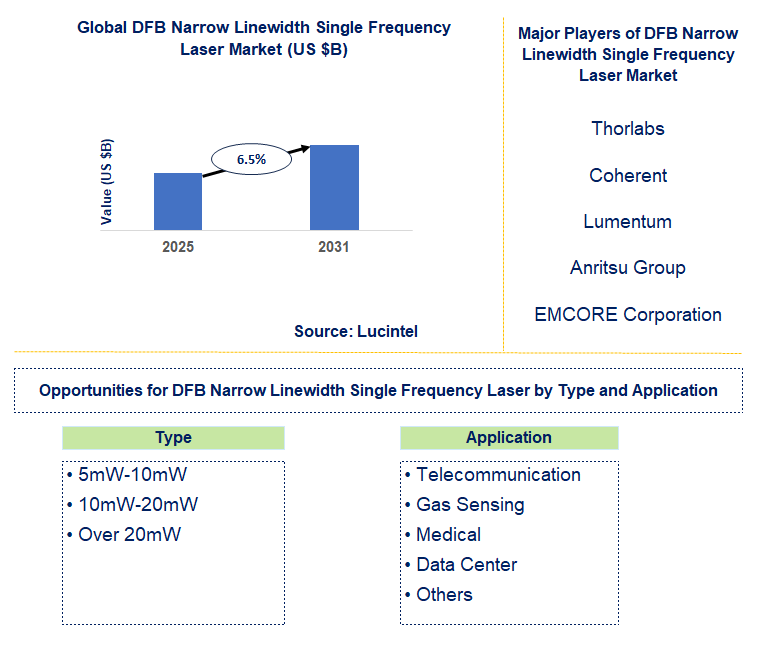
Key data points: The growth forecast = 6.5% annually for the next 7 years. Scroll below to get more insights. This market report covers trends, opportunities and forecasts in DFB narrow linewidth single frequency laser market to 2031 by type (5mW-10mW, 10mW-20mW, and over 20mW), application (telecommunication, gas sensing, medical, data center, and others), and region (North America, Europe, Asia Pacific, and the Rest of the World)
We'll send your sample report shortly.
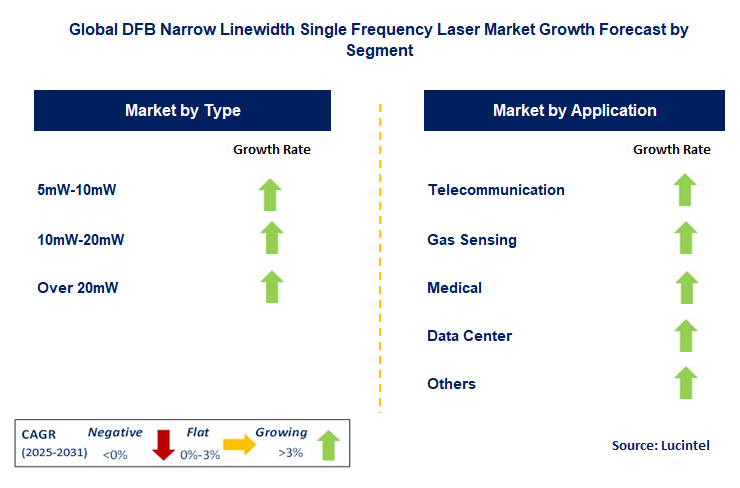
• Lucintel forecasts that, within the type category, 10mW-20mW is expected to witness the highest growth over the forecast period.
• Within the application category, telecommunication is expected to witness the highest growth.
• In terms of region, APAC is expected to witness the highest growth over the forecast period. Gain valuable insights for your business decisions with our comprehensive 150+ page report. Sample figures with some insights are shown below.
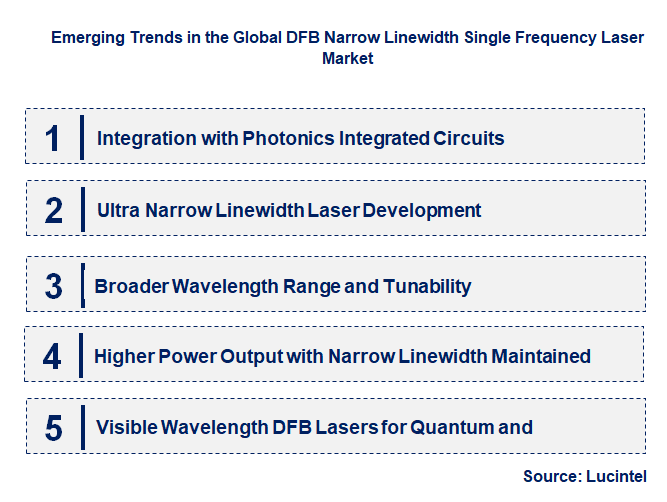
• Integration with Photonics Integrated Circuits: An important trend is the growing integration of DFB lasers with PICs. This facilitates the development of miniaturized, low-cost, and highly stable laser sources integrated with other optics on a single chip. This is a particularly important trend for optical communications, sensing, and quantum technologies where scaling and miniaturization are vital.
• Ultra Narrow Linewidth Laser Development: There is an ongoing push to achieve even smaller linewidths, extending the limits of laser stability and spectral purity. Ultra narrow linewidth lasers, with linewidths in the kilohertz or even hertz order, are essential for high-demand applications such as precision metrology, atomic clocks, and gravitational wave detection, allowing for more sensitive and precise measurements.
• Broader Wavelength Range and Tunability: Increasing the accessible wavelength range and improving the tunability of DFB lasers are significant trends. This enables these lasers to be applied in a wider range of applications, including spectroscopy for the detection of different gases and materials, and in high-performance optical communication systems employing different wavelength bands for greater data capacity.
• Higher Power Output with Narrow Linewidth Maintained: While ensuring a narrow linewidth, there is an increasing need for DFB lasers with higher power output. Higher power allows applications in such areas as LiDAR for longer range sensing and industrial processing that demand precise and coherent laser sources with enough power.
• Visible Wavelength DFB Lasers for Quantum and Biphotonic: Visible spectrum DFB lasers are a recent development, with major applications in quantum information science (at specific atomic transitions) and biphotonic (for high resolution sensing and imaging). Visible DFB lasers provide stable and compact options compared to classical bulky laser setups. These nascent trends are collectively propelling the DFB narrow linewidth single frequency laser market towards improved performance, increased versatility, and increasingly integrated and smaller solutions, broadening their use in a broader range of scientific and industrial applications.
• Enhanced Linewidth and Stability Performance: Recent developments in laser design and fabrication processes have resulted in DFB lasers with much better linewidths, going down to sub kilohertz levels in certain commercial products. Better stability against environmental disturbances such as temperature and vibrations has also been attained.
• Commercialization of Integrated DFB Laser PICs: Increasing numbers of companies now provide commercially sold PICs, which integrate the DFB lasers with other optical devices like modulators and detectors. The integrated solutions provide size, cost, and power efficiency advantages for use in applications like coherent optical communications.
• Extension of DFB Laser Wavelength Bands: Progress has been made in the extension of the wavelength range of high-performance DFB lasers, such as the establishment of stable sources in the visible and mid-infrared regions, with new application possibilities in quantum technologies and gas sensing.
• Integration of High-End Control Electronics: The latest advancements involve the integration of high-end control electronics with DFB laser modules, which facilitate accurate wavelength tuning, stabilization, and modulation with low noise operation, essential for applications such as coherent communication and high resolution spectroscopy.
• Enhanced Adoption in Next-Generation Quantum Applications: DFB narrow linewidth single frequency lasers are gaining enhanced adoption in numerous quantum technology applications such as atomic clocks, quantum computing, and quantum communication, wherein their high spectral accuracy is critical for controlling quantum states. These latest advances underscore a market intent on expanding the performance capabilities of DFB lasers, combining them with more sophisticated and compact systems, increasing their wavelength range, and making them usable in leading edge technologies such as quantum computing.
• Coherent Optical Communications: The ever-increasing demand for high speed and long distance data transmission in telecommunications drives a significant need for DFB lasers with narrow linewidths for coherent detection systems. The ability to create lasers with wider tuning ranges and greater output power for DWDM and advanced modulation formats is a strong growth opportunity.
• Precision Metrology and Sensing: Precision measurement applications like interferometry, optical coherence tomography (OCT), and high resolution spectroscopy need lasers with very narrow linewidths and stable frequencies. Customized DFB laser solutions for individual sensing modalities and metrology equipment provide a significant growth opportunity.
• Quantum Technologies: The emerging area of quantum computing, quantum communication, and quantum sensing is dependent to a large extent on single frequency lasers with extremely narrow linewidths for the manipulation of atomic and photonic qubits. The development of DFB lasers at precise wavelengths needed for these quantum systems is a high growth potential market.
• LIDAR and Remote Sensing: Advanced LiDAR systems for autonomous transportation, environmental monitoring, and factory automation take advantage of DFB lasers with low linewidths for enhanced range resolution and precision. Producing cost effective and reliable DFB laser modules for these markets is a major opportunity.
• Biphotonic and Medical Imaging: Medical imaging, flow cytometry, and laser-based diagnostics applications necessitate stable and narrow linewidth lasers at precise wavelengths. The need for compact and reliable DFB laser sources in these medical and life science applications presents an increasing market segment. These growth opportunities are strategic that highlight the growing need for DFB narrow linewidth single frequency lasers in cutting-edge technology industries based on the requirement for high coherence, precision, and stability in sources of light for a variety of advanced applications.
• Thorlabs
• Coherent
• Lumentum
• Anritsu Group
• EMCORE Corporation
• MACOM
• Mitsubishi Electric
• Nanoplus Nanosystems and Technologies
• QD Laser
• Toptica Eagleyard
• 5mW-10mW
• 10mW-20mW
• Over 20mW
• Telecommunication
• Gas Sensing
• Medical
• Data Center
• Others
• North America
• Europe
• Asia Pacific
• The Rest of the World
• United States: The DFB narrow linewidth single frequency lasers market in the US is dominated by robust photonics, quantum computing, and next-generation sensing technology research activity. Recent examples include university and private industry collaboration to create high performance lasers tailored to specific application areas. A high degree of attention is also placed on embedding such lasers in small and rugged systems for field application in applications such as LiDAR and environmental monitoring. Quantum technology funding from the government is also contributing significantly to this market segment.
• China: The Chinese DFB narrow linewidth single frequency laser market is witnessing a fast-paced growth, driven by heavy investments in telecommunication infrastructure, such as 5G networks, and an increased focus on indigenous technological advancements. Recent trends include enhanced domestic production capabilities and research on lasers with improved performance attributes. China‘s emerging quantum technology industry also accounts for a considerable demand for these specialized lasers.
• Germany: Germany is well placed in the DFB narrow linewidth single frequency laser market, thanks to its established photonics industry and top research centers. Recent trends have seen the creation of highly stable lasers for metrology and spectroscopy applications, as well as their integration into industrial measurement and sensing tools. Energy efficiency and miniaturization of laser systems are also areas of focus.
• India: The Indian market for DFB narrow linewidth single frequency lasers is comparatively in an early stage but will grow with growing investments in research and development, especially in telecommunication and defense industries. Recent trends may include early adoption in sophisticated communication systems and certain research work in educational institutions. As India‘s technology infrastructure matures, the demand for these high-performance lasers is expected to increase.
• Japan: Japan enjoys a long history in photonics and a dominant position in the DFB narrow linewidth single frequency laser market. The latest breakthroughs emphasize extending the frontiers of laser performance in linewidth, stability, and tunability for use in optical communications, precise measurement, and quantum information processing. Merging these lasers with sophisticated optical components and systems is a major area of development as well.


• Thorlabs
• Coherent
• Lumentum
• Anritsu Group
• EMCORE Corporation
• MACOM
• Mitsubishi Electric
• Nanoplus Nanosystems and Technologies
• QD Laser
• Toptica Eagleyard Q5. Which DFB narrow linewidth single frequency laser market segment will be the largest in future? Answer: Lucintel forecasts that, within the type category, 10mW-20mW is expected to witness the highest growth over the forecast period. Q6. In DFB narrow linewidth single frequency laser market, which region is expected to be the largest in next 5 years? Answer: In terms of region, APAC is expected to witness the highest growth over the forecast period. Q7. Do we receive customization in this report? Answer: Yes, Lucintel provides 10% customization without any additional cost.


Choose a license that fits your team. Instant PDF delivery.
Prices exclude taxes. Instant delivery. Custom licensing available on request.
Market Report · July 24, 2026
Market Report · July 20, 2026
Market Report · July 20, 2026
Trusted partner for strategic intelligence and business growth


Receive a complimentary market analysis tailored to your industry. Our analysts will identify key growth opportunities and competitive dynamics specific to your business.

Market size, growth rate, and key trend analysis for your specific sector.

Top competitor positioning and market share analysis.

Strategic recommendations backed by data-driven insights.
Get curated market intelligence and competitive moves straight to your inbox.
By subscribing, you agree to receive our monthly insights. Unsubscribe anytime.
Receive a complimentary market analysis tailored to your industry. Our analysts will identify key growth opportunities and competitive dynamics specific to your business.
Market size, growth rate, and key trend analysis for your specific sector.
Top competitor positioning and market share analysis.
Strategic recommendations backed by data-driven insights.
Get curated market intelligence, emerging trends, and competitive moves straight to your inbox each month.
By subscribing, you agree to receive our monthly insights. Unsubscribe anytime.
We'll send your sample report shortly.