
Market Report · July 15, 2026

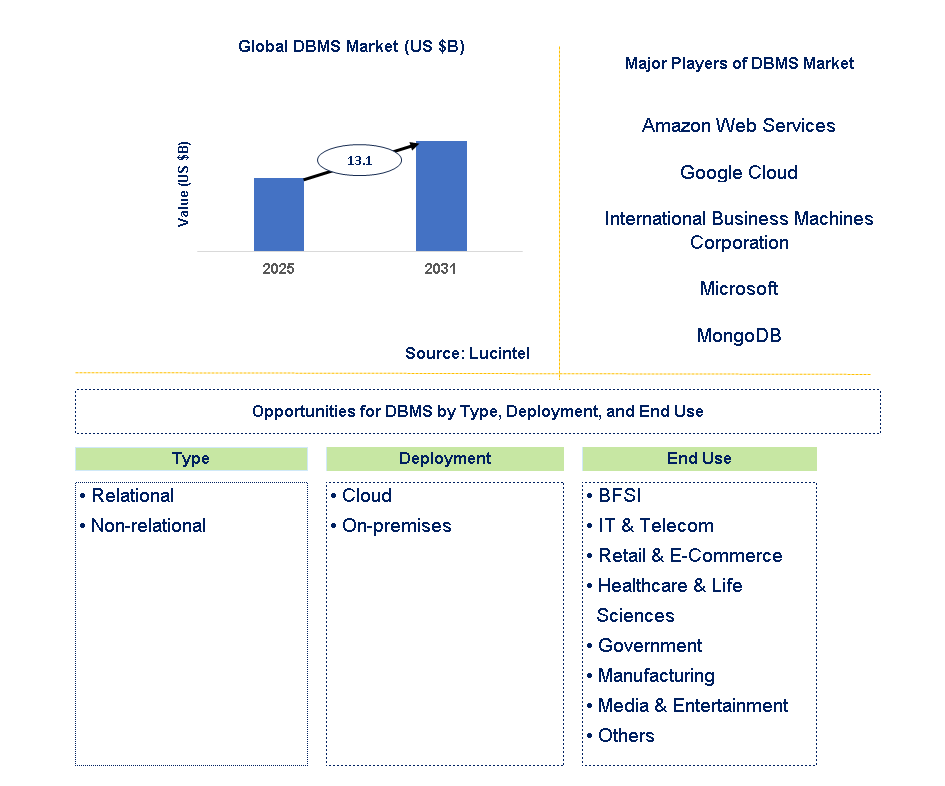
Key data points: The growth forecast = 13.1% annually for the next 7 years. Scroll below to get more insights. This market report covers trends, opportunities and forecasts in DBMS market to 2031 by type (relational and non-relational), deployment (cloud and on-premises), end use (BFSI, IT & telecom, retail & E-commerce, healthcare & life sciences, government, manufacturing, media & entertainment, and others), and region (North America, Europe, Asia Pacific, and the Rest of the World)
We'll send your sample report shortly.
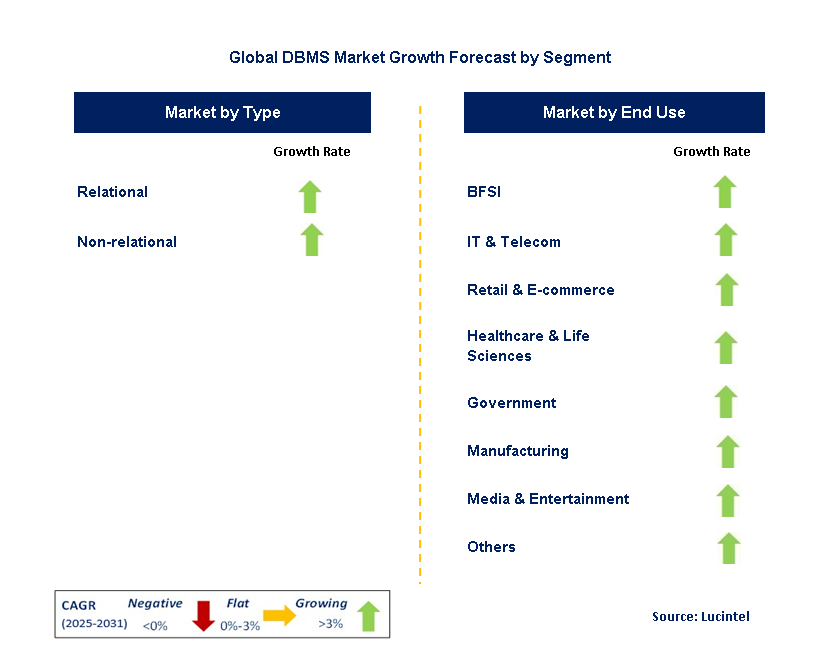
• Lucintel forecasts that, within the type category, relational is expected to witness higher growth over the forecast period.
• Within the end use category, BFSI is expected to witness the highest growth.
• In terms of region, North America is expected to witness the highest growth over the forecast period. Gain valuable insights for your business decisions with our comprehensive 150+ page report. Sample figures with some insights are shown below.
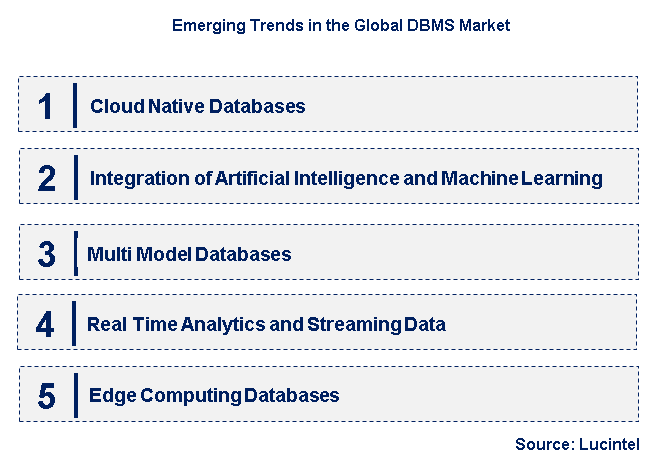
• Cloud Native Databases: In this trend, the design and deployment of the databases is done for cloud environments, utilizing cloud infrastructure for scalability, robustness, and elasticity. Cloud native databases are designed to fully leverage services provided by cloud vendors, including managed services, serverless computing, and object storage. This allows companies to dynamically scale their database resources up or down as necessary, without the administrative burden of managing the underlying infrastructure. The result is lower operating costs, higher agility, and greater availability, making sophisticated database capabilities available to a broader set of organizations.
• Integration of Artificial Intelligence and Machine Learning: Integration of AI and ML in DBMS is transforming database operations. Such a trend results in autonomous databases that are able to manage, tune, and heal themselves, automating mundane tasks such as patching, backup, and performance tuning. AI and ML also improve data quality, anomaly detection, and predictive analytics within the database directly. This convergence minimizes the dBs’ manual labor, enhances system performance, and allows organizations to uncover richer insights from their data more rapidly.
• Multi Model Databases: Multi model databases store several data models in a single database system, e.g., relational, document, graph, key value, and columnar. This trend solves the problem of storing different types of data and structures without the use of independent, specialized databases. Organizations can keep and query various forms of data in a single platform, reducing the hassle of data management and integration complexities. The effect is greater flexibility, fewer data silos, and enhanced efficiency in dealing with complex and diverse datasets for use in applications such as content management, IoT, and social media.
• Real Time Analytics and Streaming Data: The need for real-time insights from fast flowing streams of data is pushing the usage of DBMS designed for real time analytics. This movement entails technologies that have the ability to ingest, process, and analyze data in real time, as it is being created, instead of using batch processing. Applications include detection of fraud, personalized customer experience, and monitoring of operations. The effect is quicker decision-making, better reaction to market shifts, and more effective operational processes through the ability of organizations to respond to new data as it is received.
• Edge Computing Databases: With the growth in IoT devices and dispersed data sources, edge computing databases are becoming more prominent. This is a trend to deploy database functionality nearer to the source of the data, at the network edge, compared to pushing all data into a single cloud or data center. Edge databases support local data processing, lower latency, and data availability even with infrequent connectivity. The effect is quicker response time for edge applications, lower network bandwidth demand, and better data privacy and security through processing sensitive data locally. These trends are deeply transforming the DBMS market from monolithic, on-premises solutions to more distributed, smarter, and more flexible architectures. The focus is on automation, scalability, and the capacity to process different types of data in real time. This revolution enables organizations to extract more value from their data, fast-track innovation, and respond more dynamically to market needs, ultimately driving digital transformation throughout all industries.
• Migration to and adoption of the Cloud: The mass migration of databases to cloud environments is a seminal development. Organizations increasingly are migrating away from traditional on premise DBMS in favor of cloud based offerings such as Amazon RDS, Google Cloud Spanner, and Azure SQL Database. This change is motivated by the advantages of scalability, cost savings, lower management overhead, and worldwide accessibility. The result is a more adaptable and robust data infrastructure, allowing enterprises to respond rapidly to shifting requirements and minimize huge capital outlay in terms of hardware and upkeep.
• NoSQL and NewSQL Databases Growth: Although relational databases remain the foundation, there is considerable growth in the use of NoSQL databases like MongoDB and Cassandra for dealing with unstructured and semi structured data from social media and IoT sensors. At the same time, NewSQL databases are surfacing that try to mesh the scalability of NoSQL with the transactional consistency of relational databases. This evolution grants companies specialized software for handling disparate data formats, with more flexibility and performance for contemporary applications and big data analysis.
• Autonomous Database Capabilities: Perhaps the biggest technology breakthrough is the arrival of autonomous databases, driven by machine learning and artificial intelligence. Such systems provide automated administration of common database tasks like provisioning, patching, backup, and tuning, with minimal human touch and errors. Oracle’s Autonomous Database is a case in point. The effect is a dramatic lowering of operational expenses, better performance of databases, and enhanced security, allowing database administrators to concentrate on higher-strategy projects.
• Data Lakes and Lake houses: The data lake notion, where raw data in its original form is stored in large quantities, has developed into lake houses. Lake houses marry the affordability and flexibility of the data lake with the data management and transactional features common to data warehouses. This innovation allows organizations to execute conventional business intelligence as well as sophisticated analytics, such as machine learning, on the same combined data platform. The effect is a consistent strategy to manage data, shattering data silos and supporting complete data analysis.
• Advanced Security and Compliance Features: As there are more data breaches and strict regulations such as GDPR and CCPA, advanced security and compliance features are essential advances in DBMS. Contemporary DBMS solutions provide strong encryption, access controls, data masking, and auditing features to safeguard sensitive data. Vendors also include compliance management tools. The benefit is enhanced data protection, lower legal and reputational risk, and higher customer trust, allowing organizations to comply with their regulatory requirements in a way that protects valuable data assets. These advancements are redefining the DBMS industry at its core by automating, adapting, and securing data management. The move towards cloud native and smart database systems is empowering businesses to create new opportunities for data-driven innovation, enhance operational effectiveness, and establish stronger and more responsive data structures. This transformation is ensuring that DBMS remains a pillar of the digital economy.
• Banking and Financial Services (BFSI): The BFSI space offers lucrative growth opportunities because of its vast amount of transactional data, regulatory compliance needs, and requirements for real-time fraud detection as well as customer analytics. DBMS technologies that can facilitate high speed transaction processing, safe data storage, and sophisticated analytical support for risk management and tailored financial products are in strong demand. The effect is increased security, better operational efficiency, and provision of innovative financial services, facilitating digital banking and fintech developments.
• Healthcare and Life Sciences: This industry provides significant opportunity for DBMS, fueled by the patient data explosion, electronic health records, medical imaging, and genomic research. Requirements for secure, compliant (e.g., HIPAA), highly available database systems to store sensitive health data and enable research are imperative. Opportunities include big data analytics, interoperability, and AI-driven diagnostics solutions. The effect is enhanced patient care, faster medical research, and better healthcare operation through improved data organization and accessibility.
• Retail and E commerce: The increasing growth of online shopping and customized customer experience is demanding DBMS solutions in the retail and e commerce industry. Opportunities arise for databases that can process huge volumes of transactions, deal with multi-product catalogs, enable real time inventory management, and drive recommendation engines. NoSQL databases come into play specifically to manage unstructured customer information and clickstreams from websites. The effect is improved customer interaction, streamlined supply chains, and boosted sales through data driven personalization and streamlined operations.
• Telecommunications and IT: The telecommunication and IT industries are witnessing data growth from network traffic, subscriber information, and IoT devices at a rate of exponentials. This opens immense opportunities for DBMS that have the capability to ingest high volume data, provide real time network monitoring, and enable agile data analytics to support service optimization and innovation in new products. Distributed and cloud native databases are central to handling global network infrastructures. The effect is better network performance, improved customer experience, and the possibility to innovate at high speed in fields such as 5G and edge computing.
• Government and Public Sector: Governments all over the world are taking on digital transformation projects, which has the result of creating huge opportunities for DBMS solutions. They include keeping citizen databases, public records, smart city data, and other government services. The emphasis is on secure, scalable, and compliant DBMS that can handle massive scale data integration and deliver insights for public policy and delivery of services. The effect is better governance, improved public services, and increased transparency through effective and secure management of data. These strategic growth prospects are transforming the DBMS market with a focus on customized solutions catering to the unique data management needs and opportunities of each industry. The emphasis lies in providing secure, scalable, and intelligent database systems that allow organizations to capitalize on their data for competitiveness, operational excellence, and innovation in various applications. This application-specific strategy is prompting specialization and differentiation of DBMS vendors.
• Amazon Web Services
• Google Cloud
• International Business Machines Corporation
• Microsoft
• MongoDB
• Oracle
• Redis
• SAP
• Snowflake
• Teradata
• Relational
• Non-relational
• Cloud
• On-premises
• North America
• Europe
• Asia Pacific
• The Rest of the World
• United States: The United States remains a leading force in the DBMS market because of a mature information technology infrastructure, strong cloud adoption rates, and significant investments in data-centric technologies. There is intense focus on embedded artificial intelligence and machine learning within DBMS for higher automation and predictive analytics. Key players such as Oracle, Microsoft, and Amazon Web Services are constantly innovating, with growing adoption of hybrid and cloud native database solutions in many industries such as banking, healthcare, and technology.
• China: The DBMS market in China is growing robustly, driven by accelerated digitalization, increasing cloud infrastructure, and the development of big data and artificial intelligence applications. Local suppliers are picking up steam, pushing back against global players, as the nation puts a premium on data sovereignty and local technology growth. The smart city, fintech, and e commerce initiatives are specifically leading the charge for high performance and scalable database solutions. Distributed databases and real time data processing are emphasized to handle large user bases and transactional volumes.
• Germany: Germany’s DBMS market is dominated by high regard for data security, regulatory compliance, especially GDPR, and the implementation of hybrid cloud approaches. Manufacturing, automotive, and financial industries are major drivers, requiring secure and trustworthy data management solutions. Although mainstream relational databases are still dominant, interest is growing in NoSQL and in memory databases for individual applications like IoT and real time analytics. Industry 4.0 projects are also driving the need for solid data platforms.
• India: India is among the highest growing DBMS markets, driven by fast digitalization, growing IT and telecommunication industries, and rising adoption of cloud in small and medium businesses and large companies. The growth of e commerce, online payments, and government programs such as Digital India are generating an enormous need for cost efficient and scalable database solutions. There exists an expanding startup ecosystem and high focus on open source data base technologies, in addition to investments in machine learning and artificial intelligence for data management.
• Japan: Japan’s DBMS market is characterized by a mix of conventional enterprise needs and evolving technologies. Though there continues to be a heavy dependence on mature relational database systems for mission critical applications, as much attention is being paid to cloud based DBMS, NoSQL databases, and data analytics platforms. Sectors like manufacturing, healthcare, and retail are investing in new generation DBMS for supporting digital transformation drives, enhancing operational effectiveness, and utilizing data for decision making. Data security and disaster recovery continue to be top priorities.


• Amazon Web Services
• Google Cloud
• International Business Machines Corporation
• Microsoft
• MongoDB
• Oracle
• Redis
• SAP
• Snowflake
• Teradata Q5. Which DBMS market segment will be the largest in future? Answer: Lucintel forecasts that, within the type category, relational is expected to witness higher growth over the forecast period. Q6. In DBMS market, which region is expected to be the largest in next 5 years? Answer: In terms of region, North America is expected to witness the highest growth over the forecast period. Q7. Do we receive customization in this report? Answer: Yes, Lucintel provides 10% customization without any additional cost.


Choose a license that fits your team. Instant PDF delivery.
Prices exclude taxes. Instant delivery. Custom licensing available on request.
Market Report · July 15, 2026
Market Report · June 26, 2026
Market Report · June 24, 2026
Trusted partner for strategic intelligence and business growth


Receive a complimentary market analysis tailored to your industry. Our analysts will identify key growth opportunities and competitive dynamics specific to your business.

Market size, growth rate, and key trend analysis for your specific sector.

Top competitor positioning and market share analysis.

Strategic recommendations backed by data-driven insights.
Get curated market intelligence and competitive moves straight to your inbox.
By subscribing, you agree to receive our monthly insights. Unsubscribe anytime.
Receive a complimentary market analysis tailored to your industry. Our analysts will identify key growth opportunities and competitive dynamics specific to your business.
Market size, growth rate, and key trend analysis for your specific sector.
Top competitor positioning and market share analysis.
Strategic recommendations backed by data-driven insights.
Get curated market intelligence, emerging trends, and competitive moves straight to your inbox each month.
By subscribing, you agree to receive our monthly insights. Unsubscribe anytime.
We'll send your sample report shortly.