
Market Report · July 15, 2026

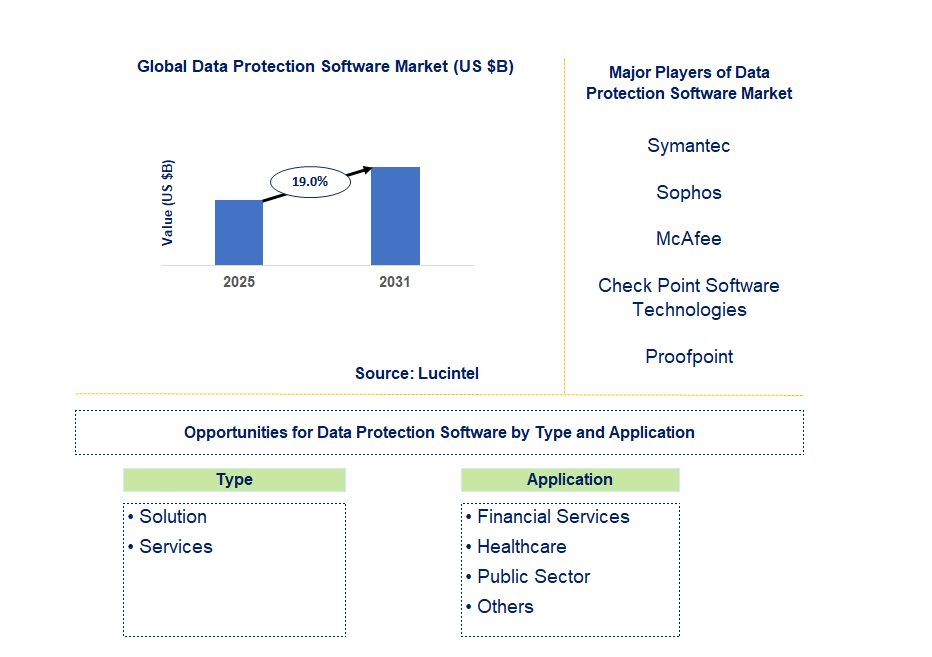
Key data points: The growth forecast = 19.0% annually for the next 7 years. Scroll below to get more insights. This market report covers trends, opportunities and forecasts in data protection software market to 2031 by type (solution and services), application (financial services, healthcare, public sector, and others), and region (North America, Europe, Asia Pacific, and the Rest of the World)
We'll send your sample report shortly.
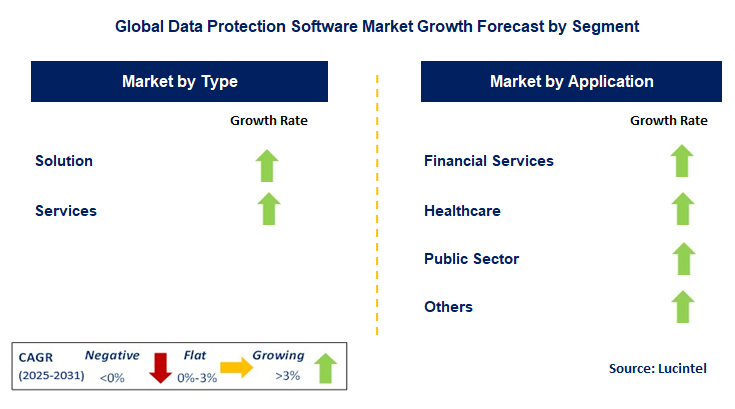
• Lucintel forecasts that, within the type category, service is expected to witness higher growth over the forecast period.
• Within the application category, healthcare is expected to witness the highest growth.
• In terms of region, APAC is expected to witness the highest growth over the forecast period. Gain valuable insights for your business decisions with our comprehensive 150+ page report. Sample figures with some insights are shown below.
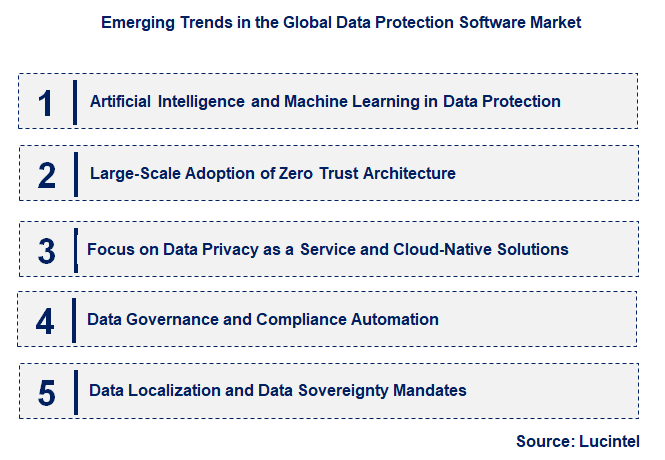
• Artificial Intelligence and Machine Learning in Data Protection: Artificial Intelligence and Machine Learning are becoming an essential part of data security software. These technologies help to provide sophisticated threat detection, anomaly detection, and predictive analysis that are far beyond the rule-based systems. AI and ML algorithms help to analyze huge data in real time, detect complex cyber threats such as ransomware and zero-day attacks, and automate response controls. This feature helps to improve an organization’s proactive protection of sensitive data and reduce risks quickly and efficiently.
• Large-Scale Adoption of Zero Trust Architecture: Zero Trust Architecture is becoming an underlying tenet in data protection mechanisms. In contrast to conventional perimeter-oriented security, ZTA is founded on the "never trust, always verify" philosophy, with no user or device within or outside the network that is taken for granted as trustworthy. This demands rigorous identity authentication, least-privilege access, and ongoing monitoring of each access request. Implementing ZTA drastically minimizes the attack surface, prevents insider threats, and improves overall data security posture by removing implicit trust.
• Focus on Data Privacy as a Service and Cloud-Native Solutions: The move towards Data Privacy as a Service and cloud-native data protection offerings is gaining speed swiftly. Organizations are looking to move away from on-premises infrastructure to exploit the scalability, elasticity, and cost savings of cloud-based offerings. Daas solutions offer complete data protection features such as backup, disaster recovery, and compliance management as subscription-based services. This enables companies to outsource complicated data protection functions and concentrate on their core business.
• Data Governance and Compliance Automation: With the growth of data privacy legislation such as GDPR, CCPA, and India’s DPDP Act, there is a heightened emphasis on sound data governance and compliance automation. Organizations are looking for software tools to automate data discovery, classification, consent management, and subject access requests. This trend seeks to simplify compliance activities, minimize manual labor, decrease the risk of non-compliance penalties, and provide transparent and accountable management of personal data in various regulatory environments.
• Data Localization and Data Sovereignty Mandates: Data localization and data sovereignty are increasingly gaining momentum around the world. Nations are increasingly implementing mandates requiring specific forms of data to be processed and stored within their territorial boundaries. This trend reflects challenges as well as opportunities for data protection software. There is a compelling demand for solutions that can impose geographical data residency, enable cross-border data transfer compliance, and make sure data is still within the jurisdiction of its home country, impacting cloud service providers and global enterprises. These new trends are really changing the data protection software market by compelling it to shift toward smarter, more proactive, and compliant solutions. The combination of AI and ML improves threat detection, while Zero Trust Architecture strengthens security stances. The transition to Daas and cloud-native technology provides scalability and cost-effectiveness, and the heightened emphasis on data governance and compliance automation alleviates regulatory complexity. Additionally, the increased attention to data localization and sovereignty redefines deployment strategies, collectively driving an industry dedicated to robust and ethical data management.
• Emergence of Ransomware Protection and Recovery Solutions: One of the key recent trends is the steep increase in advanced ransomware protection and recovery products. As ransomware threats become more prevalent and costly, organizations are putting a priority on software with immutable backups, fast data recovery, and built-in threat intelligence to identify and eliminate ransomware attacks. These products incorporate machine learning and AI to detect unusual behavior and allow granular recovery to reduce downtime and data loss.
• Advanced Data Loss Prevention for Cloud and Hybrid Environments: Data Loss Prevention (DLP) software has made huge strides, especially for cloud and hybrid environments. With data increasingly being out of the traditional network perimeter, organizations need DLP solutions that can monitor, classify, and safeguard sensitive data in SaaS applications, public clouds, and remote endpoints. Latest improvements include more fine-grained policy enforcement, context-aware data classification, and integration with cloud access security brokers (CASB) to stop inadvertent or malicious exfiltration of data.
• Growing Adoption of Data Protection as a Service: The market is seeing an increased adoption of Data Protection as a Service solutions. This trend is fueled by organizations that are looking to outsource the complexity of data backup, recovery, and compliance to dedicated service providers. Daas solutions provide scalability, lower infrastructure expenses, and advanced management, which are extremely desirable for small and medium-sized businesses (SMEs) and organizations with minimal in-house IT capabilities, simplifying their data protection processes.
• Artificial Intelligence and Machine Learning Integration for Predictive Security: One of the major advancements is deeper AI and ML integration into data protection software for predictive security. AI and ML programs are utilized to scan enormous amounts of data for unusual activity, identify new threats more quickly, and automate security incident responses. This smart automation assists in the forecasting of probable breaches, detection of vulnerabilities, and constant updating of security policies, thus shifting data protection from a reactive to a highly proactive position.
• Unified Data Governance and Privacy Platforms: Current trends reflect a strong emphasis on building unified data governance and privacy platforms. As regulations become increasingly interdependent, organizations are looking for a single solution that can handle data discovery, classification, consent, privacy impact assessments, and data subject access requests. This unification seeks to capture a comprehensive view of data assets, enforce consistent policy across the enterprise, and simplify compliance with numerous global data protection regulations from a centralized platform. These latest advancements are deeply affecting the data protection software industry by rendering solutions more robust, flexible, and holistic. The focus on high-end ransomware security, more mature DLP for disparate networks, and the adoption of Daas demonstrates a direct reaction to changing cyber threats and operational needs. In addition, the use of AI for proactive security and the transition to unified data governance platforms reflect an industry-wide push for intelligent automation and streamlined compliance, providing strong data protection in a complicated digital landscape.
• Cloud Data Protection: The quick migration of applications and data to cloud infrastructure (public, private, and hybrid) offers the largest growth potential. Companies need strong protection of data for cloud-native applications, SaaS applications, and cloud storage. This includes potential in backup and recovery for the cloud, data loss prevention (DLP) for cloud data, cloud security posture management (CSPM) to make sure configurations are secure, and solutions for data residency and sovereignty within multi-cloud stacks.
• Data Privacy and Compliance Management: The continually widening data privacy compliance landscape (e.g., GDPR, CCPA, DPDP Act of India) provides staggering growth prospects in compliance management software. This category encompasses data discovery and mapping solutions, consent management platforms, automated data subject access requests (DSARs), privacy impact assessment (PIA) software, and data governance frameworks that enable organizations to prove accountability and mitigate substantial regulatory penalties while gaining customers’ trust.
• Ransomware Protection and Cyber Recovery: As ransomware attacks become an existential threat to companies, strategic expansion comes in the form of end-to-end ransomware protection and lightning-fast cyber recovery solutions. Potential comes in the form of software that offers immutable backup, isolated recovery environments, behavioral analytics to identify ransomware activity, and automated orchestration for instant and trustworthy data restoration. The emphasis is shifting from simple data backup to business continuity and resistance to next-gen cyber extortion.
• Endpoint Data Protection: With remote and hybrid work patterns becoming more prevalent, endpoint data protection is a key area of growth. Possibilities range from sophisticated endpoint DLP to endpoint detection and response (EDR) solutions that include data protection, secure file sync and share, and strong encryption for data at rest and in motion on varied endpoint devices. The explosion of endpoints accessing corporate information requires robust, distributed data protection.
• Database and Application Security: Protecting data in key business applications and databases provides an important growth area. This covers database encryption, database activity monitoring (DAM), data masking and tokenization for sensitive data, and application security testing (AST) that embeds data protection concepts throughout the software development lifecycle (SDLC). With ever-increasing sophisticated applications and interconnectivity, safeguarding the underlying data contained within them is critical. These growth opportunities highlight the core and dynamic function of data protection software throughout the digital landscape. The widespread transition to cloud platforms, the need for regulatory compliance, the ongoing threat of ransomware, the distributed character of contemporary work, and the necessity to protect core applications all come together to provide rich soil for innovation and expansion. By concentrating on these significant application areas, data protection software providers can properly respond to the most crucial issues organizations are experiencing these days.
• Symantec
• Sophos
• McAfee
• Check Point Software Technologies
• Proofpoint
• Solution
• Services
• Financial Services
• Healthcare
• Public Sector
• Others
• North America
• Europe
• Asia Pacific
• The Rest of the World
• United States: The United States data protection software market is extremely dynamic, driven by mounting cyber-attacks and ongoing expansion of state-level privacy regulations, including the California Consumer Privacy Act (CCPA), in addition to larger federal debates. Recent trends indicate high uptake of cloud-based data protection offerings, including Data Protection as a Service (Daas), demonstrating a shift towards elastic and adaptable security infrastructure. There is also a heavy investment in AI-powered threat detection and automated incident response capabilities to deal with sophisticated cyberattacks efficiently.
• China: The Chinese market for data protection software is growing quickly, being pushed mainly by strict national cybersecurity regulations, such as the Cybersecurity Law, Data Security Law, and Personal Information Protection Law. Latest trends suggest a strong focus on homegrown solutions and an initiative towards higher data localization, affecting cross-border data flows. The private sector and government are making major investments in next-generation application security platforms, AI-based security systems, and real-time threat detection to protect extensive digital infrastructures and ensure national digital sovereignty.
• Germany: The German market for data protection software is dominated by a strong emphasis on General Data Protection Regulation (GDPR) and national Federal Data Protection Act compliance. Recent trends point to greater investment in privacy management software, especially data discovery and mapping, and consent management solutions. German companies, in industry sectors such as finance and healthcare, are focusing on strong privacy management tools to hold themselves accountable, foster customer confidence, and sidestep exorbitant fines under the stringent European regulation environment.
• India: The Indian market for data protection software is growing at a large scale, led mainly by the passing of the Digital Personal Data Protection Act (DPDP Act) 2023. Current trends involve a growing demand for security solutions for data centers as a result of increasing IT infrastructure and cloud usage. Organizations are emphasizing the installation of basic security controls such as encryption, obfuscation, and access control. The DPDP Act also requires data breach notifications and Data Protection Officer appointments, pushing software adoption further to maintain compliance.
• Japan: The Japanese market for data protection software is strong, spurred by growing business digitalization and meeting the requirements of the Act on the Protection of Personal Information (APPI). Recent trends indicate an uptick in the use of AI-based security analysis and machine learning algorithms for improved threat detection. Strong demand is also there for Identity and Access Management (IAM) solutions, such as Privileged Access Management (PAM), to protect user authentication and manage access to highly sensitive systems, particularly with the increased adoption of hybrid work models and cloud computing.


• Symantec
• Sophos
• McAfee
• Check Point Software Technologies
• Proofpoint Q5. Which data protection software market segment will be the largest in future? Answer: Lucintel forecasts that, within the type category, service is expected to witness higher growth over the forecast period. Q6. In data protection software market, which region is expected to be the largest in next 5 years? Answer: In terms of region, APAC is expected to witness the highest growth over the forecast period. Q7. Do we receive customization in this report? Answer: Yes, Lucintel provides 10% customization without any additional cost.


Choose a license that fits your team. Instant PDF delivery.
Prices exclude taxes. Instant delivery. Custom licensing available on request.
Market Report · July 15, 2026
Market Report · June 26, 2026
Market Report · June 24, 2026
Trusted partner for strategic intelligence and business growth


Receive a complimentary market analysis tailored to your industry. Our analysts will identify key growth opportunities and competitive dynamics specific to your business.

Market size, growth rate, and key trend analysis for your specific sector.

Top competitor positioning and market share analysis.

Strategic recommendations backed by data-driven insights.
Get curated market intelligence and competitive moves straight to your inbox.
By subscribing, you agree to receive our monthly insights. Unsubscribe anytime.
Receive a complimentary market analysis tailored to your industry. Our analysts will identify key growth opportunities and competitive dynamics specific to your business.
Market size, growth rate, and key trend analysis for your specific sector.
Top competitor positioning and market share analysis.
Strategic recommendations backed by data-driven insights.
Get curated market intelligence, emerging trends, and competitive moves straight to your inbox each month.
By subscribing, you agree to receive our monthly insights. Unsubscribe anytime.
We'll send your sample report shortly.