
Market Report · July 16, 2026

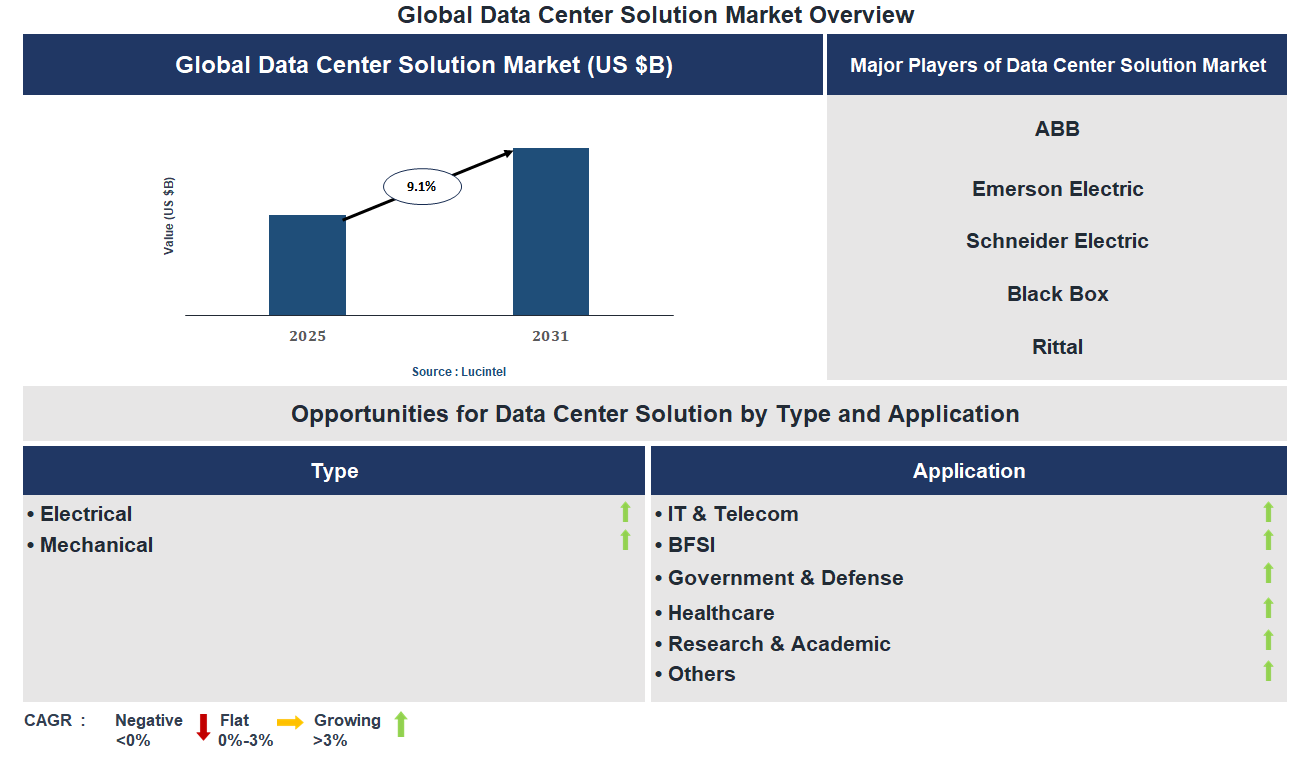
Key data points: The growth forecast = 9.1% annually for the next 7 years. Scroll below to get more insights. This market report covers trends, opportunities and forecasts in data center solution market to 2031 by type (electrical and mechanical), application (IT & telecom, BFSI, government & defense, healthcare, research & academic, and others), and region (North America, Europe, Asia Pacific, and the Rest of the World)
We'll send your sample report shortly.
• Lucintel forecasts that, within the type category, electrical is expected to witness higher growth over the forecast period.
• Within the application category, IT & telecom is expected to witness the highest growth.
• In terms of region, APAC is expected to witness the highest growth over the forecast period. Gain valuable insights for your business decisions with our comprehensive 150+ page report. Sample figures with some insights are shown below.
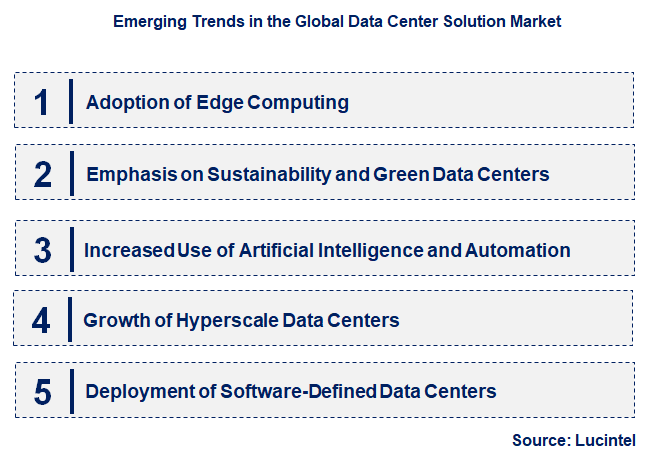
• Adoption of Edge Computing: As data generation accelerates at the networks edge, data centers are increasingly deploying edge solutions to process data closer to end-users. This reduces latency, improves real-time data processing, and enhances user experience. Edge computing enables organizations to handle IoT, autonomous vehicles, and smart city applications more efficiently. It also decentralizes data storage, reducing the load on centralized data centers. This trend is driving investments in smaller, distributed data centers and fostering a hybrid approach that combines centralized and edge infrastructure for optimal performance.
• Emphasis on Sustainability and Green Data Centers: Environmental concerns and regulatory pressures are pushing data center providers to adopt sustainable practices. This includes utilizing renewable energy sources, improving energy efficiency, and implementing innovative cooling solutions. Green data centers reduce carbon footprints and operational costs, aligning with corporate social responsibility goals. Technologies like liquid cooling, AI-driven energy management, and waste heat reuse are gaining prominence. This trend not only benefits the environment but also enhances brand reputation and compliance, making sustainability a key differentiator in the market.
• Increased Use of Artificial Intelligence and Automation: AI and automation are transforming data center management by optimizing operations, predictive maintenance, and resource allocation. AI-driven analytics help identify inefficiencies, forecast failures, and automate routine tasks, reducing human error and operational costs. Automation tools streamline provisioning, security, and workload balancing, enabling faster deployment and scaling. This trend enhances overall efficiency, reliability, and security of data centers, allowing operators to focus on strategic initiatives. As AI technology matures, its integration into data center infrastructure is expected to deepen, driving smarter, more autonomous operations.
• Growth of Hyperscale Data Centers: The demand for cloud services and digital transformation is fueling the expansion of hyperscale data centers. These massive facilities support large-scale cloud providers like Amazon, Google, and Microsoft, offering scalable, flexible, and cost-effective solutions. Hyperscale centers benefit from economies of scale, advanced automation, and modular designs, enabling rapid deployment and expansion. They also support high-density computing and storage needs, catering to enterprise and consumer markets. This trend is reshaping the market by shifting focus towards large, centralized facilities that can efficiently handle exponential data growth and service diverse digital applications.
• Deployment of Software-Defined Data Centers: SDDC integrates hardware and software to create flexible, programmable, and automated data center environments. This approach allows dynamic resource allocation, simplified management, and enhanced security through virtualization and cloud technologies. SDDC enables rapid provisioning, disaster recovery, and workload mobility, reducing capital and operational expenditures. It supports hybrid cloud strategies and facilitates seamless integration across multiple platforms. As organizations seek agility and scalability, the adoption of SDDC is accelerating, transforming traditional data centers into intelligent, adaptable infrastructures capable of meeting evolving digital demands. In summary, these emerging trends are fundamentally reshaping the data center solution market by promoting smarter, greener, and more agile infrastructure. They enable organizations to meet increasing data demands efficiently while reducing environmental impact and operational costs. As these developments continue to evolve, they will drive innovation, improve performance, and create new opportunities for growth and competitiveness in the digital age.
• Adoption of Edge Computing: Expansion of edge data centers to reduce latency and improve real-time data processing, enabling new applications like IoT and autonomous vehicles, thus driving market growth and creating new revenue streams.
• Green Data Center Initiatives: Increased focus on energy-efficient and sustainable solutions, including renewable energy integration and advanced cooling techniques, which reduce operational costs and meet regulatory standards, enhancing market attractiveness.
• Integration of AI and Automation: Deployment of AI-driven management tools and automation to optimize data center operations, improve security, and reduce human error, leading to increased efficiency and lower operational costs.
• Cloud Hybrid and Multi-Cloud Strategies: Growing adoption of hybrid and multi-cloud architectures to enhance flexibility, scalability, and disaster recovery capabilities, influencing infrastructure investments and service offerings.
• Security Enhancements and Compliance: Strengthening of cybersecurity measures and adherence to data privacy regulations to protect sensitive information, build customer trust, and ensure compliance, thereby impacting solution design and deployment. These developments are collectively transforming the data center solution market by fostering innovation, improving efficiency, and emphasizing sustainability and security. As a result, the market is becoming more competitive, with increased opportunities for providers who adapt to these trends, ultimately driving growth and technological advancement.
• Cloud Computing Integration: Expanding cloud services drive demand for flexible, scalable data center solutions, enabling seamless hybrid and multi-cloud environments that improve operational efficiency and reduce costs.
• Edge Data Centers: The rise of IoT and 5G necessitates localized data processing, leading to increased investments in edge data centers that offer low latency and real-time data handling capabilities.
• Artificial Intelligence and Big Data: The integration of AI and big data analytics requires advanced data center infrastructure capable of supporting high-performance computing, thus boosting processing power and storage capacity.
• Green Data Center Solutions: Growing environmental concerns and regulations promote the adoption of energy-efficient and sustainable data center technologies, reducing carbon footprints and operational costs.
• Security and Compliance Solutions: Increasing cyber threats and data privacy regulations compel data centers to implement robust security measures and compliance frameworks, ensuring data integrity and trustworthiness. These growth opportunities are significantly impacting the data center solution market by fostering innovation, enhancing operational efficiencies, and addressing evolving customer needs. They are also driving market expansion, attracting investments, and shaping the future of digital infrastructure globally.
• Technological Innovation: Rapid advancements in cloud computing, AI, and edge computing are revolutionizing data center operations. These innovations enable higher efficiency, scalability, and automation, which are essential for managing the exponential growth of data. As organizations seek to optimize their infrastructure, the demand for cutting-edge data center solutions increases, fostering market expansion. The integration of IoT and 5G further accelerates this trend, requiring more sophisticated and flexible data center architectures to support new applications and services.
• Growing Data Volumes: The surge in data generated by digital platforms, IoT devices, and enterprise applications is a primary driver. Organizations across industries are collecting and analyzing vast amounts of data to gain competitive advantages, necessitating robust data center infrastructure. This exponential data growth demands scalable storage, high-speed processing, and reliable connectivity, fueling investments in advanced data center solutions to handle the increased load efficiently.
• Cloud Adoption and Digital Transformation: The shift towards cloud-based services and digital transformation initiatives is significantly impacting the market. Businesses are migrating their workloads to cloud platforms to enhance agility, reduce costs, and improve scalability. This trend drives demand for data center solutions that support hybrid and multi-cloud environments, including virtualization, containerization, and automation tools, to ensure seamless integration and management of cloud resources.
• Energy Efficiency and Sustainability: Increasing awareness of environmental impact and rising energy costs are pushing data centers to adopt energy-efficient technologies. Innovations such as advanced cooling systems, renewable energy integration, and power management solutions are critical for reducing carbon footprints. Governments and regulatory bodies are also imposing stricter standards, encouraging market players to develop sustainable data center solutions that align with global environmental goals.
• Strategic Partnerships and Mergers: Collaborations between technology providers, cloud service providers, and hardware manufacturers are fostering innovation and expanding market reach. Strategic alliances enable the development of integrated solutions tailored to specific industry needs, accelerating deployment and adoption. Mergers and acquisitions also facilitate resource sharing, technological advancements, and market consolidation, further propelling growth in the data center solutions sector. The challenges facing data center solution market include:-
• Data Security and Privacy Concerns: As data centers handle sensitive information, ensuring robust security measures is paramount. Increasing cyber threats, data breaches, and stringent privacy regulations such as GDPR pose significant challenges. Organizations must invest heavily in advanced security protocols, which can increase operational costs and complexity. Failure to adequately address security concerns can lead to reputational damage, legal penalties, and loss of customer trust, hindering market growth.
• High Capital and Operational Expenditure: Establishing and maintaining modern data centers require substantial investment in infrastructure, hardware, and skilled personnel. The high costs associated with energy consumption, cooling, and maintenance can be prohibitive, especially for small and medium-sized enterprises. These financial barriers may slow down adoption rates and limit market expansion, particularly in emerging regions with limited capital resources.
• Regulatory and Environmental Challenges: Stringent regulations related to data sovereignty, environmental impact, and energy consumption create compliance complexities. Data localization laws require data to be stored within specific jurisdictions, affecting global deployment strategies. Additionally, environmental regulations demand sustainable practices, which may involve significant upgrades and investments. Navigating these regulatory landscapes can delay projects and increase costs, posing a persistent challenge for market participants. In summary, the data center solution market is driven by technological innovation, data growth, cloud adoption, sustainability efforts, and strategic collaborations. However, security concerns, high costs, and regulatory complexities present notable challenges. These factors collectively shape the markets trajectory, requiring stakeholders to innovate continuously and adapt to evolving demands. The overall impact is a dynamic environment with significant growth potential, tempered by the need for strategic risk management and compliance.
• ABB
• Emerson Electric
• Schneider Electric
• Black Box
• Rittal
• Delta Electronics
• Eaton
• HP
• Tripp Lite
• Siemens
• Electrical
• Mechanical
• IT & Telecom
• BFSI
• Government & Defense
• Healthcare
• Research & Academic
• Others
• North America
• Europe
• Asia Pacific
• The Rest of the World
• United States: The US market continues to lead with significant investments in hyperscale data centers, driven by cloud giants like Amazon, Google, and Microsoft. Innovations in energy efficiency, such as liquid cooling and renewable energy integration, are prominent. The adoption of edge computing is accelerating, supporting faster data processing closer to end-users. Regulatory focus on data security and privacy is shaping infrastructure upgrades. Additionally, government initiatives aim to enhance cybersecurity resilience and promote sustainable data center practices, fostering a competitive and innovative environment.
• China: China is rapidly expanding its data center infrastructure to support its digital economy and government initiatives like Smart Cities and AI development. Major players like Alibaba and Tencent are investing heavily in large-scale, energy-efficient facilities. The government’s push for green energy integration and sustainable practices is influencing new developments. The adoption of 5G and IoT technologies is driving demand for localized data centers. Regulatory policies are evolving to ensure data sovereignty and security, prompting domestic investments and partnerships to bolster the local data center ecosystem.
• Germany: Germany’s data center market is characterized by a focus on energy efficiency and sustainability, aligning with the country’s environmental commitments. Major investments are being made in renewable energy-powered facilities, with a growing emphasis on green certifications. The adoption of modular and scalable solutions is increasing to meet the rising demand for cloud services and digital transformation. Regulatory frameworks around data privacy, such as GDPR, are influencing infrastructure design and security measures. The market also sees a rise in colocation and hybrid cloud solutions to optimize resource utilization.
• India: India’s data center market is experiencing exponential growth driven by digital adoption, government initiatives like Digital India, and the expansion of cloud services. Investments from global hyperscalers and local players are fueling the development of large-scale, energy-efficient data centers. The focus is on cost-effective, scalable infrastructure to support e-commerce, banking, and telecom sectors. The government’s push for renewable energy and sustainable practices is shaping new projects. Additionally, the rising demand for edge data centers in rural and semi-urban areas is creating new opportunities for market expansion.
• Japan: Japan’s data center industry is evolving with a focus on disaster resilience, energy efficiency, and advanced technology integration. Investments are increasing in high-density, secure facilities to support AI, robotics, and IoT applications. The adoption of renewable energy sources and innovative cooling solutions is prominent. Regulatory policies emphasize data security and privacy, influencing infrastructure upgrades. The market is also witnessing growth in colocation and hybrid cloud services, driven by enterprises seeking flexible, scalable solutions. Japan’s strategic location and technological expertise position it as a key player in the Asia-Pacific data center landscape.


• ABB
• Emerson Electric
• Schneider Electric
• Black Box
• Rittal
• Delta Electronics
• Eaton
• HP
• Tripp Lite
• Siemens Q5. Which data center solution market segment will be the largest in future? Answer: Lucintel forecasts that, within the type category, electrical is expected to witness higher growth over the forecast period. Q6. In data center solution market, which region is expected to be the largest in next 5 years? Answer: In terms of region, APAC is expected to witness the highest growth over the forecast period. Q7. Do we receive customization in this report? Answer: Yes, Lucintel provides 10% customization without any additional cost.


Choose a license that fits your team. Instant PDF delivery.
Prices exclude taxes. Instant delivery. Custom licensing available on request.
Market Report · July 16, 2026
Market Report · May 18, 2026
Market Report · May 18, 2026
Trusted partner for strategic intelligence and business growth


Receive a complimentary market analysis tailored to your industry. Our analysts will identify key growth opportunities and competitive dynamics specific to your business.

Market size, growth rate, and key trend analysis for your specific sector.

Top competitor positioning and market share analysis.

Strategic recommendations backed by data-driven insights.
Get curated market intelligence and competitive moves straight to your inbox.
By subscribing, you agree to receive our monthly insights. Unsubscribe anytime.
Receive a complimentary market analysis tailored to your industry. Our analysts will identify key growth opportunities and competitive dynamics specific to your business.
Market size, growth rate, and key trend analysis for your specific sector.
Top competitor positioning and market share analysis.
Strategic recommendations backed by data-driven insights.
Get curated market intelligence, emerging trends, and competitive moves straight to your inbox each month.
By subscribing, you agree to receive our monthly insights. Unsubscribe anytime.
We'll send your sample report shortly.