
Market Report · July 16, 2026

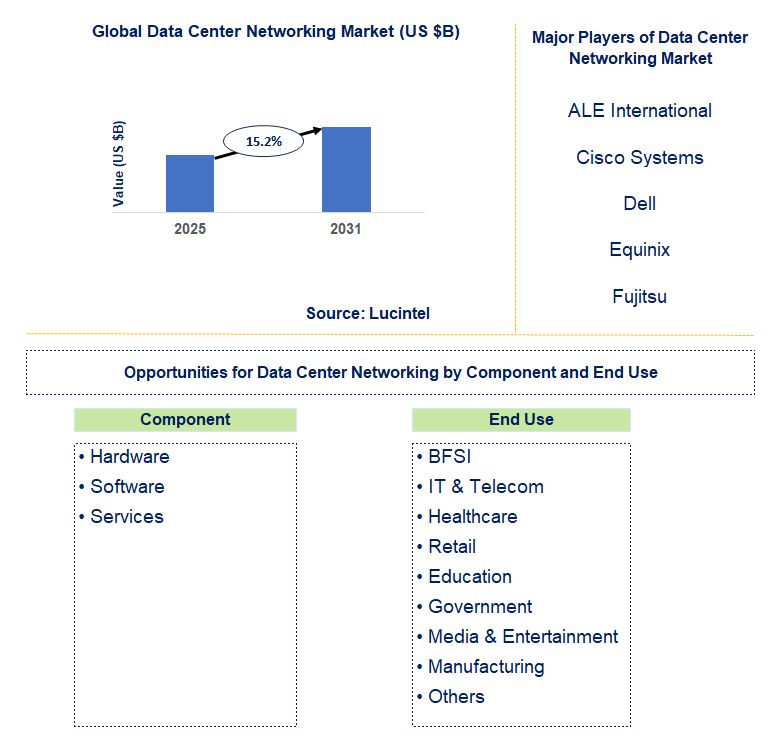
Key data points: The growth forecast = 15.2% annually for the next 7 years. Scroll below to get more insights. This market report covers trends, opportunities and forecasts in data center networking market to 2031 by component (hardware, software, and services), end use (BFSI, IT & telecom, healthcare, retail, education, government, media & entertainment, manufacturing, and others), and region (North America, Europe, Asia Pacific, and the Rest of the World)
We'll send your sample report shortly.
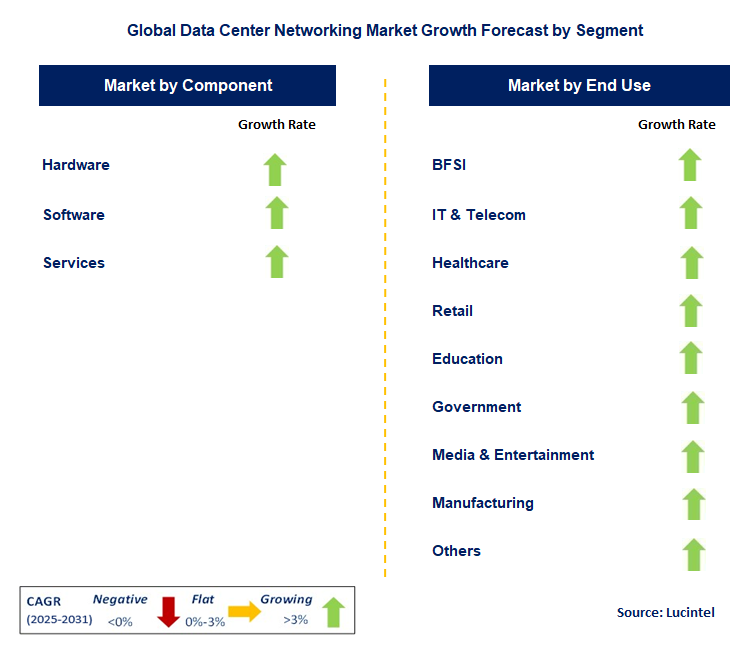
• Lucintel forecasts that, within the component category, hardware is expected to witness the highest growth over the forecast period.
• Within the end use category, IT & telecom is expected to witness the highest growth.
• In terms of region, North America is expected to witness the highest growth over the forecast period. Gain valuable insights for your business decisions with our comprehensive 150+ page report. Sample figures with some insights are shown below.
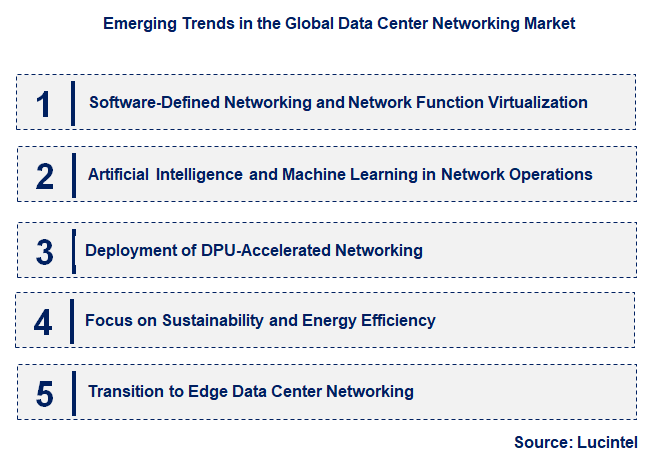
• Software-Defined Networking and Network Function Virtualization: SDN and NFV are transitioning from early-stage conceptual models to established, widespread deployments. They break the coupling of network control and hardware, enabling dynamic configuration and centralized management of network resources. This facilitates increased agility, automated provisioning, and traffic flow optimization within the data center. The result is increased network flexibility, simplified operations, and substantial cost savings through reduced dependence on proprietary hardware and the ability to accelerate services scale-out.
• Artificial Intelligence and Machine Learning in Network Operations: AI and ML are being used more and more in data center networking for automated monitoring, predictive analysis, and self-optimization. AIOps technologies inspect large volumes of network data for anomalies, forecast potential failures, and perform automated troubleshooting. The result is enhanced network performance, minimized downtime through proactive problem resolution, and optimized resource utilization. This also alleviates the workload on human operators so that they can prioritize strategic initiatives.
• Deployment of DPU-Accelerated Networking: Data Processing Units (DPUs) or Smarties are gaining momentum. These network interface cards, optimized for network and security processing, relieve the main CPU of such tasks so that servers can leave more resources for applications. The result is a dramatic acceleration of application performance, lowered latency for network-intensive applications, and better security through isolation of network functions. This trend is especially important in high-performance computing and AI clusters.
• Focus on Sustainability and Energy Efficiency: With increasing energy usage of data centers, sustainability has emerged as a major trend. This entails using power-saving networking equipment, efficiently utilizing power with smart network management, and using liquid cooling for switches and servers. The result is minimized operational expenses, less carbon footprint for data centers, and meeting more stringent environmental regulations, making data centers a greener option.
• Transition to Edge Data Center Networking: The growth of IoT devices and real-time applications is fueling the move towards edge computing, where data processing is done closer to its source. This requires the installation of smaller, localized data centers with optimized networking for low-latency communications. The result is less latency for end-users, enhanced performance for mission-critical applications, and distributed network designs that can manage localized traffic more effectively, enabling new models of service delivery. These new trends are all coming together to reframe the data center networking market in terms of more automated, intelligent, and distributed network architectures. They are improving performance, streamlining efficiency, lowering operational costs, and supporting new use cases so that data centers remain the core of the digital economy and evolve to meet future needs.
• Accelerated Adoption of 400 Gigabit Ethernet and Beyond: Data centers are quickly adopting 400GbE to address the growing bandwidth demand brought about by cloud computing, artificial intelligence, and massive data transfers. The faster speed standard enables much higher data throughput across and among data center racks. The effect is a dramatic boost in network capacity, fewer bottlenecks, and enhanced performance for high-bandwidth applications, supporting more efficient and more capable data center operation.
• Greater Emphasis on Hyperscale Network Architectures: Hyperscale cloud vendors are persistently innovating and standardizing network architectures for extreme scale and distributed workloads. This includes flattened network designs, disaggregated hardware and software, and next-generation routing protocols optimized for cloud-native applications. The effect is extremely scalable, robust, and economical networks to manage the tremendous traffic associated with public cloud environments, establishing standards for data center design throughout the industry.
• Improved Network Automation and Orchestration: Complexity in today's data center networks calls for sophisticated automation and orchestration solutions. Solutions such as Infrastructure as Code (IaC), intent-based networking, and AI-powered platforms are increasingly being used to provision, set up, and manage network resources automatically. The effect is less human error, accelerated service deployment, enhanced operational efficiency, dynamic adjustment to shifting traffic patterns, resulting in more agile and responsive data centers.
• Integration of the Security Directly into the Network Fabric: Rather than depending on perimeter security, there is a new trend to integrate security capabilities directly into the data center network switches and routers. This involves micro-segmentation, intrusion detection, and advanced threat intelligence capabilities at the network level. The effect is strengthened east-west traffic security, better protection against internal threats, and more fine-grained control over data flows, developing a stronger and more resilient security stance for the entire data center.
• Increased Edge Data Center Deployments: The need for lower latency and local processing of data for use cases such as IoT, 5G, and real-time analytics is fueling the growth of edge data centers. These are smaller facilities that need compact, high-performance networking gear optimized for remote and distributed environments. The effect is edge applications with improved response times, less dependence on central data centers for all processing, and new possibilities for local data services and infrastructure. These new advancements are collectively shaping the data center networking market by taking speeds, scales, and intelligence to new levels. They are allowing data centers to serve the needs of a more digitized world, enable cloud growth, AI, and edge computing, and ultimately change the way organizations access, store, and process information.
• Hyperscale Cloud Data Centers: The ongoing growth of hyperscale cloud providers (i.e., AWS, Azure, Google Cloud) generates huge demand for high-performance, scalable network equipment. Such data centers need state-of-the-art switches, routers, and optical interconnects to accommodate their enormous, multi-tenant environments and process huge data traffic. The effect is long-term growth for network hardware vendors and cutting-edge software-defined networking solutions, spurred on by the growing demand for public cloud services globally.
• Enterprise Hybrid and Multi-Cloud Environments: Hybrid and multi-cloud strategies are being pursued by more enterprises, combining on-premises data centers with multiple public cloud vendors. This necessitates advanced networking solutions that provide end-to-end connectivity, uniform policy management, and secure data exchange between disparate environments. The effect is extraordinary expansion for network orchestration, automation, and security platforms that support streamlined management and interoperability across such hybrid complex infrastructures.
• Edge Computing and IoT Implementations: The explosion of IoT devices and need for real-time analytics are propelling edge computing adoption, necessitating smaller, local data centers near sources of data. The edge data centers require hardened, compact, and highly automated networking solutions with low latency. The effect is new market spaces for specialized network hardware and software optimized for distributed environments, supporting mission-critical applications in smart cities, manufacturing, and healthcare.
• AI and High-Performance Computing Clusters: The rising deployment of AI and ML workloads, in conjunction with conventional HPC, requires ultra-low latency, lossless, very high-bandwidth networks within data centers. This creates demand for optimized network interconnects like InfiniBand and very high-speed Ethernet fabrics tuned for parallel processing. The effect is tremendous investment in networking solutions specifically designed to manage the heavy data movement needs of AI training and inferencing, stretching the capabilities of the network.
• Improved Data Center Security and Compliance: As cyber threats rise and there are more stringent regulatory demands (e.g., GDPR, HIPAA), security in the data center is an ever-important factor. This presents opportunity for growth in integrated network security solutions, such as micro-segmentation, intrusion detection/prevention systems (IDPS) in the network fabric, and AI-based security analytics. The result is greater focus on zero-trust architectures and secure networks that can safeguard sensitive information and provide regulatory compliance, encouraging innovation in security-oriented networking. These growth opportunities are deeply affecting the data center networking market through diversified revenues and technological innovation in different application areas. They underscore the central role of strong and smart networking in making the next generation of digital services possible, ranging from cloud-native applications to real-time artificial intelligence and ubiquitous edge computing deployments.
• ALE International
• Cisco Systems
• Dell
• Equinix
• Fujitsu
• Hewlett Packard Enterprise Development
• Hitachi Vantara
• Intel Corporation
• Juniper Networks
• Broadcom
• Hardware
• Software
• Services
• BFSI
• IT & Telecom
• Healthcare
• Retail
• Education
• Government
• Media & Entertainment
• Manufacturing
• Others
• North America
• Europe
• Asia Pacific
• The Rest of the World
• United States: United States data center networking market is marked by strong growth fueled by high-speed cloud adoption, growing demand for edge computing, and rising investment in AI-optimized infrastructure. The key hyper scalers remain front and center, pushing the pace of development of high-speed Ethernet switches and software-defined networking (SDN) technology. There is also a great focus on power-efficient designs and enhancing supply chain resilience for data center equipment. The market also experiences heightened demand for professional integration and installation services as a result of complex deployments.
• China: China's data center networking market is rapidly growing, driven by massive digitalization efforts, the large-scale deployment of 5G, and rampant AI and industrial internet adoption. Provincial governments are aggressively encouraging the development of mega data centers, causing a proliferation of colocation and hyperscale facilities. The market is dominated by a emphasis on carbon-free data centers and enhanced Power Usage Effectiveness (PUE) ratios facilitated by artificial intelligence-powered software. Investment in global submarine cables is also propelling the market, enhancing connectivity.
• Germany: Germany is one of the top European data center markets, experiencing strong growth fueled by growing demand for digital infrastructure for cloud and artificial intelligence industries. Frankfurt continues to be a key hub with heavy future data center capacity. Stringent environmental laws and energy-intensive costs are pushing innovation in energy-efficient technologies and the use of renewable energy. The market is also witnessing an increased demand for smaller, localized edge data centers to support low-latency needs for AI inference and GDPR compliance.
• India: The data center networking market in India is growing strongly, powered by speeding digitalization, initiatives like Digital India from the government, and increasing consumption of data. There is high growth in data center capacity, with investment and development opportunities highest in Mumbai and Chennai. There is a move towards wholesale colocation, driven by demand from cloud service providers. Sustainability is becoming more important, with greater numbers of green-certified data centers and investment under way for edge computing in order to deliver rapid regional services.
• Japan: Japan's data center networking industry is growing aggressively and is a prime investment opportunity in light of its strong infrastructure, cutting-edge technology environment, and favorable location. The market is experiencing the acceleration of hyperscale facilities in Tokyo and Osaka, led by leading cloud operators. Sustainability is a high priority, and operators are adding renewable energy sources and innovative cooling technologies. Japan also enjoys its data adequacy status with the UK and EU, which enables cross-border data flow.


• ALE International
• Cisco Systems
• Dell
• Equinix
• Fujitsu
• Hewlett Packard Enterprise Development
• Hitachi Vantara
• Intel Corporation
• Juniper Networks
• Broadcom Q5. Which data center networking market segment will be the largest in future? Answer: Lucintel forecasts that, within the component category, hardware is expected to witness the highest growth over the forecast period. Q6. In data center networking market, which region is expected to be the largest in next 5 years? Answer: In terms of region, North America is expected to witness the highest growth over the forecast period. Q7. Do we receive customization in this report? Answer: Yes, Lucintel provides 10% customization without any additional cost.


Choose a license that fits your team. Instant PDF delivery.
Prices exclude taxes. Instant delivery. Custom licensing available on request.
Market Report · July 16, 2026
Market Report · May 18, 2026
Market Report · May 18, 2026
Trusted partner for strategic intelligence and business growth


Receive a complimentary market analysis tailored to your industry. Our analysts will identify key growth opportunities and competitive dynamics specific to your business.

Market size, growth rate, and key trend analysis for your specific sector.

Top competitor positioning and market share analysis.

Strategic recommendations backed by data-driven insights.
Get curated market intelligence and competitive moves straight to your inbox.
By subscribing, you agree to receive our monthly insights. Unsubscribe anytime.
Receive a complimentary market analysis tailored to your industry. Our analysts will identify key growth opportunities and competitive dynamics specific to your business.
Market size, growth rate, and key trend analysis for your specific sector.
Top competitor positioning and market share analysis.
Strategic recommendations backed by data-driven insights.
Get curated market intelligence, emerging trends, and competitive moves straight to your inbox each month.
By subscribing, you agree to receive our monthly insights. Unsubscribe anytime.
We'll send your sample report shortly.