
Market Report · May 18, 2026

This market report covers trends, opportunities, and forecasts in the global data center cooling market to 2031 by technology (rack/row-based and room-based), end use industry (bfsi, colocation, energy, government, and others), and region (North America, Europe, Asia Pacific, and the Rest of the World)
We'll send your sample report shortly.
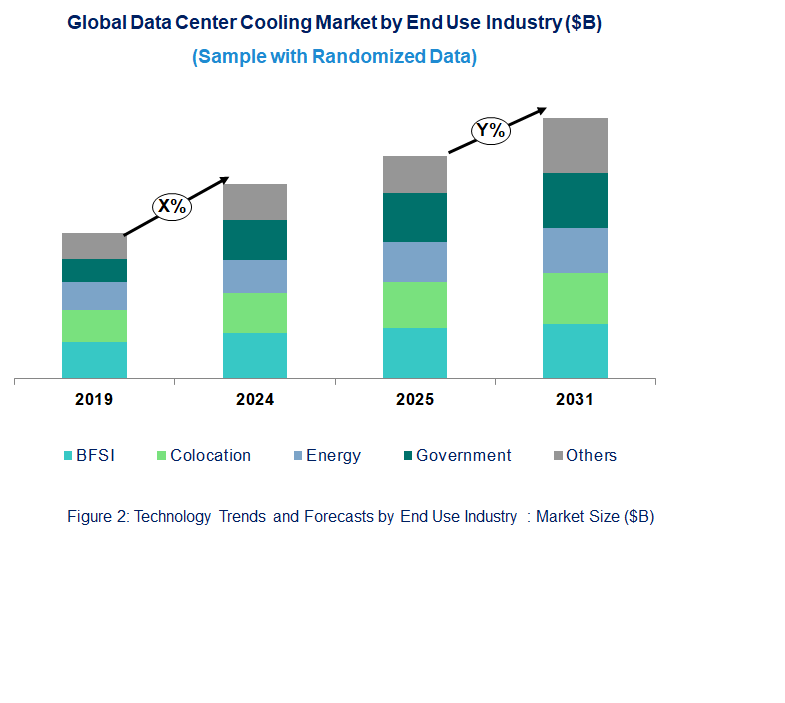
• Adoption of Liquid Cooling Technologies Liquid cooling, including direct-to-chip and immersion cooling, is gaining traction for its ability to efficiently manage high thermal densities in modern servers. This trend is driven by AI and HPC workloads, offering better heat dissipation and reduced energy consumption compared to traditional air-based systems.
• AI-Powered Intelligent Cooling Systems AI and machine learning are being used to optimize cooling efficiency in real time. These systems adjust airflow, temperature, and energy use based on data center workloads, reducing operational costs and supporting predictive maintenance.
• Sustainable and Green Cooling Initiatives Operators are increasingly integrating renewable energy and eco-friendly refrigerants, and adopting water-efficient or water-free cooling solutions to meet sustainability goals. This shift supports carbon neutrality and regulatory compliance.
• Modular and Edge Data Center Cooling Solutions The rise of edge computing is fueling demand for compact, scalable cooling systems tailored to micro data centers. Modular cooling units provide flexibility, faster deployment, and efficient thermal management in remote or space-constrained locations.
• Integration of Heat Reuse Systems Advanced cooling systems are now being designed to capture and reuse waste heat generated by data centers. This trend not only enhances energy efficiency but also opens up new opportunities for district heating and co-location benefits.
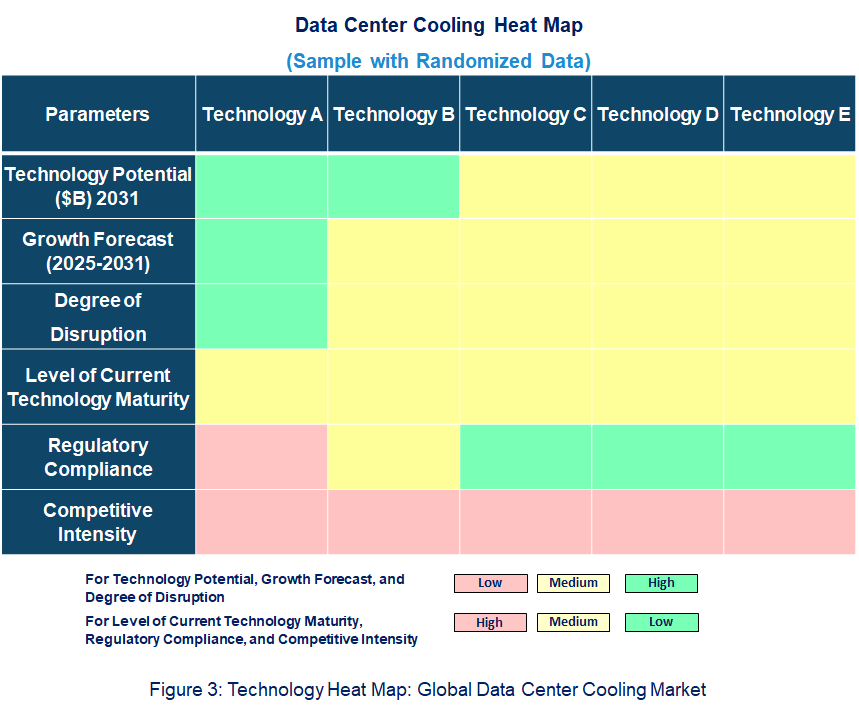
• Technology Potential: The technology potential in the data center cooling market is substantial, driven by the growing demand for high-performance computing, edge infrastructure, and sustainable operations. Innovations such as liquid cooling (direct-to-chip and immersion), AI-based intelligent cooling systems, and modular cooling for edge environments are reshaping how thermal loads are managed. These technologies offer significant improvements in cooling efficiency, power usage effectiveness (PUE), and server density accommodation, making them attractive for hyperscale and enterprise data centers. Additionally, heat reuse technologies are emerging as a way to turn cooling systems into energy recovery tools, adding economic and environmental value.
• Degree of Disruption: The degree of disruption is high, particularly as traditional room-based air cooling systems are being replaced by more efficient and scalable solutions like rack/row-based and liquid cooling. These disruptive technologies not only reduce energy consumption but also optimize data center footprints and operational costs. AI-driven systems disrupt conventional cooling models by enabling predictive control and dynamic adjustment, leading to autonomous, low-intervention operations. As demand for sustainability and real-time performance grows, these technologies are fundamentally changing infrastructure planning and operations in data centers worldwide.
• Level of Technology Maturity: The maturity of technologies varies across the spectrum. Room-based cooling systems are well-established and have been standard for decades. Rack/row-based cooling is moderately mature, increasingly adopted for managing localized heat in dense server environments. Liquid cooling is in the early-to-mid stage of adoption, gaining traction in high-performance computing (HPC), AI, and hyperscale environments. AI-driven cooling platforms are still emerging, with early deployments showing promising results. Overall, while traditional methods remain dominant, new technologies are advancing quickly toward broader commercialization.
• Regulatory Compliance: Regulatory compliance is a growing factor in shaping technology adoption in the data center cooling space. Governments and industry bodies are tightening regulations around energy efficiency, carbon emissions, water use, and refrigerants. Standards such as ASHRAE 90.4, EU Energy Efficiency Directive, and U.S. DOE requirements are influencing cooling system design and performance benchmarks. Environmental concerns are pushing adoption of low-GWP refrigerants and water-efficient systems. To remain competitive and avoid penalties, operators are integrating technologies that support compliance with both regional and global sustainability mandates.
• Vertiv Group: Vertiv has significantly expanded its liquid cooling portfolio to support AI deployments. Notably, the company introduced the Vertiv™ CoolPhase CDU, a liquid-to-refrigerant coolant distribution unit, and the Vertiv™ CoolChip Fluid Network in-rack manifold. These systems enable modular, cost-effective liquid cooling deployments in data centers not originally configured for such systems. Additionally, Vertiv launched the MegaMod™ CoolChip, a high-density prefabricated modular data center solution designed to accelerate AI compute deployment by up to 50% compared to traditional builds.
• Rittal: Rittal unveiled a modular cooling distribution unit (CDU) delivering over 1 MW of cooling capacity, utilizing direct liquid cooling based on water. This innovation aligns with Open Compute Project (OCP) principles and is tailored for AI applications. The CDU’s modular design facilitates integration with existing IT infrastructure, offering scalability and efficient thermal management for high-density data centers.
• Schneider Electric: Schneider Electric has bolstered its cooling capabilities through the acquisition of a controlling stake in Motivair, a provider of liquid cooling solutions. This move enhances Schneider’s end-to-end infrastructure offerings, from grid to chip, catering to the evolving needs of AI and HPC workloads. Furthermore, Schneider has partnered with Nvidia to develop digital twins of AI data centers, aiming to optimize electricity usage and improve operational efficiency.
• Rising Data Demand: Increased global reliance on data drives innovation in cooling technologies.
• Energy Efficiency Requirements: Growing focus on reducing operational costs and carbon footprints.
• High-Performance Computing Needs: Advanced cooling systems are essential for modern workloads. Challenges
• High Implementation Costs: Advanced technologies require significant initial investments.
• Regulatory Pressures: Compliance with energy efficiency and environmental standards adds complexity. These factors collectively shape the development and adoption of innovative cooling solutions, transforming the data center ecosystem.
• Air Enterprises
• Asetek
• Climaveneta
• Coolcentric
• Fujitsu
• Schneider Electric
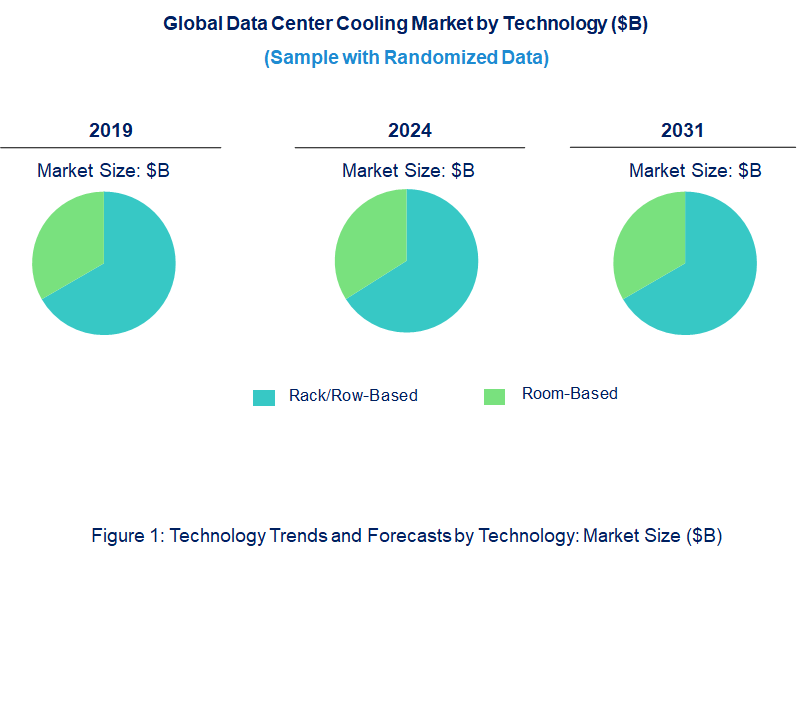
• Technology Readiness and Key Applications: Room-based cooling is fully mature with high technology readiness, widely used in legacy enterprise and colocation data centers. It is suited for large, uniform IT loads where cost efficiency is prioritized over precision. Rack/row-based cooling has high readiness and is optimized for high-density deployments, modular setups, and edge data centers. These systems are increasingly used in hyperscale, AI workloads, and mission-critical environments that demand localized, dynamic cooling. Rack/row solutions offer granular thermal control and better airflow management. They integrate well with smart systems and IoT-enabled monitoring. Room-based cooling remains prevalent in retrofit and low-density applications.
• Disruption Potential: Rack/row-based cooling has high disruption potential in the data center cooling market due to its precision, energy efficiency, and scalability, making it ideal for high-density and modular data centers. As computing loads increase and edge data centers expand, this technology aligns well with evolving architecture. Room-based cooling has lower disruption potential as it is a mature technology suited for traditional data centers but struggles with efficiency in high-density environments. Rack/row-based solutions enable targeted cooling, reducing energy waste and supporting green data center initiatives.
• Competitive Intensity and Regulatory Compliance: Room-based cooling systems operate in a highly competitive space with established players offering standardized, cost-effective solutions. Rack/row-based cooling faces growing competition from specialized vendors focused on precision and modular solutions, with increasing investments in R&D. As sustainability pressures mount, regulatory frameworks such as ASHRAE guidelines, EU energy efficiency directives, and green data center certifications (e.g., LEED, ENERGY STAR) are becoming more critical. Rack/row-based technologies must meet stricter compliance for energy usage effectiveness (PUE) and environmental footprint.
• Rack/Row-Based
• Room-Based
• BFSI
• Colocation
• Energy
• Government
• Others
• North America
• Europe
• Asia Pacific
• The Rest of the World
• Latest Developments and Innovations in the Data Center Cooling Technologies
• Companies / Ecosystems
• Strategic Opportunities by Technology Type


Choose a license that fits your team. Instant PDF delivery.
Prices exclude taxes. Instant delivery. Custom licensing available on request.
Market Report · May 18, 2026
Market Report · May 18, 2026
Market Report · May 18, 2026
Trusted partner for strategic intelligence and business growth


Receive a complimentary market analysis tailored to your industry. Our analysts will identify key growth opportunities and competitive dynamics specific to your business.

Market size, growth rate, and key trend analysis for your specific sector.

Top competitor positioning and market share analysis.

Strategic recommendations backed by data-driven insights.
Get curated market intelligence and competitive moves straight to your inbox.
By subscribing, you agree to receive our monthly insights. Unsubscribe anytime.
Receive a complimentary market analysis tailored to your industry. Our analysts will identify key growth opportunities and competitive dynamics specific to your business.
Market size, growth rate, and key trend analysis for your specific sector.
Top competitor positioning and market share analysis.
Strategic recommendations backed by data-driven insights.
Get curated market intelligence, emerging trends, and competitive moves straight to your inbox each month.
By subscribing, you agree to receive our monthly insights. Unsubscribe anytime.
We'll send your sample report shortly.