
Market Report · July 22, 2026

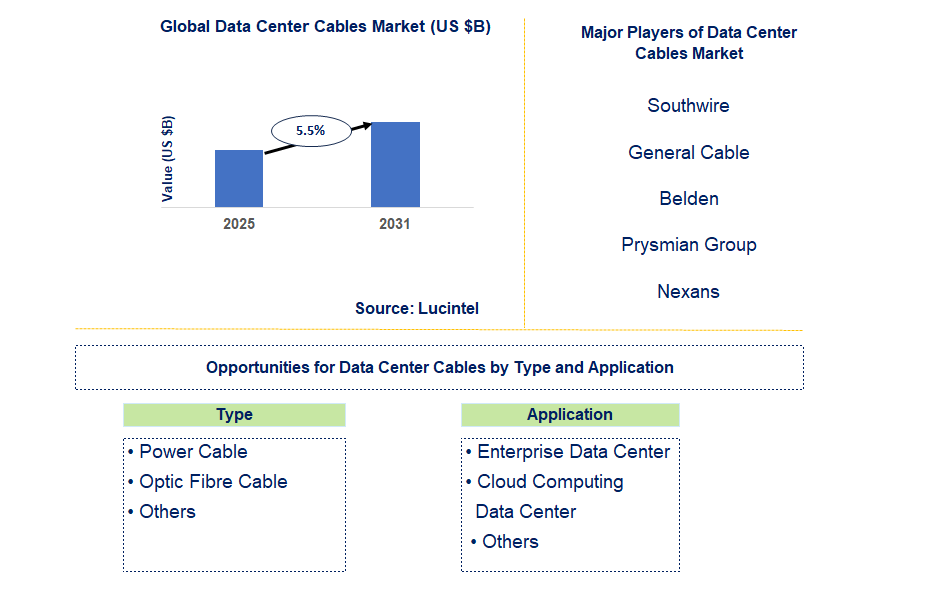
Key data points: The growth forecast = 5.5% annually for the next 7 years. Scroll below to get more insights. This market report covers Trends, opportunity and forecast in data center cables market to 2031 by type (power cable, optic fibre cable, and others), application (enterprise data center, cloud computing data center, and others), and region (North America, Europe, Asia Pacific, and the Rest of the World)
We'll send your sample report shortly.
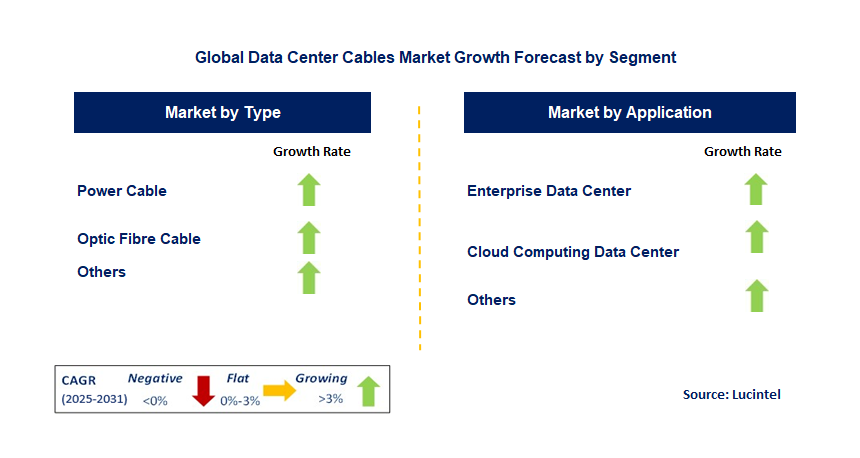
• Lucintel forecasts that, within the type category, power cable is expected to witness higher growth over the forecast period.
• Within the application category, the enterprise data center will remain the largest segment.
• In terms of region, APAC will remain the largest region over the forecast period. Gain valuable insights for your business decisions with our comprehensive 150+ page report. Sample figures with some insights are shown below.
• Adoption of High-Speed Fiber Optic Cables: The shift to fiber optic cables is accelerating due to their superior speed, bandwidth, and data transmission capabilities compared to traditional copper cables. Fiber optics support high-speed connectivity essential for modern data center operations, including 5G networks, AI workloads, and cloud applications. They offer reduced latency, higher reliability, and longer transmission distances, making them a critical component of large-scale and hyperscale data centers. As data demands grow, the adoption of advanced fiber optic solutions is enabling faster, more efficient data center performance while supporting future scalability.
• Advancements in Structured Cabling Systems: Structured cabling systems are gaining traction for their ability to streamline data center operations and improve manageability. These systems simplify cable organization, enhance scalability, and reduce downtime by providing a standardized framework for cable installation and management. With the increasing complexity of data center environments, structured cabling minimizes the risk of network disruptions, improves airflow, and optimizes energy efficiency. Innovations in modular cabling and pre-terminated solutions are further enhancing flexibility and reducing deployment time, making structured cabling a cornerstone of modern data center design.
• Rising Demand for Energy-Efficient Cabling Solutions: Energy efficiency is a top priority for data centers seeking to reduce operational costs and environmental impact. Energy-efficient cables are designed to minimize power loss during data transmission, contributing to overall energy savings. Technologies like low-smoke zero-halogen (LSZH) cables and advanced insulation materials are improving the thermal performance and safety of data center cabling. These solutions align with global sustainability initiatives and help organizations achieve greener operations while maintaining high-performance standards, driving their widespread adoption.
• Integration of Smart Cabling Technologies: Smart cabling technologies equipped with sensors and monitoring capabilities are transforming data center cable management. These systems enable real-time tracking of cable performance, temperature, and power usage, allowing for proactive maintenance and fault detection. Smart cables enhance network reliability by reducing downtime and identifying issues before they escalate. Additionally, they support remote monitoring and automation, aligning with the broader trend of intelligent data center management. This integration improves operational efficiency and ensures uninterrupted connectivity in critical applications.
• Expansion of Hyperscale Data Centers Driving Cable Innovations: The rapid expansion of hyperscale data centers is pushing the boundaries of cable design and innovation. Hyperscale environments require high-density cabling solutions that support massive data traffic and scalable infrastructure. Innovations such as ultra-high-fiber-count cables, flexible cable routing systems, and advanced connectors are meeting these demands. These developments ensure efficient space utilization, simplified maintenance, and seamless scalability, enabling hyperscale data centers to deliver exceptional performance and reliability. The growing demand for hyperscale capabilities is shaping the future of the data center cable market. The data center cables market is undergoing a transformative phase as technological advancements reshape its landscape. High-speed fiber optics, structured cabling, energy-efficient solutions, smart cabling technologies, and innovations driven by hyperscale data centers are redefining how data centers operate. These trends are addressing the growing demands for faster, more reliable, and sustainable connectivity, ensuring that data centers remain at the forefront of global digital infrastructure. By adopting these cutting-edge cabling solutions, organizations are better equipped to meet the challenges of an increasingly connected world, driving progress in the data center industry.
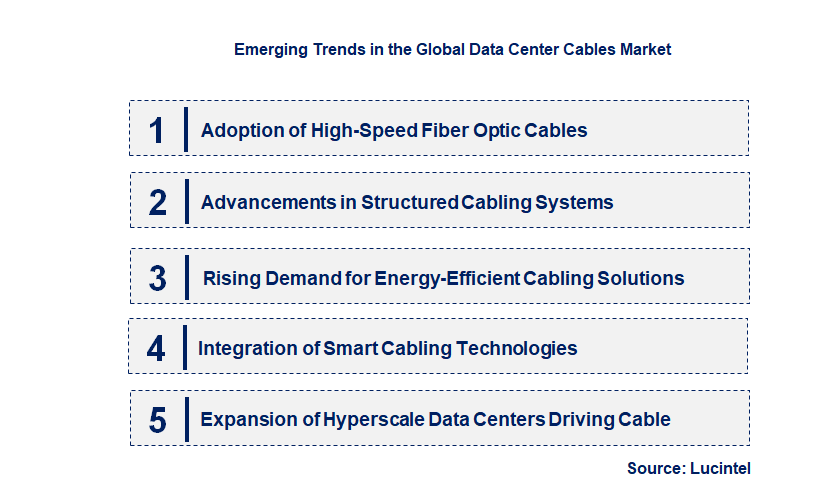
• Adoption of High-Speed Fiber Optic Cables: High-speed fiber optic cables are revolutionizing the data center cables market by enabling ultra-fast data transmission and supporting higher bandwidths. With increasing data traffic, these cables ensure reliable connectivity for applications like cloud computing, AI, and IoT. Innovations such as multi-core and hollow-core fibers are enhancing performance while reducing signal loss. This shift toward fiber optics is helping data centers meet the demands of next-generation networks, driving the adoption of advanced cabling solutions that improve overall operational efficiency and scalability.
• Deployment of Structured Cabling Systems: Structured cabling systems are becoming the standard in modern data centers due to their scalability, ease of maintenance, and reduced downtime. These systems streamline cable management by organizing cables into predefined structures, improving airflow, and reducing operational costs. Structured cabling also supports faster installation and integration of new hardware, ensuring data centers remain agile in a rapidly evolving market. This development enhances data center reliability and aligns with the industry's push for efficient, future-ready infrastructure.
• Advancements in Low-Loss Copper Cables: Low-loss copper cables are gaining traction as a cost-effective alternative to fiber optics for short-distance connections within data centers. These cables offer improved signal integrity, reduced power consumption, and compatibility with high-speed data protocols. The development of advanced shielding techniques and optimized conductor materials is further enhancing copper cable performance. This innovation provides data centers with versatile connectivity options while maintaining affordability and operational flexibility, particularly in legacy systems and hybrid environments.
• Focus on Energy-Efficient Cable Design: Energy efficiency is a growing concern in the data center industry, driving innovation in cable design to reduce power consumption. Energy-efficient cables minimize heat generation and electromagnetic interference, ensuring optimal performance in high-density environments. Manufacturers are integrating eco-friendly materials and advanced insulation technologies to improve sustainability without compromising reliability. This focus on green cable solutions helps data centers align with global environmental goals, reduce operational costs, and promote sustainable growth in the market.
• Increased Use of Pre-Terminated Cabling: Pre-terminated cabling solutions are simplifying the installation process, reducing deployment time, and minimizing errors in data center setups. These cables come pre-tested and ready for immediate use, ensuring consistent performance and reliability. Pre-terminated cabling is particularly advantageous for large-scale data centers that require rapid expansion and upgrades. By reducing labor costs and installation complexity, this development supports the demand for efficient, high-performance data center infrastructure, contributing to market growth. The data center cables market is evolving through advancements such as high-speed fiber optics, structured cabling, low-loss copper cables, energy-efficient designs, and pre-terminated solutions. These developments are enhancing data center performance, scalability, and sustainability while reducing operational complexities and costs. As the demand for reliable, high-speed connectivity grows, the market is poised for continued innovation, solidifying its role in supporting global digital transformation.
• High-Speed Fiber Optic Cables: The growing demand for high-speed data transmission is fueling the adoption of fiber optic cables in data centers. These cables offer superior bandwidth and lower latency than traditional copper cables, making them ideal for handling the increasing data traffic within modern data centers. As cloud services, AI, and IoT applications expand, the need for fiber optic cables to support high-capacity networks is becoming critical. This trend is driving the growth of the fiber optic segment as businesses seek to enhance the performance and efficiency of their data center infrastructure with advanced connectivity solutions.
• Power and Data Integration Cables: Power and data integration cables are becoming a key growth opportunity in the data center cables market. These cables combine power and data transmission capabilities into a single solution, offering several advantages, such as space-saving, simplified installation, and reduced cable clutter. As data centers evolve into more complex infrastructures, the need for integrated solutions that can reduce the number of cables and improve operational efficiency is rising. By streamlining connectivity and minimizing potential points of failure, power and data integration cables are contributing to the growth of the market and supporting the efficient operation of data centers.
• Cloud and Edge Data Center Connectivity: The expansion of cloud services and the proliferation of edge computing are creating new opportunities in the data center cables market. As data is increasingly processed closer to the source, the demand for robust, low-latency connectivity solutions is rising. This includes the deployment of specialized cables that can support edge data centers, which require smaller, more efficient infrastructures. High-performance cables that enable fast and reliable communication between cloud and edge data centers are crucial to meeting the growing demand for real-time data processing and minimizing latency. This shift is stimulating demand for high-quality cables designed to support next-generation network architectures.
• Energy-Efficient Cables: As data centers are some of the largest consumers of energy, energy-efficient cables have become a critical growth opportunity. With increasing pressure to reduce operating costs and meet sustainability goals, businesses are turning to cables that reduce energy consumption and improve the overall efficiency of their data center operations. Energy-efficient cables, which incorporate materials that minimize power loss, contribute to lowering the carbon footprint and enhancing the overall energy efficiency of data centers. As data center operators prioritize green initiatives and sustainability, energy-efficient cables are expected to see strong demand, driving further growth in the market.
• Custom and Specialized Cables for High-Density Applications: With the rise of high-density server configurations and complex data center architectures, there is a growing need for custom and specialized cables. These cables are designed to meet the unique requirements of high-density applications where space is limited and performance demands are high. Custom cables offer tailored solutions for data centers with specific needs, such as support for 10GbE, 40GbE, and 100GbE networks. The demand for specialized cables is increasing as data centers continue to scale and adopt high-performance computing solutions. This trend is creating a niche market for custom cable solutions that optimize space, performance, and reliability. The strategic growth opportunities in the data center cables market reflect the increasing complexity and demand for high-performance, efficient, and scalable solutions. Fiber optic cables, power and data integration cables, cloud and edge connectivity, energy-efficient cables, and custom cables for high-density applications are driving innovation and improving the functionality of data centers worldwide. As these trends evolve, the market is poised for sustained growth, with businesses increasingly adopting advanced cable technologies to support their expanding infrastructure needs. These opportunities are crucial to shaping the future of data center connectivity and operational efficiency.
• Southwire
• General Cable
• Belden
• Prysmian Group
• Nexans
• Sumitomo Electric
• LS Cable & System
• Power Cable
• Optic Fibre Cable
• Others
• Enterprise Data Center
• Cloud Computing Data Center
• Others
• North America
• Europe
• Asia Pacific
• The Rest of the World
• United States: The United States continues to lead in the adoption of high-performance data center cables, driven by the expansion of hyperscale data centers and cloud service providers like AWS, Google, and Microsoft. Fiber optic cables are in high demand due to their superior data transfer speeds and bandwidth capabilities. Companies are introducing innovative solutions, such as bend-insensitive fibers and high-speed copper cables, to cater to diverse infrastructure needs. The focus on green data centers has prompted the development of cables with enhanced energy efficiency. Additionally, the U.S. market is witnessing significant growth in structured cabling systems for improved data management.
• China: The Chinese data center cables market is expanding rapidly, fueled by the country’s digital transformation and large-scale investments in cloud computing and 5G infrastructure. Domestic companies like Huawei and YOFC are leading advancements in fiber optic cables, ensuring higher data transfer speeds and durability. The rise of smart cities and government-backed digital initiatives is boosting the deployment of advanced cable solutions. Additionally, innovations in manufacturing processes and materials have made cables more cost-effective and efficient. With the increased adoption of edge data centers, China is focusing on cables designed to support low-latency and high-speed connectivity for IoT and AI applications.
• Germany: Germany is experiencing steady growth in the data center cables market, driven by its focus on Industry 4.0, IoT, and digital transformation initiatives. The demand for high-speed fiber optic cables is rising as enterprises upgrade their infrastructure to support cloud computing and AI workloads. Companies are adopting modular cabling solutions to enhance scalability and reduce deployment times. Germany’s commitment to green technology has led to the development of energy-efficient cable systems, aligning with the country’s sustainability goals. Additionally, advancements in optical networking are enabling data centers in Germany to achieve greater bandwidth efficiency and reduced latency.
• India: The Indian data center cable market is growing rapidly, propelled by the increasing adoption of cloud services, internet penetration, and digitalization efforts. Fiber optic cables dominate the market, supporting the growing need for high-speed connectivity in hyperscale and colocation data centers. Government initiatives like Digital India and the roll-out of 5G are further accelerating demand for advanced cable technologies. Companies are focusing on flexible and durable cable designs to support diverse infrastructure needs. Additionally, the rise of edge computing in India has increased the demand for short-distance, high-performance cabling solutions to enhance data transmission in local networks.
• Japan: The Japanese data center cables market is advancing, driven by the country’s technological leadership and focus on innovation. The growing adoption of AI, 5G, and IoT technologies has increased the demand for high-speed fiber optic and copper cables. Japanese companies like Fujikura and Sumitomo Electric are pioneering advancements in cable technology, including ultra-low-loss fibers and environmentally friendly materials. The rise of green data centers in Japan has also prompted the development of energy-efficient cabling solutions. Additionally, Japan’s focus on disaster-resilient infrastructure has led to innovations in robust cable designs that ensure reliability and performance in challenging conditions.


• Southwire
• General Cable
• Belden
• Prysmian Group
• Nexans
• Sumitomo Electric
• LS Cable & System Q5. Which data center cables market segment will be the largest in future? Answer: Lucintel forecasts that power cable is expected to witness higher growth over the forecast period. Q6. In data center cables market, which region is expected to be the largest in next 5 years? Answer: APAC will remain the largest region over the forecast period. Q7. Do we receive customization in this report? Answer: Yes, Lucintel provides 10% customization without any additional cost.


Choose a license that fits your team. Instant PDF delivery.
Prices exclude taxes. Instant delivery. Custom licensing available on request.
Market Report · July 22, 2026
Market Report · July 17, 2026
Market Report · July 17, 2026
Trusted partner for strategic intelligence and business growth


Receive a complimentary market analysis tailored to your industry. Our analysts will identify key growth opportunities and competitive dynamics specific to your business.

Market size, growth rate, and key trend analysis for your specific sector.

Top competitor positioning and market share analysis.

Strategic recommendations backed by data-driven insights.
Get curated market intelligence and competitive moves straight to your inbox.
By subscribing, you agree to receive our monthly insights. Unsubscribe anytime.
Receive a complimentary market analysis tailored to your industry. Our analysts will identify key growth opportunities and competitive dynamics specific to your business.
Market size, growth rate, and key trend analysis for your specific sector.
Top competitor positioning and market share analysis.
Strategic recommendations backed by data-driven insights.
Get curated market intelligence, emerging trends, and competitive moves straight to your inbox each month.
By subscribing, you agree to receive our monthly insights. Unsubscribe anytime.
We'll send your sample report shortly.