
Market Report · July 15, 2026

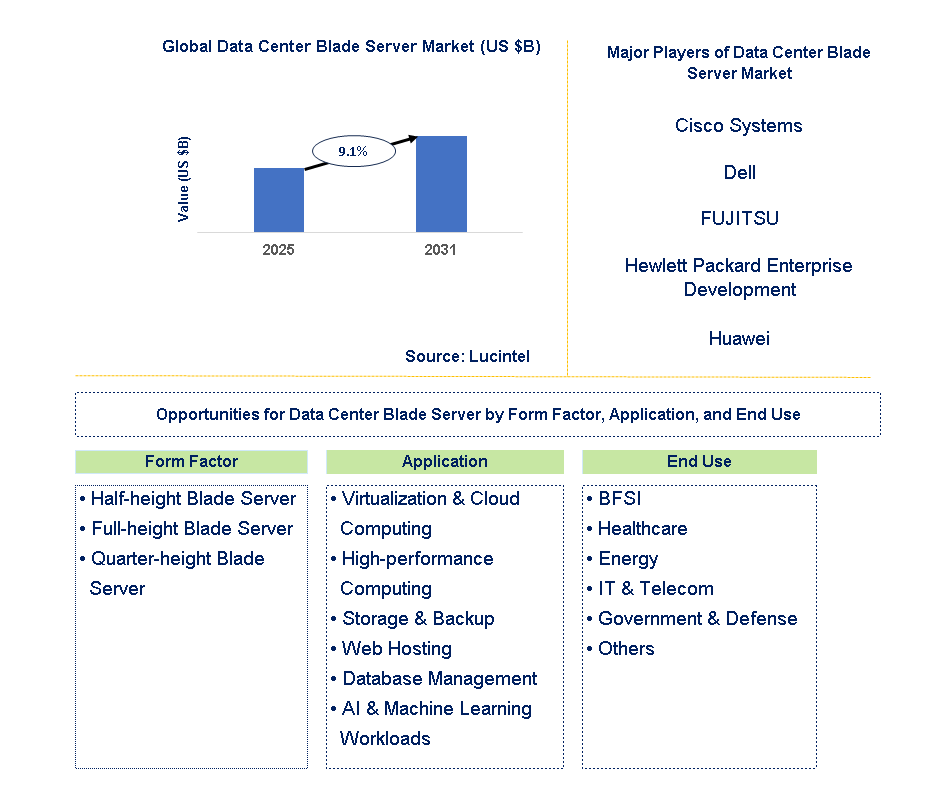
Key data points: The growth forecast = 9.1% annually for the next 7 years. Scroll below to get more insights. This market report covers trends, opportunities and forecasts in data center blade server market to 2031 by form factor (half-height blade server, full-height blade server, and quarter-height blade server), application (virtualization & cloud computing, high-performance computing, storage & backup, web hosting, database management, and AI & machine learning workloads), end use (BFSI, healthcare, energy, IT & telecom, government & defense, and others), and region (North America, Europe, Asia Pacific, and the Rest of the World)
We'll send your sample report shortly.
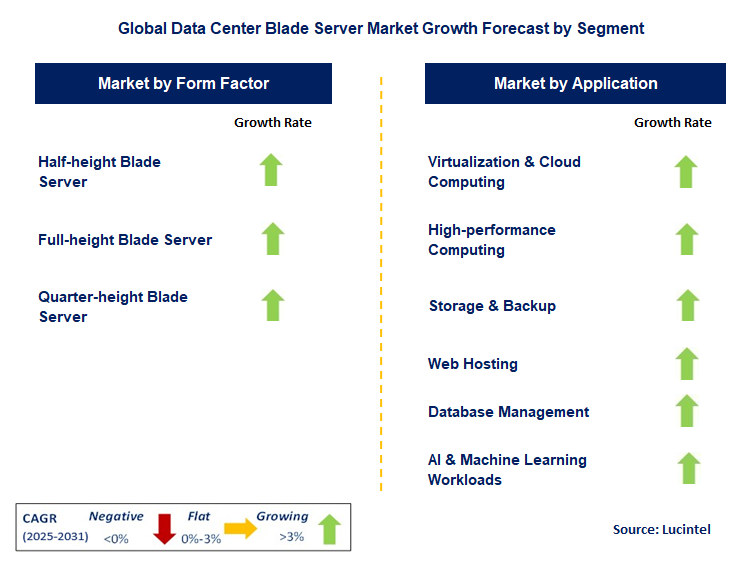
• Lucintel forecasts that, within the form factor category, full-height blade server is expected to witness the highest growth over the forecast period.
• Within the application category, AI & machine learning workload is expected to witness the highest growth.
• In terms of region, APAC is expected to witness the highest growth over the forecast period. Gain valuable insights for your business decisions with our comprehensive 150+ page report. Sample figures with some insights are shown below.
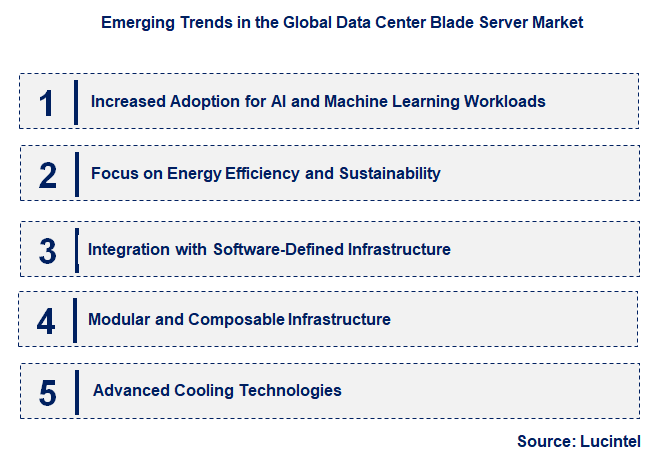
• Increased Adoption for AI and Machine Learning Workloads: The growth of artificial intelligence and machine learning workloads is a major catalyst for the adoption of blade servers. These workloads require vast computational capacity and high-density processing, and blade servers are perfectly suited because they can support multiple high-end processors and GPUs in a very small space. This is creating an opportunity for the creation of blade server configurations optimized for AI training and inference that include improved cooling and compute acceleration capabilities.
• Focus on Energy Efficiency and Sustainability: With escalating energy prices and mounting environmental issues, operators of data centers are increasingly focusing on power efficiency. Blade servers naturally provide higher power utilization than rack servers by having shared power supplies and cooling. Power consumption is optimized further in the direction of adopting advanced cooling methods such as liquid cooling, and designing blade server architectures that have less environmental impact, in line with international green initiatives.
• Integration with Software-Defined Infrastructure: The shift toward software-defined infrastructure is significantly influencing the market for blade servers. Blade servers are becoming more tightly embedded in SDI infrastructures to provide increased automation, flexibility, and orchestration of resources. With this direction, data center administrators can allocate and manage compute, storage, and network resources across pools of blade servers using software, which results in very agile and efficient environments that can rapidly transform to meet shifting workload demands.
• Modular and Composable Infrastructure: The idea of composable and modular infrastructure is picking up speed, with blade servers at the center. This helps data center providers to aggregate disjoined compute, storage, and networking assets and assemble them on-demand to suit particular application demands. This gives them unparalleled flexibility and efficiency, allowing them to optimize utilization of resources and deploy customized infrastructure configurations rapidly without physical reconfiguration, taking the value proposition of blade servers to the next level.
• Advanced Cooling Technologies: As blade servers load increasingly more processing capability into compact sizes, conventional air cooling tends to fall short. This has driven a trend toward the adoption of advanced cooling technologies, such as direct-to-chip liquid cooling and immersion cooling, for blade server deployments. These approaches dissipate heat more effectively, allow for increased rack densities, and help reduce overall energy usage, and are appropriate for the most intense HPC and AI environments. These new trends are revolutionizing the data center blade server market at its core by expanding the horizons of performance, efficiency, and flexibility. The insatiable demand from AI and machine learning applications, the unrelenting emphasis on power efficiency, smooth integration with software-defined infrastructure, the move towards composable and modular architectures, and the use of next-generation cooling technologies are all supporting the pivotal position of blade servers. This development makes blade servers a critical element for contemporary data centers pursuing maximum performance and green operations.
• Increased Density and More Compute Power: One of the most notable recent innovations is the introduction of blade servers with even greater computing density and processing capacity. Companies are designing their blade architectures with higher generations of multi-core processors, usually with higher core counts and better clock speeds. This enables more computational capacity to be fitted into a reduced physical space, which meets the need for high processing power for demanding workloads such as big data analysis and virtualization.
• Accelerated Computing Integration: Increased requirements for AI, machine learning, and HPC have resulted in the increased integration of accelerated computing hardware, including GPUs and FPGAs, onto blade servers. With this innovation, blade servers are more efficient in processing computationally demanding tasks, providing a dense yet powerful platform for demanding workloads requiring extremely large parallel processing capability.
• Improved Networking Features: Current advances are particularly notable in the networking scalability of blade server systems. Advances in new blade chassis generations and network module generations provide greater bandwidth, reduced latency, and compatibility with evolving networking technologies such as 100GbE and InfiniBand. This prevents the high compute power inside the blade servers from being hampered by network performance, promoting quicker data movement and better application responsiveness, particularly in virtualized and cloud environments.
• Enhanced Management and Orchestration Software: Companies are investing heavily in creating more advanced management and orchestration software for blade server environments. Such innovations deliver centralized management, automated provisioning, active monitoring, and smart resource distribution throughout the whole blade infrastructure. Such software streamlines complex data center operations, minimizes manual intervention, and enhances overall efficiency, rendering blade servers more manageable and optimized.
• Emphasis on Sustainability and High-end Cooling Solutions: There is increasingly a focus on sustainability, and therefore the creation of blade server solutions that are more energy efficient and have enhanced cooling approaches. Some of the innovations encompass more efficient power supplies, smart fan control, and increasingly, direct-to-chip liquid cooling solutions for blade servers. These innovations help minimize power usage and consequently deal with the heat that results from high-density blade deployments, making data center operations greener and cheaper. All these recent advancements are collectively driving the data center blade server market by reaffirming its value proposition as an efficient, high-density, and high-performance computing solution. The emphasis on greater compute power, accelerator integration, advanced networking, better management software, and eco-friendly cooling solutions reflects the responsiveness of the market to changing IT needs. These improvements make blade servers continue to be an integral part for organizations in optimizing their data center capabilities and accelerating digital transformation.
• Cloud Computing and Virtualization: One of the most substantial growth areas for blade servers is cloud computing and virtualization environments. Blade servers are well-suited to virtual machine consolidation and multitenant cloud platform support owing to their density and shared infrastructure. Owing to continued moves towards cloud-based offerings and the use of virtualization in the optimization of resources, there will be continued demand for highly scalable and efficient blade server solutions to power these environments.
• High-Performance Computing and AI/ML: The explosive growth of High-Performance Computing (HPC) and Artificial Intelligence/Machine Learning (AI/ML) loads offers a huge growth opportunity. Such applications demand massive amounts of computational power and customized processors (such as GPUs), which blade servers can accommodate economically in a small, liquid-cooled package. Creating blade server configurations specifically tuned for scientific inquiry, big data analysis, and AI model training will address a profitable and expanding niche.
• Enterprise Data Centers and Legacy Modernization: Numerous large-scale enterprises plan to modernize their mature data center infrastructure to enhance efficiency, cut costs, and increase scalability. Blade servers provide an attractive solution to consolidate legacy rack servers, maximize floor space, and replace older systems with more energy-efficient ones. Growth opportunities lie in offering complete migration and integration services to enterprises that embark on such modernization efforts, utilizing the advantages of blade architecture.
• Edge Computing Deployments: Edge computing’s rapid expansion, in which processing is brought nearer the source of the data, presents a new market opportunity for blade server expansion. As edge deployments are generally smaller in scale, the demand for powerful, compact, and manageable compute solutions is more paramount than ever. Opportunities exist in creating ruggedized or reduced-form-factor blade solutions that are capable of running efficiently in various edge environments, targeting the particular needs of IoT, 5G, and real-time data processing at the network edge.
• Data Center Consolidation and Optimization: Companies are continuously looking to consolidate their data center footprint and maximize resource utilization. Blade servers naturally favor this objective by delivering the maximum computing density per rack. Growth opportunities lie in providing consulting and implementation services that enable companies to get significant space, power, and cooling savings with deployments of blade servers, with clear return on investment by streamlining their current data center assets. These application-focused strategic growth opportunities are fundamentally shaping the data center blade server market by pushing targeted product innovation and services. By targeting the high-growth spaces of cloud and virtualization, HPC/AI/ML, enterprise modernization, edge computing, and data center consolidation, service providers and makers can position themselves strategically. This enables blade servers to remain an extremely pertinent and essential technology for addressing the changing needs of contemporary digital infrastructure.
• Cisco Systems
• Dell
• FUJITSU
• Hewlett Packard Enterprise Development
• Huawei
• IBM
• INSPUR
• Lenovo
• Oracle
• Super Micro Computer
• Half-height Blade Server
• Full-height Blade Server
• Quarter-height Blade Server
• Virtualization & Cloud Computing
• High-performance Computing
• Storage & Backup
• Web Hosting
• Database Management
• AI & Machine Learning Workloads
• North America
• Europe
• Asia Pacific
• The Rest of the World
• United States: The United States data center blade server market persists in its robust growth path, fueled by the widespread deployment of cloud computing and hyperscale data center expansion at breakneck speeds. There is a significant rise in demand for HPC-capable and AI-compatible blade servers requiring highly capable processors and sophisticated cooling systems. Large technology leaders and cloud vendors are heavily investing in such technologies, making the U.S. a leading power in blade server development and implementation.
• China: China’s blade server market in data centers is witnessing rapid growth, driven by enormous government investment in digital infrastructure and the rapidly developing domestic cloud computing market. The nation is concentrating on the establishment of large-sized data centers to power its digital economy, creating a strong demand for dense and power-efficient server solutions. Domestic manufacturers are aggressively working on advanced blade server technologies, frequently combining AI potential and liquid cooling to address increasing computational needs of various industries.
• Germany: The German data center blade server market is defined by a clear focus on sustainability, data protection, and adherence to strict European Union regulations. Colocation facilities and enterprises alike are embracing blade servers more and more to gain greater energy efficiency and lower their carbon footprint. The trend has recently shifted towards modularity that facilitates easy upgrades and maintenance, fitting in with Germany’s trend for long-term, dependable, and eco-friendly IT infrastructure solutions.
• India: India data center blade server market is growing rapidly, driven by the country’s fast-tracked digitalization and growing investment in data center infrastructure by local and foreign players. Demand for scalable and cost-effective server solutions is high, especially to serve the growing cloud services, e-commerce, and digital government initiatives. Blade servers are being deployed to maximize data center space and energy efficiency, helping build a strong digital backbone in India.
• Japan: Japan’s blade server market for data centers is characterized by a robust emphasis on technological advancement, disaster recovery, and relentless innovation. Japanese service providers and businesses are spending on blade servers for supporting sophisticated applications with high computational demands and low latency levels like AI, IoT, and 5G. Japanese industry has a discernible pattern of liquid cooling solutions for blade servers to manage heat in high-density environments, indicated the focus of Japan on advanced and efficient data center operations.


• Cisco Systems
• Dell
• FUJITSU
• Hewlett Packard Enterprise Development
• Huawei
• IBM
• INSPUR
• Lenovo
• Oracle
• Super Micro Computer Q5. Which data center blade server market segment will be the largest in future? Answer: Lucintel forecasts that, within the form factor category, full-height blade server is expected to witness the highest growth over the forecast period. Q6. In data center blade server market, which region is expected to be the largest in next 5 years? Answer: In terms of region, APAC is expected to witness the highest growth over the forecast period. Q7. Do we receive customization in this report? Answer: Yes, Lucintel provides 10% customization without any additional cost.


Choose a license that fits your team. Instant PDF delivery.
Prices exclude taxes. Instant delivery. Custom licensing available on request.
Market Report · July 15, 2026
Market Report · June 26, 2026
Market Report · June 24, 2026
Trusted partner for strategic intelligence and business growth


Receive a complimentary market analysis tailored to your industry. Our analysts will identify key growth opportunities and competitive dynamics specific to your business.

Market size, growth rate, and key trend analysis for your specific sector.

Top competitor positioning and market share analysis.

Strategic recommendations backed by data-driven insights.
Get curated market intelligence and competitive moves straight to your inbox.
By subscribing, you agree to receive our monthly insights. Unsubscribe anytime.
Receive a complimentary market analysis tailored to your industry. Our analysts will identify key growth opportunities and competitive dynamics specific to your business.
Market size, growth rate, and key trend analysis for your specific sector.
Top competitor positioning and market share analysis.
Strategic recommendations backed by data-driven insights.
Get curated market intelligence, emerging trends, and competitive moves straight to your inbox each month.
By subscribing, you agree to receive our monthly insights. Unsubscribe anytime.
We'll send your sample report shortly.