
Market Report · July 29, 2026

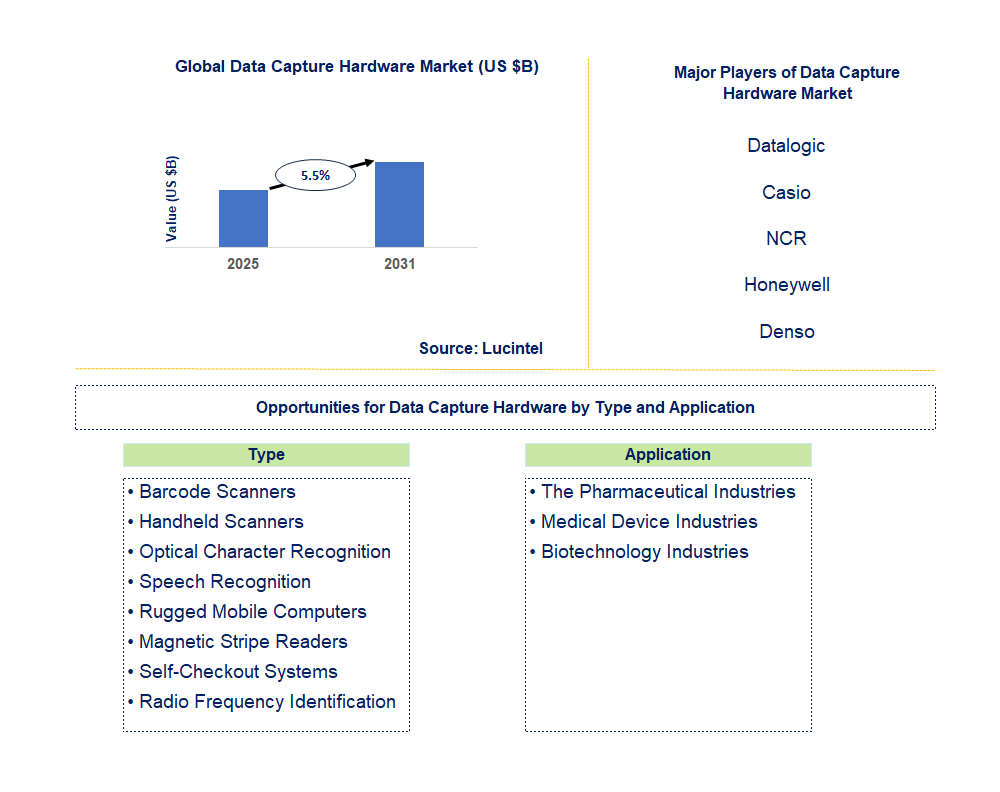
Key data points: The growth forecast = 5.5% annually for the next 7 years. Scroll below to get more insights. This market report covers Trends, opportunity and forecast in data capture hardware market to 2031 by type (barcode scanners, handheld scanners, optical character recognition, speech recognition, rugged mobile computers, magnetic stripe readers, self-checkout systems, and radio frequency identification), application (the pharmaceutical industries, medical device industries, and biotechnology industries), and region (North America, Europe, Asia Pacific, and the Rest of the World)
We'll send your sample report shortly.
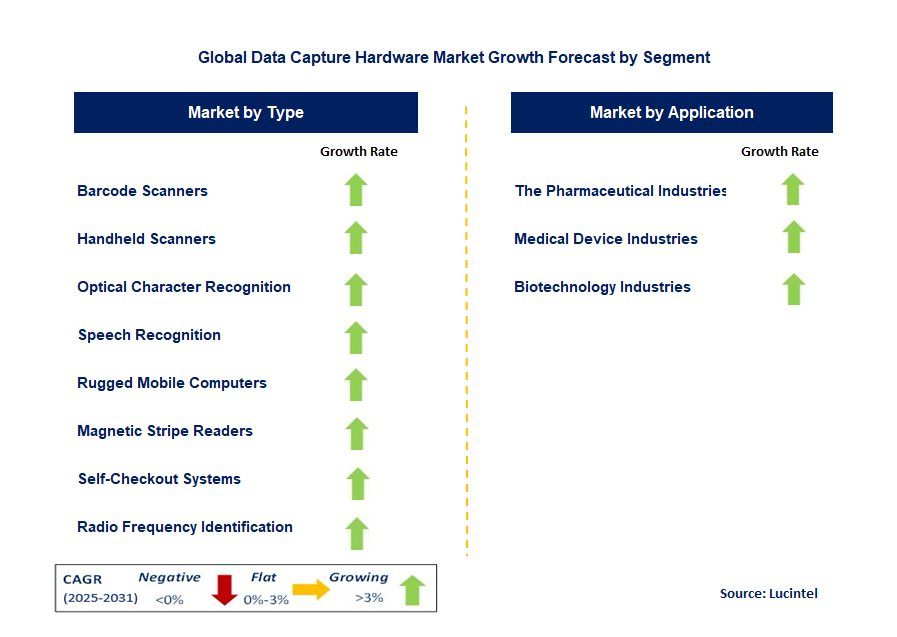
• Lucintel forecasts that, within the type category, barcode scanners will remain the largest segment over the forecast period due to growing demand for efficient inventory and asset management in retail and logistics is driving the adoption of barcode scanners.
• Within the application category, pharmaceutical industries will remain the largest segment due to rising demand for real-time inventory management in pharmaceutical supply chains is supporting the deployment of data capture solutions.
• In terms of region, North America is expected to witness the highest growth over the forecast period due to high demand for data capture solutions like barcode scanners and RFID systems. Gain valuable insights for your business decisions with our comprehensive 150+ page report. Sample figures with some insights are shown below.
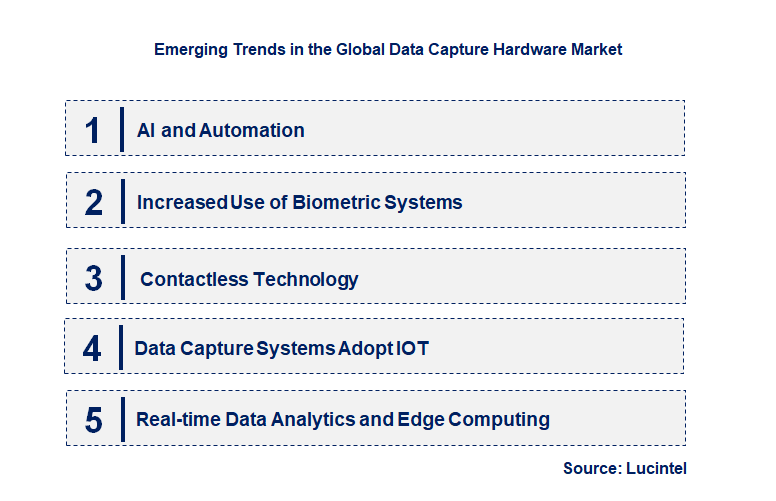
• AI and Automation: The integration of AI and automation into data capture hardware is transforming the retail, healthcare, and logistics industries. Smart cameras and sensors are increasingly using AI-powered systems to capture and analyze data in real-time. This automation increases operational efficiency, reduces human error, and enhances decision-making. For instance, facial recognition and object detection systems based on AI-driven technology are now essential for security applications. The rapid processing of large amounts of data by AI is driving its wide-scale adoption in various sectors.
• Increased Use of Biometric Systems: Biometric systems, such as facial recognition, fingerprint scanning, and iris recognition, are increasingly being used in data capture hardware. With the growing demand for secure identity verification and access control, biometric technology is being adopted in banking, healthcare, government, and transportation sectors. With the increasing development of digital identities and secure authentication technologies, biometrics have now emerged as the safest solution against fraud while ensuring safety. Accuracy and efficiency in biometric systems are the driving factors for their growing use in different sectors.
• Contactless Technology: Contactless technology, one of the market's fastest-growing trends, is growing dynamically in the data capture hardware market. Contactless payment systems, RFID-enabled solutions, and other touchless interactions are favored by consumers and businesses due to convenience and safety concerns, particularly in the wake of the COVID-19 pandemic. RFID and NFC technologies are being used in retail, healthcare, and logistics industries to manage inventory, enhance customer experiences, and collect data. The demand for touchless systems is expected to continue growing as consumers place importance on convenience and hygiene.
• Data Capture Systems Adopt IOT: Adoption of IoT is spearheading the growth of data capture hardware. With its huge popularity, IoT-enabled devices, such as smart sensors and connected cameras, are increasingly used to collect data from different sources and stream it to central systems for analysis. In industries such as manufacturing, logistics, and agriculture, IoT devices give real-time tracking of assets, equipment, and inventory. This is essential for improvement in operational efficiency and decision-making. As the IoT technology progresses, the use of connected data capture hardware is going to surge.
• Real-time Data Analytics and Edge Computing: In today's time, real-time data analytics and edge computing are reshaping the process of capturing and processing data of businesses. Edge computing will enable devices for capturing data to process the information locally and minimize latency so that faster decision-making is made possible. It is especially significant in logistics, healthcare, and manufacturing, where real-time data becomes very critical. Real-time analytics will enable businesses to track performance, detect anomalies, and take proactive measures. Increasing demand for faster and efficient processing of data will continue to push the edge computing solutions into the data capture hardware. These emerging trends, including AI integration, biometric systems, contactless technology, IoT adoption, and real-time analytics, are reshaping the data capture hardware market. Companies embracing these trends are better positioned to meet the evolving demands of consumers and businesses, leading to increased innovation and growth in the market.
• Advancement in RFID and Barcode Technology: RFID and barcode technology have continued to evolve, offering faster, more accurate data capture capabilities. The increased use of RFID systems in logistics, retail, and manufacturing has improved inventory management and operational efficiency. New advancements in RFID tags, such as smaller, more durable versions, have enabled the widespread deployment of this technology. Barcode scanners have also become more efficient, offering quicker scanning times and the ability to read multiple codes simultaneously.
• Security Biometric Systems: Biometric systems are among the recent prominent applications of security due to their fast development in face recognition, fingerprint scanning, and iris recognition. These systems find various applications in secured access control and identity verification systems and in fraudulent activities. Higher accuracy and greater speed in these biometric systems have made the systems more robust and friendly for users. As concerns over data security and identity theft grow, businesses and governments are looking towards biometrics as a secure and convenient method of authentication.
• IoT in Data Capture Hardware: IoT technology has opened up new possibilities in the direction of real-time data collection and monitoring by integrating into data capture hardware. With the help of connected sensors, cameras, and devices, industries like manufacturing, logistics, and agriculture can gain insights into the source data for improved visibility and decision-making. Real-time monitoring of assets and processes using IoT-enabled data capture systems gives businesses a good insight that may be helpful in increasing operational efficiency and reducing downtime.
• Contactless Payment Systems: Contactless payment systems have been the biggest development in the data capture hardware market. The advent of NFC technology has allowed consumers to make payments by merely tapping their card or mobile device. Retailers and financial institutions are increasingly implementing NFC-enabled POS systems to make it easier for customers and simplify transactions. This trend has accelerated due to the need for hygienic, touchless interactions in the wake of the COVID-19 pandemic.
• Real-time Data Analytics and Edge Computing: The demand for real-time data analytics and edge computing has grown in parallel with advances in data capture hardware. Edge computing allows data to be processed closer to the source, reducing latency and enabling faster decision-making. This is particularly beneficial in industries where timely information is crucial, such as healthcare and logistics. Real-time analytics enable businesses to monitor performance, detect issues, and take immediate action, improving operational efficiency and reducing costs. Recent technological advancements in data capture hardware market are changing the way data capture, processing, and usage across industries are viewed. Growth in RFID, biometric systems, IoT, contactless payments, and real-time analytics is a major driver in the market and provides new business opportunities for greater efficiency, security, and enhanced customer experience.
• Retail and E-commerce Solutions: For retail and e-commerce sectors, data capture hardware, like barcode scanners and RFID systems, provides tremendous opportunities for growth. These technologies are used by retailers to track their inventory, follow shipments, and enhance customer services. With e-commerce and omnichannel retailing growing, there is a growing demand for efficient data capture solutions for smooth operations, accurate stock management, and rapid delivery.
• Healthcare Applications: The role of data capture hardware in health care is critical to the enhancement of patient care and efficiencies in operations. Barcode scanners, RFID systems, and biometric devices are used more and more to identify patients, track medications, and ensure security of sensitive data. With a healthcare industry that leans to becoming more digitized, the need to improve patient safety through workflows and ensure data accuracy through digitization is exponentially growing.
• Logistics and Supply Chain Management: Data capture equipment is used to enhance logistics and supply chain management companies to be able to track goods, monitor inventory, and increase efficiency. RFID and barcode scanning devices are already installed in most warehouses and distribution centers for shipment monitoring, error reduction, and effective asset monitoring. Firms in this sector have been employing the advanced data capture technologies that support faster and more efficient logistics as demand for this increases.
• Government and Public Sector: The governments have adopted data capture hardware for applications such as identity verification, secure access control, and biometric systems in voter registration and border control. There is an increased need for security and efficiency in public services. Biometric solutions, facial recognition systems, and RFID technology are thus in greater demand. Governments invest in digital infrastructure to improve citizen services and security measures.
• Manufacturing and Industry 4.0: The key growth area is the incorporation of data capture hardware into the manufacturing process with the advent of Industry 4.0. RFID systems, barcode scanners, and IoT-enabled devices are used in tracking materials, monitoring equipment performance, and gaining supply chain visibility. As factories are becoming more automated, so will the need for advanced data capture solutions enabling real-time monitoring and predictive maintenance. There exist strategic growth opportunities in the data capture hardware market across various industries, such as retail, healthcare, logistics, government, and manufacturing. Capitalizing on these opportunities is what drives businesses in terms of innovation, efficiency, and remaining at the forefront of market trends.
• Datalogic
• Casio
• NCR
• Honeywell
• Denso
• Barcode Scanners
• Handheld Scanners
• Optical Character Recognition
• Speech Recognition
• Rugged Mobile Computers
• Magnetic Stripe Readers
• Self-Checkout Systems
• Radio Frequency Identification
• The Pharmaceutical Industries
• Medical Device Industries
• Biotechnology Industries
• North America
• Europe
• Asia Pacific
• The Rest of the World
• United States: In the United States, there is a significant change being driven toward RFID technology, scanners with barcode readers, and biometric tools. The rising adoption of contactless payment systems, security solutions, and efficient inventory management has led to this demand. RFID and barcode scanners have been massively adopted by retail and logistics companies to manage their flow and service offerings better. It integrates biometric authentication solutions into the security systems in increasing numbers to deliver secure access controls for various facilities, such as airports and corporate offices.
• China: China's data capture hardware market has rapidly grown with more focus on the advanced automation and AI-powered solution. The Chinese government's smart city and digital infrastructure push has been driving the adoption of data capture technologies such as facial recognition, smart inventory management, and electronic point of sale (POS) systems. With a strong focus on technology innovation, China has been at the forefront of implementing biometric data capture systems in public spaces for security and identity verification. It further gives way to higher demand of automated data capture systems in logistic, manufacturing, and retail industries during the progression of urbanization of the country.
• Germany: The data capture hardware market in Germany has experienced considerable growth on account of Germany's robust manufacturing and industrial base. The primary facets related to adoption of RFID and barcode systems have been within the domains of automotive, healthcare, and logistics sectors for better supply chain management, inventory tracking, and product authentication. Germany has also deployed automated data capture systems due to the push for Industry 4.0 and the increased need for automation in factories and warehouses. Germany, as part of its commitment to digital transformation, has also embraced biometric systems for secure access control in both corporate and public sectors.
• India: The data capture hardware market in India is booming because the Indian nation has significantly increased its reliance on technology for different applications. The country has started to use barcode scanners as well as RFID systems in various sectors including retail, logistics, and healthcare to make them more efficient and streamlined. In India, due to the emergence of e-commerce, there is growing demand for automated data capture solutions for managing inventory and ensuring timely deliveries. In addition, biometric technology is also gaining acceptance for digital identity verification, banking, and secure access control in the government and private sectors.
• Japan: Japan's data capture hardware market is known for its high innovation and technology-based focus. Biometric solutions like facial recognition and fingerprint scanning are being adopted by both the public and private sectors for applications like secure access control and identity verification. The retail and logistics industries in Japan have embraced advanced data capture technologies to enhance operational efficiency. RFID and barcode systems are widely used to streamline inventory management, while AI-powered data capture solutions are gaining popularity for real-time monitoring and analytics in industrial and manufacturing applications.


• Datalogic
• Casio
• NCR
• Honeywell
• Denso Q5. Which data capture hardware market segment will be the largest in future? Answer: Lucintel forecasts that barcode scanners will remain the largest segment over the forecast period due to growing demand for efficient inventory and asset management in retail and logistics is driving the adoption of barcode scanners. Q6. In data capture hardware market, which region is expected to be the largest in next 5 years? Answer: North America is expected to witness the highest growth over the forecast period due to high demand for data capture solutions like barcode scanners and RFID systems. Q7. Do we receive customization in this report? Answer: Yes, Lucintel provides 10% customization without any additional cost.


Choose a license that fits your team. Instant PDF delivery.
Prices exclude taxes. Instant delivery. Custom licensing available on request.
Market Report · July 29, 2026
Market Report · July 20, 2026
Market Report · July 20, 2026
Trusted partner for strategic intelligence and business growth


Receive a complimentary market analysis tailored to your industry. Our analysts will identify key growth opportunities and competitive dynamics specific to your business.

Market size, growth rate, and key trend analysis for your specific sector.

Top competitor positioning and market share analysis.

Strategic recommendations backed by data-driven insights.
Get curated market intelligence and competitive moves straight to your inbox.
By subscribing, you agree to receive our monthly insights. Unsubscribe anytime.
Receive a complimentary market analysis tailored to your industry. Our analysts will identify key growth opportunities and competitive dynamics specific to your business.
Market size, growth rate, and key trend analysis for your specific sector.
Top competitor positioning and market share analysis.
Strategic recommendations backed by data-driven insights.
Get curated market intelligence, emerging trends, and competitive moves straight to your inbox each month.
By subscribing, you agree to receive our monthly insights. Unsubscribe anytime.
We'll send your sample report shortly.