
Market Report · July 22, 2026

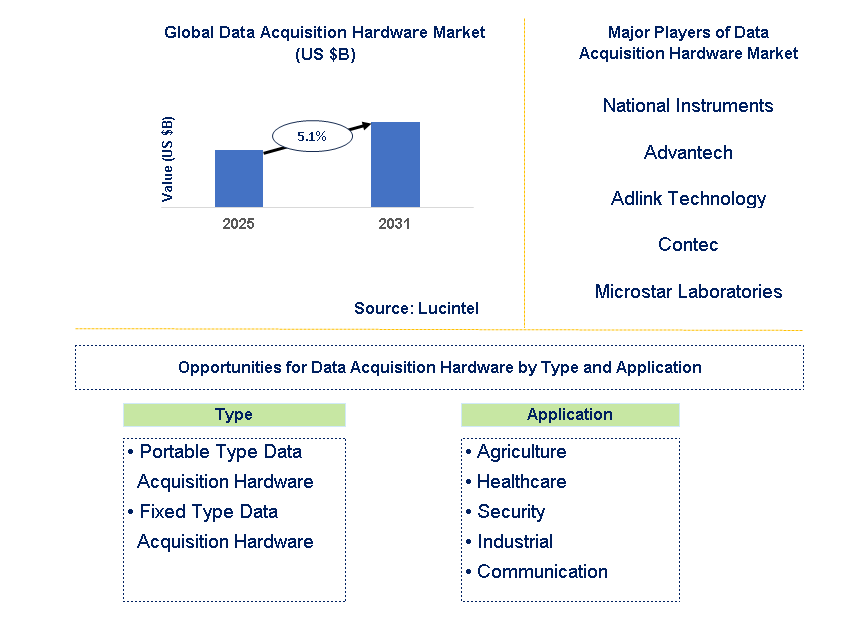
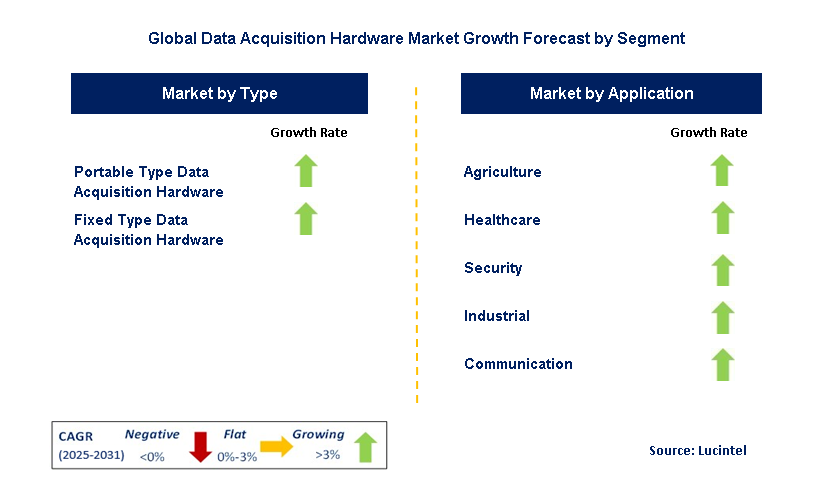
Key data points: The growth forecast = 5.1% annually for the next 7 years. Scroll below to get more insights. This market report covers Trends, opportunity and forecast in data acquisition hardware market to 2031 by type (portable type data acquisition hardware and fixed type data acquisition hardware), application (agriculture, healthcare, security, industrial, and communication), and region (North America, Europe, Asia Pacific, and the Rest of the World)
We'll send your sample report shortly.
• Internet of Things: Data acquisition hardware is now combined with IoT technology. Data will be collected effortlessly and analyzed in real-time to make better decision-making choices continuously monitor industrial processes, equipment, and environmental conditions. In digital transformation by industries, devices enabled with IoT are adding greater functionality to the data acquisition systems, which increases efficiency and access. Increased use of IoT further calls for a surge in demand for data collection devices or sensors to retrieve information from hard-to-reach and remote places. It thereby further widens the use of data acquisition hardware.
• Real-time data processing and analytics: Since instant insight needs increase, real-time data processing and analytics become part and parcel of contemporary data acquisition hardware. Systems now gather and process data in real time, thus quickening the time to decision-making. Real-time systems have significant value for most mass manufacturing industries, healthcare fields, and the energy sector as it saves time that will otherwise be lost in decision-making. Advances in more powerful, efficient, and better-connected hardware systems are causing shifts towards real-time processing.
• Integration of Automation and Machine Learning: Automation and machine learning are slowly being integrated into data acquisition systems to increase efficiency and performance. From automated data collection to AI-driven analytics integration, the system can identify patterns, predict outcomes, or correct issues automatically in real time. The trend is escalating in industries, including automobile, health care, and manufacturing industries, as predictive maintenance, quality control, and process optimization are crucial. The integration of automation with machine learning capabilities makes it possible for businesses to upgrade productivity in operations while minimizing the intervention by man, making data-acquisition systems more intelligent and independent.
• Miniaturization and Portability: Another major trend is the miniaturization of data acquisition hardware, resulting from demand for portable and compact, light and smaller systems. Miniaturized data acquisition devices are of great importance in automotive testing, aerospace, as well as in field research where portability is highly emphasized. Such devices are small and can gather quality data from the remote or difficult-to-access environments, enabling the industries to monitor their processes and equipment in real time. As technology progresses, miniaturized sensors, integrated circuits, and wireless transmission solutions help companies easily deploy efficient and cost-effective data acquisition systems on the go.
• More Focus on Energy Efficiency and Sustainability: With growing awareness of environmental issues, there is a stronger focus on energy-efficient and sustainable data acquisition hardware. Manufacturers are incorporating low-power sensors and energy-efficient components to reduce the environmental impact of their systems. Additionally, there is an emphasis on using sustainable materials and minimizing waste during production. This happens more in sectors such as energy, where correct and efficient collection of data is necessary to control energy consumption and eventually carbon footprints. The focus on sustainability also resonates with global efforts in avoiding environmental impact, which in turn gets the world toward greener and more efficient technologies.
Emerging trends, such as IoT integration, real-time data processing, automation, miniaturization, and sustainability, are changing the game for data acquisition hardware. As industry requirements call for progressively more efficient, accurate, and connected data solutions, manufacturers have evolved to create improved performance systems that support better decisions. These trends drive the evolution of the market and are expected to be a key influence on the further development of data acquisition technologies in the following years.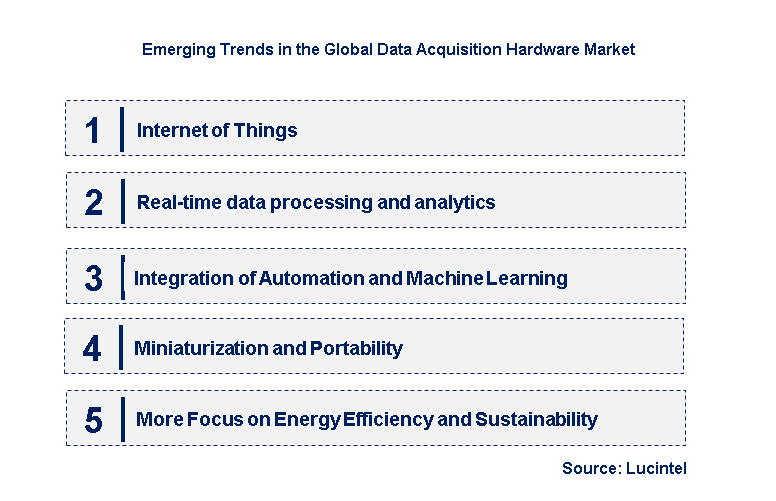
• Advanced Sensor Technology: The rate at which new sensor technologies have come on board has revolutionized the data acquisition hardware market. Sensors have become highly accurate, reliable, and versatile to achieve more accurate measurements of various parameters, including temperature, pressure, humidity, and vibration. All this leads to the application of data acquisition systems in automation, healthcare, and environmental monitoring. With advancements in the sensitivity and range of sensors, business can realize more complete and precise data gathering that creates a demand for advanced data acquisition hardware systems that support such innovations.
• Wireless Data Acquisition Systems: The wireless data acquisition systems are acquiring wide usage through convenience and flexibility. These systems are capable of remote monitoring and data collection and avoid the need for cables, hence enabling the mounting of sensors at inaccessible locations. Real-time transmission of data from the sensors placed at a remote location is enabled by the various wireless technologies available in the form of Wi-Fi, Bluetooth, and cellular networks. The increasing use of wireless data acquisition systems is pushing the development of highly efficient and cost-effective solutions for industries in agriculture, transportation, and energy.
• Cloud-Based Data Acquisition Solutions: Cloud-based data acquisition solutions are changing everything in terms of how data is stored, analyzed, and shared across all industries. Leveraging cloud infrastructure, businesses can access and analyze data remotely in real-time, improving all phases of decision-making processes and operational efficiency. Cloud solutions also allow for scalability, enabling companies to expand their data acquisition systems without major infrastructure changes. This development is particularly beneficial for industries like manufacturing, logistics, and healthcare, where large volumes of data need to be processed and shared across multiple locations or teams.
• High-Speed Data Acquisition Systems: With the increasing demand for real-time data analysis, high-speed data acquisition systems are gaining prominence. These systems can handle vast amounts of data in limited time frames; they are also perfect for most applications in various fields such as telecommunications, aerospace, and automotive testing. High-speed systems have been used in the monitoring of fast processes. Such systems assist in real-time monitoring to determine anomalies or faults. For example, the acquiring and processing capabilities at high frequency led to highly developed systems possessing high processing ability and greater bandwidth.
• Integration with Artificial Intelligence (AI): The integration of artificial intelligence with data acquisition hardware is changing the way data is collected, processed, and analyzed. AI algorithms are applied to interpret data in real-time, providing actionable insights and automating decision-making processes. This development is particularly beneficial for industries that rely on predictive maintenance, process optimization, and anomaly detection. AI-enabled data acquisition systems also improve the accuracy of measurements and make better use of resources, thereby increasing the value of these systems.
High-speed data acquisition, advanced sensors, wireless systems, AI, and cloud solutions are just some of the technologies driving data acquisition hardware. Since there is a move by industries to obtain more efficient and advanced means of executing transactions, these technologies are helping companies collect data while minimizing the processing time. The future horizon for the data acquisition hardware market is promising as it continues to transform.• Industrial Automation: The industrial automation segment is growing rapidly, and significant opportunities are opening up for data acquisition hardware. Data acquisition systems are essential in a smart factory for monitoring machine performance, energy usage, and production efficiency. The demand for real-time data in optimizing operations and predicting maintenance requirements is on the rise. Wireless sensors, IoT-enabled devices, and integrated systems are being adapted by manufacturers for collecting and analyzing data, thereby enhancing the efficiency of operational activities, minimizing downtime, and increasing the productivity of automated production lines. This enhances the need for advanced data acquisition hardware solutions.
• Automotive Industry: The automotive industry is increasingly adopting data acquisition systems for various purposes, including vehicle performance monitoring, testing, and autonomous driving technologies. Data acquisition hardware allows for precise measurement of parameters such as engine performance, braking systems, and fuel efficiency. With the advent of electric vehicles (EVs) and autonomous vehicles, there is a growing need for sophisticated data acquisition systems to ensure safety, performance, and regulatory compliance. With the improving technology and a growing demand for electric and autonomous vehicles, this sector offers an excellent opportunity for the data acquisition hardware providers.
• Healthcare and Medical Devices: The healthcare industry, particularly in the field of medical devices, is experiencing unprecedented demand for precise and reliable data acquisition systems. This accounts for monitoring patient health, managing medical devices, and many more diagnostic procedures. With the development of telemedicine and personalized health care, there is a surge in the requirement for real-time health data. Advanced data acquisition hardware forms the basis for wearable devices, remote monitoring systems, and diagnostic tools that ensure the accuracy of captured and analyzed data. This ever-increasing use of health data will further provide scope for hardware companies to innovate and diversify their products within the health sector.
• Telecommunications: Telecommunications infrastructure is becoming more data-intensive, which increases the need for efficient data acquisition systems to monitor network performance. As 5G networks and high-speed data services expand globally, telecom companies require advanced hardware to collect and analyze data for optimizing network management, preventing system failures, and improving service quality. Data acquisition hardware enables telecom providers to monitor traffic, bandwidth usage, and system load, ensuring seamless communication. With continued rollout of 5G and complexity in telecom networks, the continued deployment of 5G will create vast growth opportunities for data acquisition hardware.
• Energy and Utilities: The energy and utility segment relies extensively on data acquisition systems in monitoring power generation, distribution, and consumption. As the adoption of renewable energy sources, smart grids, and energy-efficient solutions continues to grow, so does the need for sophisticated hardware to collect data on energy usage, load management, and grid performance. Real-time data from power plants, substations, and smart meters is crucial for improving operational efficiency, reducing energy waste, and ensuring grid stability. The demand for alternative sustainable energy is pushing the need forward for innovative acquisition hardware in that sector.
The growing demand for hardware in data acquisition across various markets is expected because of the technological requirements and the importance of real-time data analytics. The growth opportunity for the manufacturing sector includes key areas of industrial automation, automotive technologies, healthcare applications, telecommunications, and energy. As more and more industries develop data-driven decision-making processes, the market is anticipated to be driven by changing hardware requirements for the data acquisition segment, thereby developing a very dynamic and competitive environment.• National Instruments
• Advantech
• Adlink Technology
• Contec
• Microstar Laboratories
• Yokogawa
• Omega Engineering
• Portable Type Data Acquisition Hardware
• Fixed Type Data Acquisition Hardware
• Agriculture
• Healthcare
• Security
• Industrial
• Communication
• North America
• Europe
• Asia Pacific
• The Rest of the World
• United States: In the United States, data acquisition hardware is expanding rapidly with automation, machine learning, and IoT technologies. Precise data collection tools are being sought by various industries like manufacturing, defense, and healthcare. Companies are increasingly integrating data acquisition systems with real-time analytics to enhance productivity and decision-making. Advances in smart factories, industrial applications of IoT, and digitalization are driving new developments in all sectors. Simultaneously, the heightened awareness of environment monitoring and the shift towards more data-driven health systems are resulting in an increased utilization of sophisticated data acquisition systems.
• China: The China market for hardware of data acquisition is growing extremely rapidly with the influence of the overall automation drive in industrial circles, intelligent manufacturing, and technologies advancement. The high investments by China in its manufacturing and infrastructure sectors have triggered the need for robust and high-performance data acquisition systems. The manufacturers in China are embracing IoT-enabled devices, sensors, and automation tools to enhance the smooth running of operations. The increasing focus on environmental monitoring, energy efficiency, and smart cities is further driving the demand for advanced data acquisition solutions, thus opening up huge opportunities for innovation and market growth in the region.
• Germany: Germany is a leader in industrial automation and data-driven technologies, driving the development of sophisticated data acquisition hardware solutions. The country's strong engineering foundation, coupled with the rise of Industry 4.0, is accelerating the adoption of smart manufacturing systems. German manufacturers are increasingly integrating data acquisition hardware with real-time analytics and predictive maintenance technologies to enhance operational efficiency. Focus on environmental sustainability and energy efficiency in automotive, industrial equipment, and renewable energy sectors also contributes to the growth of the market. Germany: Data acquisition systems are being significantly integrated into automated processes in Germany.
• India: Increased investment in smart manufacturing, automation, and industrial IoT applications is propelling the growth of the data acquisition hardware market in India. With Indian industries becoming more modern, the need for real-time data collection and analysis tools is increasing. It has specifically focused attention on sectors that involve energy, transportation, and manufacturing sectors wherein efficient acquisition of data has proven to increase productivity while reducing operation costs. Secondly, the expanding infrastructure of the digital world as well as the increasing trend of developing smart cities calls for innovative methods of data acquisition. The increasing momentum in terms of digitalization efforts by the government also forms an important element for the market's expansion in India.
• Japan: Japan is known for its technological innovation, and the data acquisition hardware market is growing robustly. With a strong focus on automation, robotics, and industrial IoT, Japan is advancing its manufacturing sector with sophisticated data collection systems. Companies are increasingly adopting IoT-enabled sensors, real-time analytics, and remote monitoring systems to optimize production and improve maintenance cycles. In addition, the demand for data acquisition systems in the automotive, energy, and healthcare industries is increasing in the Japanese market. The government's commitment to creating a "smart society" is further accelerating the development and adoption of advanced data acquisition technologies in Japan.


• National Instruments
• Advantech
• Adlink Technology
• Contec
• Microstar Laboratories
• Yokogawa
• Omega Engineering
Q5. Which data acquisition hardware market segment will be the largest in future?

Choose a license that fits your team. Instant PDF delivery.
Prices exclude taxes. Instant delivery. Custom licensing available on request.
Market Report · July 22, 2026
Market Report · July 17, 2026
Market Report · July 17, 2026
Trusted partner for strategic intelligence and business growth


Receive a complimentary market analysis tailored to your industry. Our analysts will identify key growth opportunities and competitive dynamics specific to your business.

Market size, growth rate, and key trend analysis for your specific sector.

Top competitor positioning and market share analysis.

Strategic recommendations backed by data-driven insights.
Get curated market intelligence and competitive moves straight to your inbox.
By subscribing, you agree to receive our monthly insights. Unsubscribe anytime.
Receive a complimentary market analysis tailored to your industry. Our analysts will identify key growth opportunities and competitive dynamics specific to your business.
Market size, growth rate, and key trend analysis for your specific sector.
Top competitor positioning and market share analysis.
Strategic recommendations backed by data-driven insights.
Get curated market intelligence, emerging trends, and competitive moves straight to your inbox each month.
By subscribing, you agree to receive our monthly insights. Unsubscribe anytime.
We'll send your sample report shortly.