
Market Report · July 29, 2026

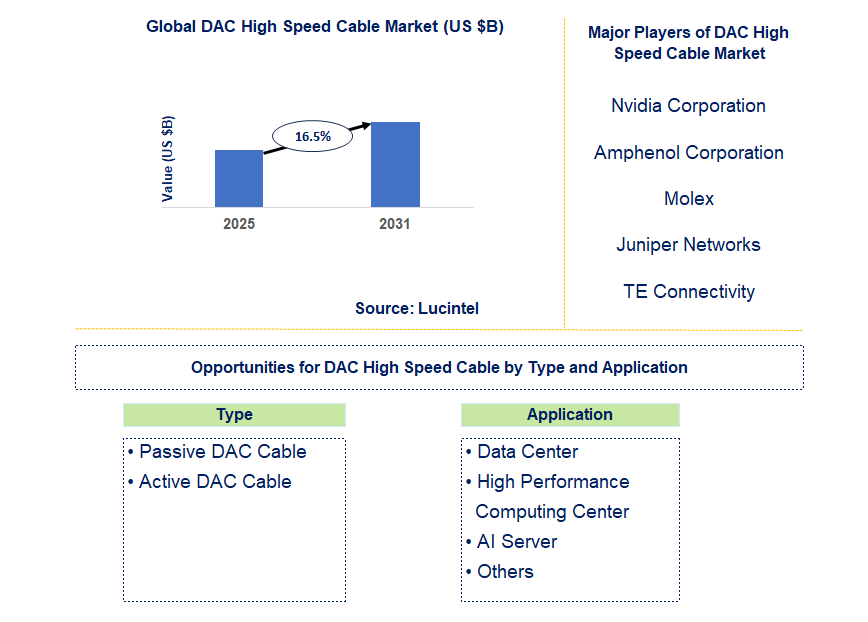
Key data points: The growth forecast = 16.5% annually for the next 7 years. Scroll below to get more insights. This market report covers trends, opportunities and forecasts in DAC high speed cable market to 2031 by type (passive DAC cable and active DAC cable), application (data center, high performance computing center, AI server, and others), and region (North America, Europe, Asia Pacific, and the Rest of the World)
We'll send your sample report shortly.
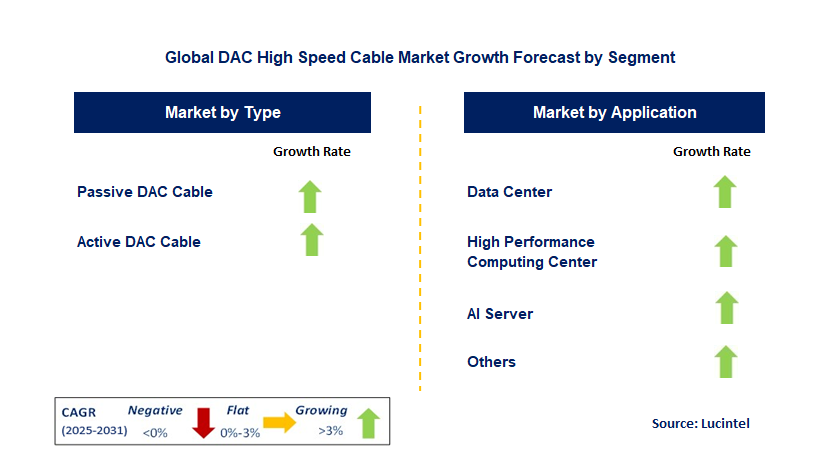
• Lucintel forecasts that, within the type category, active DAC cable is expected to witness higher growth over the forecast period.
• Within the application category, AI server is expected to witness the highest growth.
• In terms of region, APAC is expected to witness the highest growth over the forecast period. Gain valuable insights for your business decisions with our comprehensive 150+ page report. Sample figures with some insights are shown below.
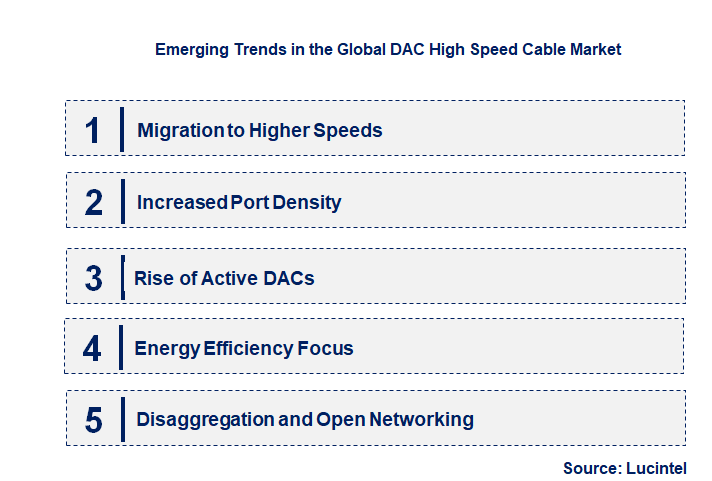
• Migration to Higher Speeds: There is a significant trend towards DACs supporting speeds beyond 100GbE, specifically 200GbE, 400GbE, and emerging 800GbE. This is crucial for meeting the exponential bandwidth demands of hyper-converged infrastructure, AI/ML workloads, and cloud computing, enabling faster data processing and reducing network bottlenecks.
• Increased Port Density: The market is witnessing a strong push towards DACs with higher port densities and smaller form factors (e.g., QSFP-DD, OSFP). This allows for more connections within a given rack space, maximizing server and switch utilization, reducing cabling complexity, and enabling more scalable and efficient network designs in dense data centers.
• Rise of Active DACs: An emerging trend is the growing adoption of Active DACs (AOCs - Active Optical Cables, and increasingly AECs - Active Electrical Cables) for longer reach applications. While passive DACs remain cost-effective for short distances, active variants overcome passive DAC length limitations, offering better signal integrity and enabling longer connections without resorting to more expensive optical transceivers.
• Energy Efficiency Focus: The market is seeing a growing focus on developing energy-efficient DACs. With rising energy costs and environmental concerns in data centers, manufacturers are designing cables with lower power consumption per connection, contributing to reduced operational expenses and a smaller carbon footprint for data center operators.
• Disaggregation and Open Networking: There is an increasing trend towards disaggregation, where hardware and software components of network infrastructure are separated. This enables open networking solutions, allowing users to select best-of-breed DACs from different vendors, promoting innovation, reducing vendor lock-in, and potentially lowering overall infrastructure costs. These emerging trends are fundamentally reshaping the DAC high speed cable market by driving innovation towards higher speeds, greater density, enhanced signal integrity through active solutions, and improved energy efficiency. The focus on next-generation data centers, cloud infrastructure, and open networking is crucial for meeting the evolving demands of high-performance digital environments, making DACs indispensable.
• 400 Gigabit Ethernet (400GbE) Adoption: Recent developments show a rapid acceleration in the adoption and deployment of 400GbE DACs. This higher speed is becoming the standard for spine-and-leaf architectures in hyperscale data centers, enabling massive bandwidth aggregation and supporting demanding applications like AI/ML, big data analytics, and high-performance computing.
• Enhanced Signal Integrity and Longer Reach: A notable development is the continuous improvement in DAC signal integrity, allowing for longer passive DAC reaches and boosting the performance of active DACs (AECs). Manufacturers are leveraging advanced copper technologies and re-timing chips within AECs to minimize signal loss and extend viable transmission distances beyond traditional copper limits.
• Form Factor Evolution: Recent advancements prioritize DACs compatible with new, higher-density form factors like QSFP-DD (Quad Small Form-factor Pluggable Double Density) and OSFP (Octal Small Form-factor Pluggable). These form factors support higher port densities and aggregate bandwidths (e.g., 400GbE, 800GbE), enabling more compact and powerful network equipment within data centers.
• Cost-Effective 25G and 50G Solutions: Developments highlight the widespread availability of cost-effective 25GbE and 50GbE DAC solutions, driving their adoption for server-to-ToR (Top-of-Rack) switch connections. This provides a more efficient and economical upgrade path from 10GbE for enterprises and smaller data centers, optimizing performance without a significant cost increase.
• Integration with Advanced Diagnostics: Recent developments emphasize integrating advanced diagnostic and monitoring capabilities directly into DACs. This provides real-time visibility into cable health, signal quality, and potential issues, enabling proactive troubleshooting and optimizing network operations through data-driven insights, enhancing reliability. These developments are profoundly impacting the DAC high speed cable market by leading to more powerful, efficient, and intelligent networking solutions. The focus on ultra-high speeds, extended reach, new form factors, cost-effectiveness, and advanced diagnostics is crucial for meeting the rigorous demands of modern data centers and cloud infrastructure, cementing DACs as a vital component.
• Hyperscale Data Centers: A primary growth opportunity lies in providing DACs for the rapidly expanding hyperscale data centers. These facilities demand massive bandwidth and low latency for inter-server communication, storage connectivity, and cloud services, making high-capacity, low-latency DACs essential for their core networking infrastructure at 400GbE and beyond.
• Cloud Computing Infrastructure: Targeting the high-growth market of cloud computing service providers offers substantial opportunities. As more enterprises migrate to the cloud and consume cloud-native applications, the underlying infrastructure requires robust and scalable DACs to ensure efficient data transfer, low latency, and reliable service delivery within their distributed environments.
• Enterprise Network Upgrades: Exploring opportunities in the enterprise sector, particularly for large corporations and campuses upgrading their existing networks, is crucial. The increasing adoption of video conferencing, unified communications, virtualization, and data-intensive applications drives the need for higher-performance DACs to improve network efficiency, reduce latency, and enhance user experience.
• 5G Core Networks: The market can grow by focusing on providing DACs for the evolving 5G core network infrastructure. As 5G technology matures, its core network will require extremely high-capacity and low-latency switching and routing to handle the massive traffic generated by connected devices and services, from IoT to enhanced mobile broadband, making DACs critical.
• High-Performance Computing (HPC) & AI/ML Clusters: A significant opportunity exists in the High-Performance Computing (HPC), Artificial Intelligence (AI), and Machine Learning (ML) sectors. These applications require extremely low-latency, high-bandwidth interconnects between GPUs, CPUs, and storage, making advanced DACs critical for efficient data processing and inter-node communication within compute clusters. These strategic growth opportunities are poised to significantly impact the DAC high speed cable market by reinforcing its indispensable role in hyperscale data centers, cloud infrastructure, and enterprise networks. Expanding into 5G core networks and HPC/AI/ML will drive product innovation and enhance market penetration, ensuring robust support for the evolving landscape of high-performance computing and communication.
• Nvidia Corporation
• Amphenol Corporation
• Molex
• Juniper Networks
• TE Connectivity
• Volex
• Panduit
• JPC Connectivity
• ATOP Corporation
• Broadex Technologies
• Passive DAC Cable
• Active DAC Cable
• Data Center
• High Performance Computing Center
• AI Server
• Others
• North America
• Europe
• Asia Pacific
• The Rest of the World
• United States: The U.S. DAC market is dominated by hyperscale data center expansion and technological innovation. Developments focus on high-density QSFP and SFP28/56/112 form factors, supporting 100GbE, 200GbE, and 400GbE, with increasing emphasis on active DACs for extended reach and lower power consumption in next-generation data centers.
• China: China’s DAC market is experiencing significant growth due to massive data center build-outs and aggressive digitalization. Recent developments include extensive domestic production capabilities, a strong focus on cost-effectiveness, and rapid adoption of 400GbE and higher speed solutions to meet the enormous demand from its burgeoning cloud and AI sectors.
• Germany: Germany’s DAC market emphasizes high-reliability, energy-efficient solutions for its advanced industrial automation and enterprise segments. Developments involve robust designs for demanding environments, low-latency performance crucial for Industry 4.0, and adherence to stringent quality standards to ensure secure and efficient data communication.
• India: India’s DAC market is witnessing burgeoning demand, driven by its rapidly expanding digital infrastructure, data center growth, and increasing cloud service adoption. Recent developments include rising imports of advanced DACs and growing interest in local assembly to support the massive data transfer needs of its evolving IT and telecommunications landscape, including 5G rollout.
• Japan: Japan is a key innovator in the DAC high speed cable market, prioritizing ultra-high performance, miniaturization, and energy efficiency. Developments focus on advanced DACs for specialized data centers, high-performance computing, and resilient network architectures, ensuring low latency and high reliability for its critical digital infrastructure and scientific research.


• Nvidia Corporation
• Amphenol Corporation
• Molex
• Juniper Networks
• TE Connectivity
• Volex
• Panduit
• JPC Connectivity
• ATOP Corporation
• Broadex Technologies Q5. Which DAC high speed cable market segment will be the largest in future? Answer: Lucintel forecasts that, within the type category, active DAC cable is expected to witness higher growth over the forecast period. Q6. In DAC high speed cable market, which region is expected to be the largest in next 5 years? Answer: In terms of region, APAC is expected to witness the highest growth over the forecast period. Q7. Do we receive customization in this report? Answer: Yes, Lucintel provides 10% customization without any additional cost.


Choose a license that fits your team. Instant PDF delivery.
Prices exclude taxes. Instant delivery. Custom licensing available on request.
Market Report · July 29, 2026
Market Report · July 20, 2026
Market Report · July 20, 2026
Trusted partner for strategic intelligence and business growth


Receive a complimentary market analysis tailored to your industry. Our analysts will identify key growth opportunities and competitive dynamics specific to your business.

Market size, growth rate, and key trend analysis for your specific sector.

Top competitor positioning and market share analysis.

Strategic recommendations backed by data-driven insights.
Get curated market intelligence and competitive moves straight to your inbox.
By subscribing, you agree to receive our monthly insights. Unsubscribe anytime.
Receive a complimentary market analysis tailored to your industry. Our analysts will identify key growth opportunities and competitive dynamics specific to your business.
Market size, growth rate, and key trend analysis for your specific sector.
Top competitor positioning and market share analysis.
Strategic recommendations backed by data-driven insights.
Get curated market intelligence, emerging trends, and competitive moves straight to your inbox each month.
By subscribing, you agree to receive our monthly insights. Unsubscribe anytime.
We'll send your sample report shortly.