
Market Report · July 20, 2026

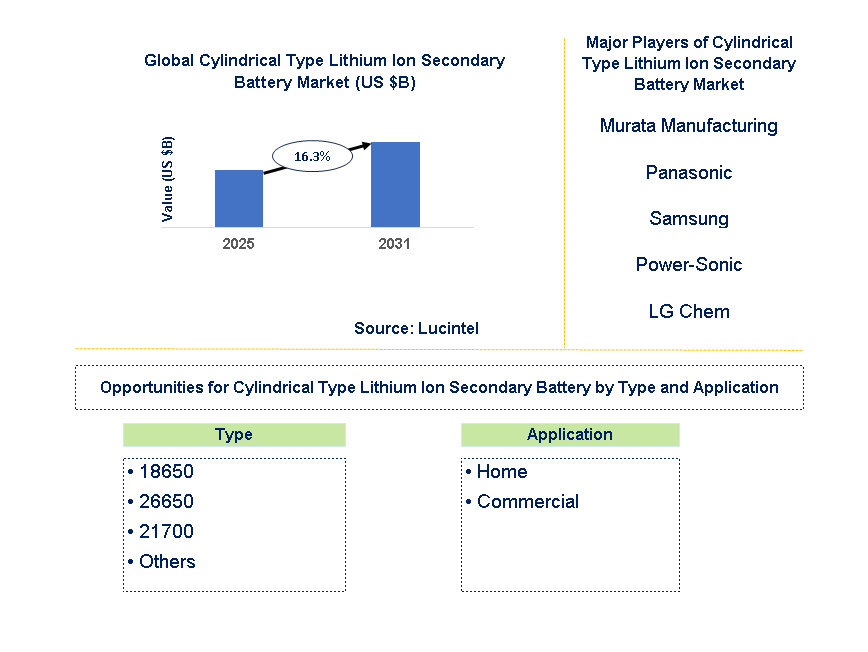
Key data points: The growth forecast = 16.3% annually for the next 7 years. Scroll below to get more insights. This market report covers Trends, opportunities and forecasts in cylindrical type lithium ion secondary battery market to 2031 by type (18650, 26650, 21700, and others), application (home and commercial), and region (North America, Europe, Asia Pacific, and the Rest of the World)
We'll send your sample report shortly.
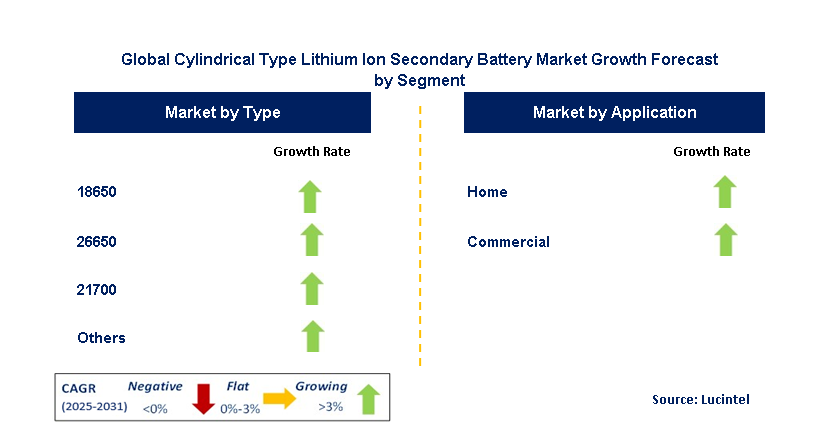
• Lucintel forecasts that, within the type category, 21700 is expected to witness the highest growth over the forecast period due to the growing energy density and longer lifespan.
• Within the application category, commercial is expected to witness higher growth.
• In terms of region, APAC is expected to witness the highest growth over the forecast period due to the growing adoption of electric vehicles in this region.
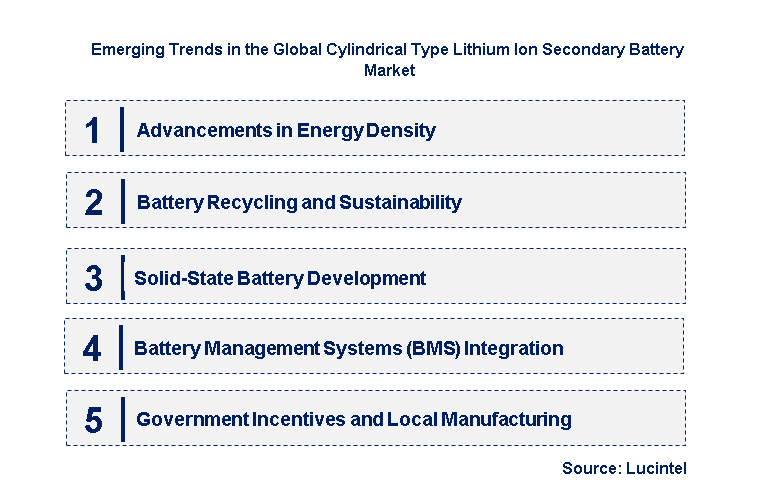
• Advancements in Energy Density: One of the primary trends in cylindrical lithium-ion batteries is the drive to increase energy density. Companies are focusing on improving the energy capacity per unit volume, allowing for longer-lasting batteries with smaller form factors. This is particularly critical for electric vehicles, where high energy density is essential for longer ranges and fast charging.
• Battery Recycling and Sustainability: With growing environmental concerns, there is an increased focus on developing efficient recycling technologies for cylindrical lithium-ion batteries. This includes innovations in material recovery processes to reduce the environmental footprint of battery production and increase the reuse of valuable materials like cobalt, lithium, and nickel.
• Solid-State Battery Development: Solid-state batteries are emerging as a potential game-changer in the lithium-ion battery market. These batteries offer higher energy densities, improved safety, and longer life spans than traditional liquid electrolyte batteries. As research progresses, solid-state cylindrical batteries are expected to become more commercially viable, especially in the EV and portable electronics sectors.
• Battery Management Systems (BMS) Integration: Another trend is the integration of advanced Battery Management Systems (BMS) to optimize battery performance and safety. These systems use artificial intelligence and machine learning algorithms to monitor battery health, improve charge cycles, and prevent issues like overheating and degradation. This trend is crucial for enhancing the longevity and reliability of cylindrical lithium-ion batteries.
• Government Incentives and Local Manufacturing: Governments, especially in countries like China, India, and the U.S., are incentivizing local battery production and research. Policies promoting battery manufacturing infrastructure, combined with subsidies and incentives for electric vehicle adoption, are driving the growth of the cylindrical lithium-ion battery market. This trend is helping to reduce costs and dependency on imports. These trends are reshaping the cylindrical lithium-ion battery market by focusing on enhancing performance, increasing sustainability, and driving innovation. As technology advances, these developments will play a pivotal role in the adoption of electric vehicles and other energy-intensive applications.
• Energy Density Improvements: Manufacturers are focusing on increasing the energy density of cylindrical lithium-ion batteries to support longer battery life and faster charging times. Companies like Panasonic and LG Chem are exploring new anode and cathode materials to achieve these improvements, which are essential for the electric vehicle sector.
• Battery Recycling Initiatives: With growing concerns over resource scarcity and environmental impact, battery recycling initiatives have gained traction. Companies are investing in technologies that enable the extraction of valuable materials such as lithium, cobalt, and nickel from spent batteries, ensuring sustainability and reducing reliance on raw materials.
• Integration of Artificial Intelligence: Battery management systems (BMS) are being integrated with AI and machine learning to optimize battery performance. This allows for better monitoring of battery health, more efficient charging cycles, and enhanced safety. AI-based BMS is becoming essential for improving battery life and performance, especially in electric vehicles.
• Collaboration Between Automakers and Battery Manufacturers: Major automakers are increasingly forming partnerships with battery manufacturers to secure a reliable supply of high-performance cylindrical lithium-ion batteries. Companies like Tesla, Panasonic, and CATL are collaborating to scale up production and improve battery performance for electric vehicles and energy storage solutions.
• Enhanced Manufacturing Processes: Battery manufacturers are investing in advanced manufacturing techniques to increase the efficiency and reduce the costs of cylindrical lithium-ion batteries. This includes automation in battery production lines and the use of advanced materials and coatings that enhance battery performance and lifespan. These developments are reshaping the cylindrical lithium-ion battery market by improving battery efficiency, driving sustainability, and ensuring greater scalability. As technology continues to evolve, these improvements will help meet the growing demand for clean energy solutions in electric vehicles and other sectors.
• Growing Sales of Electric Vehicles: The growth of electric vehicles sales represents a considerable opportunity for cylindrical lithium-ion batteries over traditional alternatives. Increased sales of EVs means that battery technology investments to facilitate longer ranges, quicker charging, and lower overall costs are more profitable, and high-capacity cylindrical batteries are ideal in this situation.
• Renewable Energy Supporting Demand: With increasing focus on achieving sustainability goals, there is a growing use of wind, solar, and other renewables that require energy storage systems. These developments create a favorable environment for growth of cylindrical lithium-ion batteries. This battery market is expected to grow with the added requirements of dependable grid storage as renewable energy outages and variations increase.
• Consumer Electronics Industry: The portable electronics industry is leveraging the utilization of compact powerful batteries for smartphones, laptops, and wearables. Cylindrical lithium-ion batteries are ideal because of compact structure, greater energy density, and as such easily serve the portable electronics industry.
• Battery Recycling and Circular Economy: Spent batteries have become a source of concern, however, they can be recycled and their materials reused. This presents a significant opportunity. The focus is now on recycling cylindrical lithium-ion batteries and retrieving lithium, cobalt, and nickel from them. This would make battery production more sustainable by incorporating the circular economy model.
• Energy Storage Systems (ESS) for Commercial Applications: The market for Energy Storage Systems (ESS) is increasing which is especially true for commercial and industrial sectors needing backup power support as well as grid stability. This is possible through the use of cylindrical lithium-ion batteries, which get integrated into the ESS to improve performance, storage, and life, therefore supporting substantial growth. A hint of optimism is emerging from the cylindrical lithium-ion battery market in electric vehicles, renewable energy, portable electronics, and energy storage. Increased demand in these sectors is bound to make positive changes in technology, sustainability, and the market itself.
• Murata Manufacturing
• Panasonic
• Samsung
• Power-Sonic
• LG Chem
• Sony
• Shenzhen Cyclen Technology
• Jiangmen TWD Technology
• Shenzhen ACE Battery
• AA Portable Power
• 18650
• 26650
• 21700
• Others
• Home
• Commercial
• North America
• Europe
• Asia Pacific
• The Rest of the World
• United States: The U.S. has seen significant advancements in cylindrical lithium-ion batteries, driven by the booming electric vehicle (EV) market. Major manufacturers, such as Tesla and Panasonic, are improving energy density and battery longevity, while also focusing on reducing production costs. The U.S. Department of Energy is investing in research to enhance recycling processes and develop more sustainable battery materials.
• China: China is a leader in the cylindrical lithium-ion battery market, with companies like CATL and BYD at the forefront. The country’s focus is on increasing the production of higher-capacity cells, improving the efficiency of battery systems, and expanding manufacturing capabilities for EVs. The government is also supporting the growth of battery recycling infrastructure to reduce reliance on raw materials.
• Germany: Germany has long been a strong player in the battery technology sector, with companies like BMW, Volkswagen, and BASF focusing on high-performance cylindrical lithium-ion batteries for their EVs. German manufacturers are investing in increasing battery efficiency and developing next-generation solid-state batteries. The country is also focusing on battery sustainability and is working to reduce the environmental impact of lithium-ion production.
• India: India is gradually becoming an emerging market for cylindrical lithium-ion batteries, primarily driven by the growing adoption of electric vehicles and renewable energy systems. Companies in India are focusing on scaling up local manufacturing and improving the supply chain for key materials like lithium and cobalt. The Indian government is also pushing for self-sufficiency in battery production, reducing reliance on imports.
• Japan: Japan is investing heavily in the development of cylindrical lithium-ion batteries for both consumer electronics and electric vehicles. Japanese companies, including Sony and Panasonic, are improving energy density and performance while focusing on enhancing safety features. Japan is also emphasizing the integration of artificial intelligence (AI) to optimize battery management systems in EVs and renewable energy systems.


• Murata Manufacturing
• Panasonic
• Samsung
• Power-Sonic
• LG Chem
• Sony
• Shenzhen Cyclen Technology
• Jiangmen TWD Technology
• Shenzhen ACE Battery
• AA Portable Power Q5. Which cylindrical type lithium ion secondary battery market segment will be the largest in future? Answer: Lucintel forecasts that, within the type category, 21700 is expected to witness the highest growth over the forecast period due to the growing energy density and longer lifespan. Q6. In cylindrical type lithium ion secondary battery market, which region is expected to be the largest in next 5 years? Answer: In terms of region, APAC is expected to witness the highest growth over the forecast period due to the growing adoption of electric vehicles in this region. Q7. Do we receive customization in this report? Answer: Yes, Lucintel provides 10% customization without any additional cost.


Choose a license that fits your team. Instant PDF delivery.
Prices exclude taxes. Instant delivery. Custom licensing available on request.
Market Report · July 20, 2026
Market Report · July 20, 2026
Market Report · July 20, 2026
Trusted partner for strategic intelligence and business growth


Receive a complimentary market analysis tailored to your industry. Our analysts will identify key growth opportunities and competitive dynamics specific to your business.

Market size, growth rate, and key trend analysis for your specific sector.

Top competitor positioning and market share analysis.

Strategic recommendations backed by data-driven insights.
Get curated market intelligence and competitive moves straight to your inbox.
By subscribing, you agree to receive our monthly insights. Unsubscribe anytime.
Receive a complimentary market analysis tailored to your industry. Our analysts will identify key growth opportunities and competitive dynamics specific to your business.
Market size, growth rate, and key trend analysis for your specific sector.
Top competitor positioning and market share analysis.
Strategic recommendations backed by data-driven insights.
Get curated market intelligence, emerging trends, and competitive moves straight to your inbox each month.
By subscribing, you agree to receive our monthly insights. Unsubscribe anytime.
We'll send your sample report shortly.