
Market Report · July 16, 2026

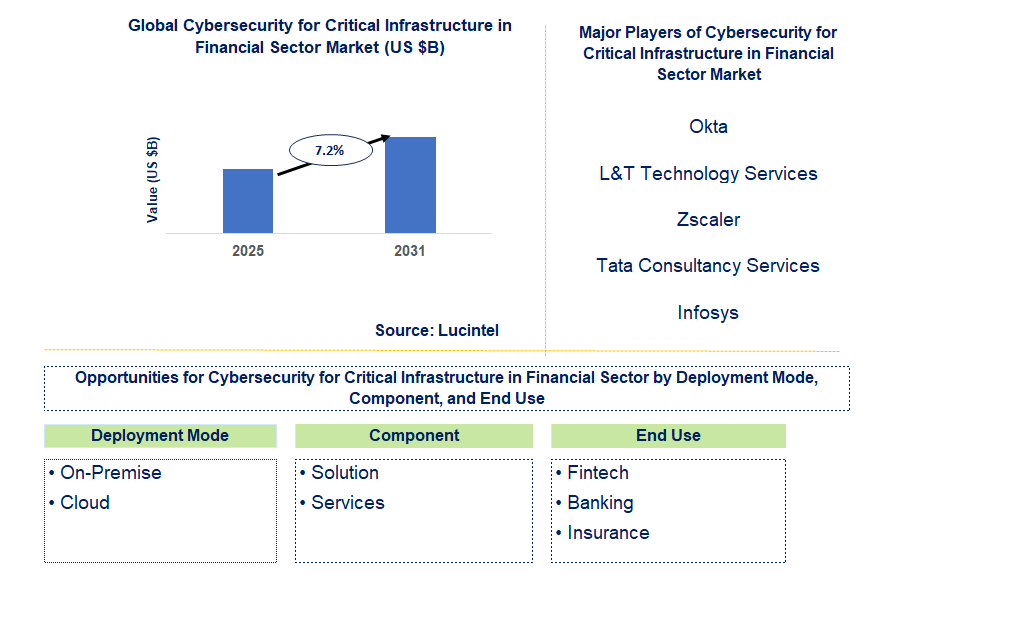
Key data points: The growth forecast = 7.2% annually for the next 7 years. Scroll below to get more insights. This market report covers Trends, opportunity and forecast in cybersecurity for critical infrastructure in financial sector market to 2031 by deployment mode (on-premise and cloud), component (solution and services), end use (fintech, banking, and insurance), and region (North America, Europe, Asia Pacific, and the Rest of the World)
We'll send your sample report shortly.
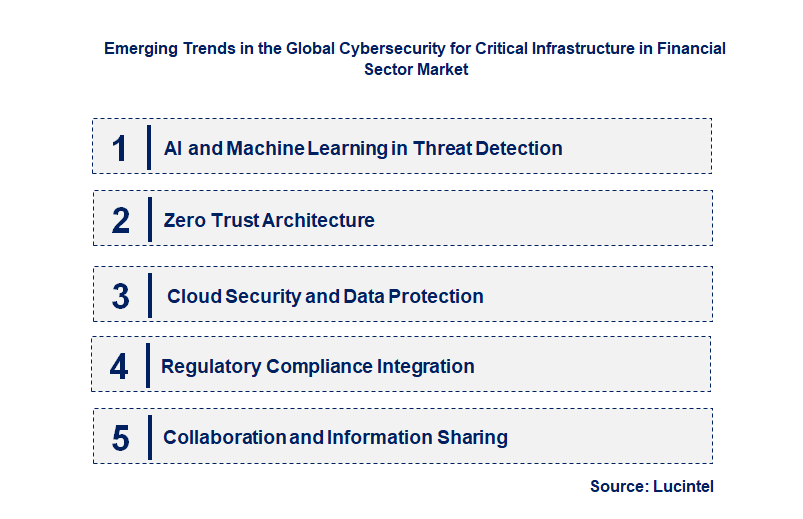
• AI and Machine Learning in Threat Detection: Institutions are now incorporating AI and machine learning features into their cybersecurity solutions to enhance threat identification and response capabilities. These features proactively analyze data, enabling institutions to manage potential cyber-attacks more efficiently and reduce response times. This enhances security measures across the board.
• Zero Trust Architecture: Another trend gaining traction is the Zero Trust model, which operates under the assumption that users within a company network can also be a threat. There is an increased push to implement identity-centric access management systems that, in conjunction with multi-factor authentication, further reduce the chances of a breach. Zero Trust is sophisticated, supplementing trust within the financial realm, which is extremely sensitive regarding system and data access, with additional authentication steps.
• Cloud Security and Data Protection: Security of cloud infrastructures presents unique vulnerabilities, and as financial institutions transition to cloud platforms, protecting these environments becomes critical. Addressing these issues is evolving alongside cloud security solutions in the areas of securing data storage, transactions, and compliance with regulations like GDPR.
• Regulatory Compliance Integration: Financial institutions incorporating stricter cybersecurity compliance regulations on a global scale are building their compliance frameworks on existing cyber strategies. The integration of data privacy laws such as GDPR, PSD2, and the U.S. CCPA ensures that market confidence is maintained without the risk of dominant penalties being enforced for non-compliance.
• Collaboration and Information Sharing: Cooperation between financial institutions, government bodies, and private cybersecurity firms is essential. Platforms that allow for information sharing are aiding in the provision of threat intelligence, enabling immediate responses to potential cyber threats. Consumer groups and organizations are emerging to improve responsiveness to the challenges of cybersecurity. The combination of these factors, along with others, is prompting the financial sector to modernize its cybersecurity policies to guard against increasingly sophisticated threats and to ensure the success of financial institutions in protecting core infrastructure.
• Solutions to Cybersecurity Problems Using AI: The use of artificial intelligence (AI) in Internet of Things (IoT) security breach identification is changing cybersecurity protection schemes. Financial institutions are using sophisticated algorithms, known as machine learning models, to automatically and instantly process enormous amounts of transactional information to detect possible threats and vulnerabilities.
• More Powerful Cybersecurity From Blockchain Technology: Financial institutions can utilize blockchain and other decentralized technologies to ensure the security of their financial infrastructure by validating transactions without relying on a central authority. Distributed ledger technology can help financial institutions defend against fraud, unauthorized access, and manipulation.
• Stronger Compliance and Security Controls in the Cloud: Protection measures accompanying an organization’s entire network environment in the cloud, for infrastructure as a service (IaaS), are proliferating. Financial institutions are adopting new cloud-based systems to improve the security of cloud-based financial systems with advanced encryption, multi-factor authentication, and solutions for ensuring data integrity.
• Governments’ Strengthening Regulation: Globally, including in the United States and the European Union, governments are tightening regulations to enforce stronger measures regarding cybersecurity within financial services. These policies include heightened data privacy restrictions and real-time reporting of breaches, forcing organizations to take precautions in their cybersecurity practices.
• Cross-Border Cooperation: Because financial transactions are global, there is an increase in cooperation among governments, regulatory bodies, and financial institutions. This cooperation involves the exchange of intelligence concerning threats and mitigating cyber risks responsible for critical infrastructure damage. All these factors are contributing to the growth of international relations, influencing investments in sophisticated solutions, and addressing sophisticated threats aimed at critical infrastructure cybersecurity.
• Digital Banking Security: As digital banking becomes more common, there is a need for cybersecurity solutions to protect online banking platforms. This includes safeguarding mobile banking applications, online transactions, and preventing user identity fraud. The adoption of biometric authentication technology further expands this segment.
• Responsibility of Securing Payment Systems: The advancement of technology, especially the acceptance of digital wallets and contactless payments, calls for sophisticated cybersecurity measures to safeguard transactions from unauthorized access. The security provided by multi-factor authentication (MFA) and tokenization is an additional benefit offered by these payment systems.
• Security Measures in Fintech: The rapid growth of fintech raises the demand for blockchain, peer-to-peer payment services, and digital asset management. It is no surprise that this segment is increasingly adopting encryption and other secure digital ledger methods.
• Managing Compliance: Compliance is not only important for accounting but also for adhering to various policies like GDPR or PSD2. Cybersecurity firms that specialize in compliance across data privacy risks are benefiting from their focus on data protection and legal adherence.
• Security for Financial Institutions Using the Cloud: Following the trend of cloud computing, the financial industry is looking for proprietary cloud security solutions. These would typically encompass secure transactions and data, identity access control verification for staff, and data processing and storage protections. To achieve advanced security approaches for crucial systems in the financial sector, these identified opportunities showcase the gaps that exist in the provision of specialized cybersecurity services, which are critically absent.
• Okta
• L&T Technology Services
• Zscaler
• Tata Consultancy Services (TCS)
• Infosys
• Broadcom
• Accenture
• On-Premise
• Cloud
• Solution
• Services
• North America
• Europe
• Asia Pacific
• The Rest of the World
• US: In the US, greater federal and state activity has been reported with the intention of improving the cybersecurity of the financial sector. The implementation of the Cybersecurity & Infrastructure Security Agency (CISA) framework is helping organizations comply with standards. In addition, the Office of the Comptroller of the Currency (OCC) has issued new guidelines regarding the management of cybersecurity risks by financial institutions.
• China: The People's Republic of China's cybersecurity regulations are changing. There is a change in the Cybersecurity Law of the People's Republic of China (2017) that transforms the approach companies, especially fintech firms, take toward cybersecurity in a more aggressive way. The government has also started privately encouraging local financial institutions to establish cyber protection of vital infrastructures through the use of artificial intelligence and blockchain technology.
• Germany: In recent years, Germany has made strides in securing critical financial infrastructure under the purview of the Federal Office for Information Security (BSI) due to an increased focus on emerging cyber threats such as ransomware attacks. Additionally, Germany is working on compliance with GDPR while simultaneously investing in enhanced security for the financial sector, thereby ensuring the protection of vulnerable advanced technologies.
• India: Recently, the Reserve Bank of India (RBI) has instituted broad-ranging cybersecurity standards to drive financial service providers to adopt a higher level of security. There is also a notable push to secure financial transactions owing to the government's initiative to build a Digital India, which includes infrastructure support such as the Indian Cyber Crime Coordination Centre (I4C).
• Japan: Japan has implemented a robust national policy, and with the digitalization of services, its financial sector is becoming more prone to cyber risks associated with cross-border payments and fintech platforms, thus requiring this sector to be prioritized for national funding. In addition, the government has developed its Critical Infrastructure Protection (CIP) framework to protect financial institutions.


• Okta
• L&T Technology Services
• Zscaler
• Tata Consultancy Services (TCS)
• Infosys
• Broadcom
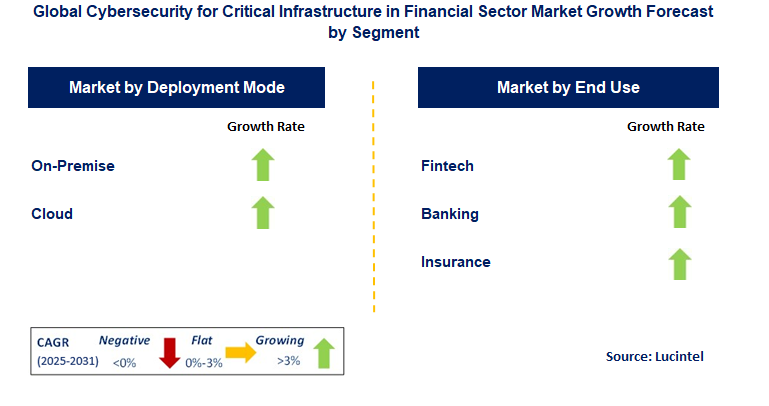
• Accenture Q5. Which cybersecurity for critical infrastructure in financial sector market segment will be the largest in future? Answer: Lucintel forecasts that the cloud is expected to witness higher growth over the forecast period. Q6. In cybersecurity for critical infrastructure in financial sector market, which region is expected to be the largest in next 5 years? Answer: APAC is expected to witness the highest growth over the forecast period. Q7. Do we receive customization in this report? Answer: Yes, Lucintel provides 10% customization without any additional cost.


Choose a license that fits your team. Instant PDF delivery.
Prices exclude taxes. Instant delivery. Custom licensing available on request.
Market Report · July 16, 2026
Market Report · May 18, 2026
Market Report · May 18, 2026
Trusted partner for strategic intelligence and business growth


Receive a complimentary market analysis tailored to your industry. Our analysts will identify key growth opportunities and competitive dynamics specific to your business.

Market size, growth rate, and key trend analysis for your specific sector.

Top competitor positioning and market share analysis.

Strategic recommendations backed by data-driven insights.
Get curated market intelligence and competitive moves straight to your inbox.
By subscribing, you agree to receive our monthly insights. Unsubscribe anytime.
Receive a complimentary market analysis tailored to your industry. Our analysts will identify key growth opportunities and competitive dynamics specific to your business.
Market size, growth rate, and key trend analysis for your specific sector.
Top competitor positioning and market share analysis.
Strategic recommendations backed by data-driven insights.
Get curated market intelligence, emerging trends, and competitive moves straight to your inbox each month.
By subscribing, you agree to receive our monthly insights. Unsubscribe anytime.
We'll send your sample report shortly.