
Market Report · May 16, 2026

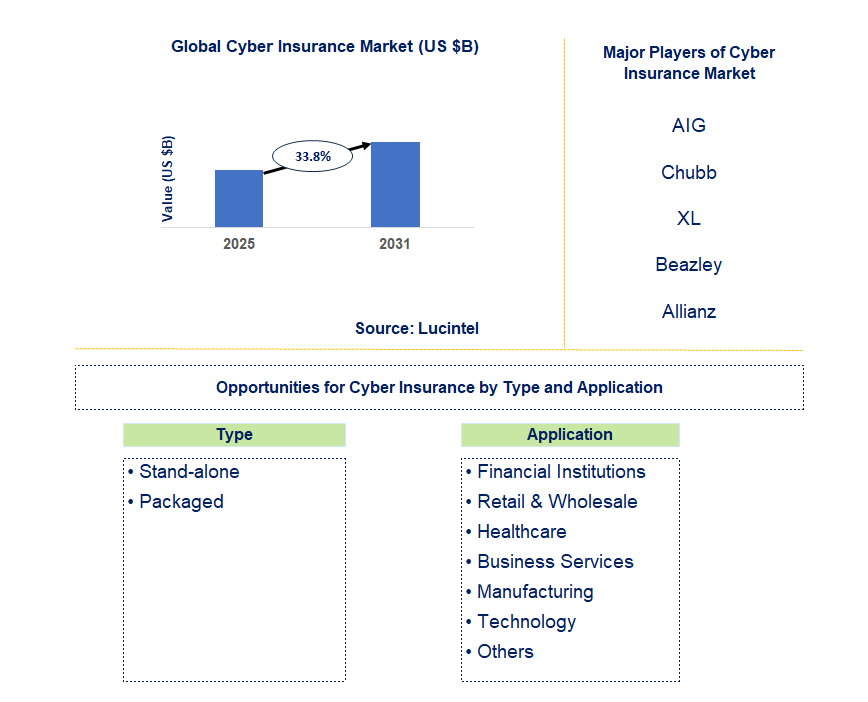
Key data points: The growth forecast = 33.8% annually for the next 7 years. Scroll below to get more insights. This market report covers trends, opportunities and forecasts in cyber insurance market to 2031 by type (stand-alone and packaged), application (financial institutions, retail & wholesale, healthcare, business services, manufacturing, technology, and others), and region (North America, Europe, Asia Pacific, and the Rest of the World)
We'll send your sample report shortly.
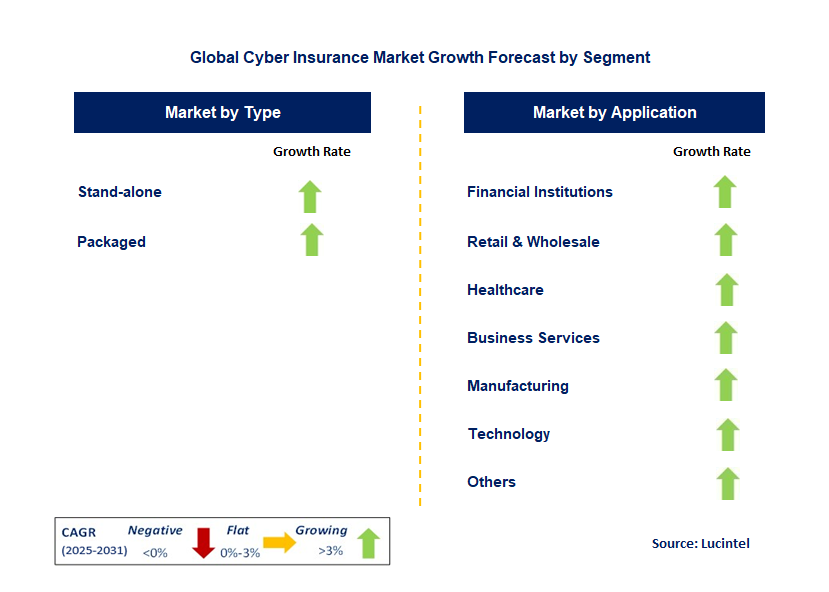
• Lucintel forecasts that, within the type category, stand-alone is expected to witness higher growth over the forecast period.
• Within the application category, healthcare is expected to witness the highest growth.
• In terms of region, APAC is expected to witness the highest growth over the forecast period. Gain valuable insights for your business decisions with our comprehensive 150+ page report. Sample figures with some insights are shown below.
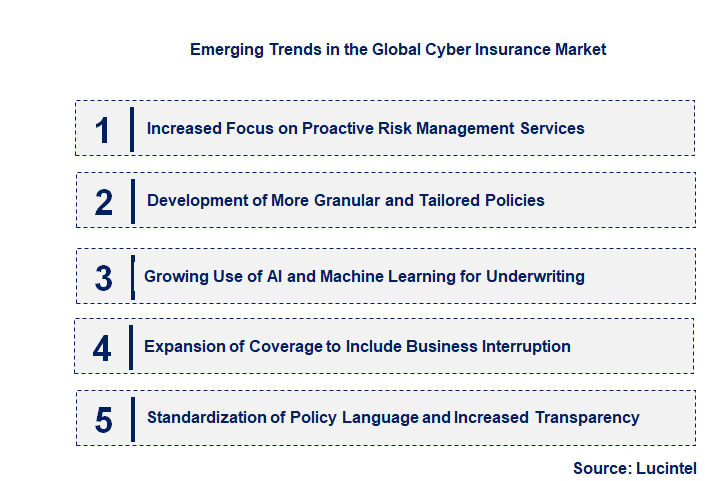
• Increased Focus on Proactive Risk Management Services: Cyber insurers are increasingly offering bundled services that go beyond traditional indemnity, including pre-breach risk assessments, employee training, and incident response planning, aiming to help policyholders prevent or mitigate cyberattacks. This proactive approach reduces overall risk.
• Development of More Granular and Tailored Policies: Recognizing the diverse cyber risks faced by different industries and organization sizes, insurers are moving towards more granular and customized cyber insurance policies that address specific vulnerabilities and operational needs. This personalization ensures more relevant coverage.
• Growing Use of AI and Machine Learning for Underwriting: Insurers are leveraging AI and machine learning to analyze vast datasets on cyber threats, incident history, and security controls to improve risk assessment, pricing accuracy, and the efficiency of the underwriting process. This data-driven approach enhances risk evaluation.
• Expansion of Coverage to Include Business Interruption: Cyber insurance policies are increasingly covering not only direct financial losses but also business interruption costs and the financial impact of cyberattacks on an organization's supply chain, reflecting the interconnected nature of modern businesses. This broader coverage addresses systemic risks.
• Standardization of Policy Language and Increased Transparency: Efforts are underway within the industry to standardize cyber insurance policy language and improve transparency around exclusions and coverage terms to reduce ambiguity and enhance understanding for policyholders. This clarity builds trust and facilitates comparison. These trends are collectively reshaping the cyber insurance market towards a more proactive, tailored, and comprehensive approach to managing cyber risk, with a greater emphasis on prevention, broader coverage, and clearer policy terms.
• Increased Capacity from Insurers Despite Rising Claims: Despite a surge in cyber insurance claims, particularly related to ransomware, many insurers are increasing their capacity, indicating a long-term commitment to the market while adjusting underwriting strategies and pricing.
• Greater Emphasis on Minimum Security Standards for Coverage: Insurers are increasingly requiring policyholders to implement minimum cybersecurity controls and best practices as a condition for obtaining or renewing coverage, incentivizing better security postures.
• Development of Public-Private Partnerships to Address Systemic Risk: Recognizing that some cyber risks have the potential to be systemic, governments and insurers are exploring public-private partnerships to share risk and develop more comprehensive solutions.
• Refinement of Exclusions, Particularly for Nation-State Attacks: Insurers are working to clarify and refine exclusions in their policies, especially concerning cyberattacks attributed to nation-states, which can be difficult to insure due to their potentially catastrophic nature.
• Growth in Cyber Reinsurance Market: The cyber reinsurance market is expanding to help primary insurers manage their exposure to cyber risks, providing additional capacity and stability to the overall market. These developments are impacting the cyber insurance market by fostering greater resilience, promoting better cybersecurity practices among policyholders, and addressing the challenges associated with insuring increasingly sophisticated and widespread cyber threats.
• Targeting Small and Medium-Sized Enterprises: SMEs are often underinsured despite being significant targets for cyberattacks. Developing affordable and accessible cyber insurance products tailored to their specific risks and budgets represents a major growth opportunity.
• Bundling Cyber Insurance with Managed Security Services Providers (MSSPs): Collaborating with MSSPs to offer bundled cyber insurance and security services can provide a comprehensive risk management solution for businesses, increasing the value proposition and market reach.
• Developing Industry-Specific Cyber Insurance Policies: Creating specialized cyber insurance policies that address the unique risks and regulatory requirements of specific industries, such as healthcare, finance, and manufacturing, can attract more targeted clientele.
• Offering Cyber Insurance for Cloud-Based Services and Data: With the increasing adoption of cloud computing, there's a growing need for cyber insurance that specifically covers risks associated with cloud environments and the data stored within them.
• Providing Cyber Insurance for Internet of Things (IoT) and Operational Technology (OT) Environments: As IoT and OT devices become more integrated into business operations, the need for cyber insurance that covers the unique vulnerabilities of these interconnected systems presents a significant growth opportunity. These strategic growth opportunities highlight the potential for the cyber insurance market to expand by addressing the diverse needs of different business segments, leveraging partnerships, and adapting to emerging technological landscapes.
• AIG
• Chubb
• XL
• Beazley
• Allianz
• Zurich Insurance
• Munich Re
• Berkshire Hathaway
• AON
• AXIS Insurance
• Stand-alone
• Packaged
• Financial Institutions
• Retail & Wholesale
• Healthcare
• Business Services
• Manufacturing
• Technology
• Others
• North America
• Europe
• Asia Pacific
• The Rest of the World
• United States: Focus on increased coverage limits and ransomware-specific policies. Recent developments include a rise in demand for higher coverage limits due to the growing cost of breaches, and the emergence of more specialized policies specifically addressing ransomware attacks, including negotiation and recovery services.
• China: Nascent market with growing awareness and government emphasis on cybersecurity. China's cyber insurance market is still in its early stages but is experiencing increasing awareness, particularly among larger enterprises. Government initiatives promoting cybersecurity are expected to drive future market growth.
• Germany: Mature market with focus on SMEs and standardized policy language. Germany has a relatively mature cyber insurance market, with a growing focus on providing coverage to small and medium-sized enterprises (SMEs). There are also efforts to standardize policy language for greater clarity and comparability.
• India: Rapid growth driven by digitalization and regulatory push. India's cyber insurance market is experiencing rapid growth, fueled by increasing digitalization across industries and regulatory mandates for data protection, leading to greater demand for cyber risk transfer solutions.
• Japan: Cautious adoption with focus on business continuity and supply chain risks. Japan's approach to cyber insurance has been more cautious, with a focus on coverage that supports business continuity following a cyber incident and addresses the growing risks associated with complex supply chains.


• AIG
• Chubb
• XL
• Beazley
• Allianz
• Zurich Insurance
• Munich Re
• Berkshire Hathaway
• AON
• AXIS Insurance Q5. Which cyber insurance market segment will be the largest in future? Answer: Lucintel forecasts that, within the type category, stand-alone is expected to witness higher growth over the forecast period. Q6. In cyber insurance market, which region is expected to be the largest in next 5 years? Answer: In terms of region, APAC is expected to witness the highest growth over the forecast period. Q7. Do we receive customization in this report? Answer: Yes, Lucintel provides 10% customization without any additional cost.


Choose a license that fits your team. Instant PDF delivery.
Prices exclude taxes. Instant delivery. Custom licensing available on request.
Market Report · May 16, 2026
Market Report · May 16, 2026
Market Report · May 16, 2026
Trusted partner for strategic intelligence and business growth


Receive a complimentary market analysis tailored to your industry. Our analysts will identify key growth opportunities and competitive dynamics specific to your business.

Market size, growth rate, and key trend analysis for your specific sector.

Top competitor positioning and market share analysis.

Strategic recommendations backed by data-driven insights.
Get curated market intelligence and competitive moves straight to your inbox.
By subscribing, you agree to receive our monthly insights. Unsubscribe anytime.
Receive a complimentary market analysis tailored to your industry. Our analysts will identify key growth opportunities and competitive dynamics specific to your business.
Market size, growth rate, and key trend analysis for your specific sector.
Top competitor positioning and market share analysis.
Strategic recommendations backed by data-driven insights.
Get curated market intelligence, emerging trends, and competitive moves straight to your inbox each month.
By subscribing, you agree to receive our monthly insights. Unsubscribe anytime.
We'll send your sample report shortly.