
Report Feature
Curing Agent Trends and Forecast
The future of the global curing agent market looks promising with opportunities in the coating, wind energy, construction, adhesive, composites, and electrical & electronic markets. The global curing agent market is expected to reach an estimated $16.7 billion by 2030 with a CAGR of 6.5% from 2024 to 2030. The major drivers for this market are the rapid expansion in the construction and wind energy sectors and the rising development of environmentally friendly low or non-VOC agents.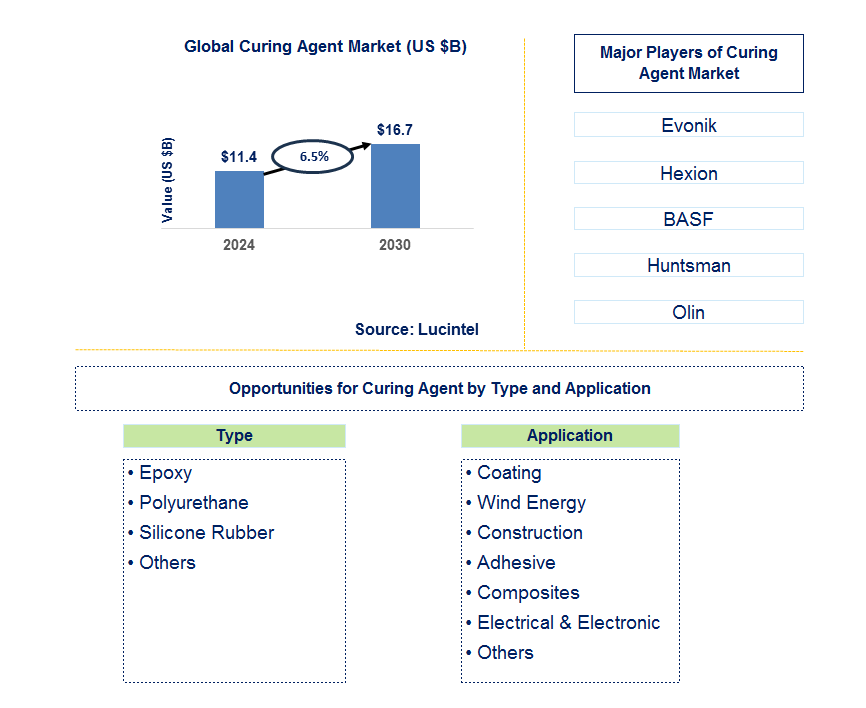
Country Wise Outlook for the Curing Agent Market
Major players in the market are expanding their operations and forming strategic partnerships to strengthen their positions. Below is an overview of recent developments by major curing agent producers in key regions: the USA, Chinese, Indian, Japanese, and German markets.• United States: The U.S. has seen a rise in the use of bio-based curing agents in construction and coatings due to sustainability trends. Companies are innovating formulations that enhance performance while reducing environmental impact, resulting in a more eco-friendly product landscape.
• China: China is rapidly expanding its curing agent production capacity to meet domestic and international demand. Recent investments in advanced manufacturing technologies have improved efficiency and product quality, particularly in the automotive and construction sectors, enabling faster market growth.
• Germany: Germany is leading in the development of high-performance curing agents for specialized applications, including aerospace and automotive. Recent innovations focus on improving curing speed and adhesion properties, aligning with the country's emphasis on precision engineering and high-quality standards.
• India: In India, the curing agent market is growing due to increasing construction activities and industrial applications. Recent government initiatives promoting infrastructure development are boosting demand for epoxy and polyurethane curing agents, leading to expanded production capabilities among local manufacturers.
• Japan: Japan is advancing in smart curing agents that respond to environmental conditions, such as humidity and temperature. These innovations are enhancing application performance and reliability, particularly in electronics and automotive industries, positioning Japan as a key player in high-tech solutions.
Emerging Trends in the Curing Agent Market
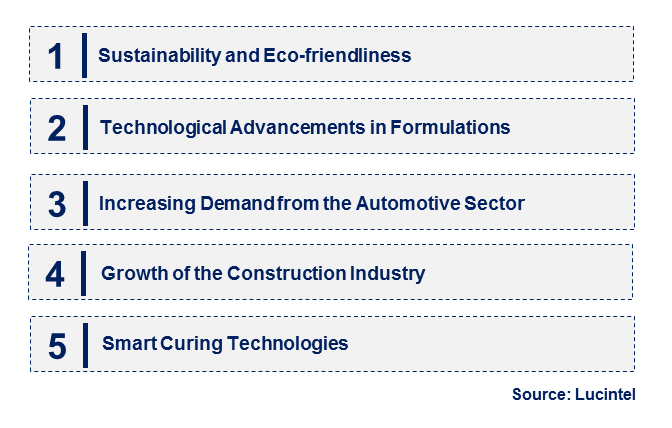
The curing agent market is evolving with several emerging trends that are shaping its future. This section outlines five key trends driving growth and innovation in the industry.• Sustainability and Eco-friendliness: There is a growing emphasis on developing bio-based and environmentally friendly curing agents. This trend is driven by regulatory pressures and consumer demand for greener products, leading manufacturers to explore renewable resources and reduce volatile organic compounds (VOCs) in their formulations.
• Technological Advancements in Formulations: Innovations in curing agent formulations are enhancing performance characteristics such as curing speed, temperature resistance, and adhesion. Manufacturers are investing in R&D to create specialized products tailored for specific applications, driving market growth and competitiveness.
• Increasing Demand from the Automotive Sector: The automotive industry is increasingly adopting advanced curing agents for coatings, adhesives, and composites. The need for lightweight materials and improved performance is pushing manufacturers to develop high-performance curing agents that meet stringent industry standards.
• Growth of the Construction Industry: The expansion of the construction sector globally is fueling demand for curing agents in concrete, sealants, and coatings. As infrastructure projects increase, the need for durable and efficient curing agents is becoming critical, boosting market prospects.
• Smart Curing Technologies: The development of smart curing agents that adapt to environmental conditions is gaining traction. These technologies enhance the efficiency and effectiveness of applications, particularly in challenging environments, providing a competitive edge in the market. These trends are transforming the curing agent market by driving innovation, enhancing product performance, and meeting the evolving needs of various industries.
Recent Developments in the Curing Agent Market
Recent developments in the curing agent market highlight significant advancements that enhance product performance and application versatility. This section outlines five key developments shaping the industry.• Introduction of bio-based curing agents: The launch of bio-based curing agents is revolutionizing the market, addressing sustainability concerns while maintaining performance. These agents, derived from renewable resources, are gaining popularity in eco-conscious industries, promoting greener practices and reducing environmental footprints.
• Advancements in rapid curing technologies: Innovations in rapid curing technologies are enabling faster application processes across various sectors. These developments enhance efficiency in manufacturing and construction, allowing for quicker project completions and reducing downtime, thereby increasing productivity.
• Enhanced properties for aerospace applications: New curing agents designed for aerospace applications are improving temperature resistance and adhesion strength. These advancements are critical for meeting stringent performance requirements in the aerospace industry, driving demand for specialized formulations.
• Integration of nanotechnology: The incorporation of nanotechnology into curing agents is enhancing their mechanical properties and thermal stability. This advancement allows for the development of high-performance materials suitable for demanding applications, expanding market opportunities.
• Strategic collaborations for product development: Increased collaborations between manufacturers and research institutions are fostering innovation in curing agent formulations. These partnerships enable the sharing of knowledge and resources, accelerating the development of cutting-edge products that meet market demands. These developments are positively impacting the curing agent market by enhancing product offerings, improving application efficiency, and fostering sustainable practices.
Strategic Growth Opportunities for Curing Agent Market
The curing agent market presents various strategic growth opportunities across key applications. This section identifies five growth opportunities that manufacturers can leverage for expansion.• Construction Industry Expansion: The continuous growth of the construction industry offers significant opportunities for curing agents in concrete and coatings. As infrastructure projects increase, manufacturers can capitalize on the rising demand for durable and efficient curing solutions.
• Automotive Coatings Market: The automotive sector's shift towards high-performance coatings presents a lucrative opportunity for specialized curing agents. Developing innovative formulations tailored for automotive applications can enhance product offerings and capture market share.
• Electronics and Electrical Applications: The increasing demand for electronic components requires reliable curing agents for encapsulation and adhesives. This growth area presents opportunities for manufacturers to develop high-performance products that meet industry specifications.
• Green Building Initiatives: The rising trend of green building practices is creating demand for eco-friendly curing agents. Manufacturers can focus on developing bio-based products that align with sustainability goals, catering to environmentally conscious consumers and businesses.
• Emerging Markets in Asia-Pacific: The expanding industrial sectors in emerging markets, particularly in Asia-Pacific, provide growth opportunities for curing agents. Manufacturers can explore these regions to tap into new markets and increase production capabilities. These strategic growth opportunities are shaping the curing agent market by expanding application areas, enhancing product offerings, and driving innovation in sustainable solutions.
Curing Agent Market Driver and Challenges
The curing agent market is influenced by various technological, economic, and regulatory factors. Understanding the major drivers and challenges helps stakeholders navigate the complexities of this evolving industry. The factors responsible for driving the curing agent market include:• Growing Construction Sector: The expansion of the global construction industry is driving demand for curing agents in concrete and coatings. Increased infrastructure investments create opportunities for manufacturers to supply high-performance curing solutions.
• Technological Innovations: Continuous advancements in curing agent formulations and application technologies enhance product performance. Innovations in rapid curing and bio-based agents are expanding market potential and attracting investments.
• Sustainability Trends: The shift towards sustainable and eco-friendly products is driving the demand for bio-based curing agents. Regulatory pressures and consumer preferences for greener solutions are encouraging manufacturers to innovate in this area.
• Rising Automotive Production: The growth of the automotive sector is fueling demand for advanced curing agents in coatings and composites. As vehicle manufacturers seek lightweight and durable materials, the market for specialized curing agents is expanding.
• Increased R&D Investments: Growing investments in research and development are fostering innovation in curing agent technologies. Enhanced R&D efforts are enabling manufacturers to develop specialized products that meet evolving market needs. Challenges in the curing agent market are:
• High Production Costs: The costs associated with developing and producing advanced curing agents can be significant. High production costs may limit market entry for smaller manufacturers and restrict competition.
• Complex Regulatory C compliance: Navigating the regulatory landscape for curing agents can be challenging, with varying standards across regions. Compliance with strict regulations may increase time and costs for manufacturers.
• Market Competition: The increasing number of players in the curing agent market creates competitive pressure. Companies must differentiate their products and demonstrate superior efficacy to maintain market share.
• Raw Material Price Fluctuations: Volatility in the prices of raw materials used in curing agents can impact production costs and profit margins. Manufacturers must effectively manage supply chain risks to mitigate these challenges.
• Consumer Awareness and Education: Limited consumer awareness regarding the benefits of advanced curing agents can hinder market growth. Educating end-users about product advantages is crucial for increasing adoption and acceptance. In summary, the interplay of drivers and challenges shapes the curing agent market's trajectory. While opportunities for growth abound, companies must strategically navigate obstacles to capitalize on emerging trends and market demands.
List of Curing Agent Companies
Companies in the market compete on the basis of product quality offered. Major players in this market focus on expanding their manufacturing facilities, R&D investments, infrastructural development, and leverage integration opportunities across the value chain. Through these strategies curing agent companies cater increasing demand, ensure competitive effectiveness, develop innovative products & technologies, reduce production costs, and expand their customer base. Some of the curing agent companies profiled in this report include-• Evonik
• Hexion
• BASF
• Huntsman
• Olin
• Cardolite
• Kukdo Chemical
• Aditya Birla Chemicals
• Mitsubishi Chemical
• Atul
Curing Agent by Segment
The study includes a forecast for the global curing agent by type, application, and region.Curing Agent Market by Type [Analysis by Value from 2018 to 2030]:
• Epoxy
• Polyurethane
• Silicone Rubber
• Others
Curing Agent Market by Application [Analysis by Value from 2018 to 2030]:
• Coating
• Wind Energy
• Construction
• Adhesive
• Composites
• Electrical & Electronic
• Others
Curing Agent Market by Region [Analysis by Value from 2018 to 2030]:
• North America
• Europe
• Asia Pacific
• The Rest of the World
Curing Agent Market Insights
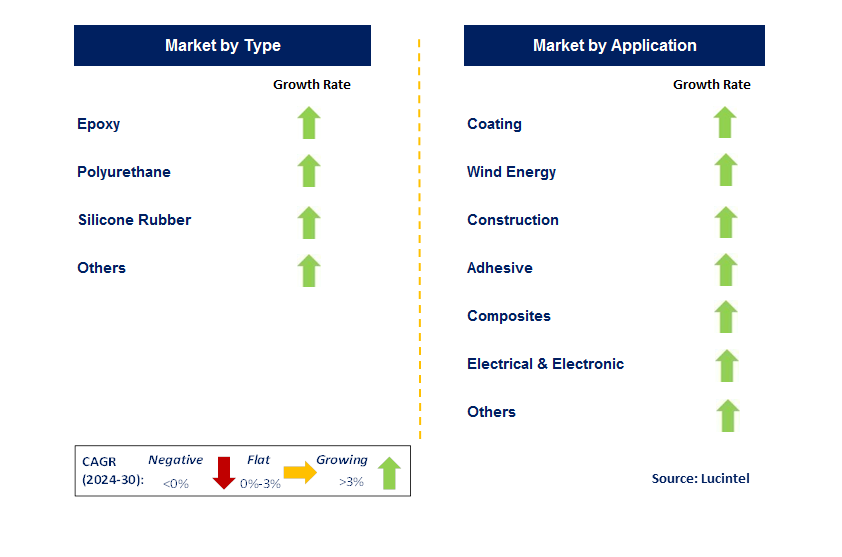
• Lucintel forecasts that, within the type category, epoxy will remain the largest segment over the forecast period due to its widespread usage in various applications, such as coatings, wind energy, electrical & electronics, construction, composites, and adhesives.
• Within the application category, coating will remain the largest segment due to the significant use of curing agent based coating in marine and other applications, particularly on metal surfaces for chemical and corrosion resistance.
• In terms of regions, APAC is expected to witness the highest growth over the forecast period due to rising demand for curing agents from various end-use industries, such as paints and coatings, adhesives, and construction in the region.

Features of the Global Curing Agent Market
Market Size Estimates: Curing agent market size estimation in terms of value ($B). Trend and Forecast Analysis: Market trends (2018 to 2023) and forecast (2024 to 2030) by various segments and regions. Segmentation Analysis: Curing agent market size by type, application, and region in terms of value ($B). Regional Analysis: Curing agent market breakdown by North America, Europe, Asia Pacific, and Rest of the World. Growth Opportunities: Analysis of growth opportunities in different types, applications, and regions for the curing agent market. Strategic Analysis: This includes M&A, new product development, and competitive landscape of the curing agent market. Analysis of competitive intensity of the industry based on Porter’s Five Forces model.If you are looking to expand your business in this or adjacent markets, then contact us. We have done hundreds of strategic consulting projects in market entry, opportunity screening, due diligence, supply chain analysis, M & A, and more.

FAQ
Q1. What is the curing agent market size? Answer: The global curing agent market is expected to reach an estimated $16.7 billion by 2030. Q2. What is the growth forecast for curing agent market? Answer: The global curing agent market is expected to grow with a CAGR of 6.5% from 2024 to 2030. Q3. What are the major drivers influencing the growth of the curing agent market? Answer: The major drivers for this market are the rapid expansion in the construction and wind energy sectors and the rising development of environmentally friendly low or non-VOC agents. Q4. What are the major segments for curing agent market? Answer: The future of the curing agent market looks promising with opportunities in the coating, wind energy, construction, adhesive, composites, and electrical & electronic markets. Q5. Who are the key curing agent market companies? Answer: Some of the key curing agent companies are as follows:• Evonik
• Hexion
• BASF
• Huntsman
• Olin
• Cardolite
• Kukdo Chemical
• Aditya Birla Chemicals
• Mitsubishi Chemical
• Atul Q6. Which curing agent market segment will be the largest in future? Answer: Lucintel forecasts that epoxy will remain the largest segment over the forecast period due to its widespread usage in various applications, such as coatings, wind energy, electrical & electronics, construction, composites, and adhesives. Q7. In curing agent market, which region is expected to be the largest in next 5 years? Answer: APAC is expected to witness the highest growth over the forecast period due to rising demand for curing agents from various end-use industries, such as paints and coatings, adhesives, and construction in the region. Q.8 Do we receive customization in this report? Answer: Yes, Lucintel provides 10% customization without any additional cost.
Table of Contents
Methodology
- In-depth interviews of the major players in this market
- Detailed secondary research from competitors’ financial statements and published data
- Extensive searches of published works, market, and database information pertaining to industry news, company press releases, and customer intentions
- A compilation of the experiences, judgments, and insights of Lucintel’s professionals, who have analyzed and tracked this market over the years.


Buy Now
Choose a license that fits your team. Instant PDF delivery.
Prices exclude taxes. Instant delivery. Custom licensing available on request.
Key Questions
- • What are some of the most promising, high-growth opportunities for the curing agent market by type (epoxy, polyurethane, silicone rubber, and others), application (coating, wind energy, construction, adhesive, composites, electrical & electronic, and others), and region (North America, Europe, Asia Pacific, and the Rest of the World)?
- • Which segments will grow at a faster pace and why?
- • Which region will grow at a faster pace and why?
- • What are the key factors affecting market dynamics? What are the key challenges and business risks in this market?
- • What are the business risks and competitive threats in this market?
- • What are the emerging trends in this market and the reasons behind them?
- • What are some of the changing demands of customers in the market?
- • What are the new developments in the market? Which companies are leading these developments?
- • Who are the major players in this market? What strategic initiatives are key players pursuing for business growth?
- • What are some of the competing products in this market and how big of a threat do they pose for loss of market share by material or product substitution?
- • What M&A activity has occurred in the last 5 years and what has its impact been on the industry? For any questions related to Curing Agent Market, Curing Agent Market Size, Curing Agent Market Growth, Curing Agent Market Analysis, Curing Agent Market Report, Curing Agent Market Share, Curing Agent Market Trends, Curing Agent Market Forecast, Curing Agent Companies, write Lucintel analyst at email: helpdesk@lucintel.com. We will be glad to get back to you soon.


