
Market Report · July 22, 2026

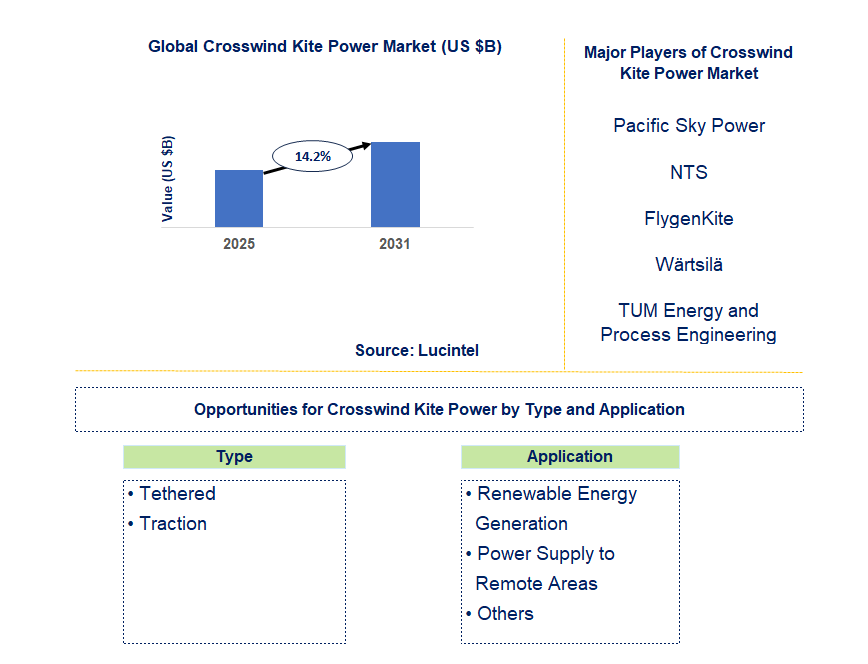
Key data points: The growth forecast = 14.2% annually for the next 7 years. Scroll below to get more insights. This market report covers trends, opportunities and forecasts in crosswind kite power market to 2031 by type (tethered and traction), application (renewable energy generation, power supply to remote areas, and others), and region (North America, Europe, Asia Pacific, and the Rest of the World)
We'll send your sample report shortly.
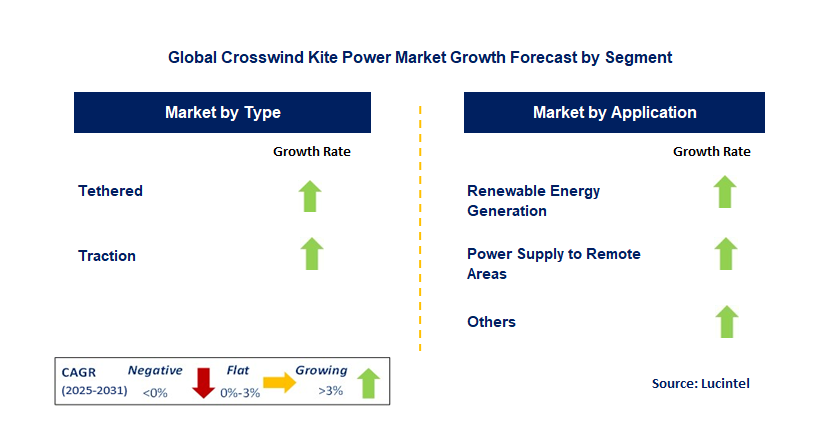
• Lucintel forecasts that, within the type category, tethered is expected to witness higher growth over the forecast period.
• Within the application category, renewable energy generation is expected to witness higher growth.
• In terms of region, APAC is expected to witness the highest growth over the forecast period. Gain valuable insights for your business decisions with our comprehensive 150+ page report. Sample figures with some insights are shown below.
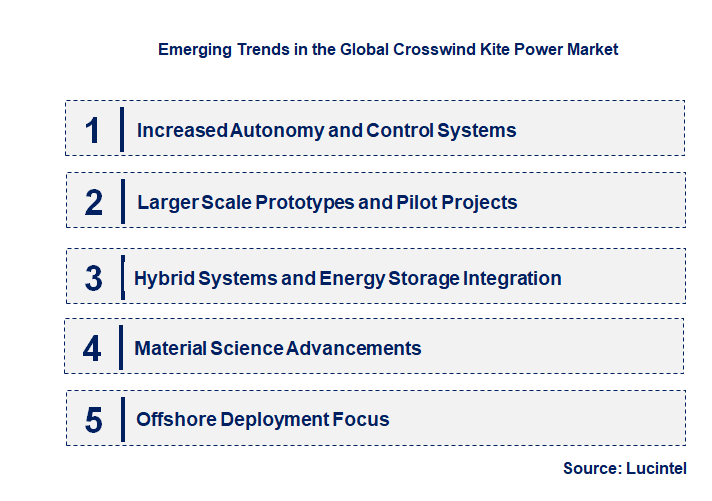
• Increased Autonomy and Control Systems: A significant trend is the development of highly autonomous flight and control systems for crosswind kites. This includes advanced sensors, real-time data processing, and AI-driven algorithms to manage complex flight trajectories, ensuring stable power generation, automatic launch and landing, and safe operation without continuous human intervention.
• Larger Scale Prototypes and Pilot Projects: The market is seeing a trend towards deploying larger-scale prototypes and initiating pilot projects globally. This shift from small-scale demonstrations to larger, more powerful systems aims to validate the energy output potential, assess long-term durability, and gather critical data for commercialization and grid integration.
• Hybrid Systems and Energy Storage Integration: There's an emerging trend of integrating crosswind kite power systems with other renewable energy sources (e.g., solar) and energy storage solutions (e.g., batteries). This hybrid approach aims to provide more consistent and reliable power output, mitigating the intermittency of wind and enhancing grid stability for diverse applications.
• Material Science Advancements: Advances in material science are a key trend, leading to the development of lighter, stronger, and more durable materials for kites and tethers. This enables the creation of larger wings that can withstand higher stresses and operate for extended periods, improving the power-to-weight ratio and overall system efficiency.
• Offshore Deployment Focus: An increasing trend is the focus on offshore deployment of crosswind kite power systems. Offshore locations offer stronger and more consistent winds, and CWP systems, being lighter and requiring no fixed towers, could significantly reduce the cost of offshore wind energy compared to traditional turbines, accessing vast untapped resources. These emerging trends are fundamentally reshaping the crosswind kite power market by pushing towards greater automation, larger scale, integrated solutions, and optimized materials. The industry's evolution towards robust, efficient, and versatile systems positions CWP as a potentially disruptive force in the future of renewable energy generation.
• Successful High-Altitude Demonstrations: Recent developments include successful demonstrations of crosswind kite power systems operating at significantly higher altitudes (e.g., 500 meters and above). These tests validate the ability to access stronger and more consistent winds, translating to higher capacity factors and greater energy yield compared to ground-based wind turbines.
• Advancements in Autonomous Flight Control: There have been notable advancements in autonomous flight control systems for crosswind kites. Improved algorithms and sensor integration enable more stable and predictable flight trajectories, crucial for maximizing energy capture and ensuring safe operation without constant human intervention, moving closer to fully automated deployment.
• Increased Power Output Prototypes: Developers are demonstrating prototypes with increased power output capacities, ranging from tens to hundreds of kilowatts. This indicates a progression towards larger-scale systems capable of generating commercially relevant amounts of electricity, shifting the focus from purely research-oriented concepts to practical power generation.
• Modular and Scalable Designs: Recent innovations emphasize modular and scalable designs for crosswind kite power systems. This allows for easier transportation, rapid deployment, and the ability to scale up power generation by adding more units, making them suitable for diverse applications, from remote microgrids to larger utility-scale deployments.
• Partnerships and Investment Growth: The market has seen an increase in strategic partnerships between technology developers and larger energy companies, alongside growing investor interest. This influx of capital and expertise is crucial for accelerating research, development, and the eventual commercialization and widespread deployment of crosswind kite power technologies. These developments are profoundly impacting the crosswind kite power market by validating its technical feasibility, demonstrating scalability, and attracting the necessary investment for commercialization. The market is progressing from a niche research area to a tangible contender in the renewable energy landscape, promising a more efficient and flexible way to harness wind energy.
• Remote and Off-Grid Electrification: A primary growth opportunity lies in providing electricity to remote communities and off-grid locations. Crosswind kite power systems are easily transportable, require minimal infrastructure, and can tap into consistent high-altitude winds, offering a cost-effective and reliable alternative to diesel generators in isolated areas.
• Offshore Wind Energy Expansion: Targeting offshore wind energy expansion offers significant growth potential. CWP systems eliminate the need for expensive fixed foundations or large floating platforms, potentially reducing the Levelized Cost of Energy (LCOE) for deep-water offshore wind by accessing stronger, more stable winds with lighter, flexible structures.
• Complementary to Existing Renewables: Exploring opportunities to integrate CWP systems as a complementary power source to existing renewable energy assets (e.g., solar farms). Their ability to generate power at different times (e.g., night, higher wind speeds) can help smooth out intermittency, improving grid stability and overall renewable energy penetration.
• Disaster Relief and Emergency Power: Developing CWP systems for rapid deployment in disaster relief and emergency power scenarios presents a crucial niche. Their portability and quick setup time make them ideal for providing immediate electricity to affected areas where conventional infrastructure is damaged or unavailable.
• Hybrid Power Solutions for Industrial Sites: Targeting industrial sites or remote operations (e.g., mining, agriculture) requiring reliable, decentralized power. Crosswind kite power systems can be integrated into hybrid solutions with existing generators or solar, reducing fuel consumption and providing a sustainable, consistent power supply. These strategic growth opportunities are poised to significantly impact the crosswind kite power market by expanding its application into diverse and often underserved segments. Focusing on these areas will drive product innovation, enhance market penetration, and solidify CWP's role as a versatile and impactful component of the global renewable energy mix.
• Pacific Sky Power
• NTS
• FlygenKite
• Wärtsilä
• TUM Energy and Process Engineering
• Tethered
• Traction
• Renewable Energy Generation
• Power Supply to Remote Areas
• Others
• North America
• Europe
• Asia Pacific
• The Rest of the World
• United States: The U.S. market is a hub for CWP research and development, with significant academic and private sector investment. Developments focus on improving system reliability, optimizing autonomous flight control, and scaling up prototypes to commercial viability. The aim is to establish a competitive alternative to traditional wind energy, particularly in regions with good high-altitude wind resources.
• China: China is rapidly emerging as a key player, with significant government support and industrial initiatives in AWES. Recent developments include the deployment of high-altitude kite systems (e.g., the S500 system at 500 meters) for electricity generation, demonstrating a strong push for technological breakthroughs and large-scale application of crosswind kite power.
• Germany: Germany boasts a strong research community and several startups actively developing CWP technologies. The focus is on robust engineering, advanced control algorithms for autonomous operation, and rigorous testing for commercial deployment. German initiatives, often supported by European consortia, aim for high efficiency and reliability in airborne wind energy.
• India: India's crosswind kite power market is in its nascent stages but is gaining interest due to ambitious renewable energy targets and the need for cost-effective solutions in diverse geographies. Research is focused on developing indigenous technologies and assessing the potential for deployment in remote or off-grid areas, leveraging existing wind energy infrastructure.
• Japan: Japan's CWP market is characterized by focused research on advanced materials and control systems for optimal performance in offshore and coastal environments. Innovations aim to develop compact and highly efficient systems that can withstand challenging weather conditions, aligning with Japan's commitment to high-tech renewable energy solutions.


• Pacific Sky Power
• NTS
• FlygenKite
• Wärtsilä
• TUM Energy and Process Engineering Q5. Which crosswind kite power market segment will be the largest in future? Answer: Lucintel forecasts that, within the type category, tethered is expected to witness higher growth over the forecast period. Q6. In crosswind kite power market, which region is expected to be the largest in next 5 years? Answer: In terms of region, APAC is expected to witness the highest growth over the forecast period. Q7. Do we receive customization in this report? Answer: Yes, Lucintel provides 10% customization without any additional cost.


Choose a license that fits your team. Instant PDF delivery.
Prices exclude taxes. Instant delivery. Custom licensing available on request.
Market Report · July 22, 2026
Market Report · July 22, 2026
Market Report · July 17, 2026
Trusted partner for strategic intelligence and business growth


Receive a complimentary market analysis tailored to your industry. Our analysts will identify key growth opportunities and competitive dynamics specific to your business.

Market size, growth rate, and key trend analysis for your specific sector.

Top competitor positioning and market share analysis.

Strategic recommendations backed by data-driven insights.
Get curated market intelligence and competitive moves straight to your inbox.
By subscribing, you agree to receive our monthly insights. Unsubscribe anytime.
Receive a complimentary market analysis tailored to your industry. Our analysts will identify key growth opportunities and competitive dynamics specific to your business.
Market size, growth rate, and key trend analysis for your specific sector.
Top competitor positioning and market share analysis.
Strategic recommendations backed by data-driven insights.
Get curated market intelligence, emerging trends, and competitive moves straight to your inbox each month.
By subscribing, you agree to receive our monthly insights. Unsubscribe anytime.
We'll send your sample report shortly.