
Market Report · May 16, 2026

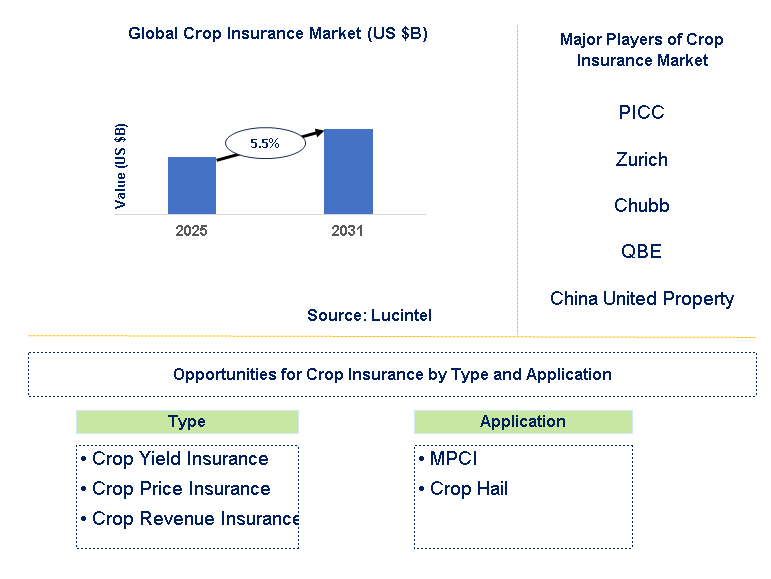
Key data points: The growth forecast = 5.5% annually for the next 7 years. Scroll below to get more insights. This market report covers trends, opportunities and forecasts in crop insurance market to 2031 by type (crop yield insurance, crop price insurance, and crop revenue insurance), application (MPCI and crop hail), and region (North America, Europe, Asia Pacific, and the Rest of the World)
We'll send your sample report shortly.
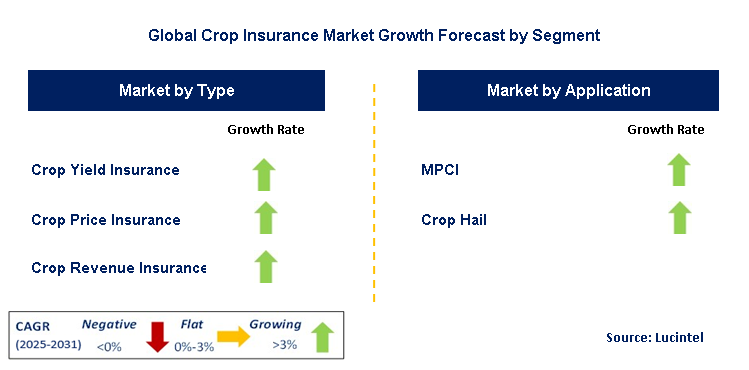
• Lucintel forecasts that, within the type category, crop revenue insurance is expected to witness the highest growth over the forecast period.
• Within the application category, MPCI is expected to witness higher growth.
• In terms of region, North America is expected to witness the highest growth over the forecast period. Gain valuable insights for your business decisions with our comprehensive 150+ page report. Sample figures with some insights are shown below.
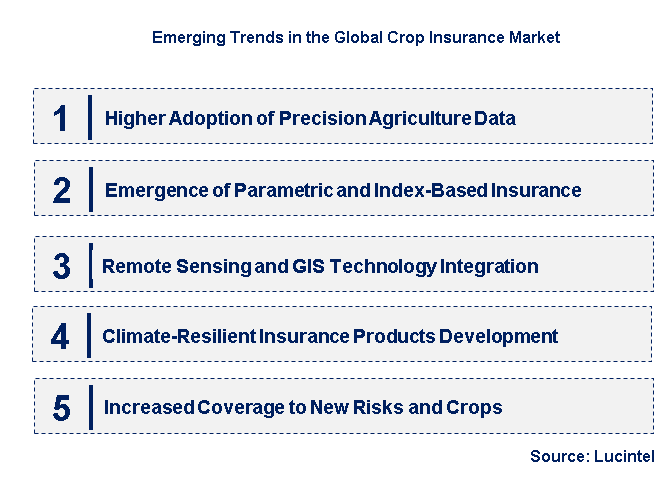
• Higher Adoption of Precision Agriculture Data: The merging of data from precision agriculture technologies like GPS-guided equipment, yield monitors, and soil sensors is increasingly common in crop insurance. This data helps to deliver precise information about the health of the crop, the variability of yield, and spatially localized risk, which aids in more accurate underwriting and customized insurance. The utilization of this data also has the ability to make loss adjustment easier and minimize disputes, resulting in smoother and fairer claims settlements.
• Emergence of Parametric and Index-Based Insurance: Conventional indemnity-based crop insurance involving on-farm loss estimation is time-consuming and expensive. Parametric or index-based insurance presents an alternative through payout on the basis of pre-agreed weather indices (e.g., rain, temperature) or area yield thresholds. The system enables quicker payout and lower administrative expenses. Emerging trends reflect increasing interest and product development of these parametric products to support or supplement conventional insurance.
• Remote Sensing and GIS Technology Integration: Satellite images, drone technology, and Geographic Information Systems (GIS) are increasingly being utilized in crop insurance for crop health monitoring, damage assessment, and loss verification. These technologies offer objective and timely information across large areas, enhancing the efficiency and accuracy of risk assessment and claim management. Integration of remote sensing data with other agricultural and weather data is increasing the complexity of crop insurance products.
• Climate-Resilient Insurance Products Development: As the frequency and severity of extreme weather events rise with climate change, 1 there is rising demand for crop insurance products that target such risks. This encompasses drought, floods, heatwaves, and other perils linked to climate. Product design innovations are targeting the integration of climate risk models and flexible coverage terms that adjust according to changing weather patterns.
• Increased Coverage to New Risks and Crops: Crop insurance has traditionally covered yield loss on account of unfavorable weather. New trends involve increasing coverage to other important risks to which farmers are exposed, including infestation by pests, diseases, and price volatility. There is also an increasing initiative to create insurance products for a broader variety of crops, such as specialty crops and horticultural products, which have been frequently under-insured by conventional insurance programs. These five major trends – the use of precision agriculture data, the emergence of parametric insurance, the use of remote sensing, the creation of climate-resilient products, and the widening of coverage – are all coming together to transform the crop insurance market. They are creating more efficient, precise, and more comprehensive risk management tools for the agricultural industry, ultimately making it more resilient and sustainable.
• Augmented Application of Technology in Risk Assessment: The most important emerging trend is growing use of innovative technologies for risk assessment that is more precise and efficient. Satellite imaging, drones, weather analytics, and machine learning-based techniques are used to assess crop conditions, estimate expected losses, and set the correct premium rates. These technologies facilitate insurers to attain a finer-level understanding of risk at the farm level.
• Development of More Flexible and Tailored Products: There is a growing trend towards the development of crop insurance products that are more flexible and tailored to the specific needs of individual farmers and regions. This includes options for different coverage levels, peril-specific insurance, and the ability to customize policies based on farm characteristics and risk profiles. This move away from one-size-fits-all solutions aims to improve the relevance and uptake of crop insurance.
• Greater Public-Private Partnerships: Most nations are experiencing a solidification of public-private partnerships for crop insurance. Governments contribute subsidies and regulatory systems, while private insurers contribute underwriting and risk management expertise. These partnerships strive to increase the coverage of crop insurance and make it financially sound.
• Emphasis on Enhancing Claim Settlement Effectiveness: Early and precise claim settlement is important to the success of crop insurance. Recent trends involve acceptance of digital platforms and mobile apps for filing claims and processing, and the application of remote sensing and data analytics to speed up loss assessments. There has been a move to enhance transparency and trust in the claim settlement process.
• Broader Insurance Coverage to New Perils and Geographies: The coverage of crop insurance is now being extended to a broader list of perils beyond classical weather-related disasters, including pest infestations, diseases, and even market price variations in a few instances. There is also a push to cover new regions and smallholder farmers that have been historically underserved, many times through innovative distribution mechanisms and microinsurance products. These five critical advances – increased utilization of technology in risk assessment, more adaptable and customized products, greater public-private partnerships, higher efficiency in the settlement of claims, and higher coverage – taken together are having a transformative influence on the crop insurance market in making it more accurate, responsive, efficient, and inclusive. These developments are essential for shaping a more secure and sustainable farm sector across the world.
• Creating Index-Based Insurance for Smallholder Farmers: Smallholder farmers in numerous developing countries rarely have access to the conventional indemnity-based crop insurance because it‘s expensive for high transaction costs as well as a challenge assessing loss. Payouts made with index-based insurance, dependent upon regional weather indexes or area yield, prove an affordable option in terms of scaling for such farmers. Strategic expansion is in creating and selling low-cost and reliable index-based products that are specifically designed to address the risks and requirements of smallholder farmers.
• Developing Bundled Insurance Products with Agri-Services: Bundling crop insurance with other agricultural services, including weather forecasting, pest and disease surveillance, and access to agricultural inputs or credit, can improve the value proposition for farmers. Bundled products can be used to enhance insurance take-up and enhance risk management practices. Growth opportunities can be achieved through strategic partnerships with Agri-tech businesses and financial institutions to provide these bundled solutions.
• Providing Parametric Insurance for Individual Perils: Parametric insurance products that pay out according to predetermined weather triggers (e.g., severe rainfall, prolonged drought) provide a rapid and transparent mechanism for insuring specific catastrophic exposures. Strategic expansion can be brought about by building and selling parametric policies against perils that are not covered well by standard insurance, ensuring that farmers gain quick financial benefits following negative occurrences.
• Utilizing Remote Sensing for Better Underwriting and Claims: By using satellite images, drone information, and GIS tools, the underwriting and claims processing can be greatly enhanced in terms of efficiency and accuracy. Strategic expansion possibilities are present by investing in the above tools and building the capabilities to effectively analyze the data, resulting in more accurate risk assessment, lower cost of operations, and quicker settlement of claims.
• Creating Climate-Smart Insurance Products: As the effects of climate change on agriculture continue to grow, more insurance products are needed that encourage climate-smart agriculture and protect against the risks of climate change. Strategic expansion is possible through new insurance products that compensate farmers for implementing sustainable agriculture and protecting against the particular challenges created by a changing climate, including extreme weather events and changes in growing seasons. These five strategic opportunities for growth – index-based insurance for smallholders, bundled insurance with Agri-services, parametric insurance for perils, use of remote sensing, and creating climate-smart solutions – show the opportunities for innovation and growth in the crop insurance industry. By emphasizing these areas, insurers can respond more effectively to the changing needs of the agriculture industry and to its long-term sustainability.
• PICC
• Zurich
• Chubb
• QBE
• China United Property Insurance
• American Financial Group
• Prudential
• XL Catlin
• Everest Re Group
• Endurance Specialty
• Crop Yield Insurance
• Crop Price Insurance
• Crop Revenue Insurance
• MPCI
• Crop Hail
• North America
• Europe
• Asia Pacific
• The Rest of the World
• United States: The US crop insurance industry, operated mainly through the Federal Crop Insurance Corporation (FCIC), is constantly developing with a view to increasing coverage choices and encouraging risk management. Developments in recent times include increases in coverage for specialty and organic crops, and modifications to keep pace with evolving climate risks. There is a growing focus on precision agriculture data to enhance underwriting and loss adjustment. Also affecting the course of federal crop insurance programs is conversation regarding the farm bill‘s future.
• China: China‘s crop insurance market has expanded rapidly, fueled by government subsidies to stabilize farm production and rural livelihoods. Recent trends include piloting index-based insurance products and using technology for more effective claims processing. There are efforts to enhance the coverage and affordability of insurance for smallholder farmers. The emphasis is also on creating insurance solutions that respond to the unique risks of various agricultural regions and crops.
• Germany: The German crop insurance industry is dominated by a combination of government and private sector participation, with an emphasis on covering farmers for weather-related perils. Recent activity has involved consideration of the extension of coverage to new perils, as well as the optimization of loss adjustment efficiency. There is increased interest in parametric forms of insurance and the application of remote sensing capabilities to track crop health and yield. The industry is responding to the growing number of catastrophic weather events.
• India: India‘s crop insurance sector, centered around the Pradhan Mantri Fazal Bima Yojana (PMFBY), has been working to boost farmer registrations and enhance claim settlement procedures. More recent progress involves streamlining the scheme, improving transparency, and using technology like satellite imagery and mobile apps to better assess risks and accelerate payouts. There is also an effort to create more risk-specific and localized insurance products to serve the varied agricultural areas of the country.
• Japan: The crop insurance of Japan is conceived to cover the farmers against the risk of natural calamities as well as crop losses. Latest developments involve adapting premium rates as well as the levels of cover in line with growing climate hazards. Young farmers are also promoted to participate and incorporate sophisticated technology for risk and loss adjustment. The market here is mature in nature, emphasizing long-term stability of the scheme.


• PICC
• Zurich
• Chubb
• QBE
• China United Property Insurance
• American Financial Group
• Prudential
• XL Catlin
• Everest Re Group
• Endurance Specialty Q5. Which crop insurance market segment will be the largest in future? Answer: Lucintel forecasts that, within the type category, crop revenue insurance is expected to witness the highest growth over the forecast period. Q6. In crop insurance market, which region is expected to be the largest in next 5 years? Answer: In terms of region, North America is expected to witness the highest growth over the forecast period. Q7. Do we receive customization in this report? Answer: Yes, Lucintel provides 10% customization without any additional cost.


Choose a license that fits your team. Instant PDF delivery.
Prices exclude taxes. Instant delivery. Custom licensing available on request.
Market Report · May 16, 2026
Market Report · May 16, 2026
Market Report · May 16, 2026
Trusted partner for strategic intelligence and business growth


Receive a complimentary market analysis tailored to your industry. Our analysts will identify key growth opportunities and competitive dynamics specific to your business.

Market size, growth rate, and key trend analysis for your specific sector.

Top competitor positioning and market share analysis.

Strategic recommendations backed by data-driven insights.
Get curated market intelligence and competitive moves straight to your inbox.
By subscribing, you agree to receive our monthly insights. Unsubscribe anytime.
Receive a complimentary market analysis tailored to your industry. Our analysts will identify key growth opportunities and competitive dynamics specific to your business.
Market size, growth rate, and key trend analysis for your specific sector.
Top competitor positioning and market share analysis.
Strategic recommendations backed by data-driven insights.
Get curated market intelligence, emerging trends, and competitive moves straight to your inbox each month.
By subscribing, you agree to receive our monthly insights. Unsubscribe anytime.
We'll send your sample report shortly.